2026 Crypto forecast: The convergence of crypto and finance

Executive summary: Entering 2026, the global financial system is undergoing a structural shift in its underlying architecture, marked by deep convergence between crypto assets and traditional finance. If 2024 represented the “Year of Access” following the approval of Bitcoin ETFs, 2026 is defined by utility, integration and institutionalisation. As the Federal Reserve settles into a sustained rate-cut cycle and US legislation—including the GENIUS Act and CLARITY Act—reduces key regulatory uncertainty, crypto assets have moved beyond their role as speculative instruments or “digital gold,” increasingly functioning as core digital financial infrastructure underpinning value storage, payments, settlement and asset issuance. Bitcoin has transitioned from a cyclical hedge into a strategic reserve asset, with institutional ETF demand and early sovereign adoption weakening the traditional four-year cycle and repositioning BTC as a long-duration store of value within global portfolios. Across the ecosystem, compliance has emerged as the primary competitive moat, as centralised exchanges evolve into regulated financial intermediaries where licensing, governance and AI-enabled infrastructure matter more than pure liquidity. In payments, the system is converging toward a dual-track model: stablecoins are becoming the default medium for commercial and machine-to-machine transactions, while XRP is re-establishing its role as a neutral settlement asset for interbank and cross-border flows. The most significant inflection point lies in real-world asset tokenisation, as the migration of stocks and ETFs on-chain—led by traditional market infrastructure providers such as Nasdaq—signals crypto’s full integration into the core of global finance rather than a parallel system. In 2026, crypto is no longer defined by speculation, but by infrastructure, with blockchain increasingly operating in the background as value, settlement and ownership converge on-chain within the mainstream financial system.
Below are some related shares and ETFs that provide exposure to these structural themes.
Below are some related shares and ETFs that provide exposure to these structural themes.
ASX shares and ETFs
Block Inc $Block Inc (XYZ.AU)$ , Digital X $Digital X Ltd (DCC.AU)$ , BetaShares Crypto Innovators ETF $BetaShares Crypto Innovators ETF (CRYP.AU)$ , Global X 21Shares Bitcoin ETF $Global X 21Shares Bitcoin ETF (EBTC.AU)$ ,Global X 21Shares Ethereum ETF $Global X 21Shares Ethereum ETF (EETH.AU)$
US shares and ETFs
Coinbase $Coinbase (COIN.US)$ , Strategy $Strategy (MSTR.US)$ , SoFi Technologies $SoFi Technologies (SOFI.US)$ , Circle $Circle (CRCL.US)$ . iShares Bitcoin Trust $iShares Bitcoin Trust (IBIT.US)$ , Fidelity Wise Origin Bitcoin Found $Fidelity Wise Origin Bitcoin Fund (FBTC.US)$ , Grayscale Bitcoin Trust $Grayscale Bitcoin Trust (GBTC.US)$ , Grayscale Ethereum Trust $Grayscale Ethereum Trust (ETHE.US)$ .
This information is general in nature and has been prepared without considering your financial objectives, situation or needs. Consider the appropriateness of this information in light of your personal circumstances before making investment decisions. Crypto-assets are highly volatile and investing in crypto-assets-linked stocks may involve significant capital risks.
1. Bitcoin (BTC): from strategic reserve to the $200,000 milestone
In 2026, Bitcoin’s positioning has shifted entirely from a “hedge asset” to a Strategic Reserve Asset for sovereign nations and global institutions.
Policy drivers: Influenced by the 2025 executive order to establish a “National Bitcoin Reserve,” at least five sovereign nations are expected to include BTC on their balance sheets by 2026.
The end of the four-year cycle: Bitwise, in its 2026 Forecast Report, notes that the mining-based “four-year cycle” theory has effectively been rendered obsolete. With institutional ETF allocations becoming normalized, 2026 is no longer viewed as a “correction year,” but rather a period of sustained growth, as institutional buying power significantly exceeds annual mining output.
Price outlook: Standard Chartered reiterates its bullish stance, asserting that driven by spot ETF accumulation and U.S. national reserve policies, the target for Bitcoin to challenge $200,000 remains clear.
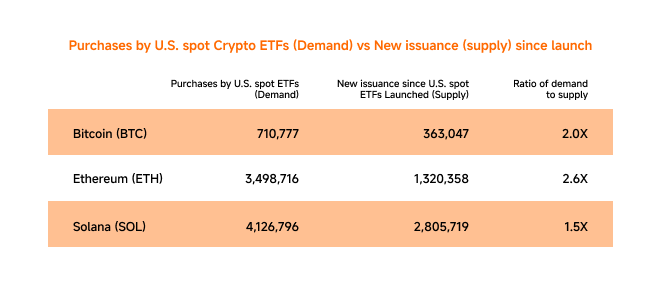
Source: Bitwise Asset Management with data from The Block, Glassnode, Dune, and CoinGecko. Data as of December 5, 2025. Note: Spot Bitcoin ETFs launched in the U.S. on January 11, 2024. Spot Ethereum ETFs launched in the U.S. on July 23, 2024. Spot Solana ETFs launched in the U.S. on October 28, 2025. New issuance estimates for 2026 are based on the prior twelve months’ issuance. Solana projected issuance has been reduced by 15%, reflecting the network’s disinflationary schedule.
2. Exchange landscape: the rise of the compliance “agent” economy
In 2026, the competitive moat for centralized exchanges (CEXs) is no longer just liquidity, but regulatory licensing and AI integration capabilities.
2.1 Binance: Compliance Premium and the “Return” to the US Market
Following an extensive global compliance overhaul, Binance has entered 2026 as one of the most tightly regulated and increasingly credible institutions in digital finance.
Strategic significance:
Co-CEO Richard Teng notes that the industry is transitioning into a phase of “maturity and integration,” where regulatory alignment becomes the foundation for durable expansion. In line with this shift, analysts argue that BNB is evolving from a simple trading utility token toward something closer to “compliant ecosystem equity.” As its economic profile converges with traditional fintech assets, valuation frameworks are expected to normalize. Benchmarking BNB against Coinbase’s price-to-earnings multiples, several research models indicate that, in a fully regulated 2026 environment, BNB could potentially challenge the USD 2,000–3,000 valuation range.
2.2 Coinbase: Defining the “AI Payment Layer”
Coinbase is redefining the future of payments with a strategic focus on serving AI-powered agents.
M2M (Machine-to-Machine) payments:
According to ARK Invest’s Big Ideas, AI agents are expected to become the dominant source of on-chain transactional activity by 2026. Coinbase is positioning itself at the centre of this evolution by building payment rails that enable autonomous economic actors—entities that cannot open traditional bank accounts—to transact seamlessly in USDC. This allows AI systems to independently purchase compute power, API access and digital services, effectively creating a functioning machine economy powered by compliant crypto infrastructure.
3. Payments and settlement: the dual-track of XRP and stablecoins
By 2026, the payment sector has formed an efficient dual-track system: stablecoins for commercial use, and XRP for interbank settlement.
3.1 XRP: The “aggressive” institutional revival
2026 marks the year XRP fully sheds its legal shadows and returns to its roots as a “settlement token.”
The $1 billion milestone: As of late 2025, spot XRP ETFs launched by firms such as Grayscale, Bitwise and Canary Capital have surpassed $1 billion in cumulative inflows.
Supply shock theory: Unlike retail-driven rallies, these inflows come from passive institutional allocations. Applying CoinShares’ fund-flow methodology to projected ETF adoption curves, models suggest that if an inflow rate of $200 million per week is sustained into 2026, over 5 billion XRP could be locked in custodial vaults, creating a significant liquidity premium.
XRPL & RLUSD: Ripple’s USD stablecoin (RLUSD) complements native XRP on the XRP Ledger. While retail users rely on stablecoins, banks utilise XRP as a “liquidity-neutral asset” to process hundreds of billions of dollars in cross-border settlements annually.
3.2 Circle: from stablecoin issuer to “federal bank”
Circle’s actions in late 2025 have built an insurmountable compliance moat heading into 2026.
OCC federal charter: Circle received conditional approval from the OCC to establish the “First National Digital Currency Bank,” evolving from a middleware issuer into a federally regulated financial institution.
Visa integration: Visa now allows U.S. financial institutions to settle via USDC on the Solana network, establishing USDC as a settlement standard for global commerce.
4. The RWA revolution: Nasdaq’s “full on-chain” initiative
The most significant shift in 2026 comes from Nasdaq’s tokenisation of stocks and ETFs.
Infrastructure upgrade: According to its SEC filing (SR-NASDAQ-2025-072), Nasdaq plans to officially launch its tokenised securities platform in Q3 2026.
Seamless integration: Traditional stocks and their tokenised versions will share the same CUSIP codes and order books, allowing investors to hold assets via traditional brokerage channels or blockchain wallets.
Trillion-dollar growth: Citi predicts this “core asset migration” will push the RWA market beyond $1.9 trillion in 2026, signalling a move from expensive private ledgers to efficient public-chain settlement layers.
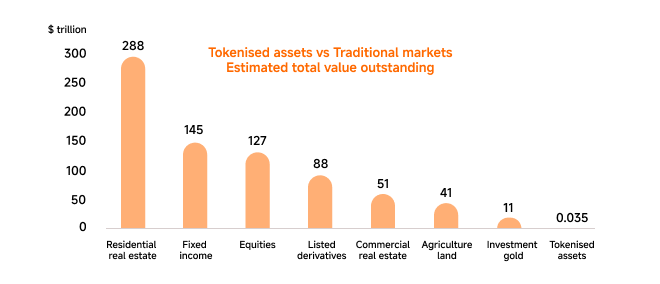
Source: SIFMA, Savills, World Gold Council, Bloomberg, RWA.xyz, Grayscale Investments. Real estate as of 2022, securities markets as of 2024; investment gold and tokenized assets as of October 31, 2025. For illustrative purposes only.
5. Core infrastructure: The Ethereum and Solana Duopoly
All payment innovation and asset tokenisation ultimately anchor on two dominant public blockchains: Ethereum and Solana.
5.1 Ethereum (ETH): The “Central Settlement Layer” of Global Finance
With unmatched security and decentralisation, Ethereum has solidified its role as the preferred clearing layer for traditional institutions.
The “risk-free rate” of digital finance: According to VanEck, Ethereum’s staking yield is increasingly recognised as the benchmark interest rate for digital assets, similar to the role Treasury yields play in traditional markets.
5.2 Solana (SOL): The “High-Performance Rail” for AI and Retail
While Ethereum handles high-value settlement, Solana provides the infrastructure for high-frequency commerce.
Speed and scale: Solana’s key advantage lies in its extreme throughput and negligible cost. If Ethereum is the “financial clearing centre,” Solana is the “fiber-optic payment network,” capable of processing tens of thousands of transactions per second for less than $0.01 per transaction.
Visa cooperation: Visa’s full support for USDC on Solana reflects the industrial-grade reliability delivered by the Firedancer upgrade, enabling global retail payments.
Fuel for the AI economy: As Cathie Wood recently noted, “Bitcoin is the currency, Ethereum is the institutional infrastructure, and Solana is the gateway for consumers.”
6. Crypto ETF Outlook: The Era of Indexation
According to Bloomberg Intelligence analyst James Seyffart, 2026 marks the shift of crypto ETFs from single-asset products to index-based adoption.
The rise of index ETFs: Market focus is moving toward multi-asset indices (e.g. Bitwise 10), enabling institutions to “buy the market” with a single allocation.
AUM projections: Cumulative inflows into U.S. spot Bitcoin ETFs are expected to exceed $120 billion by the end of 2026.
Market consolidation: Seyffart cautions that while over 100 new crypto ETFs (including SOL, XRP and LTC) may be approved, the market is likely to experience its first major shakeout by late 2026, leaving only the most liquid issuers standing.
Conclusion
By 2026, the crypto industry has moved decisively beyond the speculation-driven era into a phase of infrastructure invisibility. For end users, whether assets clear on Ethereum or flow through the XRP Ledger is increasingly irrelevant—what matters is 24/7 availability, instant settlement and federal-grade security.
In this new era, BTC anchors value, XRP and stablecoins power circulation, and the entry of incumbents such as Nasdaq signals the full embrace of blockchain by traditional finance.
This information is general in nature and has been prepared without considering your financial objectives, situation or needs. Consider the appropriateness of this information in light of your personal circumstances before making investment decisions. Crypto-assets are highly volatile and investing in crypto-assets-linked stocks may involve significant capital risks.
This presentation is for informational and educational use only and is not a recommendation or endorsement of any particular investment or investment strategy. Investment information provided in this content is general in nature, strictly for illustrative purposes, and may not be appropriate for all investors. Read more