Top 5 US Cruise Stocks to Watch After Fed Rate Cuts in 2024

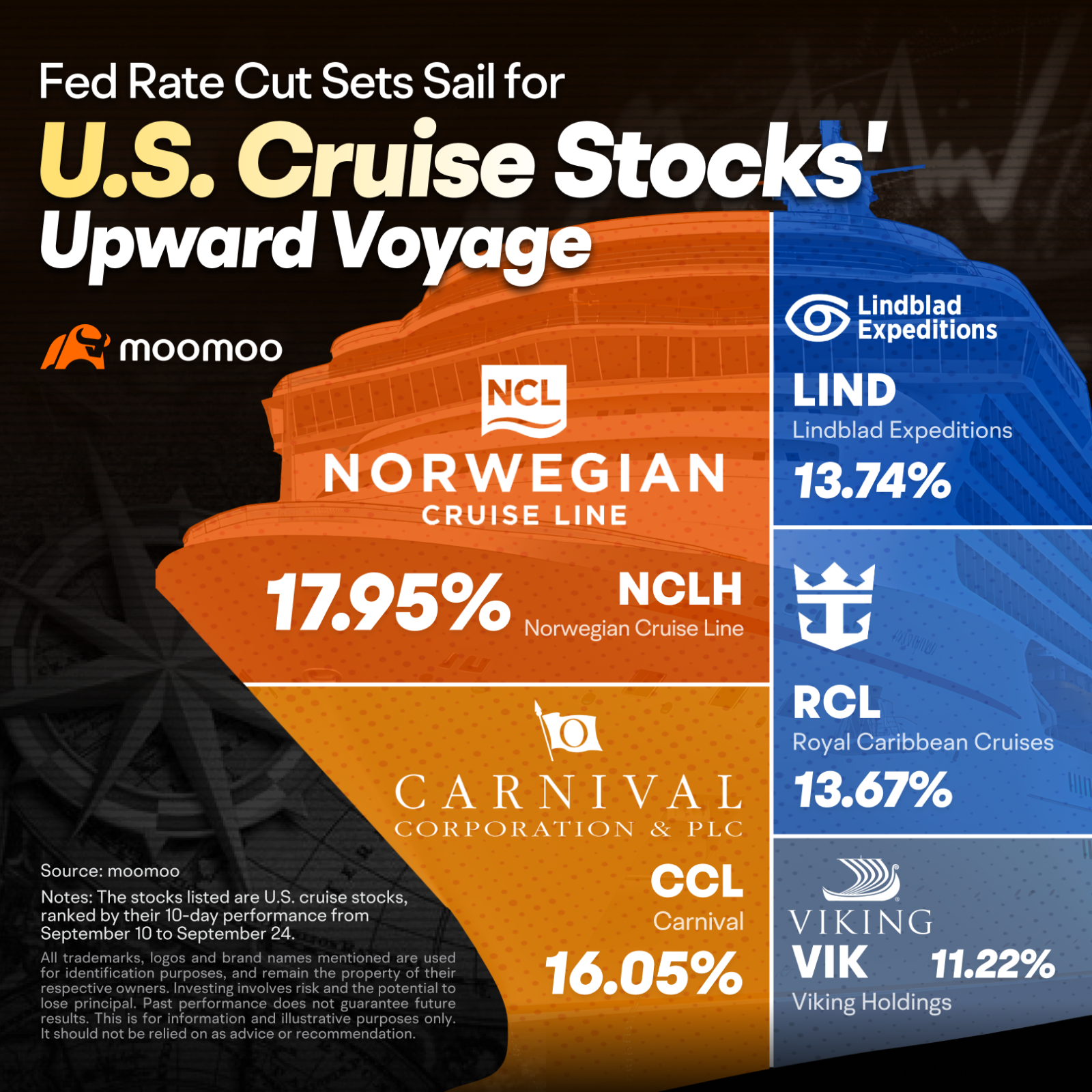
Almost all travel companies were affected during the New Crown outbreak, with cruise lines being hit harder. According to the data, cruise passenger numbers plummeted from 29.7 million in 2019 to 4.8 million in 2021. However, the cruise Companies has rebounded strongly since the end of the New Crown outbreak, with cruise passenger numbers jumping to 20.4 million in 2022 and 31.7 million in 2023. Especially after the Fed's rate cut, cruise stocks have posted strong gains, reflecting the market's optimism about future growth prospects for cruise companies.
In an evolving global financial landscape, decisions made by the Federal Reserve could have far-reaching implications for various industries, including the cruise industry. For Australian investors who follow the US market closely, it is important to understand how the Federal Reserve's interest rate cuts could impact cruise companies. Looking ahead to 2024, the Fed's recent rate cuts present both opportunities and challenges for those considering investing in US cruise stocks.
The purpose of this article is to provide a detailed analysis of the impact of these rate cuts and highlight the top 5 US cruise stocks for Australian investors to consider.
Effects of Fed rate cuts on Cruise stocks
The Federal Reserve's interest rate cuts have a significant impact on cruise companies, affecting borrowing costs, consumer spending and share price performance. At the same time, lower interest rates can create a favourable environment for growth and profitability in the cruise industry by reducing financing costs, increasing consumer travel budgets and improving investor sentiment.
Lower Borrowing Costs
One of the most immediate effects of the Federal Reserve's interest rate cut is a reduction in the cost of borrowing for businesses. For cruise companies, this means that they can obtain loans at lower interest rates, which can be used to finance new ship construction, expand operations or refinance existing debt. For example, Carnival Corporation (CCL) recently announced plans to launch several new ships over the next few years. Lower interest rates will significantly reduce the cost of financing these projects, improving the company's financial health and long-term profitability.
Increased Consumer Spending
Lower interest rates typically translate into more disposable income for consumers as mortgages and loan payments become more manageable. This can boost consumer confidence and spending, particularly in discretionary areas such as travel and leisure. According to a recent report by the Cruise Lines International Association (CLIA), the cruise industry expects passenger numbers to grow by 5% by 2024, driven by improving economic conditions and lower interest rates. More people are choosing cruises as a holiday option, which could mean more bookings and revenue for cruise comapanies.
Operational Efficiency Enhancement
During a pandemic, cruise operators are forced to take on large amounts of debt and issue shares at low prices in order to stay afloat during a blockade. Carnival, for example, increased its borrowings by nearly $20 billion between 2019 and 2022, ending fiscal 2023 with a net debt to EBITDA ratio of 6.7x, up from 2x before the pandemic. This puts pressure on the operational efficiency of many cruise operators, given the large amount of debt they accumulated during the pandemic. However, with demand for cruises returning strongly, the Fed's rate cut may give cruise operators greater flexibility to improve margins in a market where demand remains high.
Currency Impact
For Australian investors, the impact of the Federal Reserve's interest rate cut on the US dollar (USD) has also been significant. Lower Fed rates can weaken the US dollar against the Australian dollar (AUD), making US stocks more affordable for Australian investors. The AUD has strengthened by 7% against the USD in 2023 and a similar trend is expected to continue in 2024, making it an opportune time for Australian investors to explore US cruise stocks.
Generally speaking, the impact of the Federal Reserve's interest rate cut on cruise stocks is multifaceted, and together these factors create a favorable environment for cruise companies, with the potential to improve profitability and create attractive investment opportunities for investors.
But on the other hand, the interest rate cut also brings some potential risks. Currency fluctuations can affect the revenue and cost structure of cruise companies. Increased competition may require more marketing and innovation. Lower rates can encourage excessive borrowing, leading to higher debt levels. Economic downturns can reduce consumer demand for travel. Policy changes can create market volatility. Therefore, investors should carefully assess these risks and consider their own risk tolerance.
Top 5 US Stocks to Watch after Fed Rate Cuts
The Federal Reserve's interest rate cuts have created a favourable environment for US cruise stocks, providing a significant boost to the sector. In particular, five US cruise stocks led the market and outperformed during the latest round of Fed rate cuts.
Company Name | Symbol | Market Cap(as of 9 Oct, 2024) |
Royal Caribbean Group | 47.21B USD | |
Viking Holdings Ltd | 15.93B USD | |
Norwegian Cruise Line Holdings Ltd | 9.15B USD | |
Carnival Corp | 5.91B USD | |
Lindblad Expeditions Holdings Inc | 504.08M USD |
Royal Caribbean Group(NYSE: RCL)
Royal Caribbean Group, founded in 1968, is a global cruise company with three prominent cruise brands: Silversea Cruises, Celebrity Cruises and Royal Caribbean International Cruises. Furthermore, Royal Caribbean Group has a stake in TUI Cruises GmbH, the operating entity responsible for TUI Cruises and Hapag-Lloyd Cruises in Germany, respectively.
This company reported profits of $854 million for the quarter ended 30 June, up approximately 86 per cent from $459 million in the same period last year, and earnings per share of $3.11, up approximately 82 per cent from $1.70 in the same period last year. Meawhile, the company is pleased to announce that it has reached the two million passenger mark in the second quarter, with cruise occupancy rising from 105% to 108.2%. In terms of future projections, robust demand on European and Alaskan routes is anticipated to fuel growth in the third quarter. Jason Liberty, Chief Executive Officer of Royal Caribbean Cruise Group, stated, "The exceptional demand for our holiday experiences has driven significant performance growth over the past few years."

Viking Holdings Ltd(NYSE: VIK)
Viking Holdings Ltd offers a premium travel experience on riverboats, ocean liners, expedition ships and regularly chartered inland waterways, with itineraries that include shore excursions in ports and enrichment programmes on board and ashore.
According to the company's reported financial results for the second quarter ended 30 June 2024, total revenue for the second quarter was $132.5 million, an increase of 9.1% compared to the same period in 2023. For the same period, adjusted gross margin increased 9.5 per cent compared to the same period last year, and net income margin reached $562. Notably, as of mid-August 2024, 95 per cent of the passenger-carrying cruise days for Viking's core product were sold in 2024, with 55 per cent scheduled for the 2025 season.
Norwegian Cruise Line Holdings Ltd(NYSE: NCLH)
Founded in 1966, Norwegian Cruise Line Holdings Ltd is a long-established company specialising in cruise travel services. The company has a wide range of operations covering Southeast Asia, Europe, South America, Africa, Australia, New Zealand, etc. Norwegian Cruise Line owns three famous brands, Regent Seven Seas Cruises, Oceania Cruises and Norwegian Cruise Line.
Strong revenue growth and a continued focus on cost reductions and efficiencies drove the company's results, with total revenues for the second quarter reaching a record $2.4 billion, an increase of 8 percent over the same period last year. During the same period, capacity grew 4 percent, EBITDA increased 14 percent to $587.7 million and adjusted earnings per share increased 33 percent to $0.40. Moreover, the company is committed to prioritising balance sheet optimisation and leverage reduction, with net leverage improving by approximately 1.5 times compared to 31 December 2023, and plans to reduce net leverage to around 4 percent by 2026.
Carnival Corp(NYSE: CCL)
Carnival Corp is the world's largest cruise company and one of the first to introduce low-cost cruising for the mass market.Carnival Corp provides leisure travel services to travellers around the world, with operations in Europe, Asia, Australia and North America, through its European Cruise Business, North American Cruise Business, Cruise Support and four other segments. Carnival's commitment to customer satisfaction has earned it the 2024 USA Today Readers' Choice Award for Best Ocean Cruise Line.
In February 2024, Carnival Corp ordered its first new ship in five years, a 6,400-passenger LNG-powered vessel.Carnival reported record revenues of $21.6 billion for the full year 2023. Fiscal 2024 continues to be a strong year, with revenues of $11.0 billion for the first half of fiscal 2024, a 20 per cent increase over the same period in 2023. In addition, free cash flow for the first half was $2.7 billion and net income for the second quarter was $92 million.
Lindblad Expeditions Holdings Inc(NASDAQ: LIND)
Lindblad Expeditions Holdings is not a large cruise company, its ships typically have a maximum capacity of 48 to 148 passengers and specialise in smaller, more expensive expedition cruises. Quality, unique experiences are Lindblad Expeditions' main advantage over its competitors in the industry, with voyages to the Caribbean coast, Patagonia and Antarctica. Lindblad Expeditions extended its 17-year partnership with National Geographic in November 2023 and is the sole partner of National Geographic Cruises until 2040, according to the company's official report. It will also work with National Geographic's sister company, The Walt Disney Company.
Looking at the financial results for the second quarter, the company reported total revenues of $136.5 million, an overall increase of 9 percent over the same period last year. Adjusted EBITDA for the same period was $10.4 million, an increase of $4.2 million. Lindblad Expeditions' bookings for the quarter ended 8 August 2024 increased by 17 per cent compared to the same period in 2023.
Final thoughts on US cruise stocks after Fed rate cuts
In addition to the positive impact of recovering demand and interest rate cuts, falling fuel prices have eased operating pressures on cruise companies. Citi analysts said in a research note that the cruise industry is experiencing strong web traffic and positive pricing trends, especially for bookings in 2025. The analysts expect Norwegian and Royal Caribbean to grow at a compound annual growth rate of about 13 per cent over the next few years. Barron says that cruise stock prices are likely to rise again in the future as investors get excited about improving earnings.
But despite the bullish outlook of many, investors can't ignore the risks of cruise companies' stocks. Cruise lines provide non-essential services, and when consumers are pessimistic about future economic prospects or face declining income levels, they may cut back on non-essential spending such as travel and entertainment. And as cruise travel is considered a discretionary expense, any reduction in demand could adversely affect the value of cruise stocks.
In conclusion, the 2024 Federal Reserve interest rate cut offers a promising outlook for the U.S. cruise ship stock market. Australian investors are encouraged to stay informed and make well-informed investment choices. However, it is essential to conduct comprehensive research and consider the broader economic context before making any investment decisions.
This presentation is for informational and educational use only and is not a recommendation or endorsement of any particular investment or investment strategy. Investment information provided in this content is general in nature, strictly for illustrative purposes, and may not be appropriate for all investors. Read more