Broad-based ETFs: a convenient way to diversify your portfolio
$SPDR® S&P 500 ETF(SPY.AU)$Investing in a single stock or sector can be tempting, but it also comes with significant risks.
Diversification is a strategy that spreads your investments across different stocks, sectors and asset classes to potentially reduce risk.
For first-time investors who lack the time or expertise to select individual investments, ETFs focused on large-cap Australian shares can be a popular choice, offering broad market exposure.
In this article, we’ll take a closer look at what broad-based ETFs are and how they can help optimise investors’ portfolios.
What are broad-based ETFs?
Broad-based ETFs track the returns of a well-established index that typically comprises tens or hundreds of securities from different sectors. They provide exposure to multiple stocks and sectors in a single investment.
When one stock or sector is underperforming, the other stocks or sectors can help to balance out the losses. Therefore, investing in broad-based ETFs can help reduce the risks of losses and provide steady returns in the long term.
The $Vanguard Australian Shares ETF(VAS.AU)$ is a prime example of a broad-based ETF. It is one of the largest ETFs by market cap in Australia, aiming to track the returns of the $S&P/ASX 300(.XKO.AU)$ index before accounting for fees, expenses and tax. As a result, investing in VAS means investing in the top 300 companies listed on the Australian Securities Exchange (ASX) proportionate to their market capitalisation.
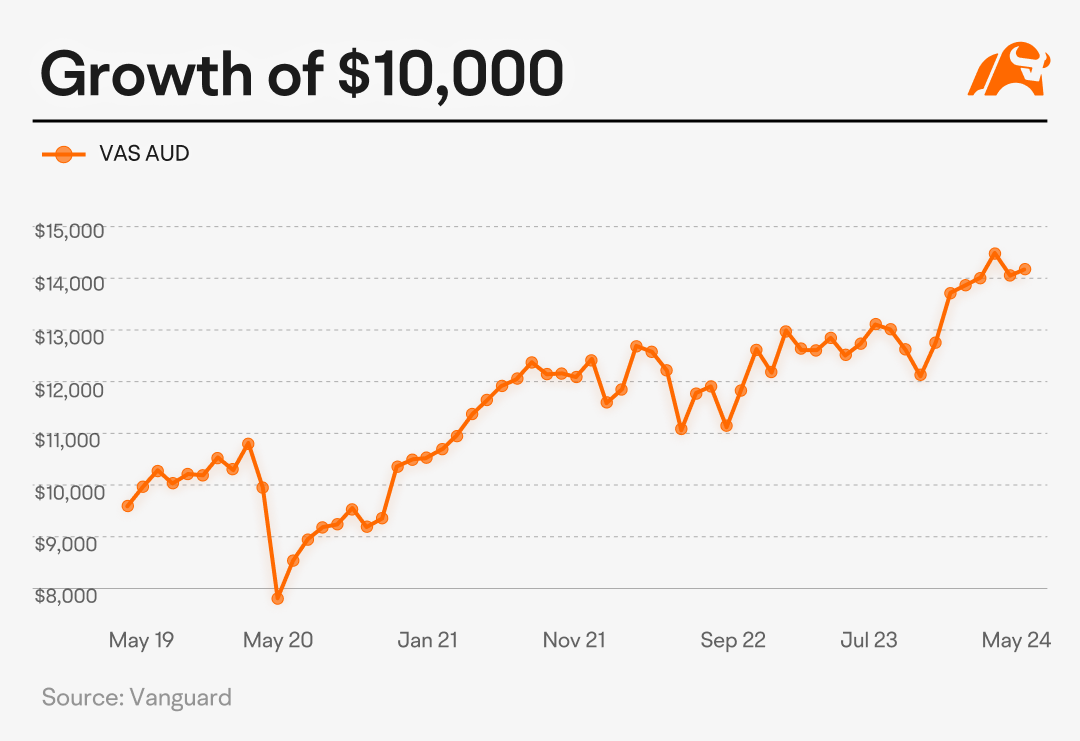
Most popular broad-based ETFs on ASX
There are over 300 ETFs in Australia, available via the ASX, with around 50% of them providing exposure to overseas markets.
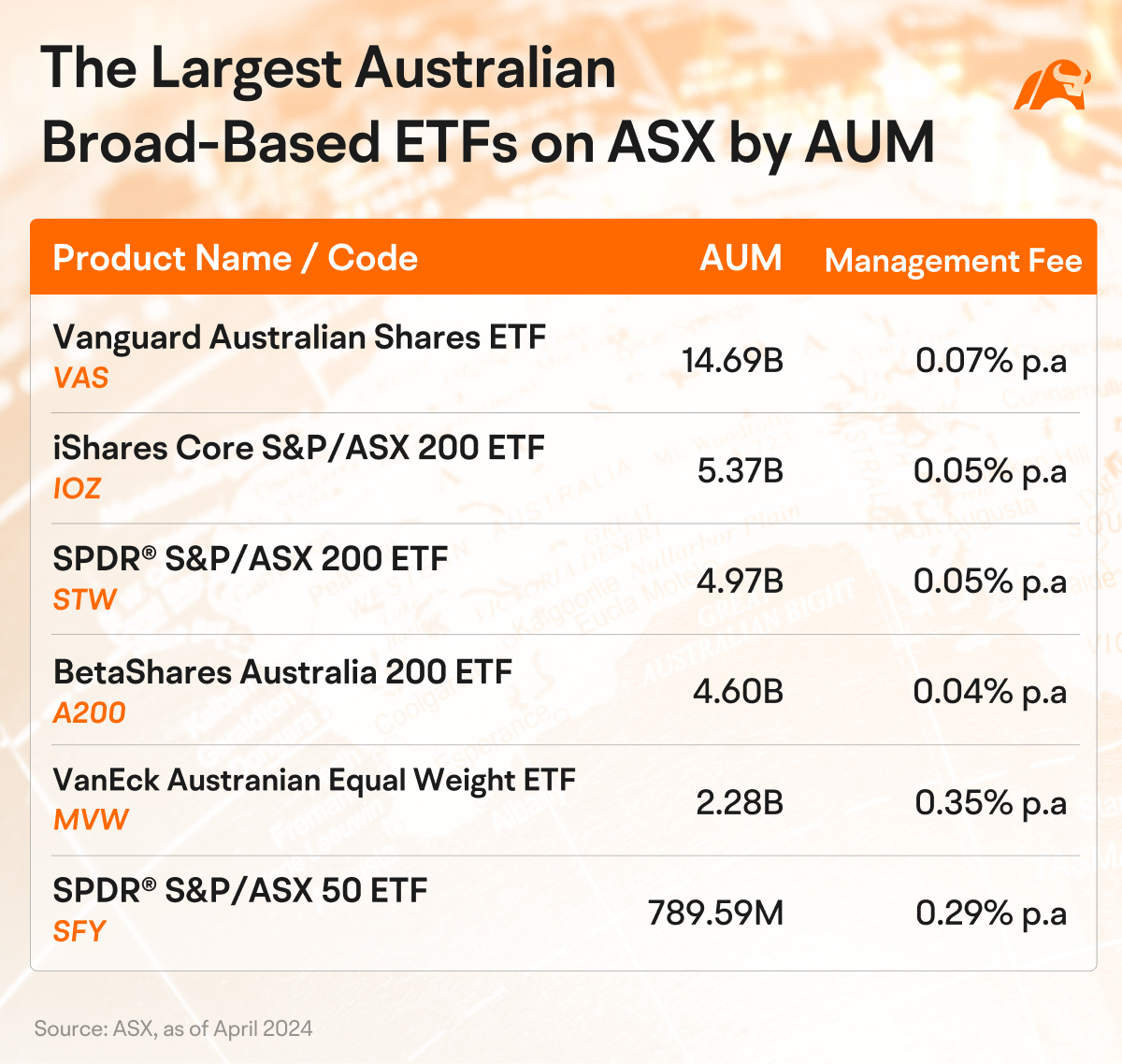
Broad-based ETFs are the most popular type based on assets under management (AUM), which is an important consideration for investors when choosing an ETF. Larger AUM may indicate a more established or popular ETF, as it suggests that more investors are participating in it.
Australian broad-based ETFs track a broad index such as the $S&P/ASX 200(.XJO.AU)$or the $S&P/ASX 300(.XKO.AU)$ . The table below displays the largest Australian broad-based ETFs on ASX by AUM.
Similarly, international broad-based ETFs track broad international share market indices, such as the $S&P 500(BK20014.AU)$ or the Russell 2000 in the United States. The table below shows the largest international broad-based ETFs on ASX by AUM.
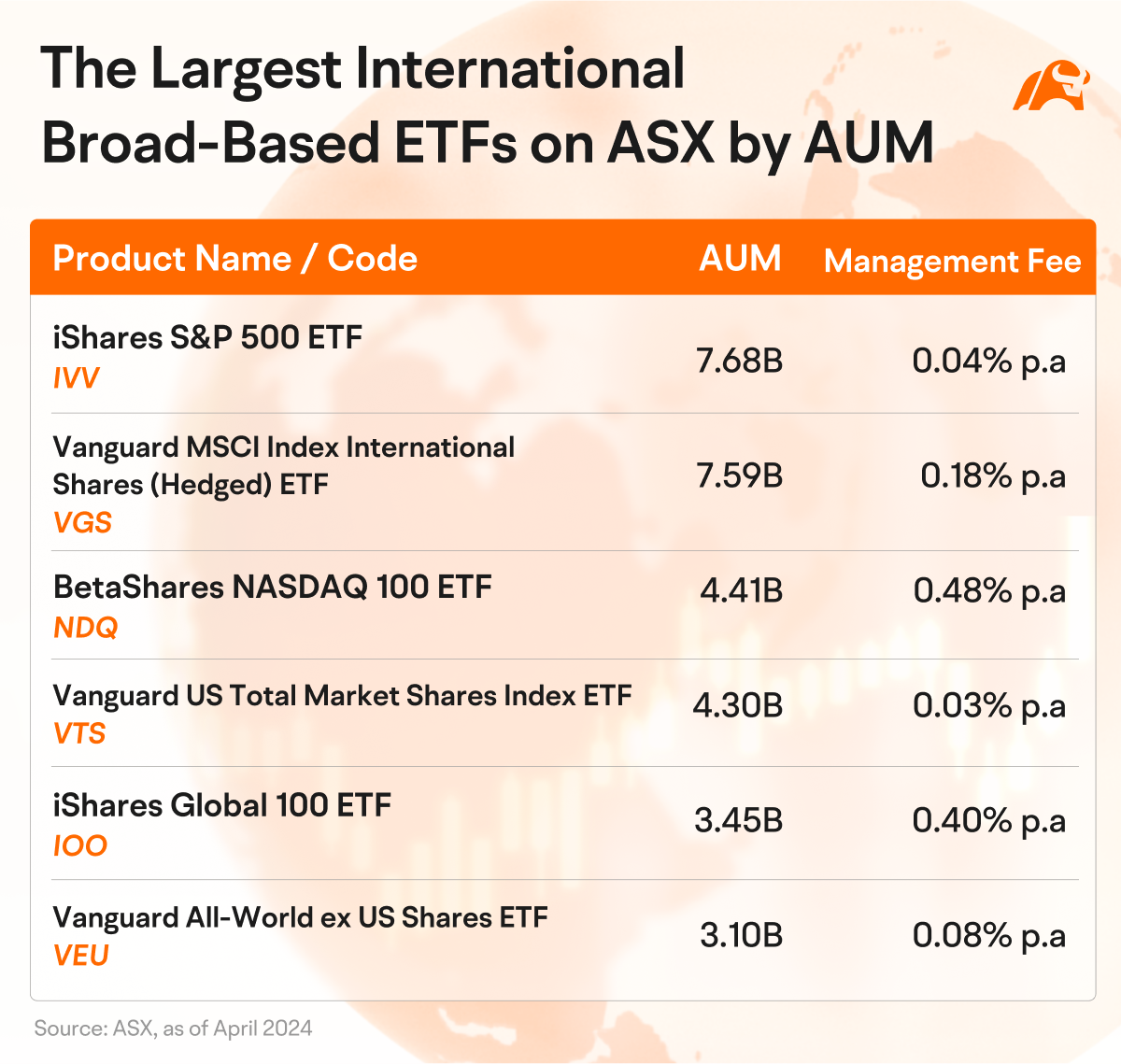
It’s important to note that international broad-based ETFs on ASX typically have higher management fees than Australian broad-based ETFs. We’ll discuss how investors can reduce these fees later in the article.
How to choose broad-based ETFs
Choosing the right broad-based ETFs for you can be overwhelming, given the number of options available. To select the suitable ETFs, investors can follow these steps:
Determine your investment goals
Are you interested in investing in the Australian domestic sharemarket or in international markets? Based on historical data, the international market, especially the U.S. sharemarket, tends to have higher returns in the long run. Therefore, it can be a good idea to put some of your money in international broad-based ETFs, which may not only improve returns but also reduce domestic market risks potentially.
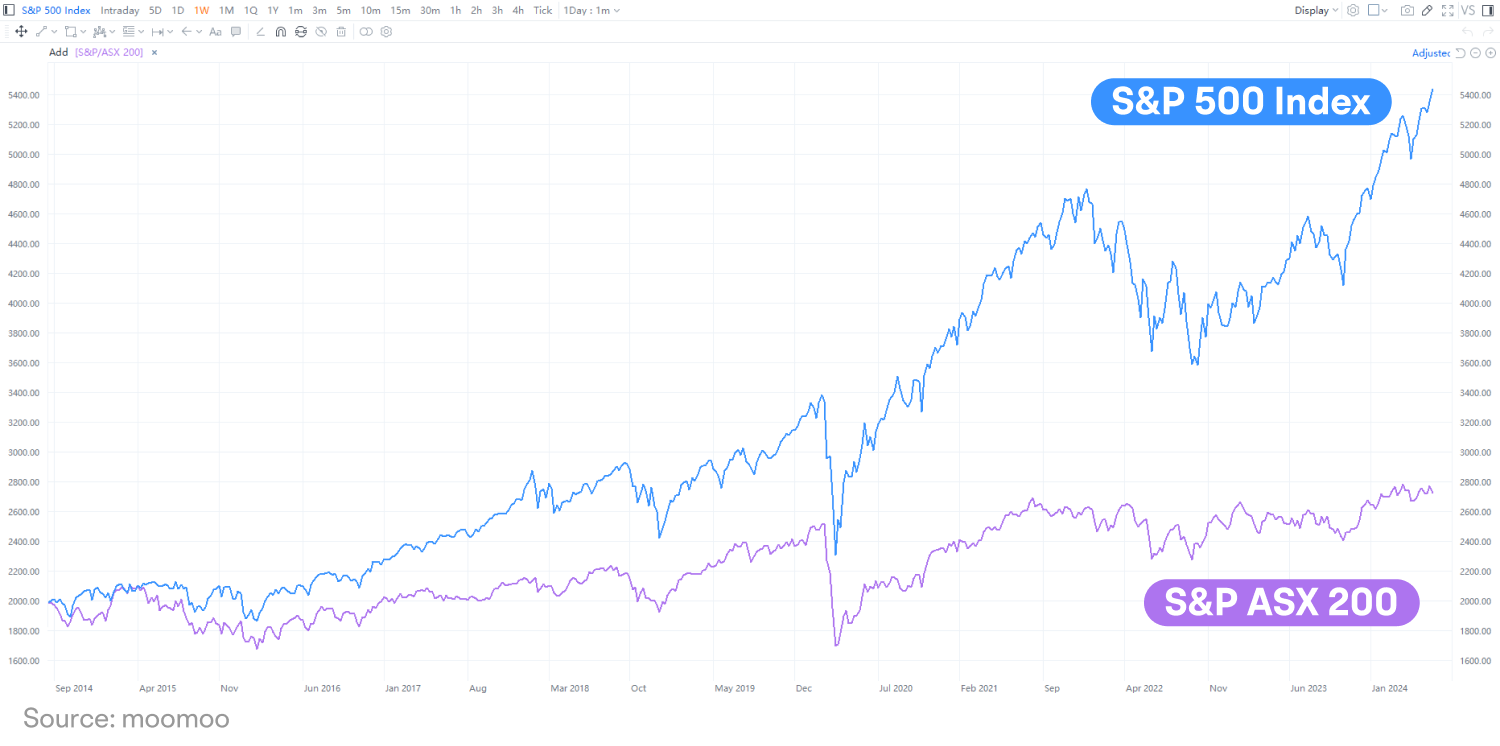
Consider the ETF’s holdings
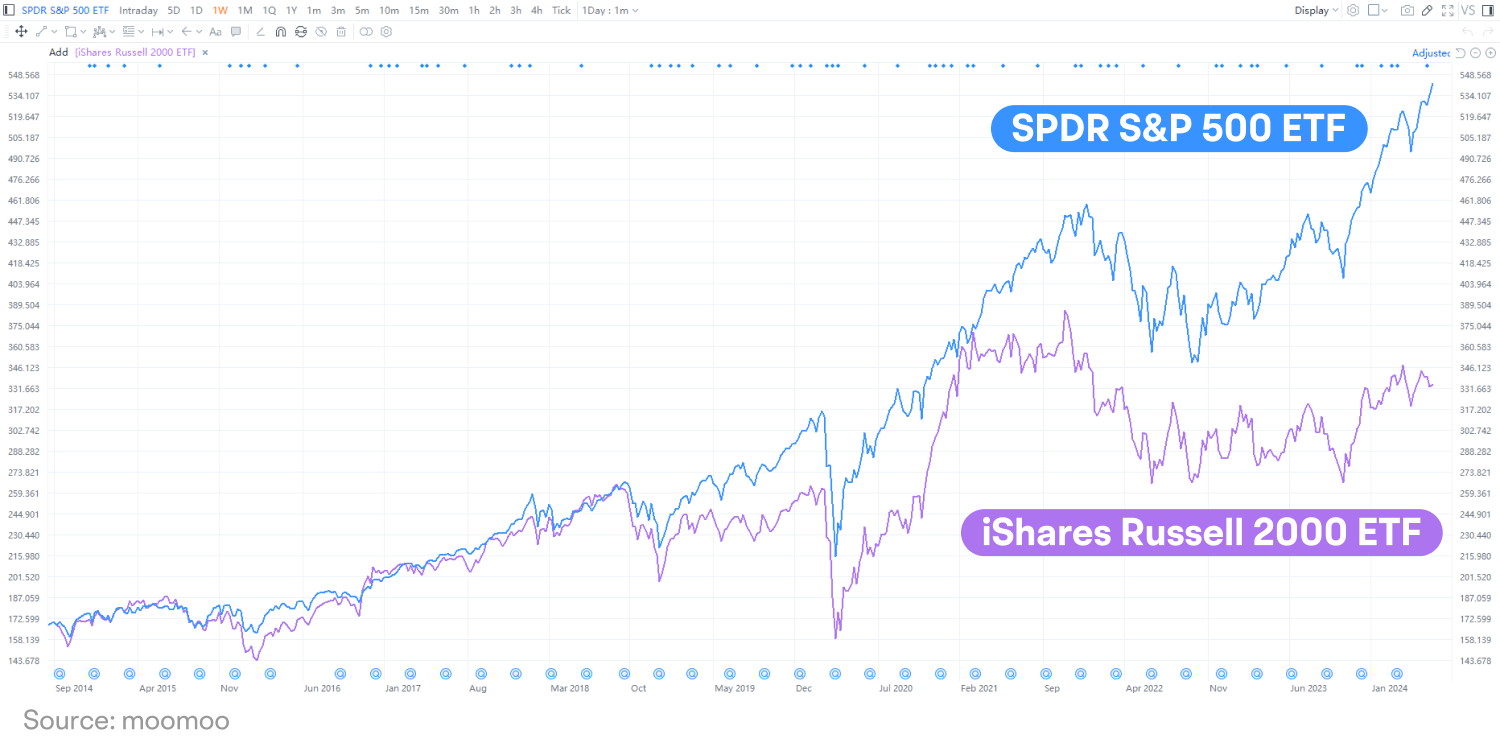
The holdings of an ETF are the securities it invests in. For a broad-based ETF, it is important to understand the underlying index that it tracks. For example, the $SPDR® S&P 500 ETF(SPY.AU)$ and the $iShares Russell 2000 BuyWrite ETF(IWMW.US)$have long been the most popular broad-based ETFs by turnover, with the SPY tracking the performance of 500 large-cap companies and the IWM tracking 2,000 small-cap companies. The returns of the two ETFs can vary significantly.
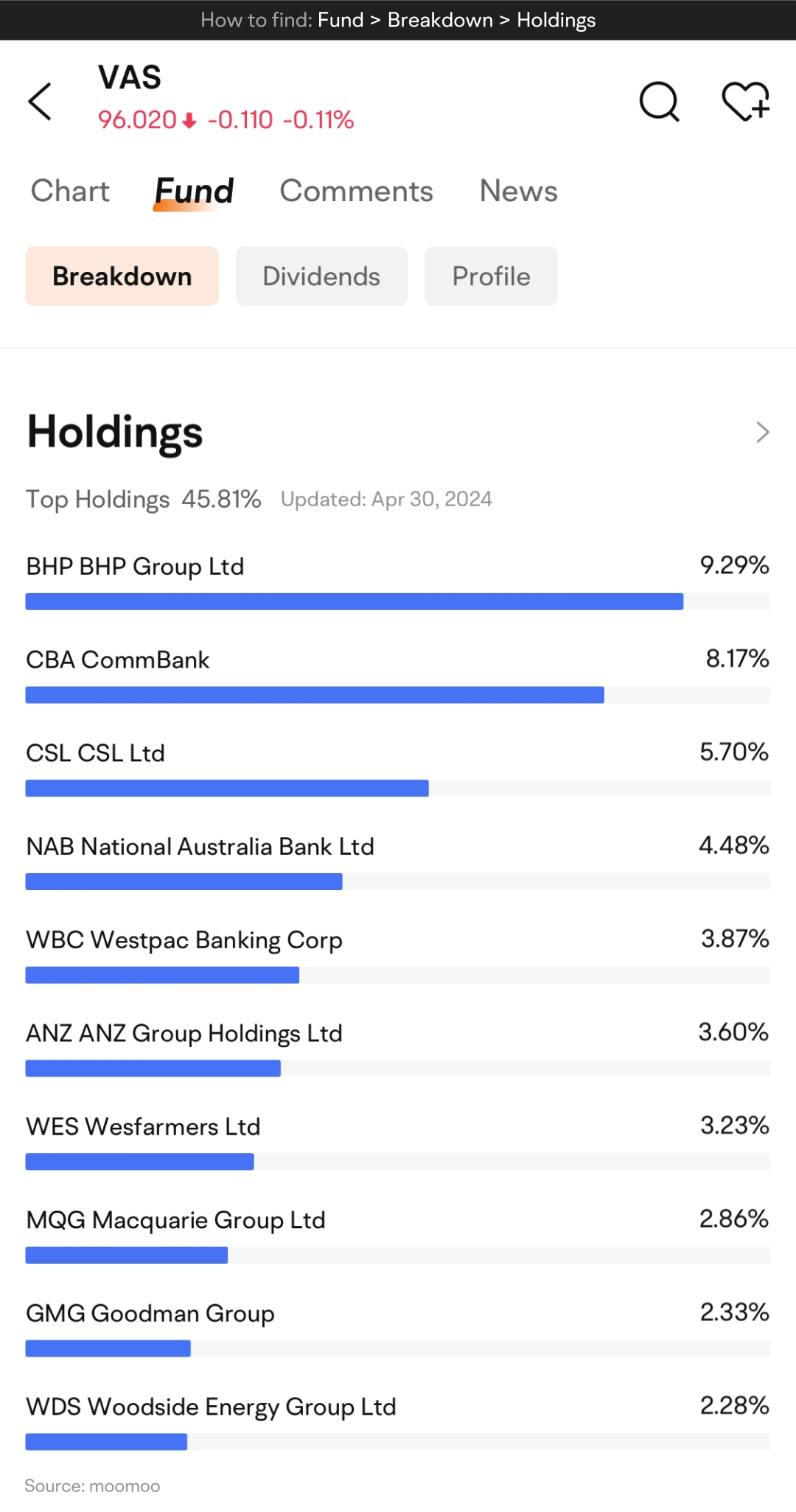
On moomoo, you can review an ETF’s holdings by tapping Fund > Breakdown > Holdings.
Evaluate the ETF’s performance
Although past performance does not indicate future results, it’s important to consider ETFs with consistent returns over the long term.
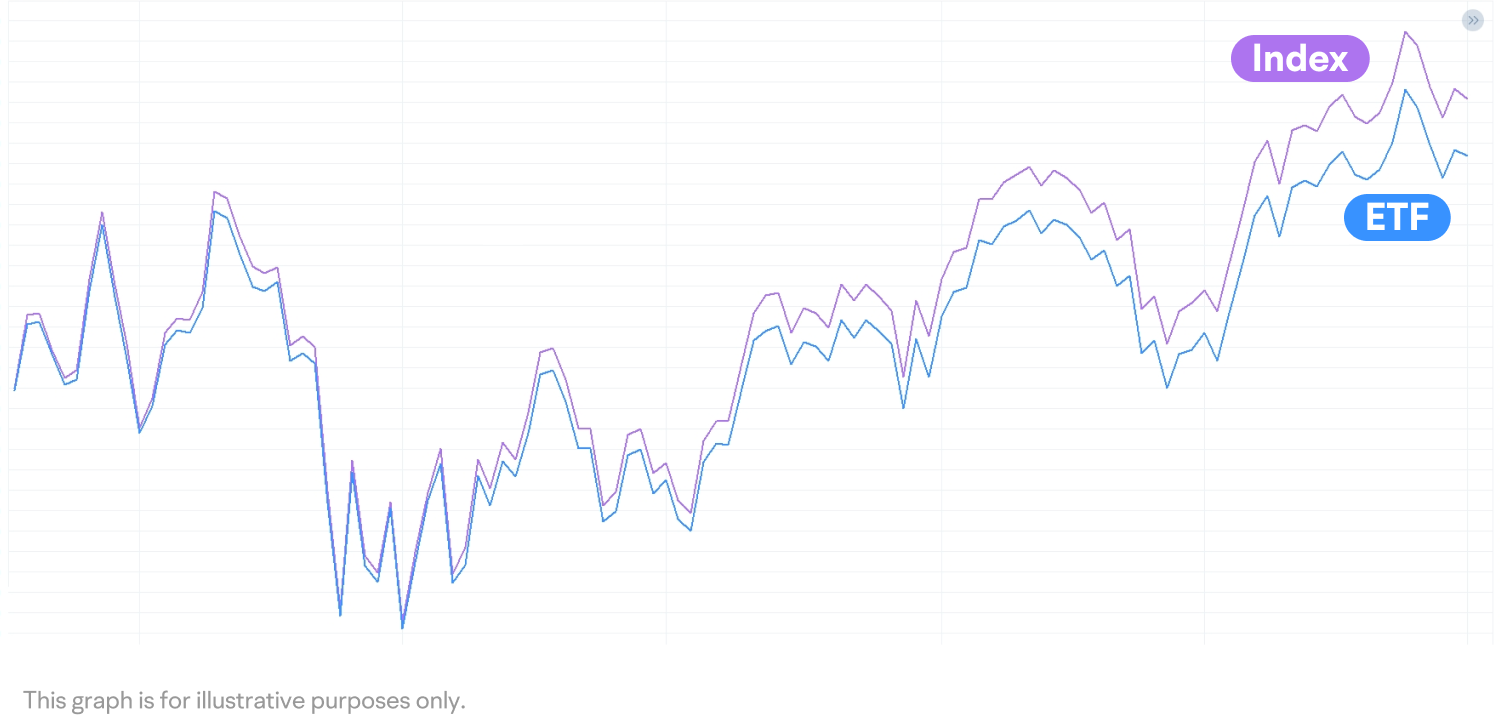
In addition, since the primary objective of most broad-based ETFs is to track an index, it's important to evaluate their 'tracking error' and 'tracking difference'. Tracking difference measures how closely the ETF's returns align with the underlying index, while tracking error assesses the consistency of this alignment over time.
Consider the ETF’s liquidity
Liquidity is a critical factor to bear in mind when choosing an ETF, as it directly affects the ease of buying or selling ETF’s units. ETFs with high liquidity typically have tighter bid-ask spreads, resulting in lower trading costs.
Furthermore, it is essential to take into account the ETF’s AUM, as those with higher AUM tend to have better liquidity and higher trading volumes.
Look for low expense ratios
Expense ratios are the fees charged by ETFs for managing the fund. It’s important to look for ETFs with low management fees to potentially minimise costs and maximise returns in the long term.
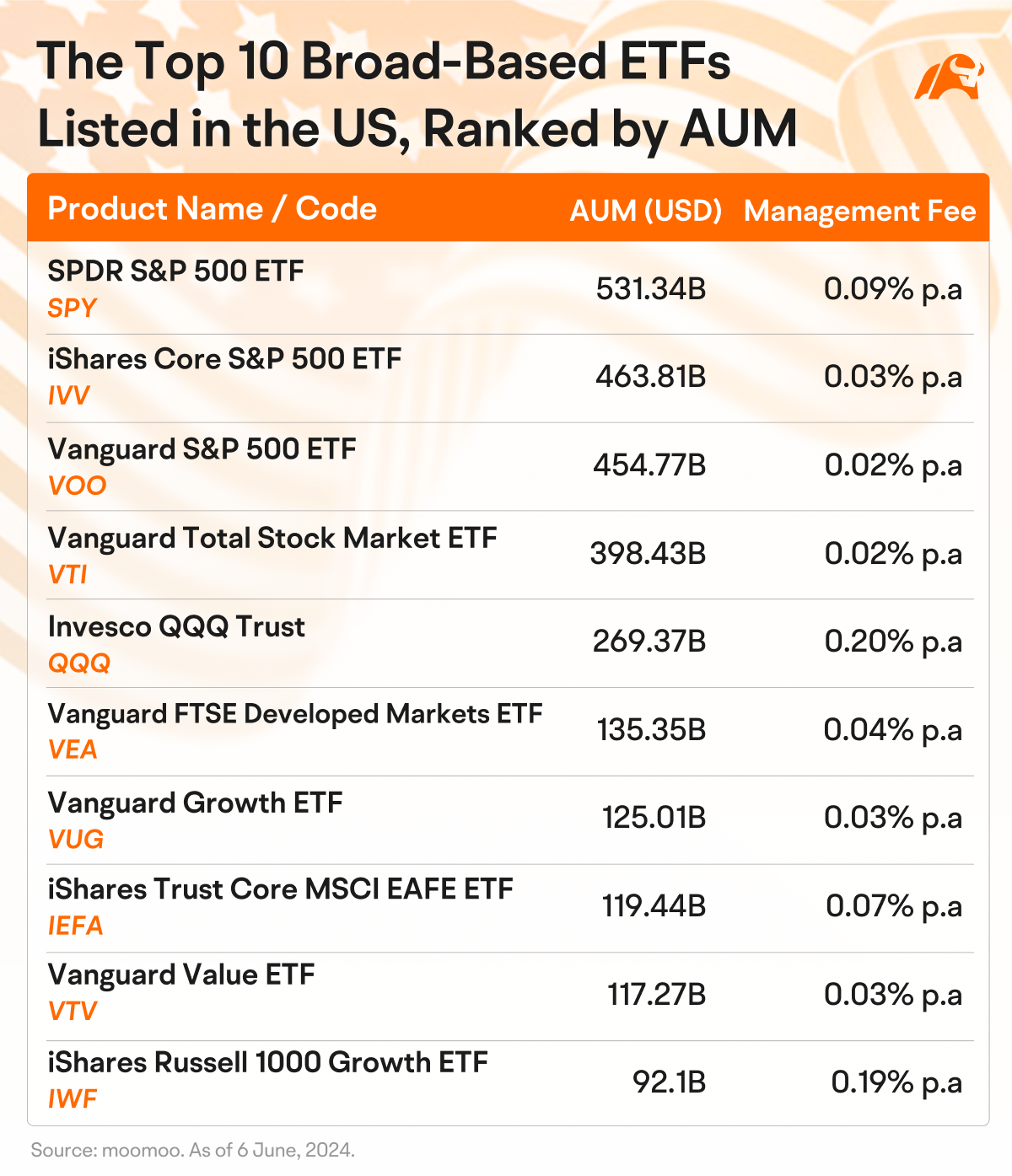
It’s worth noting that ETFs listed in the U.S. market tend to have lower management fees compared to international ETFs listed on ASX. For instance, the $BetaShares NASDAQ 100 ETF(NDQ.AU)$and the Invesco QQQ Trust (NASDAQ: QQQ) are both tracking the performance of the NASDAQ 100 index. However the former charges a management fee of 0.38%, while the latter charges only 0.20%.
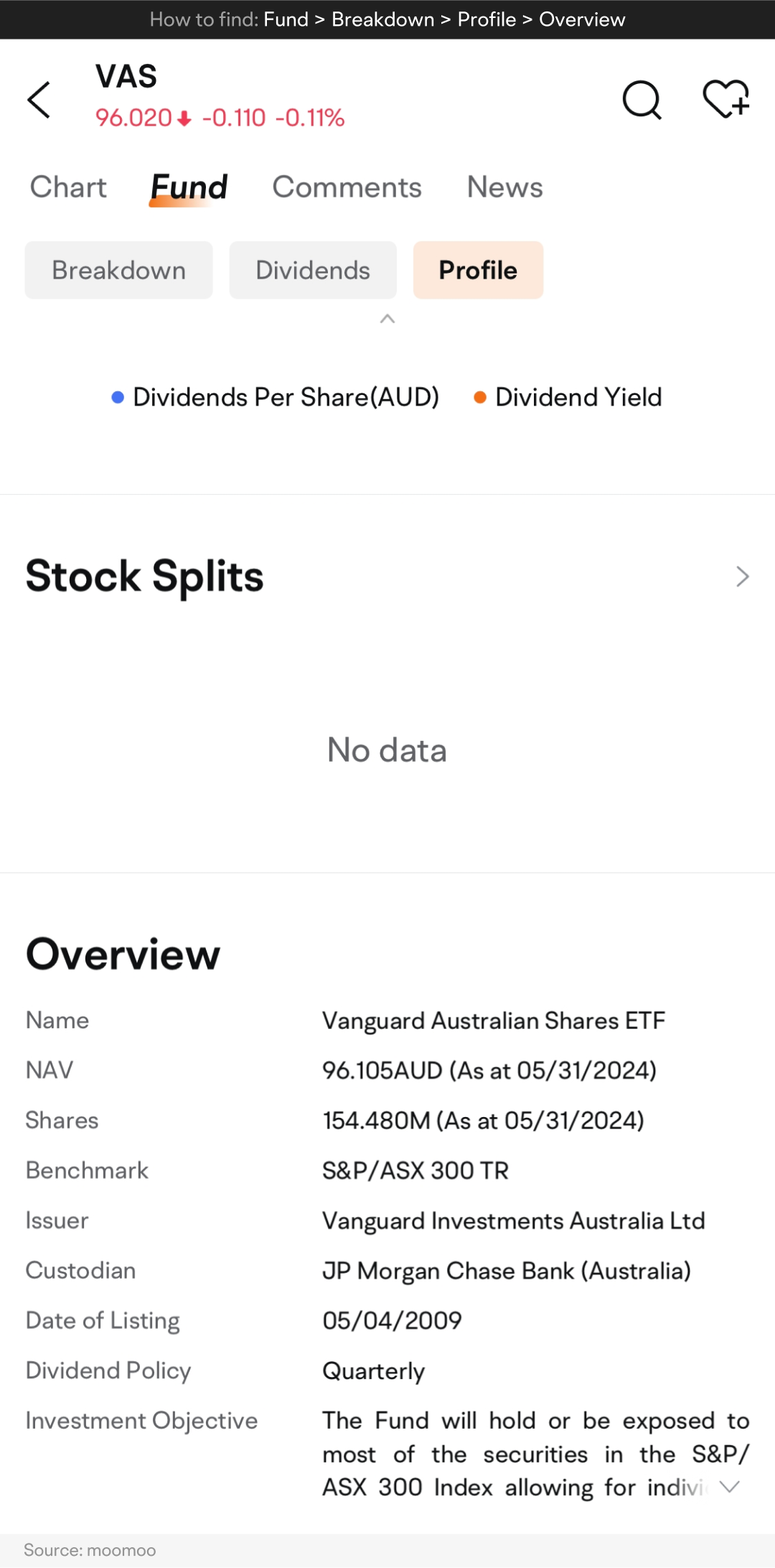
On moomoo, you can review an ETF’s management fee by going to Fund > Profile > Overview.
Invest in US listed ETFs
The US ETF market is the largest and most dynamic ETF market in the world, boasting over US$8 trillion in AUM and over 3,000 ETFs as of December 2023. The market offers a wide range of investment options, including broad-based ETFs, sector-specific ETFs and specialty ETFs, while also featuring some of the lowest management fees globally.
The table below shows the top 10 broad-based ETFs listed in the US, ranked by AUM.

Benefits of broad-based ETFs
Broad-based ETFs offer investors inherent diversification benefits, providing exposure to a group of securities at a cost much lower than if investors were to individually purchase them and pay brokerage on every transaction.
In addition, broad-based ETFs generally have lower transaction and management fees compared to actively managed funds. They are also transparent, allowing investors to see the securities the ETF is investing in and any associated costs. Investors also have visibility over the ETF's trading price and net asset value (NAV).
For investors who do not have the time or expertise to research and track companies constantly, a broad-based ETF eliminates much of that effort while still providing access to a professionally managed portfolio.
The bottom line
Broad-based ETFs can have a place in almost every portfolio, depending on the investor’s goals, risk tolerance and asset allocation.
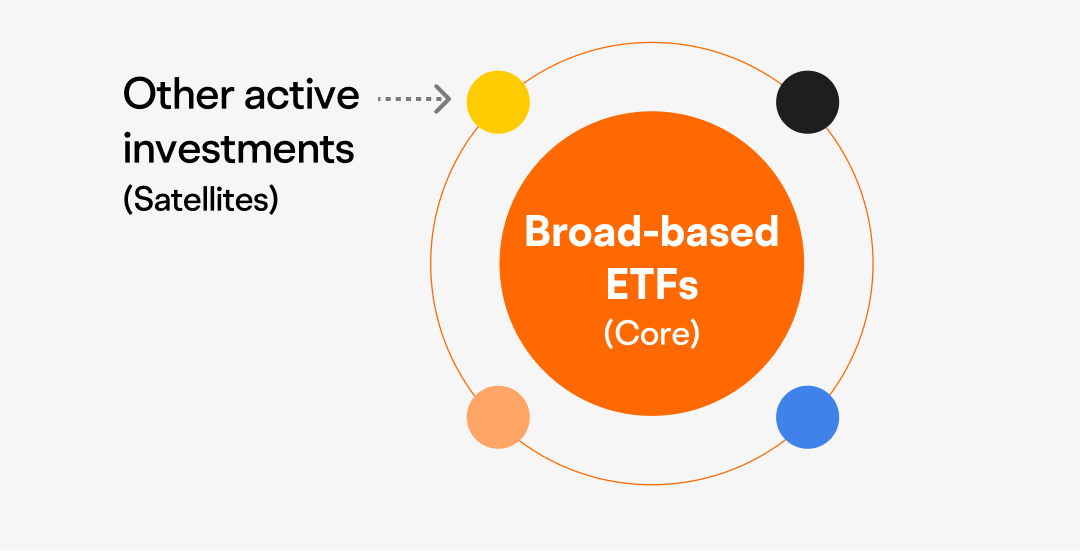
They can be used in a core-satellite approach, where they form the majority of an investment portfolio. Select securities or active investments are then used in a complementary role to seek market outperformance.
This presentation is for informational and educational use only and is not a recommendation or endorsement of any particular investment or investment strategy. Investment information provided in this content is general in nature, strictly for illustrative purposes, and may not be appropriate for all investors. Read more