Are These the Top Semiconductor ETFs in 2025?
Key takeaways
The semiconductor industry has gained attention due to the demand brought by the AI wave. Semiconductor ETFs provide investors with different ways to gain exposure to this sector.
Thematic semiconductor ETFs typically provide broad industry exposure. Leveraged ETFs are structured to deliver amplified returns but also involve higher risks and are generally designed for short-term trading. Single-stock ETFs focus on an individual company, offering targeted exposure but with increased risk.
Moomoo offers a variety of tools, such as the ETF Compare and Morningstar Rankings, to help you select your preferred semiconductor ETFs.
At the end of 2022, ChatGPT burst onto the scene, sparking a sweeping wave of AI innovation. The semiconductor industry, acting as the "shovel sellers" in this gold rush, has become one of the hottest sectors in the U.S. stock market.
The rapid advancement of AI has created a huge demand for computing power, and the core carriers of this power are advanced semiconductor chips. The semiconductor sector has earned significant attention, and prominent companies like NVIDIA, TSMC, and Broadcom are all part of this thriving industry.
There are quite a few ETFs on the market that track the sector, but how do they differ from one another? This article provides an overview of 10 semiconductor ETFs in 2025, based on publicly available information, to assist investors with their own comparisons. Let moomoo explore with you!
What is a semiconductor ETF?
A semiconductor ETF is a type of investment fund that is traded on stock exchanges and is designed to track the performance of a basket of semiconductor-related companies.
These ETFs focus specifically on companies involved in various aspects of the semiconductor supply chain, including designers, equipment & materials providers, and manufacturers.
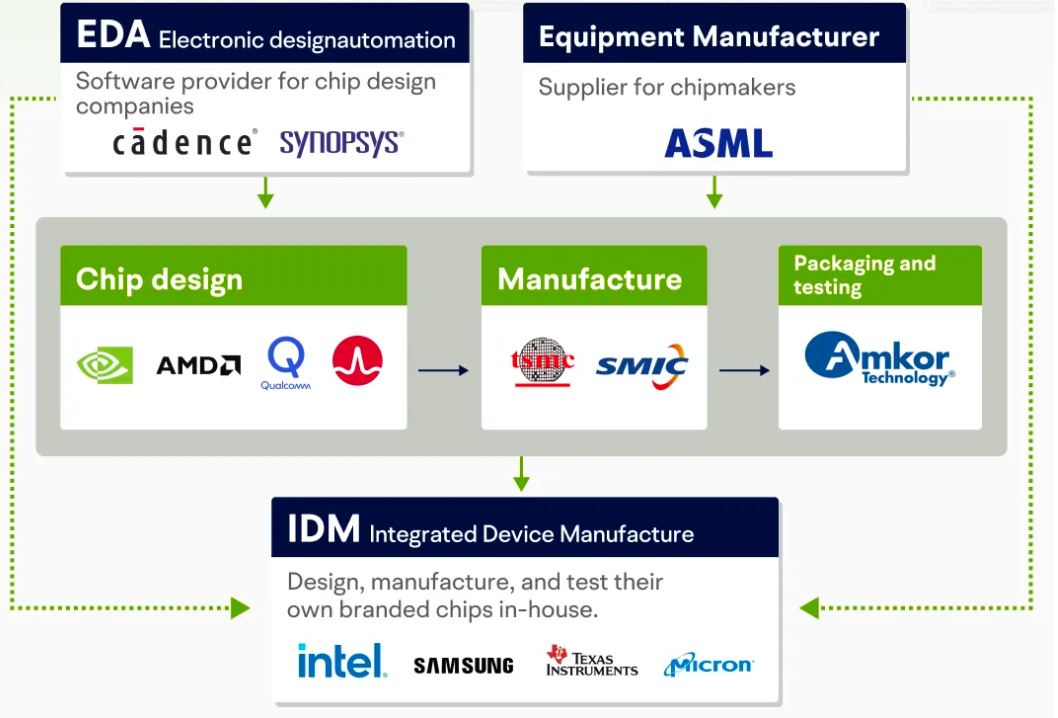
This is for information and illustrative purposes only. It should not be relied on as advice or a recommendation.
By investing in semiconductor ETFs, you are investing in dozens or even hundreds of the world's semiconductor companies, mitigating the hassle of researching and buying individual stocks one by one.
What are the types of semiconductor ETFs?
Due to the rapid development of the industry, there are many ETF products on the market that track the performance of the semiconductor industry. We can roughly divide them into three categories, each with its own characteristics.
Thematic ETFs
This category is the most common type, typically tracking a specific semiconductor industry index, and is also known as a broad-based ETF or index ETF.
Key Features:
Diversification: Thematic ETFs spread investments across a wide range of companies within the semiconductor industry, reducing the risk associated with any single company's performance.
Balanced outcomes: Because they hold a wide range of stocks, gains in some companies may be offset by losses in others.
Leveraged ETFs
Leveraged ETFs aim to provide a multiple (e.g., 2x or 3x) or inverse multiple (e.g., -2x or -3x) of the daily performance of an underlying semiconductor index. They utilize derivatives and other financial tools to amplify returns, which can result in significant gains or losses over short periods.
Advantages:
Amplified Returns: Leveraged ETFs offer the potential for significantly higher returns over short periods by magnifying the performance of the underlying index.
Hedging: Inverse leveraged ETFs can be used to hedge against potential declines in the semiconductor sector.
Disadvantages:
Higher Risk and Volatility: The amplification of returns also means amplified losses, making these ETFs riskier and more volatile than non-leveraged ETFs.
Not Suitable for Long-Term Holding: Due to daily rebalancing, leveraged ETFs can experience performance decay over time.
Complexity: They are more complex financial instruments, requiring a good understanding of how leverage and derivatives work.
>> Learn more: Leveraged ETFs Made Easy: How They Work and What to Know
It's important to note that leveraged and inverse ETFs are not designed for buy-and-hold investors or investors who do not intend to manage their investments on a daily basis. The use of leverage by an ETF increases the risk and is not suitable for all investors and should be utilised only by sophisticated investors who understand leverage risk, the consequences of seeking daily leveraged or daily inverse leveraged investment results, and intend to actively monitor and manage their investment.
Single-stock ETFs
Single-stock ETFs are designed to provide exposure to the performance of a single semiconductor company. They are relatively rare in the ETF space but offer a way to invest in specific companies within the semiconductor industry without directly buying the stock. In recent years, single-stock ETFs developed for core stocks have gained popularity, such as the 2x Long NVDA Daily ETF (NVDL), which tracks Nvidia. It aims to deliver two multiples of the daily return of that stock rather than directly mirroring its performance.
It is important to note that some of these products are highly concentrated in their holdings on top of the characteristics of leveraged ETFs. They carry high risks and are not suitable for most investors.
Advantages:
Focused Exposure: Provides targeted investment in a particular company, allowing investors to capitalize on specific business strategies or innovations.
Disadvantages:
Concentration Risk: Investing in a single stock increases exposure to company-specific risks, such as management decisions, competitive pressures, and market dynamics.
Volatility: Single-stock ETFs can be more volatile than most ETFs due to their focus on one company.
What are the top semiconductor ETFs in 2025?
When searching for the best semiconductor ETFs in 2025, investors typically compare a range of factors, such as size, holdings, and expense ratio.
According to these criteria, we select the top 10 semiconductor ETFs for Australian investors, ranked by assets under management (AUM).
These ETFs encompass the three types of semiconductor ETFs previously discussed. Investors can conduct further research based on their own investment goals and risk preferences.
ETF Ticker | ETF Name | AUM(B) | Management | Types | Features |
SMH | VanEck Semiconductor ETF | 27.14 | 0.35% | Thematic | Large Cap, Concentrated |
SOXX | iShares Semiconductor ETF | 13.8 | 0.34% | Thematic | Large Cap, Diversified |
SOXL | Direxion Daily Semiconductor Bull 3X Shares | 12.02 | 0.75% | Leveraged | 3x Bullish |
NVDL | GraniteShares 2x Long NVDA Daily ETF | 4.44 | 0.99% | Single-stock | NVIDIA Focus, 2x Bullish |
NVDY | YieldMax NVDA Option Income Strategy ETF | 1.9 | 0.99% | Single-stock | NVIDIA Focus, Covered Call |
SOXS | Direxion Daily Semiconductor Bear 3X Shares | 1.4 | 0.75% | Thematic | 3x Bearish |
XSD | SPDR S&P Semiconductor ETF | 1.39 | 0.35% | Thematic | Small & Mid Cap |
USD | ProShares Ultra Semiconductors | 1.38 | 0.75% | Leveraged | 2x Bullish |
PSI | Invesco Semiconductors ETF | 0.73 | 0.50% | Thematic | Small & Mid Cap |
SEMI | Global X Semiconductor ETF | 0.37 | 0.45% | Thematic | Listed on ASX |
Source: moomoo. Data as of Aug 27, 2025.
Past performance does not guarantee future results. This is for information and illustrative purposes only and should not be relied on as advice or recommendation.
Important note: Leveraged and single-stock ETFs involve higher risk, volatility, and complexity. They are generally designed for short-term trading and may not be appropriate for all investors.
VanEck Semiconductor ETF (SMH)
SMH is currently the largest ETF in the sector, tracking the MVIS US Listed Semiconductor 25 Index. Its holdings are relatively concentrated, tracking only 25 companies within the industry and weighting them by market capitalization. Nvidia accounts for more than 20% of its holdings, while TSMC and Broadcom each account for about 10%.
iShares Semiconductor ETF (SOXX)
This ETF tracks the ICE Semiconductor Sector Index. It primarily focuses on U.S. stocks, while allocating approximately one-quarter of its assets to international companies. This product offers a reasonable level of diversification. The largest holding is AMD, accounting for about 10%.
Direxion Daily Semiconductor Bull 3X Shares (SOXL)
The investment seeks daily investment results of 300% of the ICE Semiconductor Index. Now you might wonder, since both track the same index and SOXL adds a 3x long leverage, why does it still underperform compared to SOXX (2.94% vs. 16.81%)?
This is due to the decay from the daily reset effect of leveraged ETFs, which vividly illustrates why leveraged ETFs are not suitable for long-term holding. Leveraged ETFs also typically have higher fees than regular ETFs.
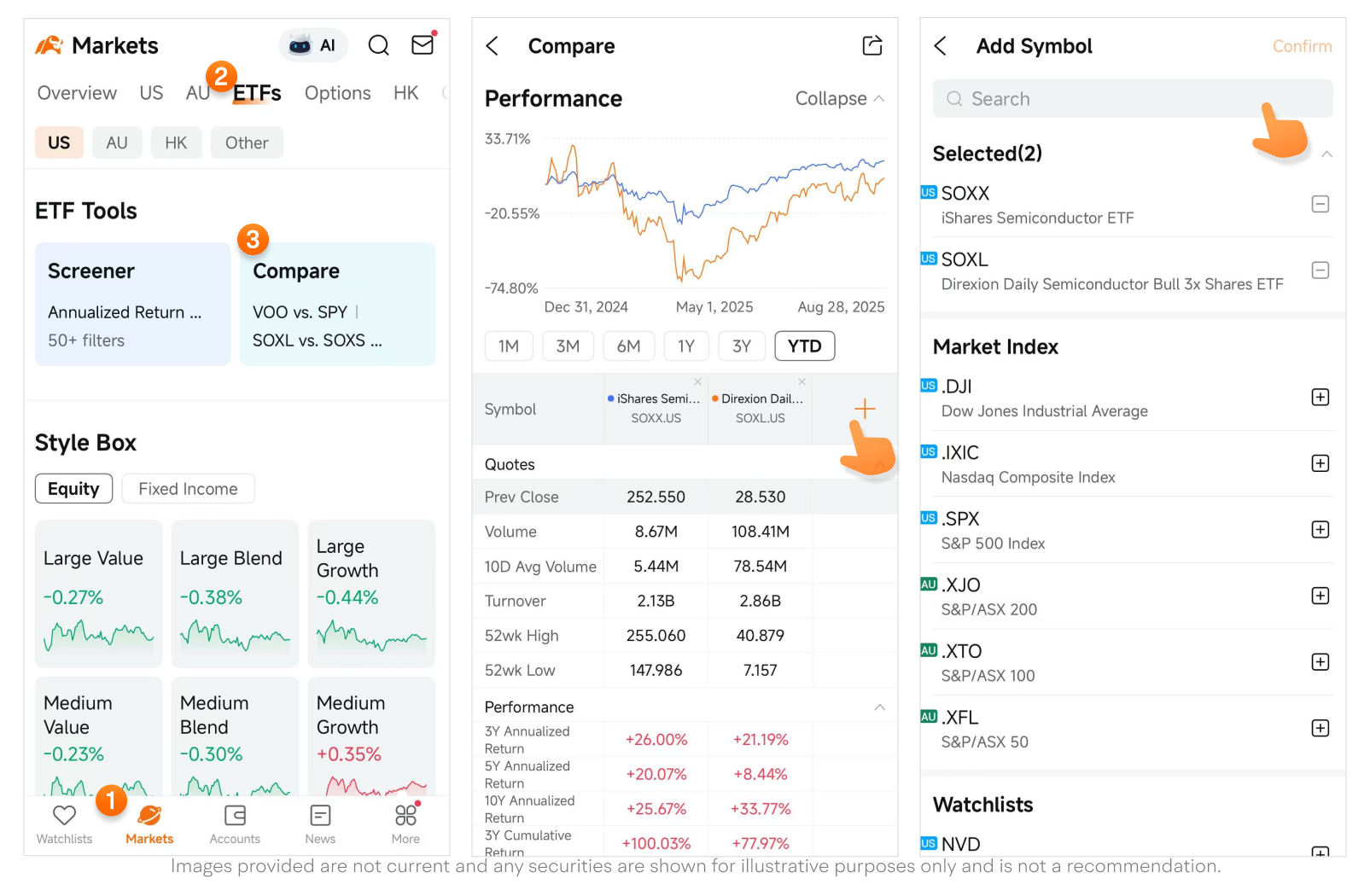
With moomoo's ETF compare feature, you can visually see the differences between these two ETFs. Here's how: Markets> ETFs> Compare. Click the "+" next to "symbol" to start searching for the ETF you want to compare, then you can add it to the comparison list.
If you want to know more about how SOXX compares to other semiconductor ETFs, this feature can also help you. The tool supports comparison of up to six different ETFs across multiple dimensions, including historical performance, analyst ratings, holding styles, and dividend details.
GraniteShares 2x Long NVDA Daily ETF (NVDL)
The investment seeks daily investment results of 200% the daily percentage change of NVIDIA. You can see that the fees for single-stock ETFs are even higher than those for leveraged ETFs, reaching nearly three times that of thematic ETFs (SOXX at 0.34% per year).
YieldMax NVDA Option Income Strategy ETF (NVDY)
It seeks to generate monthly income by selling call options on NVDA while holding NVIDIA stocks. This type of ETF is also known as a Covered Call ETF. It distributes the premium income obtained from selling call options on Nvidia to investors monthly, resulting in a relatively high dividend yield. We have previously discussed the characteristics and risks of Covered Call ETFs in detail in the context of high dividend ETFs.
>> Learn more: Are These the Top High Dividend ETFs in 2025?
Direxion Daily Semiconductor Bear 3X Shares (SOXS)
SOXS, SOXX, and SOXL track the same index, but SOXS provides 300% of the inverse performance. Due to the index itself rising, coupled with the impact of leverage decay, this ETF has suffered significant losses within the year, with a drawdown of about 70%.
SPDR S&P Semiconductor ETF (XSD)
Its benchmark is the S&P Semiconductor Index. Unlike traditional ETFs that assign weights according to market capitalization, XSD employs an equal-weight strategy, distributing its funds evenly across all holdings. This approach provides greater exposure to small and mid-sized companies.
ProShares Ultra Semiconductors (USD)
This ETF offers 2x daily long leverage to the Dow Jones U.S. Semiconductors Index. Nvidia is the largest holding of the ETF, accounting for over 30% of its portfolio.
Invesco Semiconductors ETF (PSI)
It tracks the Dynamic Semiconductor Intellidex Index, and similar to XSD, it also focuses more on small and mid-cap semiconductor companies.
All nine of these semiconductor ETFs are listed on U.S. exchanges, which means Australian investors will need to trade in U.S. dollars. With moomoo’s in-app currency exchange, converting AUD to USD is seamless, making it easier to access and invest in these U.S. assets.
Global X Semiconductor ETF (SEMI)
Its benchmark is the Solactive Global Semiconductor 30 Index. Unlike the previously mentioned ETFs, this one is an Australian local ETF listed on the ASX. Its largest holdings also include prominent companies such as Nvidia, Broadcom, and TSM, with a combined weight of over 30%.
How to find semiconductor ETFs on moomoo?
You already have a basic understanding of semiconductor ETFs, including the various categories and some of the top ETFs. If you're considering investing, Moomoo provides a convenient platform for investing in semiconductor ETFs.
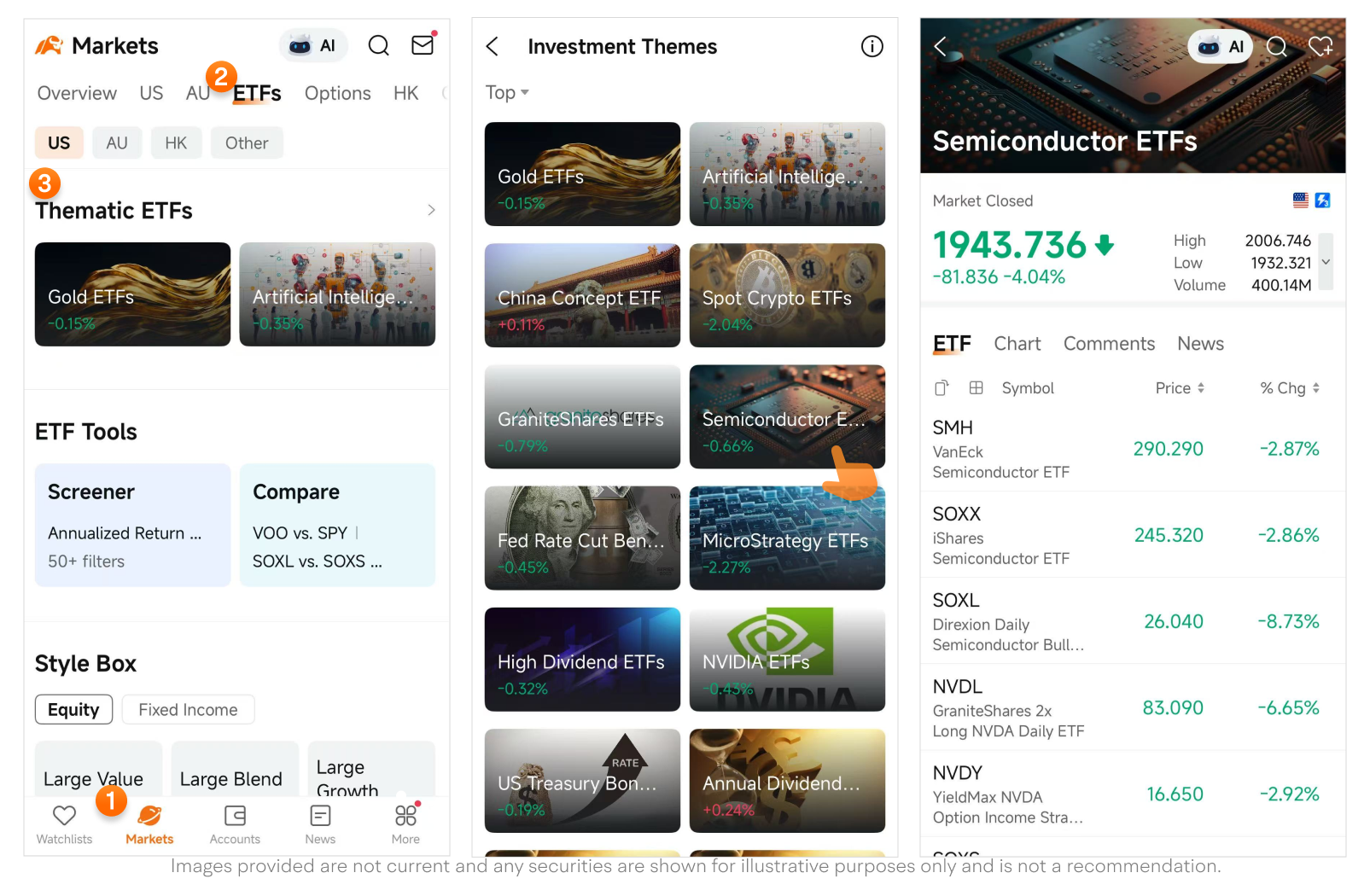
Navigate to the ETFs page and select Thematic ETFs, and you'll find a list of the best Semiconductor ETFs. Within this section, you can easily discover assets related to semiconductors.
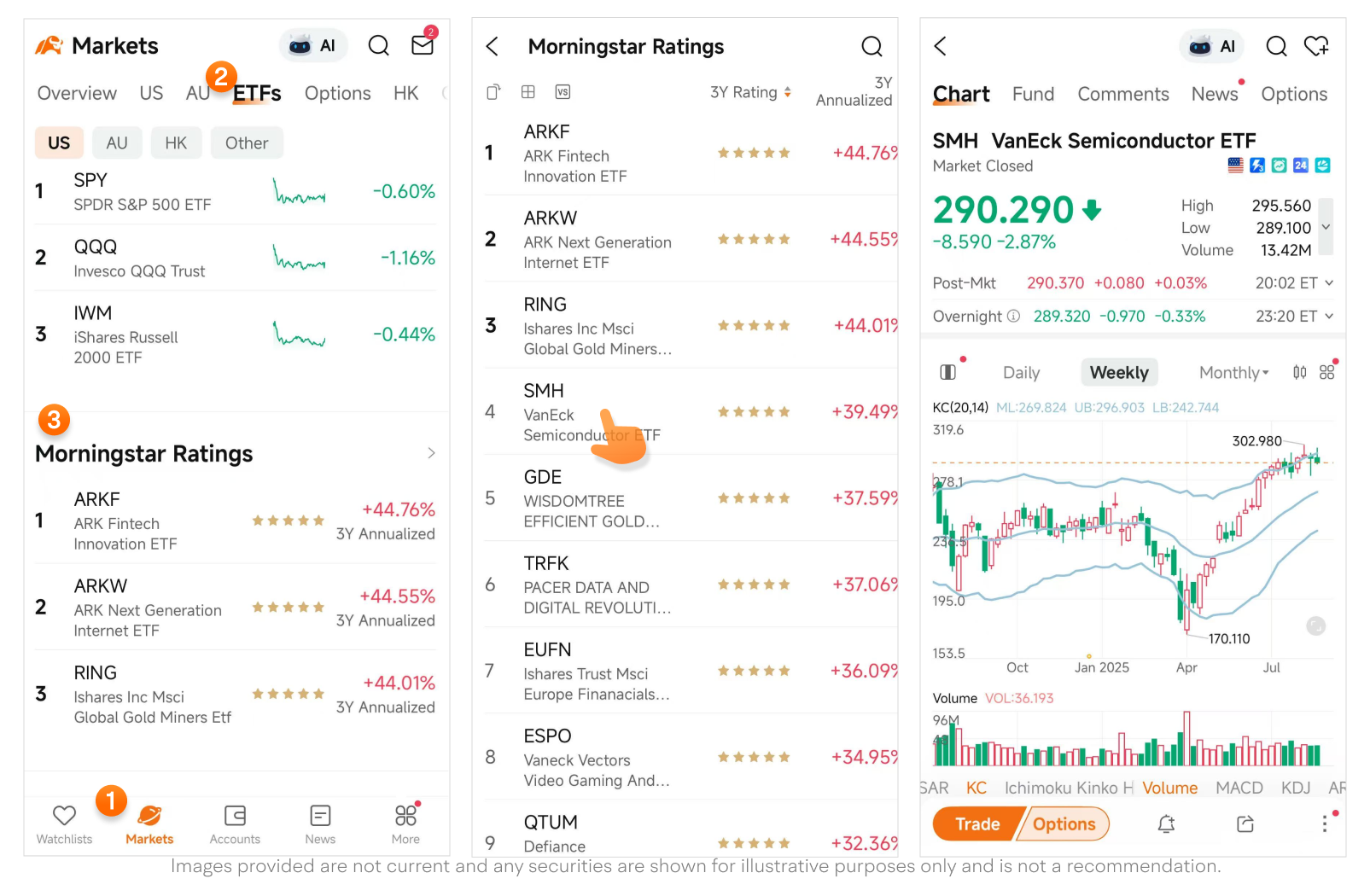
Moomoo also provides Morningstar ratings for ETFs for your reference. Morningstar is an established firm for fund evaluation.
Ratings of 1 to 5 stars are based on the fund's historical returns and risk control performance. Funds within the same category are then ranked based on the key indicator of 'risk-adjusted return.' A higher ranking corresponds to a higher rating.
On Moomoo, you can find Morningstar Ratings on the ETFs page. By entering, you can see highly-rated ETFs, and by clicking on a specific ETF, you can access its quote page.
If you already have a favored semiconductor ETF in mind, moomoo can also provide you with a detailed analysis of the individual ETF.
On the ETF's quote page, click on Fund, and in the Breakdown section, you can find the top 10 holdings of the ETF and their respective weightings. Additionally, you can view visual charts of the portfolio and investment style.
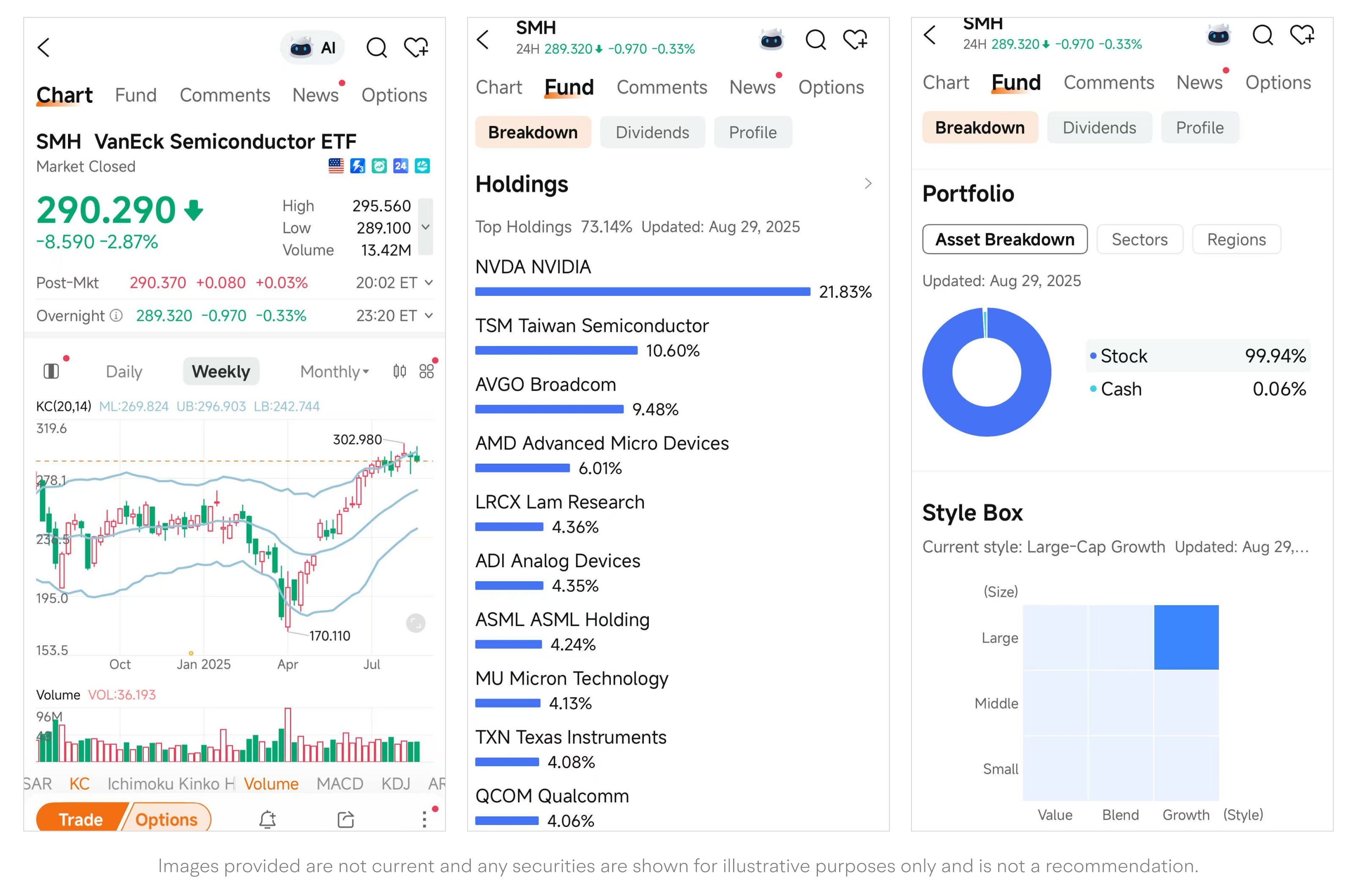
Alongside the Breakdown tab, there are also Dividends and Profile tabs, where you can find detailed information about the ETF's past dividend distributions and more basic information about the product.
With these tools from moomoo, investing in semiconductor ETFs could become much easier. If you haven't joined moomoo yet, you can easily set up an account in just three simple steps!

Are semiconductor ETFs a good investment?
Semiconductor ETFs offer a diverse range of options for investors seeking to capitalize on the AI growth potential.
Thematic semiconductor ETFs can give broad exposure to the industry, encompassing multiple companies. Leveraged ETFs aim to deliver 2x or 3x the daily performance of an index. These are complex and high-risk products, generally used for short-term trading rather than long-term investing. Single-stock semiconductor ETFs focus on individual companies, with increased risk due to limited diversification.
It's important to note that the semiconductor industry is inherently volatile, influenced by factors such as supply chain dynamics and geopolitical tensions. As such, semiconductor ETFs may be more relevant to investors with a relatively higher risk tolerance.

Frequency Asked Questions
Should I buy a semiconductor ETF?
Investing in a semiconductor ETF depends on your financial goals, risk tolerance, and market outlook. These ETFs provide exposure to the growth of technologies like AI, but it's important to note that the semiconductor industry can be volatile. Consider how a semiconductor ETF aligns with your overall investment strategy and whether it supports your diversification goals. Staying informed about industry trends and current market conditions is crucial.
Is VanEck Semiconductor ETF a good investment?
The VanEck Semiconductor ETF (SMH) offers exposure to large-scale semiconductor companies. Like other sector ETFs, its performance is influenced by trends in the semiconductor industry, which can experience periods of strong growth and high volatility. Ultimately, whether SMH is a good investment for you will depend on how well it aligns with your investment strategy and financial goals.
Does Vanguard have a semiconductor ETF?
No, Vanguard does not currently offer a semiconductor-specific ETF. However, they do have broader technology-focused ETFs that include semiconductor companies as part of their holdings. Other providers, such as VanEck and iShares, offer semiconductor-specific ETFs.
This presentation is for informational and educational use only and is not a recommendation or endorsement of any particular investment or investment strategy. Investment information provided in this content is general in nature, strictly for illustrative purposes, and may not be appropriate for all investors. Read more