10 Best Index Funds and ETFs in Australia for 2026
- The 10 ETFs compared are A200, VAS, IVV, VGS, NDQ, QUAL, VDHG, VDGR, VAF and VBND, covering Australian shares, international equities, diversified portfolios and bonds.
- There is no single best index ETF. Compare the underlying index, holdings, management costs, assets under management (AUM), liquidity, currency exposure and risks rather than relying on recent returns alone.
- Moomoo’s ETF research, comparison and recurring-investment tools can help investors explore eligible ETFs and plan regular investments. Always verify key information against the issuer’s latest PDS and factsheet.
- There is no single best index ETF. Compare the underlying index, holdings, management costs, assets under management (AUM), liquidity, currency exposure and risks rather than relying on recent returns alone.
- Moomoo’s ETF research, comparison and recurring-investment tools can help investors explore eligible ETFs and plan regular investments. Always verify key information against the issuer’s latest PDS and factsheet.
Index funds remain a popular way for Australians to build a diversified portfolio without selecting individual shares. Through one ASX-listed exchange-traded fund (ETF), an investor may gain exposure to hundreds — or even thousands — of companies.
But “best” depends on what you need. An Australian shares ETF, a global equity ETF and a bond ETF serve very different purposes. Fees matter, but so do geographic exposure, currency risk, portfolio overlap and your investment timeframe. This guide compares 10 widely used index and rules-based ETFs available on the ASX.
How we selected these ETFs
We selected these ETFs as representative ASX-listed products across major asset classes and investment approaches. The assessment considered market coverage, assets under management, management costs, liquidity and operating history. The list is intended to support product comparison rather than rank ETFs solely by past returns. Inclusion does not constitute a recommendation or endorsement, and no ETF is suitable for every investor. Fund information and management fees were checked against issuer disclosures on 27 August 2026 and may change.
Please note that ETFs are subject to market volatility and the risks of their underlying securities, which may include risks associated with smaller companies, international securities, commodities, and fixed income, among others.
Best index ETFs in Australia: quick comparison
ASX code | ETF | Main exposure | Management fee p.a.* | AUM(A$) | Potential role |
A200 | Betashares Australia 200 ETF | 200 largest ASX-listed Australian companies by market capitalisation | 0.04% | A$11.06B | Low-cost Australian core |
VAS | Vanguard Australian Shares Index ETF | S&P/ASX 300 | 0.07% | A$26.19B | Broader Australian core |
IVV | iShares S&P 500 ETF | Large US companies, tracking the S&P 500 index | 0.04% | A$14.49B | US equity exposure |
VGS | Vanguard MSCI Index International Shares ETF | Developed markets excluding Australia | 0.18% | A$17.2B | Broad international core |
NDQ | Betashares Nasdaq 100 ETF | Nasdaq-listed non-financial companies | 0.48% | A$8.85B | Growth/technology tilt |
QUAL | VanEck MSCI International Quality ETF | International quality companies | 0.40% | A$8.70B | Factor-based global exposure |
VDHG | Vanguard Diversified High Growth Index ETF | About 90% growth assets, 10% defensive | 0.27% | A$4.0B | High-growth all-in-one portfolio |
VDGR | Vanguard Diversified Growth Index ETF | About 70% growth assets, 30% defensive | 0.27% | A$1.54B | Moderate-growth all-in-one portfolio |
VAF | Vanguard Australian Fixed Interest Index ETF | Australian investment-grade bonds | 0.10% | A$3.79B | Australian defensive allocation |
VBND | Vanguard Global Aggregate Bond Index (Hedged) ETF | Global investment-grade bonds | 0.20% | A$4.6B | Diversified defensive allocation |
*Management fees and costs are based on the latest issuer disclosures and may change. Additional transaction costs may apply.
** AUM figures are approximate and based on the latest available issuer data as at 24–26 August 2026. year-to-date (YTD) return are calculated in Australian dollars to 26 August 2026 using adjusted market prices, including distributions where reflected in the adjusted-price data. Returns do not include brokerage, bid–ask spreads or investor tax. Past performance is not indicative of future results.
1. Betashares Australia 200 ETF (ASX: A200)
A200 tracks 200 of the largest companies listed in Australia on the ASX, ranked by market capitalisation. Its 0.04% annual management fee is among the lowest for broad Australian share exposure; equivalent to about A$4 a year for every A$10,000 invested, before other costs.
The ETF may suit investors looking for a simple domestic equity holding. Australian shares can also provide franked distributions, although payment amounts and franking levels are never guaranteed.
The trade-off is concentration. The Australian market has a heavy weighting toward banks and mining companies, so A200 is less diversified by sector than a broad global ETF.
Key consideration: A200 provides low-cost exposure to 200 of the largest companies listed in Australia.
2. Vanguard Australian Shares Index ETF (ASX: VAS)
VAS tracks the S&P/ASX 300 and holds roughly 300 Australian companies. That gives it slightly broader exposure than an ASX 200 fund, although its performance is still largely driven by the biggest banks and resources companies.
Its management fee is 0.07% a year. VAS is one of the largest ASX-listed ETFs and can work as the Australian component of a diversified portfolio.
Holding VAS together with A200 usually adds little diversification because their largest positions overlap substantially. Most investors choosing a broad Australian core need one or the other, not necessarily both.
Key consideration: VAS covers the S&P/ASX 300, providing broader domestic exposure than an ASX 200 ETF.
3. iShares S&P 500 ETF (ASX: IVV)
IVV provides exposure to the S&P 500, covering many of the largest listed companies in the United States. Its management fee is 0.04% a year.
The fund is Australian domiciled and traded on the ASX in Australian dollars. However, trading in AUD does not remove currency risk. Because the underlying companies are US-listed, changes in the AUD-USD exchange rate can affect returns for Australian investors.
The S&P 500 is also increasingly influenced by a relatively small group of mega-cap companies. IVV offers broad company exposure, but it remains a single-country, large-cap investment.
Key consideration: IVV provides low-cost exposure to large US companies, with returns also affected by movements in the AUD/USD exchange rate.
Investors comparing different ways to track the index can read our guide to the best S&P 500 ETFs on the ASX, including standard, equal-weighted, currency-hedged and income-focused options.
4. Vanguard MSCI Index International Shares ETF (ASX: VGS)
VGS tracks developed share markets outside Australia. It holds more than 1,000 companies across the US, Japan, Europe, Canada and other developed economies.
Although geographically broader than IVV, the US still represents most of the portfolio. Investors should therefore check whether combining VGS with IVV creates more US exposure than intended.
VGS charges 0.18% a year and is unhedged, so movements in the Australian dollar can increase or reduce returns.
Key consideration: VGS covers several developed markets, although US companies still account for a substantial share of the portfolio.
5. Betashares Nasdaq 100 ETF (ASX: NDQ)
NDQ tracks 100 of the largest non-financial companies listed on the Nasdaq. It has significant exposure to technology and other growth-oriented businesses.
That concentration helped the fund during periods when large technology companies performed strongly, but it can also magnify losses when growth shares fall. NDQ should not be treated as a diversified substitute for the entire US or global market.
Its 0.48% management fee is considerably higher than IVV’s. Investors considering both should also examine their overlapping mega-cap holdings.
Key consideration: NDQ provides concentrated exposure to Nasdaq-listed growth companies and carries higher concentration risk and management costs than a broad US market ETF.
6. VanEck MSCI International Quality ETF (ASX: QUAL)
QUAL tracks an index of international companies selected using measures such as profitability, earnings stability and financial leverage. It holds approximately 300 companies and charges a 0.40% annual management fee.
Unlike a standard market-cap index fund, QUAL applies a “quality” factor screen. That may change its sector and company weightings substantially relative to the broader global market.
The strategy can underperform for long periods when lower-quality or more cyclical companies lead the market. Its higher fee should also be weighed against the potential benefit of the quality screen.
Key consideration: QUAL applies a rules-based quality screen, resulting in different company and sector weightings from a broad global index.
7. Vanguard Diversified High Growth Index ETF (ASX: VDHG)
VDHG combines Australian shares, international shares, emerging markets, smaller companies and bonds in one ETF. Its strategic allocation is approximately 90% growth assets and 10% defensive assets.
The fund automatically rebalances its underlying investments, reducing the portfolio maintenance required from the investor. Its management fee is 0.27% a year.
Convenience comes with less control. Investors cannot independently change the Australian, international or bond allocations, and VDHG can overlap with separate VAS, VGS or bond ETF holdings.
Key consideration: VDHG combines multiple asset classes in one ETF, with approximately 90% allocated to growth assets.
8. Vanguard Diversified Growth Index ETF (ASX: VDGR)
VDGR follows a more moderate allocation than VDHG, with approximately 70% in growth assets and 30% in defensive assets. It also charges 0.27% a year.
The larger bond allocation may reduce some volatility, but it does not make the fund risk-free. Share markets can fall sharply, while bond prices may decline when interest rates rise.
VDGR may be relevant to investors who want an all-in-one portfolio but do not want the 90% equity exposure of VDHG.
Key consideration: VDGR holds approximately 70% in growth assets and 30% in defensive assets, giving it a larger defensive allocation than VDHG.
9. Vanguard Australian Fixed Interest Index ETF (ASX: VAF)
VAF tracks a broad portfolio of Australian government, semi-government and investment-grade corporate bonds. Its management fee is 0.10% a year.
Bond ETFs can help diversify an equity-heavy portfolio, but their prices still move. Longer-duration bonds are particularly sensitive to changes in interest rates, and corporate bonds introduce some credit risk.
VAF should therefore be assessed by its portfolio role and duration—not simply by its distribution yield.
Key consideration: VAF provides exposure to Australian investment-grade bonds and remains sensitive to interest-rate and credit-market movements.
10. Vanguard Global Aggregate Bond Index (Hedged) ETF (ASX: VBND)
VBND invests across global government, corporate and securitised bond markets. Its foreign-currency exposure is hedged to the Australian dollar, reducing currency movements as a source of volatility.
The ETF charges 0.20% a year. Compared with VAF, it provides wider geographic and issuer diversification, although global interest-rate and credit-market changes still affect its value.
Key consideration: VBND provides diversified global bond exposure with foreign-currency exposure hedged to the Australian dollar.
How to choose an index ETF
Consider these factors when comparing index ETFs:
Market exposure: Check whether the ETF covers Australian shares, international markets or bonds.
Portfolio overlap: Multiple ETFs may hold many of the same companies.
Currency risk: Trading in Australian dollars does not necessarily mean the ETF is currency hedged.
Total cost: Compare management fees, brokerage and bid–ask spreads.
Risk and timeframe: Make sure the ETF’s volatility and asset class align with your investment horizon.
Always review the fund's latest PDS and Target Market Determination (TMD) before investing, to check the product is likely to be consistent with your objectives, financial situation and needs.
How to invest in index ETFs from Australia
Investing in index funds can give Australian investors exposure to a range of markets and asset classes without selecting individual securities. While market indices cannot be purchased directly, investors can access them through ASX-listed ETFs that track Australian shares, international equities, bonds or diversified portfolios. The following steps explain how to research, compare and trade index ETFs in Australia.
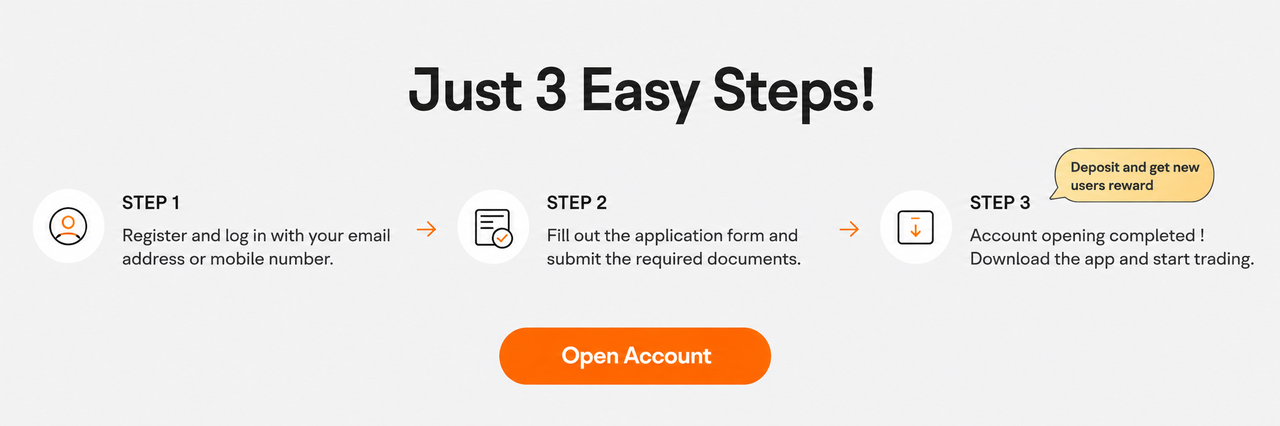
Step 1: Open and verify your account via moomoo
Sign up via the moomoo app or visit the Moomoo Australia website and complete identity verification. Ensure you comply with any necessary identification requirements.
Step 2: Fund your account
Deposit funds into your account using methods like bank transfers, debit cards, or other accepted payment options.
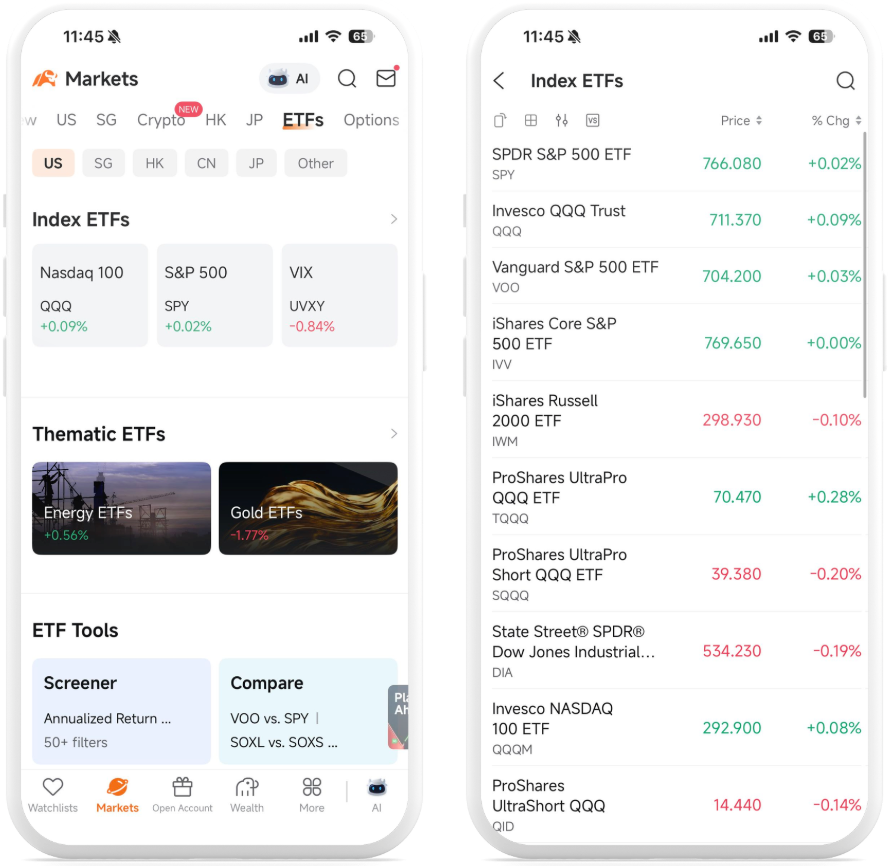
Step 3: Research index ETFs
Use moomoo’s ETF section to explore funds tracking indices such as the S&P 500, Nasdaq 100 and S&P/ASX 300. Compare each ETF’s underlying index, holdings, management costs, historical performance and risks before making a decision. Diversification varies by fund, and neither returns nor protection against market losses are guaranteed.
Step 4: Know what you are buying
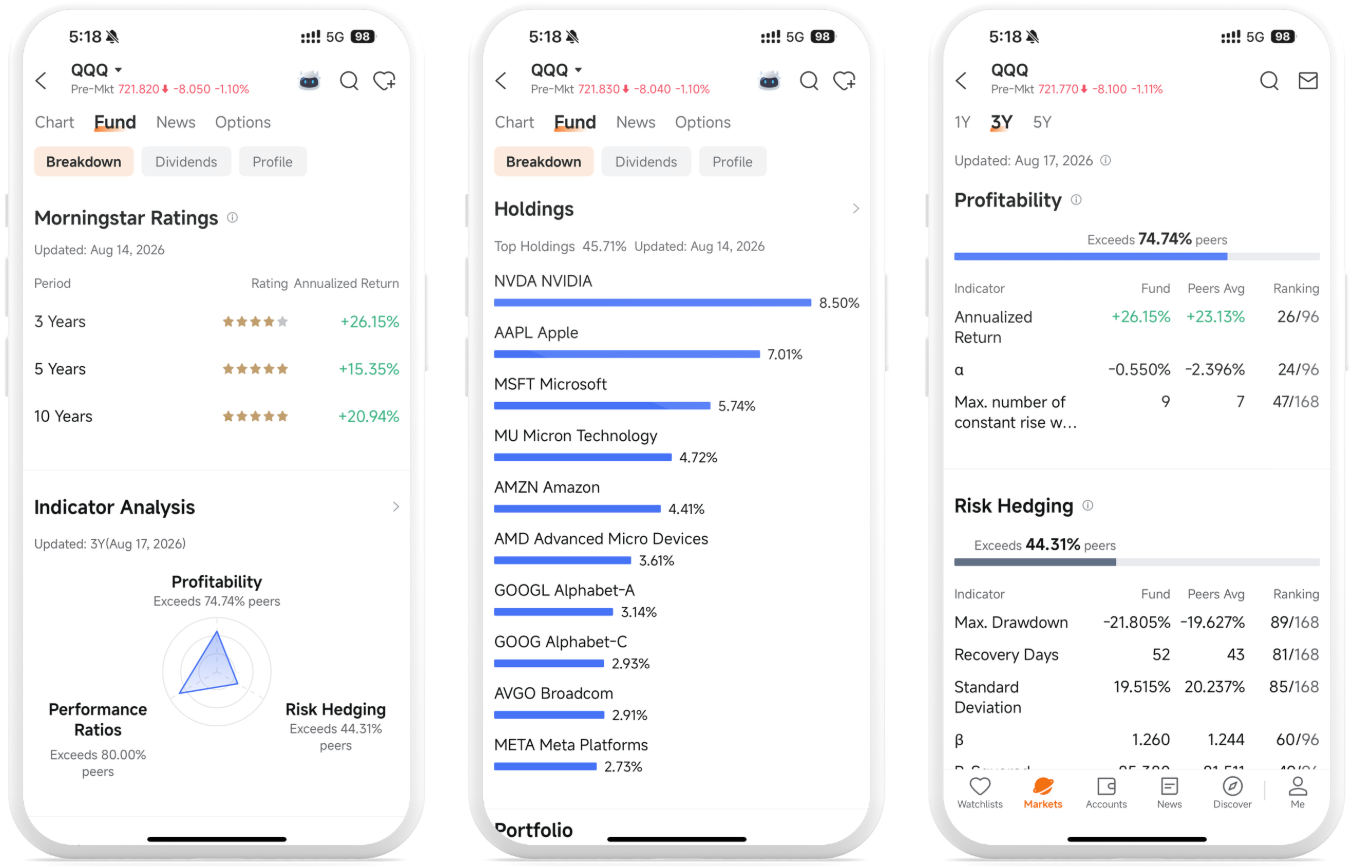
After shortlisting an ETF, review what it holds, how it is structured and the risks involved before investing. Moomoo users can access these ETF research features in the app at no additional subscription cost:
Morningstar Ratings: Use independent Morningstar ratings to sort and compare eligible ETFs.
Holdings: Review top holdings, sector allocations, portfolio weights, fees and tracking performance.
Indicator Analysis: Use radar charts to compare performance, valuation and risk metrics across a broad range of ETFs.
*Ratings and analytical tools are for reference only and do not constitute investment advice.
Step 5: Place your order
Use the platform to buy your selected ETF. Depending on your trading strategy, you can choose from market, limit, and stop orders, as well as 12 other advanced order types.
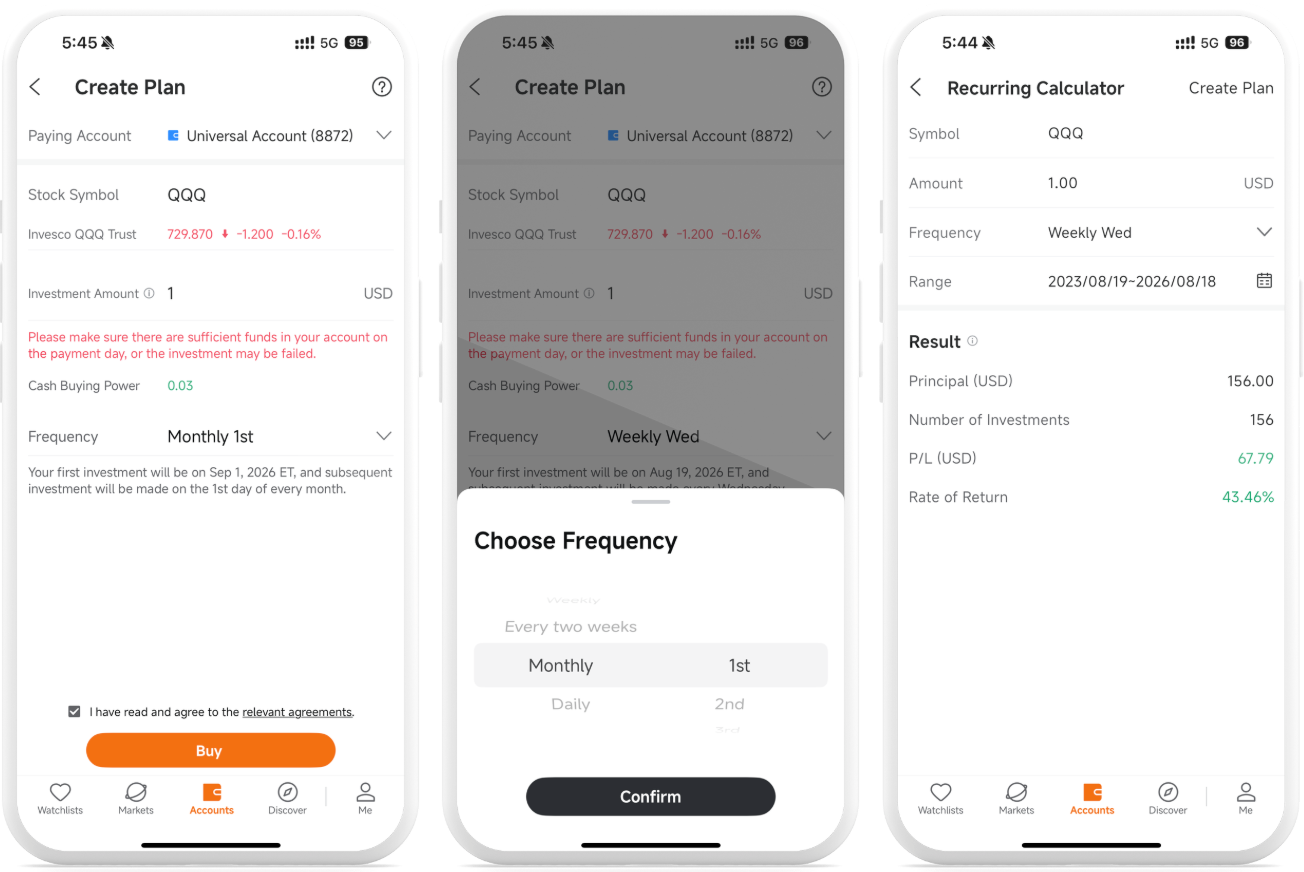
Step 6: Plan a recurring investment
For investors who are uncertain about market timing or prefer not to invest a lump sum at once, recurring investment can reduce timing-related decisions by spreading purchases over time.
Use moomoo’s Recurring Calculator to test different amounts and schedules using historical data. After reviewing the simulated results, you can create a recurring plan for an eligible ETF in the app.
Recurring investment does not reduce all investment risks or protect against losses. Calculator results are hypothetical and do not predict future performance.
Download the moomoo app to explore more than 4400 ETFs across Australian and US markets. You can compare fund data and holdings using ETF research tools and Moomoo AI, and set up recurring investments for eligible ETFs. Fees, minimum investment amounts and other requirements may apply.
Frequently asked questions
1. Why invest in index funds?
Index funds provide exposure to a market or asset class by tracking a specified index. They generally require less portfolio maintenance and may charge lower management fees than comparable actively managed funds. Holding multiple securities can reduce company-specific concentration risk, but index funds remain exposed to market movements and may lose value.
2. Are index funds a good investment for beginners?
Index funds may be worth considering for beginners because they provide exposure to multiple securities without requiring investors to select each holding individually. However, they are not necessarily low-risk. Their risk level depends on the underlying index, asset class, market exposure and currency treatment. Beginners should review the fund’s PDS, fees and risks before investing.
3. What is the best Australian index fund?
There is no single best Australian index fund. When comparing similar funds, investors can consider the index tracked, management fees and costs, fund size, liquidity, tracking difference and portfolio holdings. Larger AUM may support liquidity and fund viability, but it does not guarantee better performance or suitability.
4. Are index funds the same as ETFs?
No. An index fund is defined by its investment strategy, while an ETF is defined by how it is structured and traded. An index fund may be offered as an ASX-listed ETF or as an unlisted managed fund. ETFs trade on an exchange throughout the trading day, while managed index funds are generally purchased or redeemed through the fund provider at a calculated unit price. Not all ETFs track an index; some are actively managed.
5. Do index ETFs pay dividends?
Many equity ETFs make distributions, but the amount and frequency vary. Distributions may include dividends, interest, realised capital gains and franking credits, and are not guaranteed. Before investing, research the ETF’s distribution policy, history, fees and tax implications, and review its latest PDS.
6. What are the potential benefits of Australian index funds?
Australian index funds may offer several features:
Lower costs: Passive index funds often charge lower management fees than comparable actively managed funds.
Diversification: A broad-market fund can spread exposure across multiple companies and sectors, reducing reliance on individual stocks.
Transparency: You can review the index methodology, holdings and fees.
Accessibility: ASX-listed index ETFs can be traded through a broker during market hours.
Lower maintenance: The fund adjusts its portfolio when the underlying index changes.
Distributions: Some Australian equity index funds make distributions that may include franked income.
These features vary by fund. Index funds remain exposed to market, concentration, liquidity and other investment risks.
7. Should I invest in index ETF or a managed fund?
The choice depends on the product’s structure, strategy, costs and how the investor wants to transact.
Index ETFs trade on an exchange throughout the trading day. Investors should consider brokerage, bid–ask spreads, management costs and market liquidity. Managed funds are generally purchased or redeemed through the fund provider at a calculated unit price and may have different minimum investment, fee and transaction requirements.
A managed fund can be either passive or actively managed, while an ETF can also use an index-tracking or active strategy. Active funds aim to outperform a benchmark but may charge higher fees, and outperformance is not guaranteed.
Compare the investment strategy, underlying assets, total costs, liquidity, tax circumstances and PDS rather than choosing solely on whether the product is an ETF or managed fund.
Final thoughts
The most useful ETF is the one that fills a defined role in your portfolio at an acceptable cost and risk level. Broad funds such as A200, VAS, IVV and VGS can serve as core holdings, while NDQ and QUAL provide more concentrated tilts. VDHG and VDGR prioritise simplicity, and VAF or VBND can add defensive exposure.
Compare what each ETF owns before comparing its recent return. Past performance does not predict future results.
This content is general information only and does not consider your objectives, financial situation or needs. ETF values and distributions can rise or fall. Read the relevant PDS and consider seeking independent financial, tax and legal advice before investing.

This presentation is for informational and educational use only and is not a recommendation or endorsement of any particular investment or investment strategy. Investment information provided in this content is general in nature, strictly for illustrative purposes, and may not be appropriate for all investors. Read more