Opportunities are rising as changes sweep the Australian market

Australian shares finished the first half of 2026 with the S&P/ASX 200 hovering around 8820 – a year-to-date gain of roughly 2.6%. That sits well behind the S&P 500 (+10%) and Nasdaq 100 (+19%) over the same period.
This clear performance gap highlights a structural divergence between the technology-heavy indexes of the United States and the older, resource-and-bank-heavy composition of the Australian sharemarket.
For Australian investors, understanding the underlying drivers of this split is essential for navigating the final six months of the year.
While international markets have ridden a sustained wave of artificial intelligence infrastructure spending and megacap technology earnings growth, the Australian market has been constrained by domestic macroeconomic pressures and shifting commodity dynamics.
Rather than viewing the Australian market’s underperformance as a reason to look away, experienced investors often see it as a signal to transition from passive index exposure toward selective, sector-specific strategies.
Three macroeconomic forces driving Australia
Three distinct forces are converging to shape the investment landscape for the remainder of the year. These forces include a prolonged period of restrictive monetary policy, a stark decoupling within the commodities complex, and a significant proposed shift in domestic tax policy that could fundamentally alter how retail portfolios are structured.
A hawkish Reserve Bank
Monetary policy remains one of the primary anchors on domestic equity valuations. The Reserve Bank of Australia has maintained a notably hawkish stance compared to many of its global peers, having delivered 75 basis points of interest rate hikes since January. This tightening cycle has been driven by stubborn underlying inflation, particularly within the services sector and domestic insurance, utilities, and rent categories.
While markets globally have spent much of the year anticipating or adjusting to interest rate cuts from the US Federal Reserve, local users have had to contend with a central bank focused on draining excess liquidity from the domestic economy. Higher interest rates exert a dual pressure on the sharemarket.
First, they raise the discount rate applied to future corporate earnings, compressing price-to-earnings multiples across the board.
Second, they place a direct strain on highly leveraged consumer and corporate balance sheets, slowing discretionary spending and increasing the cost of debt servicing. Until the central bank observes a sustained retracement in core inflation toward its target band, monetary policy is likely to remain restrictive, capping broad index expansions.
2. Commodity dispersion
Australia’s resources sector is no longer moving as a monolithic block. Instead, a deep structural dispersion is occurring across different resource types. Iron ore, historically the engine of Australian corporate profits and dividend generation, is facing clear structural supply pressure. The primary driver is the accelerating development of the Simandou project in Guinea, which is poised to introduce high-grade iron ore supply into a global market already balancing moderating demand from traditional industrial sectors.
In contrast, copper and uranium are benefiting from strong structural demand themes that are insulated from short-term economic cycles. Copper remains the critical physical link in global electrification, renewable energy generation, and the massive power networks required to support artificial intelligence data centres. Uranium is experiencing a multi-year renaissance as global policy shifts decisively back toward nuclear energy to secure stable, emissions-free baseload power.
Meanwhile, the gold sector presents a more nuanced picture. While long-term buying from central banks around the world remains exceptionally firm, near-term sentiment among institutional brokers has turned more cautious. Easing concerns regarding global central bank independence and shifting macroeconomic expectations have led to tactical target downward revisions, creating a two-speed narrative between long-term physical asset support and short-term paper market pricing.
3. Tax-driven rotation
The third major force shaping the Australian market is investor reaction to capital gains tax changes that will come into effect on July 1, 2027. Over the next year investors will prepare for a new tax regime that could lift the effective rate by roughly 40% for certain asset classes and structures.
When the effective tax rate on capital growth increases, the relative value of regular, reliable income-stream income improves on an after-tax basis. In Australia, this effect is magnified by the unique nature of the dividend franking system. Fully franked dividends allow users to receive a tax credit for corporate tax already paid by the company. Under this new tax framework, large companies with heavy physical assets that generate consistent, franked income streams screen significantly better than growth-oriented entities that rely almost entirely on capital appreciation. This creates a strong structural incentive for a sector rotation away from high-multiple growth stocks and toward mature cash-generating businesses.

What the market consensus actually sees
To build a balanced view of the next six months, it is helpful to contrast top-down macroeconomic factors with bottom-up institutional data. Bloomberg's bottom-up aggregation of analyst targets puts the 12-month aggregated price target of the ASX 200 at 9271. This implies a modest 5.1% upside from the mid-year level of 8820. The broader institutional coverage breakdown remains generally constructive, sitting at 56% ‘buy’ ratings, 40% ‘hold’ ratings, and just 3% ‘sell’ ratings across the constituents of the index.
From a top-down valuation perspective, the index sits at a last-12-month price-to-earnings multiple of 21.8 times. This is slightly elevated compared to the rolling six-month average of 21.6 times, indicating that equities are not structurally cheap on a historical basis. When we apply mean-reversion mathematics against forward corporate earnings expectations, the data points to a 12-month implied range of around 10,000 to 11,400 across both price-to-earnings and price-to-book value statistical bands.
Taken together, these data points suggest a single-digit-return year for the broad index. Because the S&P/ASX 200 is heavily weighted toward specific large-cap iron ore miners and traditional financial institutions, a flat or slowly grinding index performance hides significant underlying opportunities. The case for precise sector selection and active portfolio structure over passive index tracking is stronger than it has been in several market cycles.
Three sectors with forward logic
Energy
The investment thesis for Australia’s energy sector combines immediate geopolitical realities with long-term structural supply limits. The Strait of Hormuz remains the critical swing variable for global oil and gas pricing as the northern hemisphere approaches high-demand winter in a few months. Any supply disruption or heightened tension in this key maritime corridor introduces an immediate geopolitical premium to energy assets, benefiting geographically insulated producers such as those in Australia.
On a structural level, upstream capital expenditure for domestic liquefied natural gas projects has been exceptionally light for more than a decade. Much of this under-investment stems from ongoing environmental, social, and governance pressures, along with complex domestic regulatory approval processes. While this has limited the volume of new supply entering the market, it has kept the global supply-and-demand balance tight, supporting structurally elevated pricing.
Furthermore, the capital gains tax reforms add an attractive tactical angle to the sector. Large, mature energy companies combine heavy physical infrastructure assets with a history of returning capital via franked dividends. Under the proposed tax changes, these characteristics make the sector highly resilient.
Key large-cap stocks in this space include Woodside Energy, Santos, Origin Energy, and Ampol. Key catalysts to monitor in the second half of the year include the OPEC+ meeting in November, progress updates on Woodside's Pluto Train 2 development, and the operational start-up of Santos's Barossa project.
2. Materials
Within the materials space, investors’ key strategy involves screening out pure-play iron ore exposure in favour of commodities backed by long-term structural demand.
Copper sits directly at the centre of the global transition toward electrification and the expansion of digital infrastructure. The sheer volume of copper required to construct artificial intelligence data centres, upgrade traditional electrical grids, and manufacture electric vehicle drivetrains is substantial. Major miners like BHP and Rio Tinto rely heavily on their expanding copper portfolios to support their valuation premiums over pure iron ore miners. This valuation gap is expected to widen as new supply from the Simandou project begins to weigh on the global iron ore spot price moving into 2027.
Uranium provides a parallel structural demand story. Throughout 2025 and into 2026, global nuclear energy policy has shifted decisively across multiple major economies. Governments are actively extending the operational lifespans of existing reactors, committing to large-scale new-build projects, and providing direct financial backing for small modular reactor programs. This policy turnaround is being accelerated by the immense, stable power demands of hyperscale data centres, which require continuous, carbon-free baseload generation. Because global uranium mine supply has been slow to react after more than a decade of structural underinvestment, the physical uranium market remains exceptionally tight, according to data from the World Nuclear Association.
Conversely, institutional sentiment regarding gold has adjusted. Goldman Sachs reduced its end-2026 gold target by US$500 to US$4900 per ounce, pointing to reduced anxieties over global central bank independence. Citigroup also lowered its short-term three-month target from US$4300 to US$4000 per ounce, citing a potential stalemate in key shipping corridors and high energy prices that could keep central bank interest rates higher for longer. However, long-term structural support remains highly visible. The World Gold Council and YouGov's annual survey of 74 central banks revealed that 45% of respondents plan to expand their gold reserves over the next 12 months – the highest percentage recorded since the survey began in 2018.
Key stocks
Copper: BHP, Rio Tinto, Sandfire Resources
Uranium: Paladin Energy, Boss Energy, Deep Yellow
Gold: Newmont, Northern Star, Evolution Mining
3. Financials
The Australian financial sector presents a distinct risk-reward profile for the second half of the year. Comprehensive industry analysis from KPMG covering the major banks' half-year results for the 2026 financial year showed that net interest margins have finally stabilised across the big four banking institutions. This stabilisation removes a significant, recurring earnings risk that had previously weighed on the sector as funding costs rose.
Beyond core operations, the domestic dividend franking system becomes highly relevant under the new capital gains tax changes. As the effective tax rate on capital appreciation increases, the immediate, tangible value of fully franked dividend yields increases on a relative basis. Because the major Australian banks are among the largest generators of franked dividends in the global financial system, their ability to distribute these tax credits makes them a core defensive pillar for income-seeking portfolios.
Discrete corporate catalysts are also visible for the remainder of the year. These include the potential retail sale process for HSBC Bank Australia and the ongoing delivery of cost and operational synergies from the ANZ–Suncorp merger.
The largest financial institutions by market capitalisation helping to anchor this theme include Commonwealth Bank of Australia, Westpac, National Australia Bank, ANZ Bank, and Macquarie Group.
The HALO and franking lens
Given this macroeconomic backdrop, a useful framework for the second half of the year centers on the HALO theme – heavy assets, low obsolescence – coupled with an intentional focus on sustainable, franked income streams.
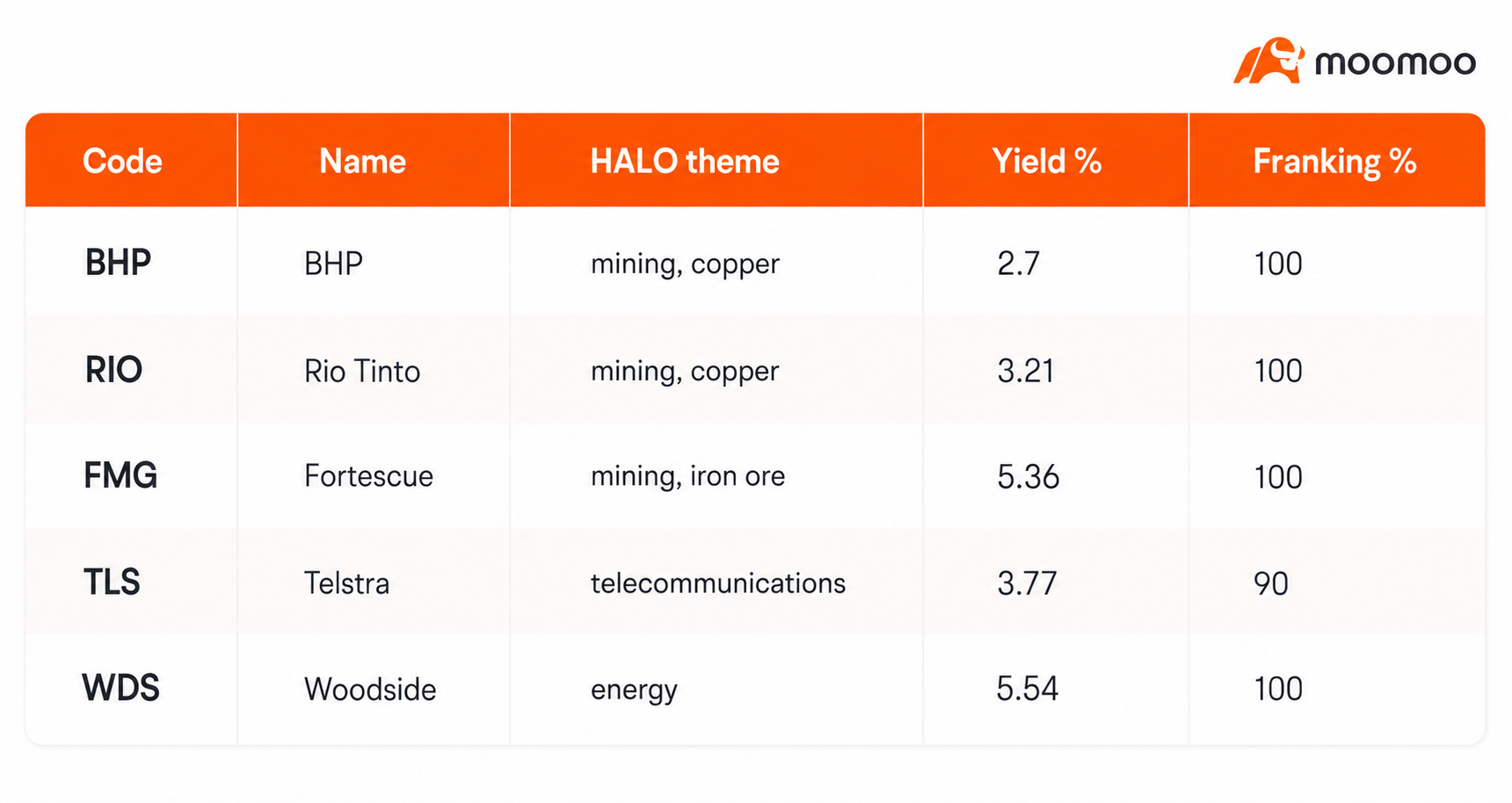
Screen data: Selected S&P/ASX 50 companies demonstrating heavy physical asset footprints and consistent domestic franked dividends, arranged by market capitalisation as of June 2026. Yield numbers reflect trailing 12-month data.*
For users who prefer diversified, broad-based exposure rather than selecting individual corporate equities, high-dividend exchange-traded funds offer an alternative pathway. These diversified funds align closely with the same after-tax logic driven by the proposed capital gains tax adjustments. The leading options in the domestic market, arranged by total assets under management, include:
VHY – Vanguard Australian Shares High Yield ETF
SYI – SPDR MSCI Australia Select High Dividend Yield Fund
IHD – iShares S&P/ASX Dividend Opportunities ETF.
Ultimately, the divergence between the Australian sharemarket and its international counterparts underscores the importance of a deliberate investment strategy. By focusing on sectors with clear structural tailwinds, understanding the impact of shifting domestic tax parameters, and using established analytical frameworks, users can position their portfolios to navigate a lower-growth index environment with clarity and confidence.
Marina Feng is market analyst and reporter for moomoo.
This presentation is for informational and educational use only and is not a recommendation or endorsement of any particular investment or investment strategy. Investment information provided in this content is general in nature, strictly for illustrative purposes, and may not be appropriate for all investors. Read more