Price-to-Earnings (P/E) Ratio
The price-to-earnings ratio indicates the company's value and helps compare the current share price and earnings per share. It is also known as earnings multiple and price multiple.
Analysts and investors use P/E ratios to assess the comparative value of a company's shares in an apples-to-apples comparison. P/E can be assessed based on the forward basis or trailing basis.
How to Calculate P/E Ratio?
To calculate the P/E ratio, divide the current stock price by the earnings per share to find the P/E value. You can find the current stock price by entering a stock's ticker symbol into any finance website.
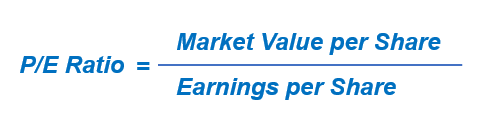
There're two main varieties of earnings per share (EPS). TTM is a Wall Street acronym for "Trailing 12 Months". It indicates how the company has performed in the previous 12 months. The 2nd type of EPS could be seen in an organization's earning report. It indicates the future estimated earnings of the company. These various EPS versions are the foundation for the trailing and forward P/E ratios.
Understanding the P/E Ratio
One of the most popular methods for analysts and investors to estimate a stock's relative value is the price-to-earnings ratio (P/E). A stock's P/E ratio can be used to assess whether it is undervalued or overvalued. The P/E ratio of a firm can also be compared to other stocks in the same sector or a broader market, such as the S&P 500 Index.
Occasionally, analysts interested in long-term valuation patterns will consider the P/E 10 or P/E 30 metrics. The P/E 10 averages the last 10 years of earnings, and P/E 30 estimates the last 30 years of earnings. These longer-term measurements can account for fluctuations in the business cycle, which is why they are frequently used to determine the overall value of stock indices, such as the S&P 500.
Forward Price-to-Earnings
The two most common types of P/E ratios are:
● Trailing P/E
● Forward P/E
Another variation of the P/E also exists that takes the last two actual quarters and adds them to determine the next two quarters.
Forward P/E doesn't use trailing figures. Instead, it uses future earnings guidance known as the estimated price to earnings. It helps compare the current and future earnings to clearly describe unmodified earnings.
However, the forward P/E metric has many limitations. For instance, companies may miscalculate the earnings to beat the estimated P/E. On the other hand, overestimation is also a problem. Additionally, estimates from external experts could differ from those made by the corporation, which could be confusing.
Trailing Price-to-Earnings
The trailing P/E can be obtained by dividing the current share price by total EPS earnings in the past 12 months. It depends on past performance. The reason behind its popularity is its objectivity and accurate earning assumption. However, trailing also has some limitations, such as not predicting future behavior from past performance.
Investors shouldn't rely on the previous earning power. Instead, they should focus on the future earning power to make final decisions. Another problem is the constant nature of the EPS number on the fluctuation of stock prices. For instance, trailing P/E is less reflective of the changes if a major company event causes it.
The trailing P/E ratio will fluctuate along with the price of a company's shares because earnings are only reported once a quarter, but stocks are traded continuously. Therefore, some investors prefer forward P/E. A lower P/E ratio than a trailing P/E ratio indicates that earnings are expected to increase. On the other hand, a higher forward P/E value than the current P/E ratio indicates that earnings are expected to decrease.
Valuation From P/E
One of the most popular stock research methods investors and analysts use to determine stock valuation is the price-to-earnings ratio or P/E. The P/E ratio can demonstrate how a firm's valuation compares to its industry group or a benchmark like the S&P 500 Index, in addition to indicating if a company's stock price is undervalued or overvalued.
The price-to-earnings ratio tells investors how much money they need to put into a firm to get $1 of earnings from that company. Since P/E indicates the amount investors are willing to pay for 1 dollar, it is also known as price multiple. For instance, if a company is trading at a P/E multiple of 20x, it indicates that investors can pay up to $20 per dollar earning.
The P/E ratio aids investors in estimating a stock's market value in relation to its earnings. In a nutshell, the P/E ratio uses past and future earnings to estimate how much the market is willing to pay for a particular stock. A high P/E may indicate a stock's price is excessively high in relation to its earnings. On the other hand, a low P/E can suggest that the current stock price is undervalued compared to earnings.
Why Is the P/E Ratio Important?
Investors can use the P/E ratio to determine whether a company's stock is overvalued or undervalued relative to its earnings. The ratio measures how much the market can pay for the company's existing activities and its potential for future growth. For instance, if a company trades at a higher P/E, the market will be willing to pay high based on the higher growth potential and potential future earnings.
Limitations of Using the P/E Ratio
Like many other indicators, P/E also has some limitations. It is important to understand these limitations because investors often consider only one metric enough to make investment decisions.
Calculating a company's P/E might be difficult for unprofitable businesses with no earnings or negative earnings per share. The best way to handle this is up for debate. The majority claim that the P/E doesn't exist (N/A or unavailable) until a company becomes profitable for comparison purposes. Some claim a negative P/E, while others assign a P/E of 0.
Comparison of the P/E ratios of different companies indicates another major limitation. Growth rates and valuations of companies vary based on the way and timeframe of making money.
As a result, P/E should only be used when comparing companies in the same industry. It may be able to help investors to determine the superior investment, but this conclusion may not always be reliable.
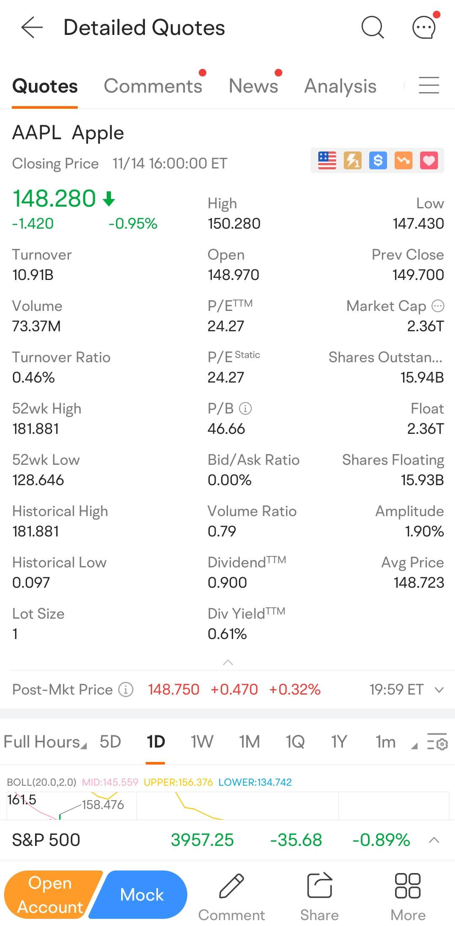
Moomoo trading app will provide investors with a comprehensive overview of individual stocks, like price-to-earnings (P/E), price-to-book (P/B), market cap, volume, and more. Sign up and download the moomoo app today to get free access to the latest stock market quotes.
This presentation is for informational and educational use only and is not a recommendation or endorsement of any particular investment or investment strategy. Investment information provided in this content is general in nature, strictly for illustrative purposes, and may not be appropriate for all investors. Read more
Recommend

How to Invest MyDCD IPO Malaysia 2026
SpaceX IPO 2026: How to Invest in SpaceX in Malaysia
Top 7 Dividend ETFs for Malaysian Investors 2026

How to Invest Stratus Global IPO Malaysia 2026
How to Invest in SkyeChip IPO in Malaysia 2026
Top 10 Features of Stock Brokers in Malaysia
How to Invest in Sunway Healthcare in Malaysia 2026
Cara Melanggan IPO Empire Sushi (5351): Panduan Lengkap
Top 7 S&P 500 ETFs Malaysian Investors
Top 9 Semiconductor ETFs Malaysia 2026
Top 8 Gold ETFs in Malaysia for 2026
Moomoo vs Robinhood: Which Platform for Malaysian Investors
Top 8 Inverse ETFs Malaysia 2026
Moomoo Scams Alert: The Official Anti-Fraud Guide in Malaysia
Top 9 Index ETFs Malaysia 2026
Top 10 Technology ETFs in Malaysia for 2026
Safe Investing in Malaysia: Moomoo MY Statement
Is Moomoo Safe in Malaysia
Top 8 Artificial Intelligence Stocks for Malaysian Investors
Invest in 99 Speedmart Share in Malaysia: A Complete Guide
Top 6 Semiconductor Stocks for Malaysian Investors in 2024
Top Investment Strategies for Banking Sector in Bursa Malaysia
How to Buy Tesla Stock in Malaysia
Top 4 Copper ETFs Malaysia 2026
How to Buy IPO Stocks in Malaysia
Top 7 Sectors in the US Stock Market for Malaysian Investors
Top 10 US Penny Stocks for Malaysian Investors
Popular China Stocks for Malaysia Investors to Buy
Top 10 High Dividend Stocks Malaysia 2026
What Is A Recession?
How to Buy Money Market Funds in Malaysia
How to Buy Stock in Malaysia 2026
Top 10 US Healthcare Stocks for Malaysian Investors 2024
Top 5 Malaysia Dividend Stocks in 2026
How to Invest in Startups Before IPO in Malaysia
Top 7 Leveraged ETFs to Invest in Malaysia
Top 8 Currency ETFs Malaysia 2026
How to Invest in Anthropic IPO Malaysia 2026
Moomoo Malaysia vs M+ Global: Which Platform to Choose
What is a Bond and How to Buy U.S. Treasury Bond?
How to Invest in Foodie Media IPO in Malaysia?
Mutual Funds vs Money Market Funds: Which to Invest in Malaysia
Moomoo Malaysia Brokerage Fees and Pricing
What is Thematic Investing?
Malaysia Data Center: Beneficial Sectors and Stocks
Is Moomoo Legal in Malaysia
8 Benefits of Using Paper Trading Apps for Malaysian Traders
Margin Trading: Guide and Strategy for Malaysian Investors
Top Fixed Deposit Rates in Malaysia 2024
Trading App Moomoo: Download and Guide
Top 8 Benefits of Using Moomoo Malaysia as a Stock Broker
Top 10 US Technology Stocks for Malaysian Investors 2026
US-Listed Chinese Stocks Surge on Policy Boost: Who is Leading the Charge?
China-Linked Stocks Surge Amid Strong Policy Stimulus: Wall Street Says, “This Time Is Different!”
How Much Room is There for Valuation Recovery in China-Linked Stocks?
Top 8 Consumer Products and Services Companies in Malaysia 2024
Top 8 Tips for Using Paper Trading for Bursa Malaysia Investors
Top 10 Real Estate Investment Trusts Companies in Malaysia 2024
Top 10 Construction Companies and Stocks in Malaysia 2024
Top 6 Plantation Companies and Stocks in Bursa Malaysia 2025
Special Purpose Acquisition Company and How to Invest
Top 8 Technology Stocks in Malaysia 2024
Top 10 ETFs in Malaysia 2026
How to Choose Your Ideal ETF in Malaysia?
Top 5 Energy Companies and Stocks in Malaysia 2024
What Is Social Trading
How to Use Paper Trading to Test and Help Refine Your Trading Strategy?
Tax Trading Strategies in a Bear Market
6 ETF Concerns That Investors Shouldn’t Overlook
HK Financial Stocks Make a Strong Comeback Amid PBOC Policies & Fed Rate Cuts: Are High-Dividend Inv
How Stock Charting Tools Can Help You
Choosing a Stock Simulator to Practice Stock Trading
Psychological Condition of the Market
What Is SWOT Analysis?
What Is Copy Trading
What Is Working Capital?
What Is the Spot Rate?
Index Funds in Singapore
How to Practice Trading Without Risking Money?
Mutual Funds in Singapore
What Is Mirror Trading?
What Is Revenue?
What Is Trend Analysis?
What Is a Volatility Smile?
What Is Beta in the Stock Market?
What Does It Mean to Have a Certificate of Deposit (CD)?
What Is a Day Order?
Price-to-Earnings (P/E) Ratio
What Is the National Best Bid and Offer (NBBO) in US Equities?
What Are Market Orders?
Using Volume Oscillators to Confirm Price Movements
Forex Trading in Singapore
What Is a Bellwether?
On-Balance Volume (OBV): What Is It?
What Is Historical Volatility (HV)?
Company Earnings and Earnings per Share What Investors Need to Know
Spot Market: What Is It?
Scalping Stock Trading: How Does It Work?
What Is Market Depth?
What Is a Trailing Stop and How to Use It?
Swing Trading vs. Day Trading: What's the Difference?
Will ESG Investing Be The Future Of Investing?
Hedge Funds in Singapore
Build a Low-Risk Portfolio with Blue-Chip Shares in Australia
What Is the Money Flow Index (MFI)?
How to Invest MyDCD IPO Malaysia 2026
SpaceX IPO 2026: How to Invest in SpaceX in Malaysia
Top 7 Dividend ETFs for Malaysian Investors 2026
How to Invest Stratus Global IPO Malaysia 2026
How to Invest in SkyeChip IPO in Malaysia 2026
Top 10 Features of Stock Brokers in Malaysia
How to Invest in Sunway Healthcare in Malaysia 2026
Cara Melanggan IPO Empire Sushi (5351): Panduan Lengkap
Top 7 S&P 500 ETFs Malaysian Investors
Top 9 Semiconductor ETFs Malaysia 2026
Top 8 Gold ETFs in Malaysia for 2026
Moomoo vs Robinhood: Which Platform for Malaysian Investors
Top 8 Inverse ETFs Malaysia 2026
Moomoo Scams Alert: The Official Anti-Fraud Guide in Malaysia
Top 9 Index ETFs Malaysia 2026
Top 10 Technology ETFs in Malaysia for 2026
Safe Investing in Malaysia: Moomoo MY Statement
Is Moomoo Safe in Malaysia
Top 8 Artificial Intelligence Stocks for Malaysian Investors
Invest in 99 Speedmart Share in Malaysia: A Complete Guide
Top 6 Semiconductor Stocks for Malaysian Investors in 2024
Top Investment Strategies for Banking Sector in Bursa Malaysia
How to Buy Tesla Stock in Malaysia
Top 4 Copper ETFs Malaysia 2026
How to Buy IPO Stocks in Malaysia
Top 7 Sectors in the US Stock Market for Malaysian Investors
Top 10 US Penny Stocks for Malaysian Investors
Popular China Stocks for Malaysia Investors to Buy
Top 10 High Dividend Stocks Malaysia 2026
What Is A Recession?
How to Buy Money Market Funds in Malaysia
How to Buy Stock in Malaysia 2026
Top 10 US Healthcare Stocks for Malaysian Investors 2024
Top 5 Malaysia Dividend Stocks in 2026
How to Invest in Startups Before IPO in Malaysia
Top 7 Leveraged ETFs to Invest in Malaysia
Top 8 Currency ETFs Malaysia 2026
How to Invest in Anthropic IPO Malaysia 2026
Moomoo Malaysia vs M+ Global: Which Platform to Choose
What is a Bond and How to Buy U.S. Treasury Bond?
How to Invest in Foodie Media IPO in Malaysia?
Mutual Funds vs Money Market Funds: Which to Invest in Malaysia
Moomoo Malaysia Brokerage Fees and Pricing
What is Thematic Investing?
Malaysia Data Center: Beneficial Sectors and Stocks
Is Moomoo Legal in Malaysia
8 Benefits of Using Paper Trading Apps for Malaysian Traders
Margin Trading: Guide and Strategy for Malaysian Investors
Top Fixed Deposit Rates in Malaysia 2024
Trading App Moomoo: Download and Guide
Top 8 Benefits of Using Moomoo Malaysia as a Stock Broker
Top 10 US Technology Stocks for Malaysian Investors 2026
US-Listed Chinese Stocks Surge on Policy Boost: Who is Leading the Charge?
China-Linked Stocks Surge Amid Strong Policy Stimulus: Wall Street Says, “This Time Is Different!”
How Much Room is There for Valuation Recovery in China-Linked Stocks?
Top 8 Consumer Products and Services Companies in Malaysia 2024
Top 8 Tips for Using Paper Trading for Bursa Malaysia Investors
Top 10 Real Estate Investment Trusts Companies in Malaysia 2024
Top 10 Construction Companies and Stocks in Malaysia 2024
Top 6 Plantation Companies and Stocks in Bursa Malaysia 2025
Special Purpose Acquisition Company and How to Invest
Top 8 Technology Stocks in Malaysia 2024
Top 10 ETFs in Malaysia 2026
How to Choose Your Ideal ETF in Malaysia?
Top 5 Energy Companies and Stocks in Malaysia 2024
What Is Social Trading
How to Use Paper Trading to Test and Help Refine Your Trading Strategy?
Tax Trading Strategies in a Bear Market
6 ETF Concerns That Investors Shouldn’t Overlook
HK Financial Stocks Make a Strong Comeback Amid PBOC Policies & Fed Rate Cuts: Are High-Dividend Inv
How Stock Charting Tools Can Help You
Choosing a Stock Simulator to Practice Stock Trading
Psychological Condition of the Market
What Is SWOT Analysis?
What Is Copy Trading
What Is Working Capital?
What Is the Spot Rate?
Index Funds in Singapore
How to Practice Trading Without Risking Money?
Mutual Funds in Singapore
What Is Mirror Trading?
What Is Revenue?
What Is Trend Analysis?
What Is a Volatility Smile?
What Is Beta in the Stock Market?
What Does It Mean to Have a Certificate of Deposit (CD)?
What Is a Day Order?
Price-to-Earnings (P/E) Ratio
What Is the National Best Bid and Offer (NBBO) in US Equities?
What Are Market Orders?
Using Volume Oscillators to Confirm Price Movements
Forex Trading in Singapore
What Is a Bellwether?
On-Balance Volume (OBV): What Is It?
What Is Historical Volatility (HV)?
Company Earnings and Earnings per Share What Investors Need to Know
Spot Market: What Is It?
Scalping Stock Trading: How Does It Work?
What Is Market Depth?
What Is a Trailing Stop and How to Use It?
Swing Trading vs. Day Trading: What's the Difference?
Will ESG Investing Be The Future Of Investing?
Hedge Funds in Singapore
Build a Low-Risk Portfolio with Blue-Chip Shares in Australia
What Is the Money Flow Index (MFI)?