How to invest in dividend stocks amid rate cut expectations
With the Federal Reserve expected to cut interest rates, dividend stocks are likely to draw more investor attention.
This article explores how to invest in dividend stocks under these conditions.
Can dividend stocks benefit from a Federal Reserve rate cut?
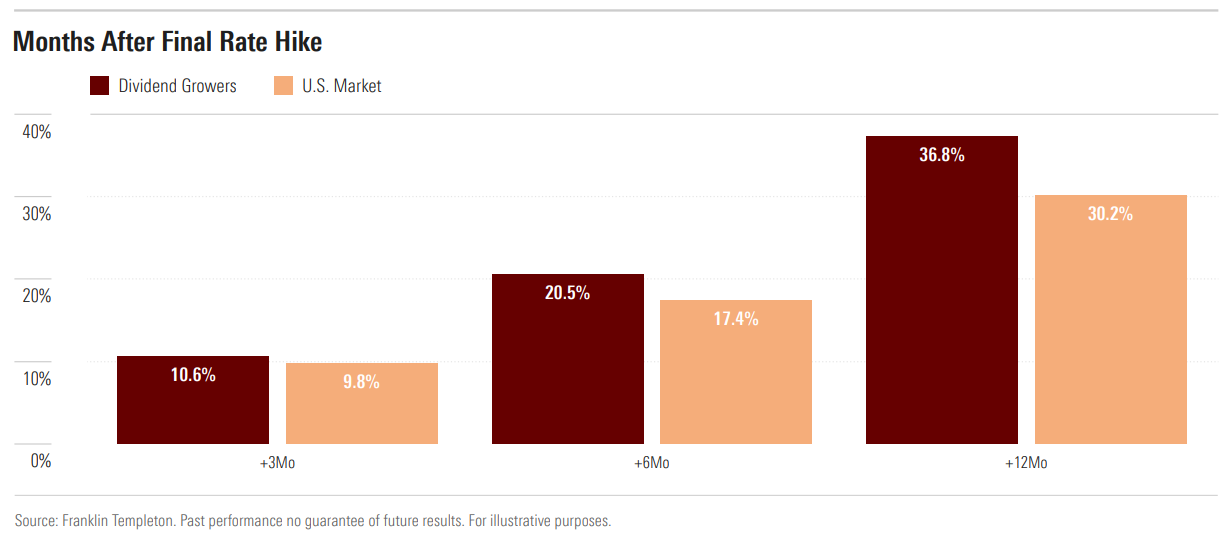
According to Morningstar, during rate cut periods, dividend-paying stocks generally outperform non-dividend-paying stocks. There are two potential reasons for this:
1. Lower interest rates may enhance the appeal of dividend stocks, as some investors rely on dividends as a primary source of income from their stock investments.
2. Dividend stocks tend to perform better during economic recessions, which are often accompanied by rate cuts.
How to select dividend stocks
With so many dividend stocks available, how should investors choose?
Columbia Threadneedle Investments’ research indicates that historically, companies that increase dividends outperform other stocks when the Federal Reserve begins to cut rates.
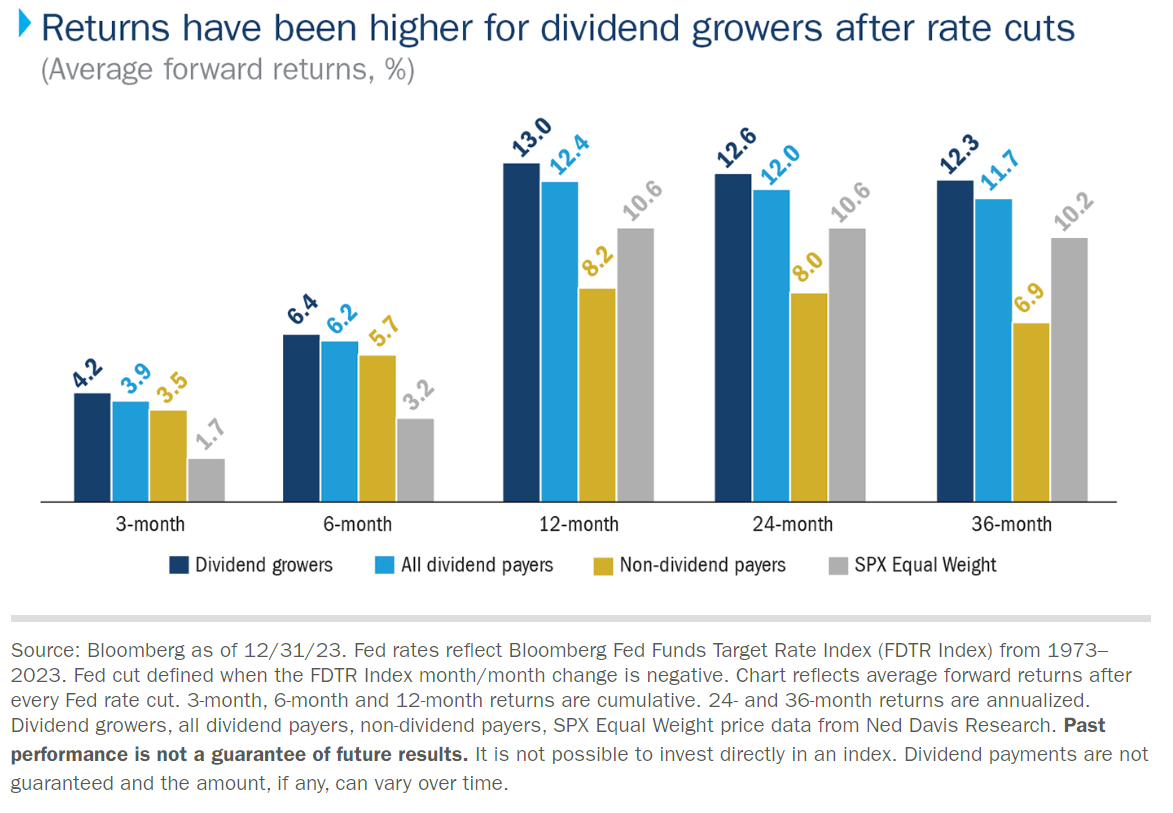
Thus, when selecting dividend stocks, the reliability and growth potential of dividends are crucial factors. In the U.S. stock market, two lists track companies that consistently increase dividends: the Dividend Aristocrats and the Dividend Kings.
Dividend Aristocrats primarily track companies that have increased dividends for 25 consecutive years.
Dividend Kings track companies that have increased dividends for 50 consecutive years.
Companies capable of maintaining and increasing dividends over long periods are rare, typically featuring stable business operations and products or services that are resilient to economic downturns.
2024 Dividend Aristocrats list (ranked by dividend yield)
Becoming a Dividend Aristocrat is not easy, with stringent criteria:
1. The company must be a member of the S&P 500 Index.
2. Constituents must have increased dividend payments every year for at least 25 consecutive years.
3. Market capitalization must exceed US$3 billion.
4. The average daily trading volume over the past 3 months should be at least US$5 million.
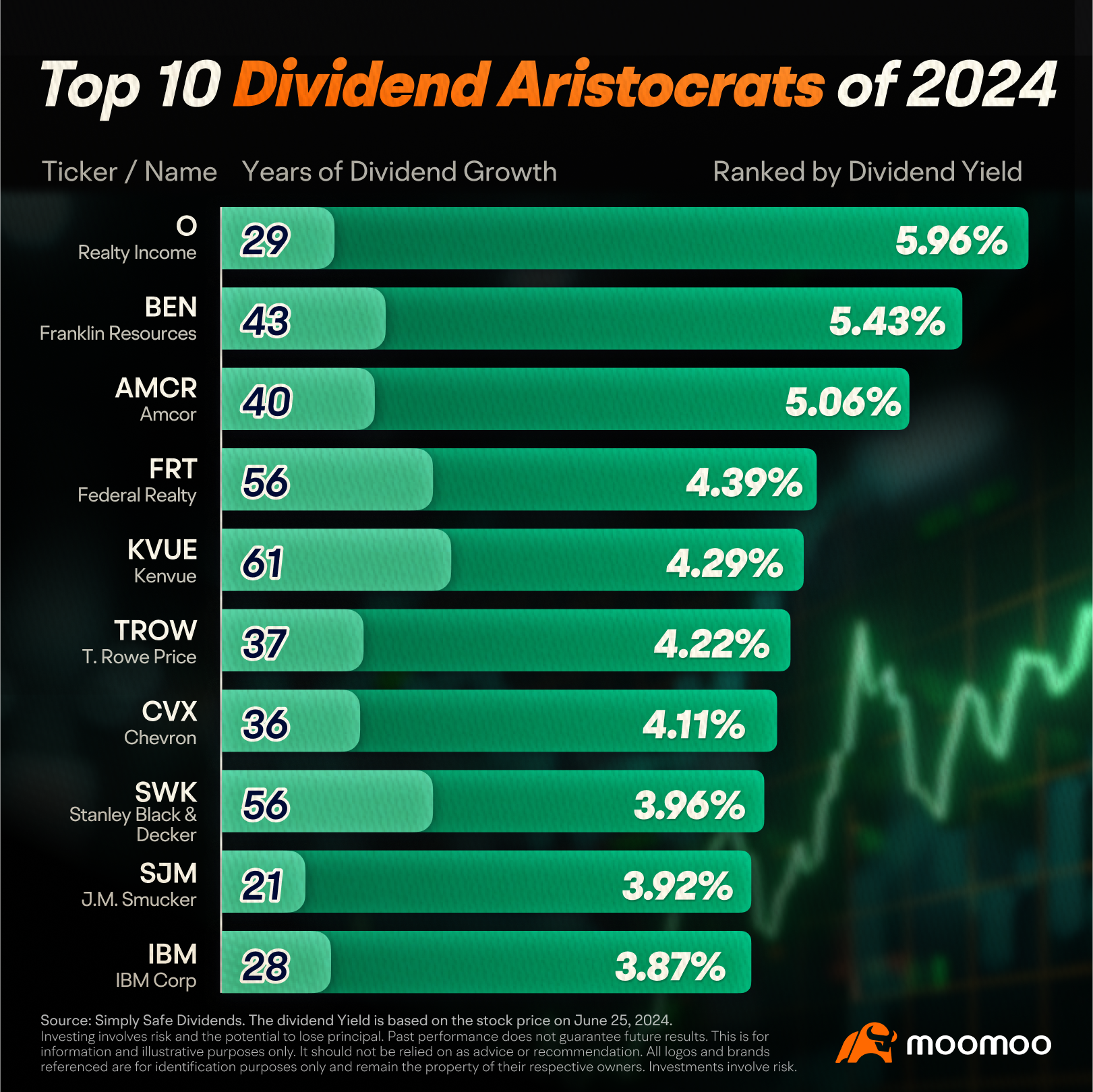
According to Simply Safe Dividends, an online research provider, there are 67 companies on the 2024 Dividend Aristocrats list. Well-known examples include $Coca-Cola(KO.US)$, $McDonald's(MCD.US)$, and$Walmart(WMT.US)$.
Investors can use various metrics, such as dividend yield, to filter noteworthy Dividend Aristocrats.
As of June 25, 2024, the top three Dividend Aristocrats by dividend yield are Realty Income (O) at 5.96%, Franklin Resources (BEN) at 5.43%, and Amcor (AMCR) at 5.06%.
2024 Dividend Kings list (ranked by dividend yield)
Unlike Dividend Aristocrats, Dividend Kings do not need to be S&P 500 components but must have increased dividends for at least 50 consecutive years.
Thus, the Dividend Kings list may overlap with Dividend Aristocrats but includes some high-quality dividend stocks outside the S&P 500.
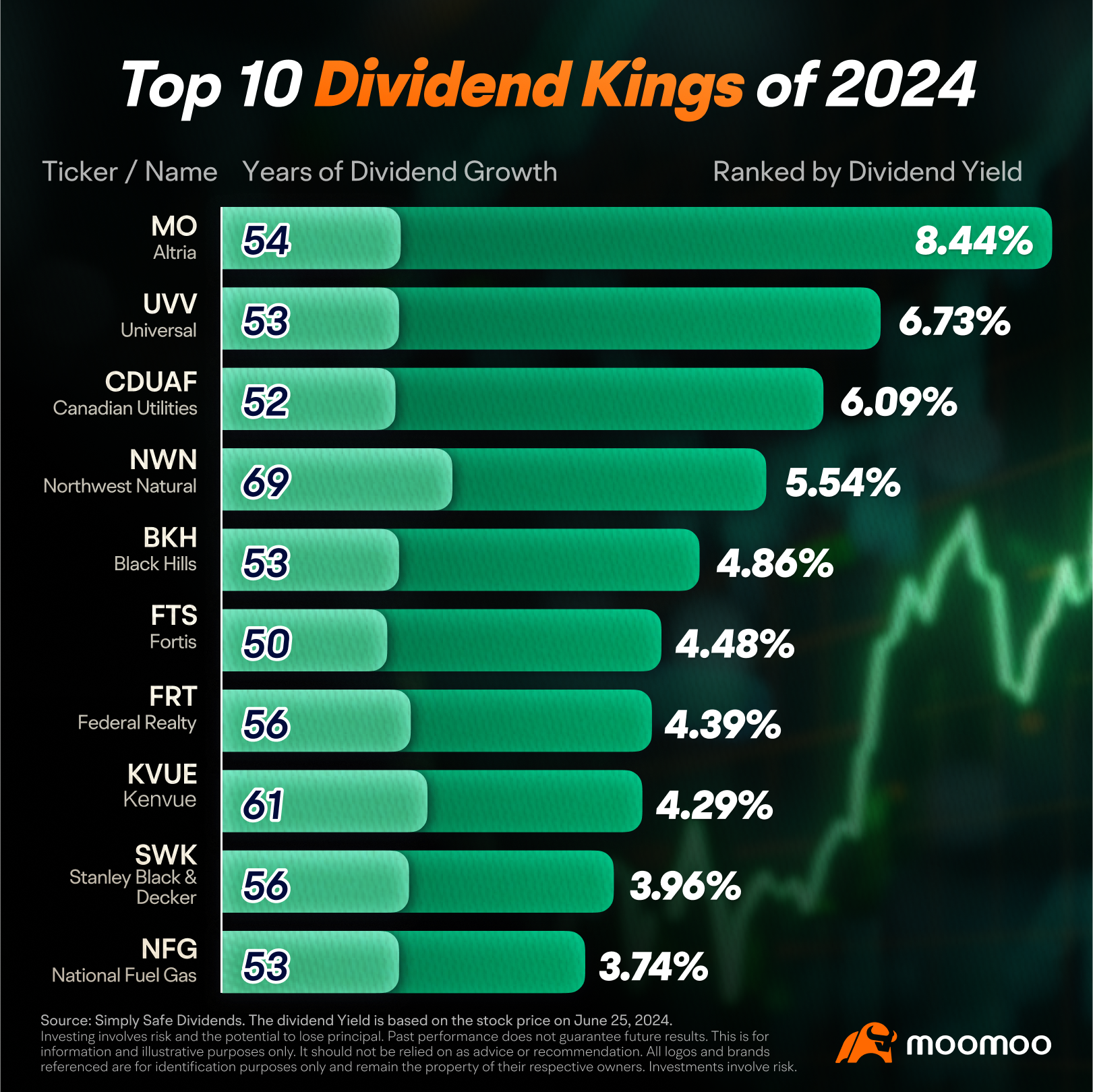
According to Simply Safe Dividends, there are 53 companies on the 2024 Dividend Kings list. The top three by longest consecutive dividend increases are $American States Water(AWR.US)$, $Northwest Natural(NWN.US)$, and $Dover(DOV.US)$, each with at least 68 years of consecutive dividend increases.
Investors can also filter this list by dividend yield. As of June 21, 2024, the top two Dividend Kings by dividend yield are $Altria(MO.US)$ at 8.44% and $Universal Corp(UVV.US)$ at 6.73%.
How to invest in dividend stocks
For investors seeking stable cash flows, the Dividend Aristocrats and Dividend Kings lists offer some choices.
Investors can use indicators like dividend yield to select preferred dividend stocks, though investing in individual stocks carries higher risks. To mitigate risk, investors can consider investing in ETFs that track these indexes rather than individual stocks.
Currently, there are ETFs specifically tracking Dividend Aristocrats, but none for Dividend Kings.
According to the S&P Dow Jones Index website, two ETFs tracking Dividend Aristocrats in the U.S. market are the ProShares S&P 500 Dividend Aristocrats ETF (NOBL) and the FT Cboe Vest S&P 500 Dividend Aristocrats Target Income ETF (KNG).
Pros and cons of dividend stocks
Pros:
Stable Cash Flow: Dividend Aristocrats and Dividend Kings provide stable dividend cash flows regardless of market downturns or economic recessions.
Strong Financial Stability: Maintaining dividend increases for at least 25 years indicates strong financial stability, even under adverse macroeconomic conditions, demonstrates resilience against market volatility.
Cons:
Low Growth: Dividend Aristocrats and Dividend Kings are typically well-established companies with limited growth potential, unlike emerging companies that may offer high growth opportunities.
Risk of Dividend Cuts: There's no guarantee that all companies on the Dividend Aristocrats and Dividend Kings lists will continue to increase dividends in the future. If a company’s performance deteriorates, it may cut dividends and be removed from the list.
Dividend Taxation: Even if you plan to hold stocks long-term to avoid capital gains tax, annual dividend payments are still taxable, which can impact total investment returns and should be considered in investment decisions.
In conclusion, dividend stocks offer a good option for investors seeking reliable dividend income but come with certain limitations. Investors must weigh these pros and cons to ensure alignment with their investment goals and risk tolerance.
Additional Disclosures: This content is also not a research report and is not intended to serve as the basis for any investment decision. The information contained in this article does not purport to be a complete description of the securities, markets, or developments referred to in this material. The information has been obtained from sources considered to be reliable, but we do not guarantee that the foregoing material is accurate or complete. Furthermore, there is no guarantee that any statements, opinions or forecasts provided herein will prove to be correct.
This presentation is for informational and educational use only and is not a recommendation or endorsement of any particular investment or investment strategy. Investment information provided in this content is general in nature, strictly for illustrative purposes, and may not be appropriate for all investors. Read more