How to Buy S&P 500 in Malaysia: A Complete Guide
Why Invest in S&P 500 in Malaysia?
Historical Stability and Diversification; Low-cost Exposure; Long-term Investment
Why Choose Moomoo MY?
 0 Commission*: New users get 6 months of free US stock trading commissions.
![]() One-stop Trading App for S&P 500 Funds/ETFs/Stocks
One-stop Trading App for S&P 500 Funds/ETFs/Stocks
![]() 24 Hours Trading on US Stocks
24 Hours Trading on US Stocks
![]() Exclusive Welcome Rewards for New Users. Click Here to Start Trading Today!
Exclusive Welcome Rewards for New Users. Click Here to Start Trading Today!
Historical Stability and Diversification; Low-cost Exposure; Long-term Investment
Why Choose Moomoo MY?
0 Commission*: New users get 6 months of free US stock trading commissions. One-stop Trading App for S&P 500 Funds/ETFs/Stocks
 24 Hours Trading on US Stocks
 Exclusive Welcome Rewards for New Users. Click Here to Start Trading Today!
The S&P 500 is one of the most highly sought-after stock market indexes, comprising 500 of the largest publicly traded companies in the U.S. For investors in Malaysia seeking to diversify their portfolios and gain exposure to the U.S. equity market, investing in the S&P 500 can be a wise choice.
>> Want to trade S&P 500? Check Commission-free Trading on Moomoo MY!

This guide will provide Malaysian investors with a comprehensive understanding on how to invest in the S&P 500, the benefits of doing so, and strategies for maximizing returns while managing risks. Additionally, we will address frequently asked questions, including whether it is the right time to invest, and why moomoo is a preferred platform for buying S&P 500.
What is the S&P 500 Index?
The S&P 500 is a stock market index that measures the performance of 500 leading companies listed on U.S. stock exchanges. Established in 1957, it is widely regarded as a benchmark for the U.S. equity market and the broader economy. The index includes companies from diverse sectors such as technology, healthcare, and financial services, offering a comprehensive view of the market's performance.
Which Companies are Listed in the S&P 500 Index?
The S&P 500 comprises well-known names like $Apple (AAPL.US)$ , $Microsoft (MSFT.US)$ , and $Amazon (AMZN.US)$ , along with a mix of other large-cap stocks across various industries. These companies are selected based on criteria such as market capitalization, liquidity, and financial performance. The index's composition is periodically adjusted to reflect changes in the market, ensuring that it remains a representative sample of the U.S. economy.
Why Invest in the S&P 500?
Malaysian investors may choose to invest in the S&P 500 for several reasons:
Historical Stability and Diversification: The S&P 500 has demonstrated long-term growth and stability, making it an attractive option for those seeking to invest in the overall health of the U.S. economy.
Market Recovery: The index has shown resilience during market downturns, making it a suitable choice for long-term investors.
Low-Cost Exposure: Investing in the S&P 500 provides exposure to hundreds of large companies without the need for extensive research or individual stock selection.
Ways to Invest in the S&P 500 for Malaysian Investors
Malaysian investors can invest in the S&P 500 through several avenues:
1. S&P 500 Index Funds
An S&P 500 index fund is a mutual fund that mirrors the performance of the index. Investing in an index fund offers instant diversification across all 500 companies. These funds are managed passively, aiming to match the index's performance, and typically have lower fees compared to actively managed funds.
2. S&P 500 ETFs
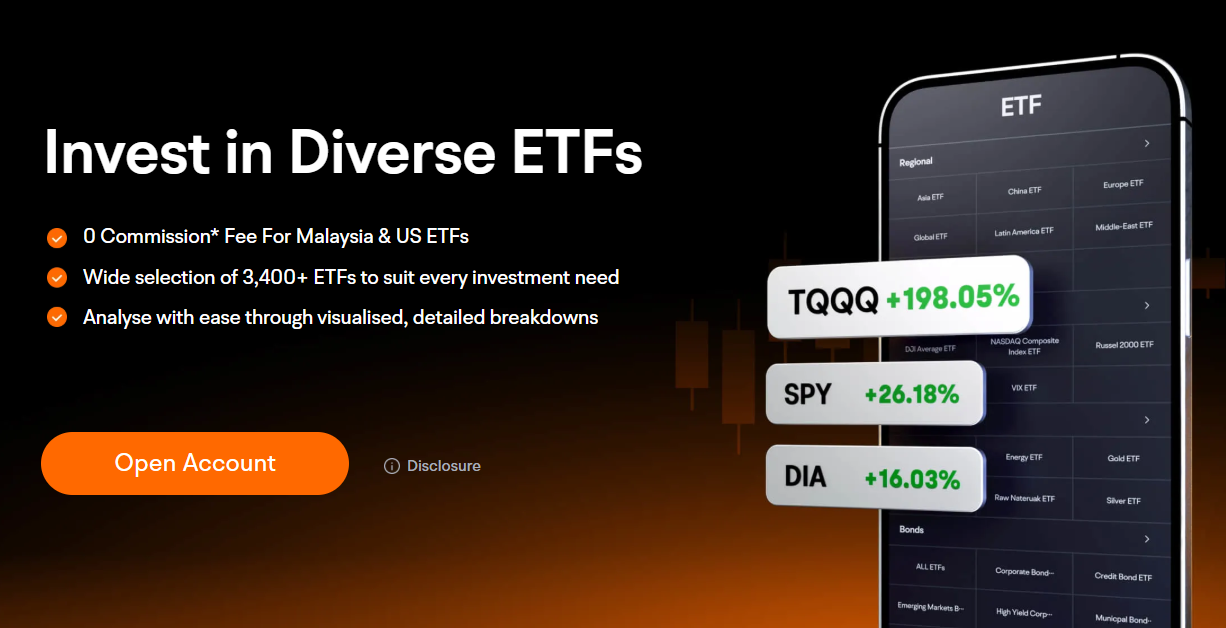
Exchange-traded funds (ETFs) that track the S&P 500 provide similar benefits to index funds but trade on stock exchanges like regular stocks. This allows for greater flexibility, as investors can buy and sell ETFs throughout the day. ETFs often have lower expense ratios and no minimum investment requirements, making them an appealing option for many investors.
3. Individual Stocks
Investing in individual stocks listed on the S&P 500 allows for more targeted investments. However, this approach requires thorough research and carries higher risk, as investors do not benefit from the diversification of the full index. This method is better suited for experienced investors with a higher risk tolerance.
S&P 500 Index Funds and ETFs
Investing in the S&P 500 index can be done through various index funds and ETFs that track the performance of the index. These funds provide investors with a diversified portfolio of the 500 largest publicly traded companies in the US, offering broad exposure to the US stock market. Some popular S&P 500 index funds and ETFs include:
1. Vanguard 500 Index Fund (VFIAX): Known for its low expense ratio and strong performance, this fund is a favorite among investors seeking to invest in the S&P 500.
2. SPDR S&P 500 ETF Trust (SPY): As one of the oldest and most widely traded ETFs, SPY offers liquidity and ease of access to the S&P 500.
3. iShares Core S&P 500 ETF (IVV): This ETF is known for its low costs and efficient tracking of the S&P 500 index.
4. Schwab U.S. Broad Market ETF (SCHB): While not exclusively an S&P 500 ETF, SCHB provides broad market exposure, including the S&P 500, at a very low cost.
These funds offer investors a low-cost and efficient way to invest in the S&P 500 index, with expense ratios ranging from 0.03% to 0.09%. By investing in an S&P 500 index fund or ETF, investors can gain exposure to the performance of the index, which has historically provided strong long-term returns. This approach allows for diversification across a wide range of sectors and companies, reducing the risk associated with investing in individual stocks.
S&P 500 Competitors: A Guide for Malaysian Investors
S&P 500 vs. Dow Jones Industrial Average (DJIA)
The Dow Jones Industrial Average (DJIA) is another well-known U.S. stock market index. The S&P 500 is often favored by institutional investors because it covers more stocks and sectors. The S&P 500 Index is seen as a broader representation of the U.S. stock market. In contrast, the DJIA tracks just 30 large companies and is more popular with individual retail investors.
The S&P 500 uses a "market-cap weighting" system: bigger companies (by market value) have a larger influence on the index. The DJIA, however, is "price-weighted," meaning stocks with higher prices have more impact. Most U.S. indexes use market-cap weighting, making the S&P 500's method more common than the DJIA's.
S&P 500 vs. Nasdaq Index
What is Nasdaq? Nasdaq Index is a global electronic stock trading platform. Many stock market indexes include Nasdaq-listed stocks. For example, a company in the S&P 500 Index might also be part of one or more Nasdaq indexes. This means some stocks are tracked by multiple indexes across different markets.
S&P 500 vs. Russell Indexes
The S&P 500 is part of a group of indexes developed by Standard & Poor's. Like the Russell index family, these indexes are generally market-capitalization-weighted, except when they are explicitly stated to be equal-weighted.
There are two main differences in how the S&P and Russell index families are constructed. Standard & Poor's uses a committee to pick the constituent companies. In contrast, Russell indexes rely on a formula to select which stocks to include. Another difference is that in S&P style indexes, such as growth and value indexes, there is no overlap in the companies included. However, Russell indexes may have the same company appear in both the value and growth style indexes.
S&P 500 vs. Vanguard 500 Fund
The Vanguard 500 Index Fund seeks to match the S&P 500's price and return. It does this by investing all its money into the same stocks in the index, holding each stock in roughly the same proportion as the S&P 500. This approach keeps the fund's performance very close to the index it's designed to follow.
Cost of Investing in the S&P 500
The cost of investing in the S&P 500 varies depending on the chosen method:
Index Funds and ETFs: These typically have low expense ratios, ranging from 0.03% to 0.1% annually. For every $1,000 invested, fees may be as low as $0.30 to $1 per year.
Individual Stocks: Transaction fees or commissions apply when buying individual stocks, which can vary based on the brokerage. It is important to consider these costs, as they can impact overall returns.
Strategies for Investing in the S&P 500
To maximize returns and manage risks, consider the following strategies:
Dollar-Cost Averaging: Invest a fixed amount of money at regular intervals, regardless of market conditions. This approach helps reduce the impact of market volatility.
Buy and Hold: Holding your investment in the S&P 500 over a long period can potentially benefit from the market's overall growth.
Reinvesting Dividends: Many S&P 500 funds or ETFs pay dividends, which can be reinvested to buy more shares, boosting long-term returns.
Risks and Limitations of Investing in the S&P 500
While investing in the S&P 500 index can provide broad diversification and potentially lower risk, there are still risks and limitations to consider. Some of these risks include:
Market Volatility: The S&P 500 index can be subject to significant market fluctuations, which can result in losses for investors. Market downturns can impact the value of your investment, especially in the short term.
Concentration Risk: The S&P 500 index is heavily weighted towards the largest companies in the US, such as Apple, Microsoft, and Amazon. This concentration can result in higher risk if these companies experience significant declines.
Tracking Error: Index funds and ETFs that track the S&P 500 index may experience tracking error, which can result in returns that differ from the index. This discrepancy can be due to various factors, including fund management and operational costs.
Fees and Expenses: While index funds and ETFs can be low-cost, they still charge fees and expenses that can eat into investor returns. It is important to consider these costs when evaluating the potential returns of your investment.
Investors should carefully consider these risks and limitations before investing in the S&P 500 index. It's also important to maintain a long-term perspective and diversify your portfolio across different asset classes to minimize risk. By understanding the potential downsides and preparing for market fluctuations, investors can make more informed decisions and better manage their investment portfolios.
FAQs on S&P 500 in Malaysia
Should I Invest in S&P 500 Now?
The decision to invest in the S&P 500 depends on your individual financial goals, risk tolerance, and investment horizon. The S&P 500 has historically demonstrated long-term growth, making it a suitable choice for those with a long-term investment perspective. However, it is important to conduct thorough research and consider market conditions before making any investment decisions.
Is the S&P 500 a suitable initial investment option?
For some newcomers, the S&P 500 could be a wise starting investment, thanks to its diversification benefits and strong historical track record. It enables investors to gain exposure to a wide array of the market without the need to select specific stocks.
Do S&P 500 exchange-traded funds (ETFs) and index funds distribute dividends?
The majority of S&P 500 ETFs and index funds indeed provide dividends. These dividends originate from the earnings of the companies included in the index, and investors have the option to either reinvest them or receive them as cash.
How can I invest in the S&P 500 without relying on a traditional broker?
Investing in the S&P 500 without a conventional broker is possible through the use of online trading platforms or mobile apps. These tools facilitate direct investments in S&P 500 ETFs or individual stocks with minimal effort. An example of such a platform is moomoo, which offers an intuitive app for buying and selling S&P 500 stocks or ETFs, equipped with various investment management tools.
What has been the average yearly return of the S&P 500 in the last decade?
The S&P 500 has delivered an average annual return of around 10-12% over the past ten years, although this figure is subject to market fluctuations. It's crucial to bear in mind that historical performance is not indicative of future outcomes.
Why Choose moomoo to Buy S&P 500?
Moomoo is a popular investment platform that offers Malaysian investors a seamless and cost-effective way to invest in the S&P 500. Here are several reasons to choose moomoo for buying stocks in Malaysia:
User-Friendly Interface: moomoo's intuitive platform makes it easy for investors to navigate and manage their investments.
Low Fees: The platform offers competitive fees, allowing investors to keep more of their potential returns.
Access to a Wide Range of Products: moomoo provides access to S&P 500 index funds, ETFs, and individual stocks, giving investors the flexibility to choose the investment option that best suits their needs.
Educational Resources: moomoo offers a range of educational resources to help investors make informed decisions and stay up-to-date on market trends.
In conclusion, investing in the S&P 500 can be a valuable addition to a Malaysian investor's portfolio. By understanding the various investment options, associated costs, and strategies for maximizing returns, investors can make informed decisions and potentially benefit from the long-term growth of the U.S. equity market. With moomoo, investors can access the S&P 500 in a user-friendly, cost-effective, and flexible manner.
This presentation is for informational and educational use only and is not a recommendation or endorsement of any particular investment or investment strategy. Investment information provided in this content is general in nature, strictly for illustrative purposes, and may not be appropriate for all investors. Read more