US Election Impacts and Trading Strategies for Malaysian Investors
In a globalised economic system, no country can remain completely outside the world political arena. Especially for investors who are closely tied to global markets, it is critical to understand and anticipate the economic impact of international political events. Among the many international events, the US election is undoubtedly one of the most influential political events.
According to various polls, the outcome of the US election will not only reshape the domestic policy direction of the US, but also trigger a chain reaction globally, with far-reaching impacts on the economies and financial markets of various countries, including Malaysia.
For Malaysian investors, the US election is not just a political event, it is also about their investment decisions and wealth growth. With the US at the centre of the global economy, changes in its policies, trade agreements and foreign relations could have a direct impact on Malaysia's exports, currency value and stock market performance. Therefore, it is particularly important for Malaysian investors to understand the potential impact of the US election and develop trading strategies accordingly.
This article will take an in-depth look at the multiple impacts of the US election on Malaysian investors, analysing how the election results will affect the stock market and currency exchange rates, and how Malaysian investors should adjust their portfolios and trading strategies during this global political cycle. It will also look at how trading platforms like Moomoo MY can be used to maximise return on investment and avoid risk. This article aims to provide Malaysian investors with a comprehensive guide to help them make informed investment decisions during the US election period.
Understanding the US Election
The United States presidential election is a cornerstone of American democracy, a process that has far - reaching implications both domestically and globally. It is a complex and highly-anticipated event that involves multiple procedures and stakeholders. In the following section, we will dissect the intricacies of this crucial process, exploring how it functions and the key elements that determine its outcome.
What is the US Presidential Election?
The US Presidential Election is a pivotal event in American democracy, held every four years on the first Tuesday after the first Monday in November. During this election, citizens of the United States cast their votes to elect the president and vice president. The president serves a four-year term and can be re-elected for one additional term, making a maximum of two terms in office.
The election process is complex and involves the Electoral College, a unique system established by the Founding Fathers. The Electoral College consists of 538 electors, with each state allocated a number of electors based on its representation in Congress. To win the presidential election, a candidate must secure a majority of the electoral votes, which is at least 270 out of 538. This system ensures that smaller states have a voice in the election process, balancing the influence of more populous states.
Key Players in the US Election
The key players in the US Presidential Election are the candidates, their running mates, and the political parties they represent. In the 2024 election, the main candidates were Donald Trump, the Republican Party's nominee, and Kamala Harris, the Democratic Party's nominee. These candidates, along with their running mates, campaigned across the country to garner support from voters.
The voters play a crucial role in the election, as they cast their ballots to elect the president and vice president. However, the final decision rests with the Electoral College, which ultimately determines the winner of the election. The electors in the Electoral College are typically chosen by the political parties and are expected to vote in line with the popular vote of their respective states.
Why the US election Matters to Malaysian Investors

The US election is not just a domestic political event; it has far-reaching implications for the global economy, including Malaysia. Here are a few key reasons why the US election is crucial for Malaysian investors:
1. Economic Policy Changes
The results of US election often lead to significant changes in economic policy. Governments may introduce different tax policies, regulatory frameworks and trade agreements. For example, the Republican Party, with Trump as its candidate, favours policies that advocate tax cuts, deregulation and increased oil production, while the Democratic Party, with Harris as its candidate, favours higher taxes on corporations and the wealthy to fund social programmes and green policies. These policy changes could directly affect the performance of transnational corporations (TNCs) and global supply chains (GSCs), which in turn could have implications for Malaysia’s export-oriented economy. The total estimated votes in the 2020 Presidential Election showed significant influence from early voting and real-time updates from election officials, which could similarly impact the 2024 election results.
2. Market Volatility
The US election could lead to short-term volatility in the markets. Uncertainty about the future direction of the US economy could lead to volatility in stock prices, bond yields and commodity prices during the election period. Market sentiment can be significantly affected by the total estimated votes in key states, leading to rapid price fluctuations during the election period. For example, the election could affect the Volatility Index (VIX), generating trading opportunities on the underlying ETFs or wide straddle options. In addition, Malaysian investors should be prepared for short-term volatility due to the impact of policies advocated by both Republican Party and Democratic Party on different sectors and consider diversifying their portfolios to manage risk.
3. Currency Exchange Rates
The US election can also have a significant impact on currency exchange rates. The Democratic Party and the Republican Party's policy ideas may have an impact on currency exchange rates by influencing trade, fiscal and monetary policies and, in turn, on currency exchange rates. Where the Democratic Party is likely to focus more on fiscal discipline and Fed independence, and the Republican Party is likely to push for protectionism and fiscal stimulus, both of which could lead to volatility in the USD exchange rate. The stronger USD may make it more expensive for Malaysian investors to invest overseas, and the more stable or slightly weaker USD may benefit Malaysian exporters.
4. Trading Relationships
The new administration resulting from the US election may take a different stance on trade agreements, tariffs and economic partnerships, which could affect the cost of imports and exports. For example, the Republican Party advocates a 10% tariff on all US imports, which could pose a threat to Malaysia's key export industries such as electronics and manufacturing. The Democratic Party, by contrast, is likely to prioritise multilateral trade agreements and international co-operation, which could open up new opportunities for Malaysian products by opening up new markets and reducing trade barriers.
5. Investor Sentiment
Investor sentiment plays a crucial role in driving market trends, and the US election can investor sentiment. Positive or negative news about elections can lead to investor optimism or pessimism, which can affect demand for various assets. Malaysian investors should keep abreast of election developments and be prepared for changes in market sentiment.
6. Geopolitical Considerations
The US election will also affect geopolitical dynamics, which in turn will affect global financial markets. The outcome of the US election could reshape the geopolitical landscape, affecting global supply chains and technology competition. Malaysia, as a member of the Association of Southeast Asian Nations (ASEAN), could be affected by changes in US foreign policy. The stance of the new government resulting from the general election in relation to major trading partners and geopolitical hotspots may influence market perceptions and risk assessments.
Key Factors of US Election Impact on Markets
The US election is a major event that could have a significant impact on the global financial markets, including Malaysia, especially the stock market and currency exchange rates. Understanding the key factors driving these impacts is critical for Malaysian investors to make investment decisions.
Stock markets
The following will look at how the US election has affected the stock market and analyse the potential impact of different election results on Malaysian investors.
1. The impact at different stages
The US election has far-reaching implications for financial markets, and understanding its impact at different stages is crucial. The election process can be divided into pre-election and post-election periods, each with distinct effects on market sentiment and volatility.
Pre-election period: According to various opinion polls, the period leading up to the US election is often fraught with uncertainty. Opinion polls and debates may affect market sentiment, leading to increased volatility. Investors may react to breaking news and changing poll numbers, which can lead to rapid price fluctuations.
Post-election period: The immediate aftermath of the US election can also be tumultuous, especially if the result is close or contested. Markets tend to stabilise once a clear winner is announced, but the initial reaction can be huge.
2. Potential impact on the US stock market
The US stock market is highly sensitive to political events, and the outcome of the US election can lead to significant changes. Different policies proposed by the competing parties can have diverse effects on various sectors of the stock market, influencing stock prices and investment strategies.
Energy sector: The Republican Party could boost energy stocks as its policies support fossil fuels and reduce environmental regulations. The Democratic Party typically favours stricter environmental regulations and a transition to renewable energy. The total estimated votes in key states could significantly influence the energy sector, depending on the policies advocated by the winning party.
Defence sector: the Democratic Party's approach to Ukraine and NATO could boost growth in the military defence sector, while Republican policies could lead to uncertainty about demand.
Financial sector: the Republican Party's advocacy of deregulation and lower corporate taxes could lower compliance costs and boost earnings for financial institutions, pushing up stock prices.
Healthcare sector: the Democratic Party's policies tend to favour expanding healthcare coverage and lowering costs, while the Republican Party places more emphasis on market mechanisms and individual responsibility. These policy differences will have an impact on the healthcare sector.
Technology sector: both parties could affect tech stocks, but Democratic Party could introduce stricter antitrust regulations, which could affect large tech companies. However, increased government spending on infrastructure and research could benefit small tech companies.
Cryptocurrencies and related stocks: both parties could have an impact on the cryptocurrency industry. Strict regulation by the Democratic Party could raise compliance costs for crypto firms, but perhaps boost market trust. The Republican Party’s accommodative policies may accelerate capital inflows into the crypto space, but may come with higher risks.
In addition to focusing on industry sectors, there are a number of stocks that are closely tied to the election, including Phunware (PHUN), Rumble (RUM), Tesla (TSLA), and Trump Media & Technology (DJT). The volatility of these companies may be affected by the outcome of the election, so it's important to be aware of the risks.
3. Potential impact on the Malaysian stock market
The US election not only affects the domestic market but also has spill-over effects on international markets, including Malaysia. The policies advocated by the different US political parties can have both positive and negative impacts on the Malaysian stock market, depending on Malaysia's economic structure and trade relations with the US.
Republican Party
Positive impact: Lowering corporate taxes and deregulation could boost global economic growth, which would benefit Malaysian companies with large international operations. Demand is likely to increase in sectors such as electronics, automotive and financial services, and stock prices will rise.
Negative impact: Trade protectionist policies could reduce Malaysia's exports, especially in sectors such as electronics and textiles. This would put downward pressure on the share prices of companies in these sectors.
Democratic Party
Positive impact: Increased government spending on healthcare, infrastructure and renewable energy could create new opportunities for Malaysian companies. Sectors such as construction and renewable energy are likely to perform strongly.
Negative impact: Advocating for the introduction of higher corporate taxes and stricter regulatory compliance may increase compliance costs for businesses, affecting their operational efficiency and profitability.
Currency Exchange Rates
The following section examines how the US election affected currency exchange rates, particularly the USD and the RM, and explores the implications for trade and capital flows.
1. USD trend
This section analyzes how the US election's political parties' policies impact the USD. The Republican Party's stances like maintaining the USD as a reserve currency, tax cuts, and deregulation may strengthen the USD. The Democratic Party's balanced trade policy and increased spending could have mixed effects on the USD.
Republican Party
Maintaining the USD as the world’s reserve currency: According to economic forecasts, the policies advocated by the Republican Party include foreign tax hikes, which could increase exchange rate pressures on trading partners, as well as the possibility that greater domestic demand stimulus may be needed to hedge against them, affecting global trade and the direction of the USD.
Tax cuts and deregulation: Lower corporate taxes and deregulation could boost economic growth and investor confidence, further strengthening the USD. This could make dollar-denominated investments more attractive, potentially attracting capital away from emerging markets such as Malaysia.
Democratic Party
Balanced trade policy: the Democratic Party may prioritize a balanced trade policy, which could lead to a more stable or slightly weaker USD. This could make US imports cheaper for Malaysian consumers and benefit Malaysian exporters.
Increased government spending: Increased government spending on infrastructure and social programmes could stimulate economic growth, but could also lead to higher inflation expectations and higher interest rates, which could support a stronger USD.
2. Impact on the RM of Malaysia
It explores the effect of the US election on the Malaysian Ringgit (RM). Republican protectionist policies may reduce Malaysian exports and devalue the RM, while Democratic open-trade policies could boost exports and strengthen the RM.
Balance of trade
Republican Party: the more protectionist US policies often advocated by the Republican Party could reduce Malaysian exports, putting downward pressure on the RM. The total estimated votes in key states could significantly influence the RM, depending on the trade policies advocated by the winning party.
Democratic Party: A more open trade policy supported by the Democratic Party could boost exports and strengthen the RM. Multilateral trade agreements and international co-operation could open up new markets for Malaysian products.
Investor Sentiment
Market confidence: Market sentiment towards the USD can also affect the RM. If the outcome of the US election leads to increased uncertainty, investors may seek safe-haven currencies, which could weaken the RM. On the other hand, stable and predictable results can boost investor confidence and strengthen the RM.
3. Capital flows and asset allocation
This part discusses how the US election affects capital flows and asset allocation. Republican policies may attract capital to the US, causing outflows from Malaysia. Democratic policies may reduce some companies' earnings but create new investment opportunities, leading to asset allocation adjustments in Malaysia.
Investor behaviour
Republican Party: Lower corporate taxes and deregulation can boost economic growth and investor confidence and attract capital flows to the US. This could reduce capital flows to emerging markets such as Malaysia, which could lead to capital outflows and a depreciation of the RM.
Democratic Party: Higher corporate taxes and tighter regulations may reduce earnings for some companies, but increased government spending could create new investment opportunities. Investors may adjust their asset allocation, which may increase flows to sectors such as healthcare and renewable energy in Malaysia.
Risk appetite
Market uncertainty: The US election could affect investors' risk appetite. A stable and predictable outcome could encourage investment in riskier assets, including emerging markets such as Malaysia. Instead, uncertainty could lead to a flight to safe-haven currencies and assets.
US Election: Analyzing Sector-Specific Impacts
The United States presidential election is always a globally-focused event. Its impact on different sectors shows distinct differences. Among them, the impacts on the technology and healthcare sectors are particularly worthy of in-depth analysis. From policy directions to market expectations, from industry innovation to the corporate survival environment, what are the waves caused by this election in these sectors?
How the US Election Affects the Technology and Healthcare Sectors?
The technology and healthcare sectors were significantly impacted by the 2024 US Presidential Election. Donald Trump’s victory was seen as a positive development for the technology sector, with many tech companies anticipating a more favorable business environment under his administration. Policies favoring deregulation and tax cuts were expected to boost innovation and growth within the tech industry, making it an attractive sector for investors.
On the other hand, the healthcare sector was expected to face significant changes. Trump’s administration aimed to repeal and replace the Affordable Care Act, also known as Obamacare, which could lead to substantial shifts in healthcare policy and funding. This potential overhaul created uncertainty within the sector, affecting healthcare providers, insurers, and pharmaceutical companies.
The election also underscored the growing importance of technology in the healthcare sector. With advancements in telemedicine, electronic health records, and medical devices, technology plays a crucial role in improving healthcare delivery and access.
However, many voters expressed concerns about the impact of technology on healthcare costs and the accessibility of services, highlighting the need for balanced policies that promote innovation while ensuring affordability and equity in healthcare.
By understanding these sector-specific impacts, Malaysian investors can better navigate the opportunities and challenges presented by the US election, making informed decisions to optimize their investment portfolios.
Top 4 Trading Strategies for Malaysian Investors to the 2024 Election

For Malaysian investors, according to market data, dealing with the uncertainty and opportunities presented by the US election requires well thought out strategies. Below are some trading strategies for the US election period that can help Malaysian investors make informed decisions.
1. Hedging Volatility: Short-term Hedging
Options and futures: An effective method of hedging against market volatility is the use of options and futures contracts. These derivatives allow investors to profit from price movements without having to own the underlying asset. Options and futures are particularly useful tools during the US election period when volatility is expected to increase.
ETFs and Inverse ETFs: ETFs and inverse ETFs can be used to hedge against the risk of market downturns. In particular, inverse ETFs provide a cushion against potential losses by rising in value when the market falls.
Hedging assets: Investing in safe-haven assets such as gold, silver and US Treasuries can also help reduce risk. These assets tend to perform well during periods of market uncertainty and provide a cushion against potential losses.
2. Sector Rotation: Forecasting Sector Performance
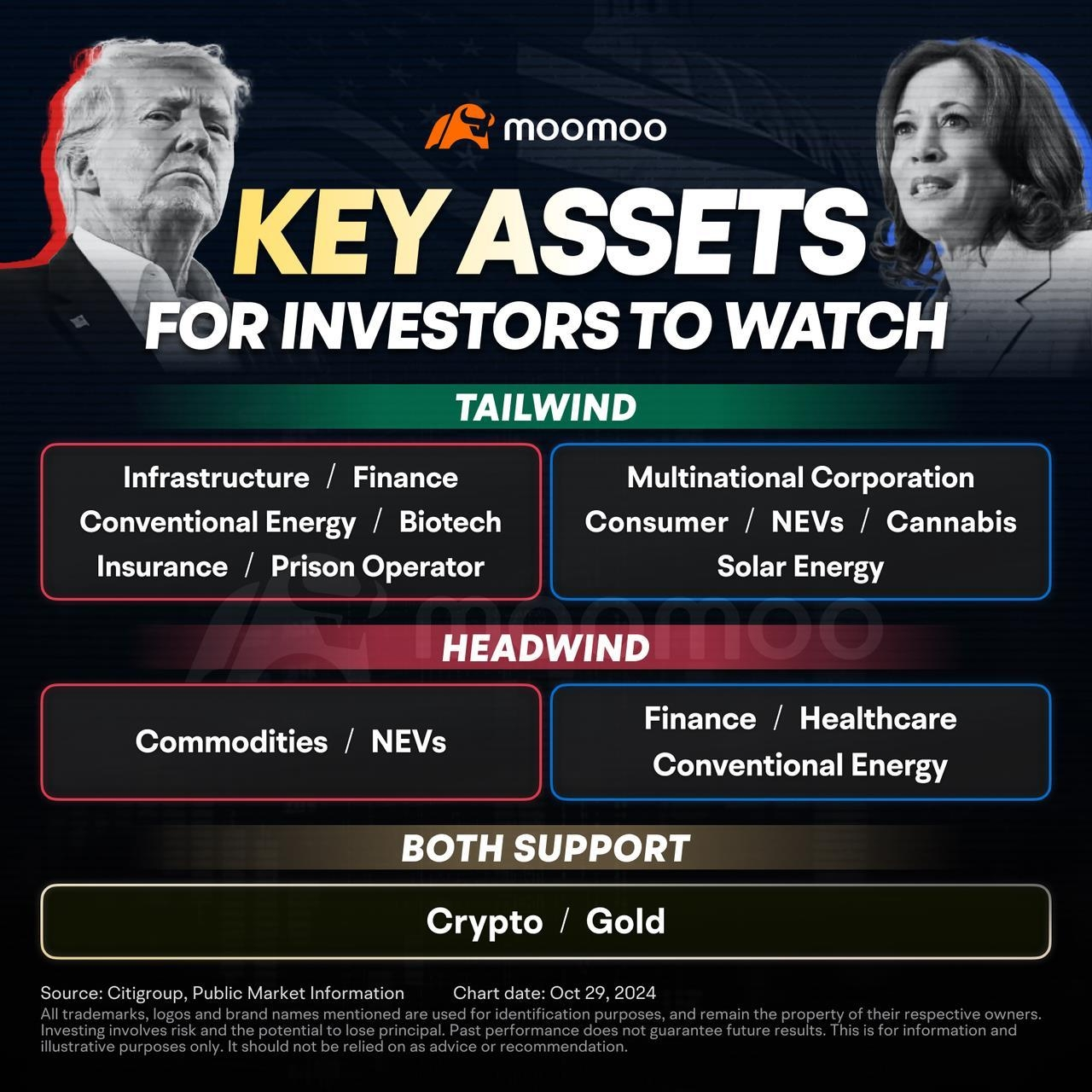
During elections: Increased market volatility due to uncertainty about policy changes provides an opportunity for sector rotation strategies. The policy ideas of different candidates may result in specific sectors benefiting or suffering.
Elections end: The market will adjust to the policies of the new government. Therefore, a sector rotation strategy requires investors to pay close attention to policy trends and be prepared to quickly adjust their portfolios in response to policy changes.
Long-term: While elections can lead to short-term market volatility and sector-specific changes, economic trends and fundamentals have a greater impact on investment performance over the long term.
3. Currency Hedging: Protection against Exchange Rate Volatility
USD-RM pair: The US election could have a significant impact on the USD and hence the RM. Use a currency hedging strategy to protect against unfavourable exchange rate movements.
Forward contract: Entering into a forward contract to lock in an exchange rate for a future transaction.
Currency ETF: Invest in a currency ETF that tracks the performance of the USD against the RM to hedge against currency risk.
4. Diversification: Diversification of Investment Risk
Asset allocation: Diversify your portfolio into different asset classes such as equities, bonds and commodities to spread risk and reduce the impact of market volatility.
Geographic diversification: Invest in assets in different regions to mitigate the impact of local economic conditions. For example, consider investing in Asian markets that were less affected by the US election.
Invest with Moomoo MY to Maximize Profits
For Malaysian investors, utilising the right tools and platforms is critical in dealing with uncertainty and capitalising on the opportunities presented by the US election. The online trading platform moomoo offers a range of features and services to help investors take advantage of trading opportunities.
1. Taking Advantage of Moomoo's Premium Market Data
Moomoo offers free US Level 2 market data to registered users, which is an advantage for investors. Level 2 market data can show buying and selling activity at multiple price levels, helping investors better understand market depth and trading dynamics. During the US election, this data is crucial for predicting market trends and making trading decisions.
2. Theme Tracking
Moomoo's ‘Themes’ feature allows investors to track the performance and insights of specific themes. During the US election, moomoo added Trump and Harris themed boards. These tools can help investors identify sectors and themes that may be affected by policy changes and thus make more informed investment decisions.
3. Competitive Fee Structure and Promotions
Moomoo offers a very competitive fee structure and also offers special promotions and bonuses. Moomoo's commission-free offer for the first 180 days is a significant cost advantage for investors looking to trade frequently during the U.S. election period. It allows them to capitalise on the opportunities presented by market volatility without increasing their trading costs.
Conclusion
In global financial markets, the outcome of the US election will not only reshape policy direction, but also have far-reaching implications for stock markets, currency exchange rates and international trade. It is therefore crucial for Malaysian investors seeking to maximise their investment returns to understand these implications and develop trading strategies accordingly.
This paper explores the multiple implications of the US election for Malaysian investors and suggests a series of top trading strategies. The article highlights the importance of diversifying portfolios to reduce the risk of single-market volatility; discusses how investment decisions can be adjusted in line with candidates' policy ideas; and analyses the opportunities that market volatility presents for short-term trading. It also discusses how to utilise the functionality of the Moomoo platform to capture market dynamics and optimise investment decisions during the US election period.
In conclusion, the US election provides a challenging and opportunistic market environment for Malaysian investors. By adopting appropriate trading strategies and utilising investment tools, investors can maximise their investment returns at this critical time. How markets will respond and how investors will adjust their portfolios as the election results are revealed will all be revealed in the coming months.
This presentation is for informational and educational use only and is not a recommendation or endorsement of any particular investment or investment strategy. Investment information provided in this content is general in nature, strictly for illustrative purposes, and may not be appropriate for all investors. Read more