What Are ASX Sectors and Their Performance?

If you're new to investing in ASX shares, the unfamiliar stock market landscape may seem daunting. To help you find your way around, we'd like to share a few pointers on the lay of the land.
In this article, we'll introduce you to the 11 sectors that make up the Australian stock market and show you which sectors have been outperforming in the long run.

What are the ASX sectors?
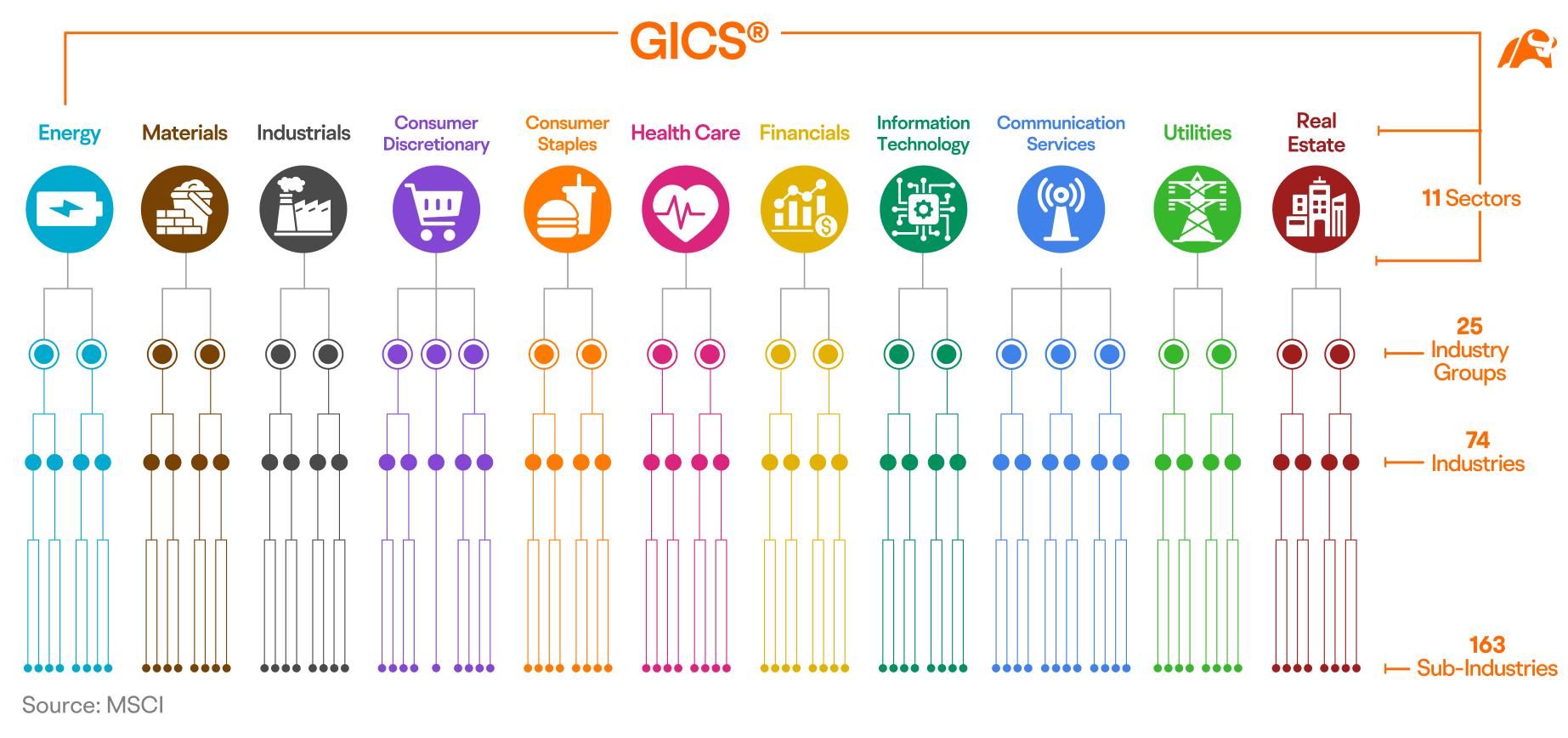
The ASX uses the Global Industry Classification Standard (GICS) to categorize companies based on their key business activities. GICS is an industry analysis framework that provides investors with a clear understanding of the companies they are investing in around the world.
To ensure precision in the investment process, GICS is structured with four levels of classifications, which include 11 sectors, 25 industry groups, 74 industries, and 163 sub-industries.
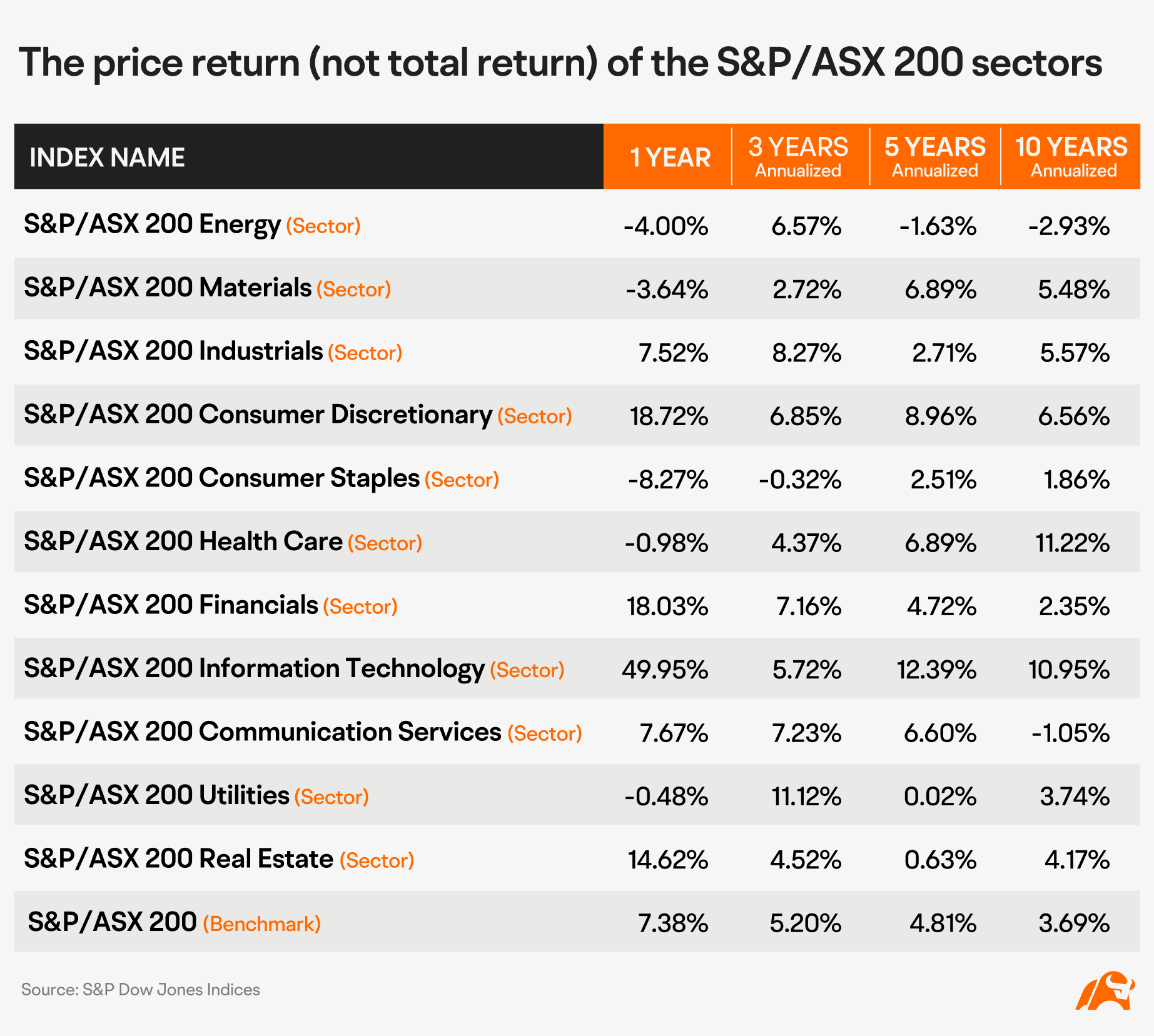
Understanding these sectors can be valuable when considering diversifying your portfolio. The table below illustrates the price return (not total return) of the S&P/ASX 200 sectors over the past 10 years.
What are the 11 sectors of the ASX?
Energy
The energy sector comprises companies engaged in exploration & production, refining & marketing, and storage & transportation of oil & gas and coal & consumable fuels. It also includes companies that offer oil & gas equipment and services.
Companies in the energy sector heavily rely on the fluctuating price of energy to generate profits. However, over the past 10 years, the S&P/ASX 200 energy sector has only achieved a total annualized return of 1.17%. This may not be attractive to many investors, as it falls behind the index benchmark (ASX 200) which has achieved a return of 7.95%.
Materials
The materials sector is a significant component of the Australian stock market, comprising nearly 1,000 companies.
This sector encompasses a diverse range of companies, including those involved in the manufacturing of chemicals, construction materials, forest products, glass, paper, packaging products, and metals. It also includes mining companies, such as steel producers.
Materials stocks, which belong to a cyclical sector, typically see their performance ebb and flow in tandem with the broader economy. The revenue of companies in this sector hinges on robust commodity prices and a thriving economic environment.
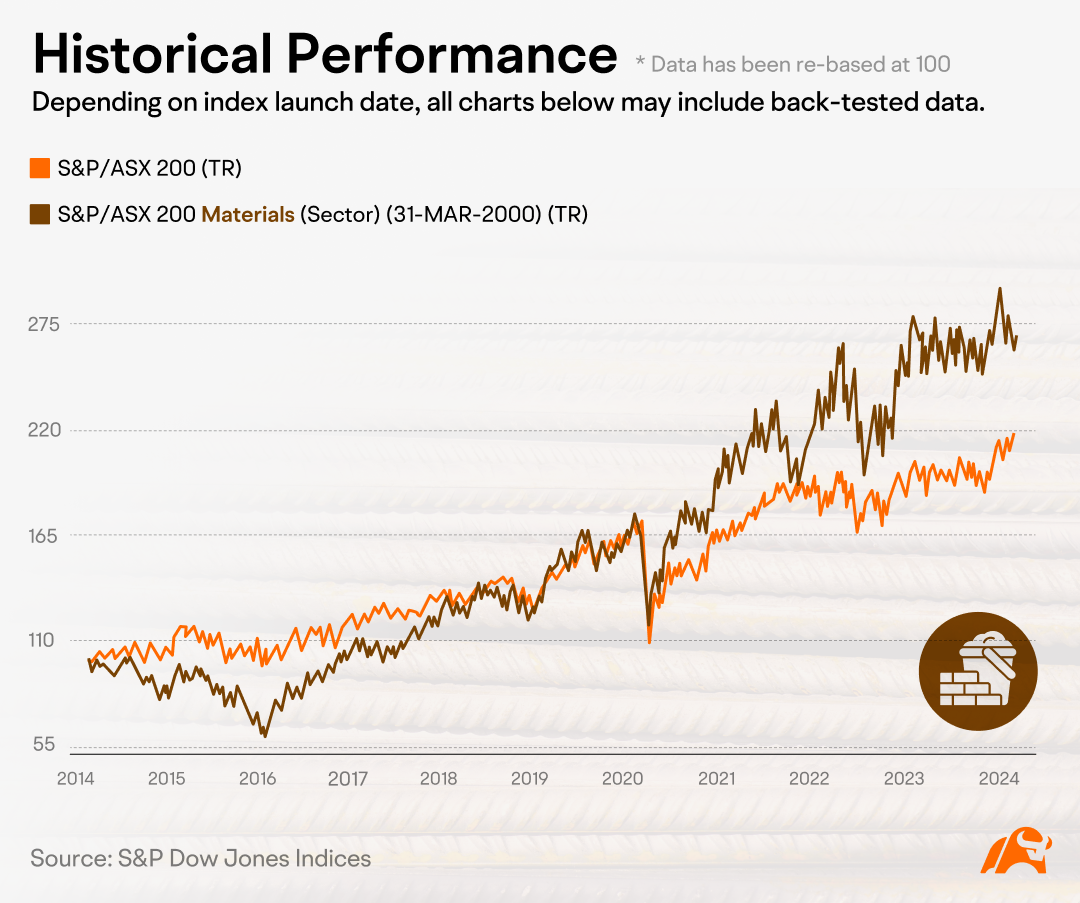
The S&P/ASX 200 materials sector has a total annualized return of 10.17% over the past 10 years.
Industrials
The industrials sector includes manufacturers and distributors of capital goods such as aerospace & defense, building products, electrical equipment and machinery and companies that offer construction & engineering services. It also includes providers of commercial & professional services including printing, environmental and facilities services, office services & supplies, security & alarm services, human resource & employment services, research & consulting services. It also includes companies that provide transportation services.
The industrials sector tends to perform well during periods of economic expansion and high demand for construction and professional services.
The S&P/ASX 200 industrials sector has a total annualized return of 9.26% over the past 10 years.
Consumer Discretionary
The consumer discretionary sector encompasses those businesses that tend to be the most sensitive to economic cycles. Its manufacturing segment includes automobiles & components, household durable goods, leisure products and textiles & apparel. The services segment includes hotels, restaurants, and other leisure facilities. It also includes distributors and retailers of consumer discretionary products.
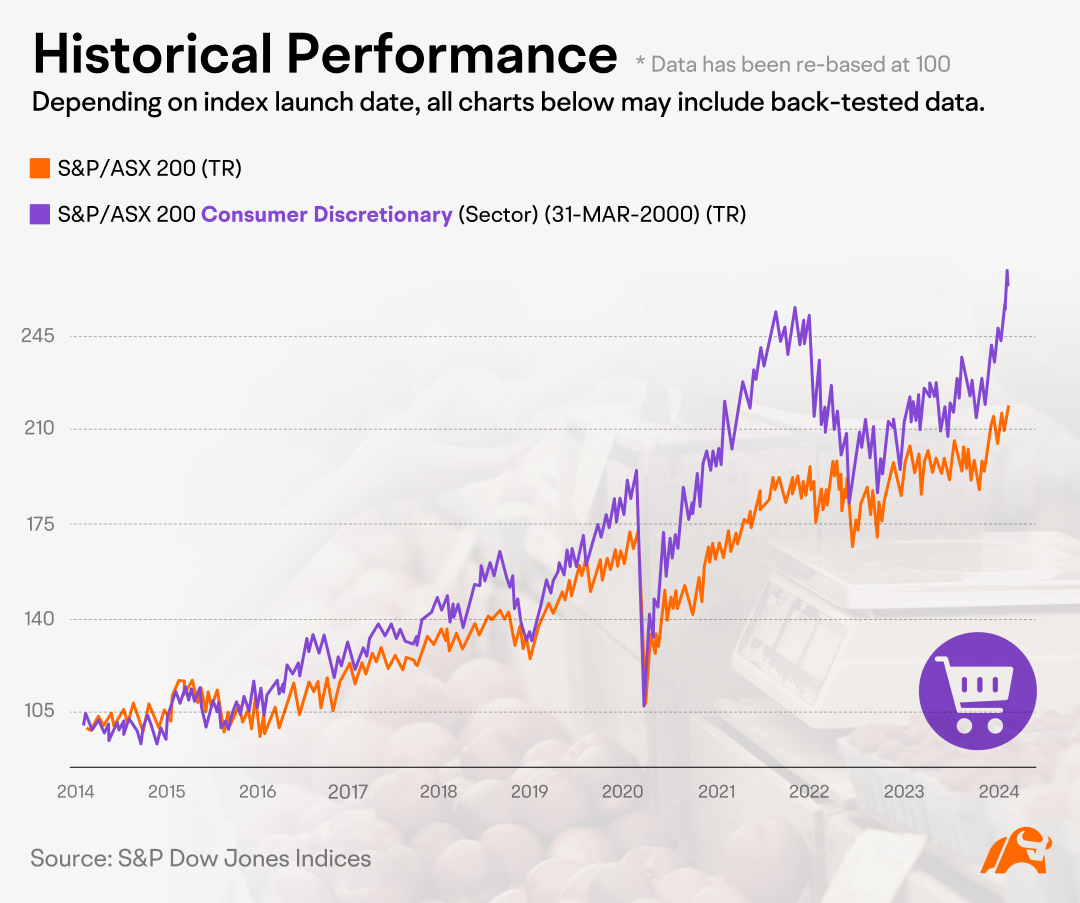
This sector tends to outperform many other sectors in an economic boom. The S&P/ASX 200 consumer discretionary sector has a total annualized return of 10.38% over the past 10 years.
Consumer Staples
The consumer staples sector comprises companies whose businesses are less sensitive to economic cycles. It includes manufacturers and distributors of food, beverages and tobacco, and producers of non-durable household goods and personal products. It also includes distributors and retailers of consumer staples products including food & drug retailing companies.
This sector is generally considered to be defensive, meaning it is likely to outperform many other sectors in a downturn. The S&P/ASX 200 consumer staples sector has a total annualized return of 5.39% over the past 10 years.

Health Care
The health care sector is one of the best-performing sectors in the ASX. It includes health care providers & services, companies that manufacture and distribute health care equipment & supplies, and health care technology companies. It also includes companies involved in the research, development, production and marketing of pharmaceuticals and biotechnology products.
Although some healthcare companies can be highly speculative, others are considered blue chips. For instance, CSL Limited, a leading global biotechnology company, is a well-established player in the industry.
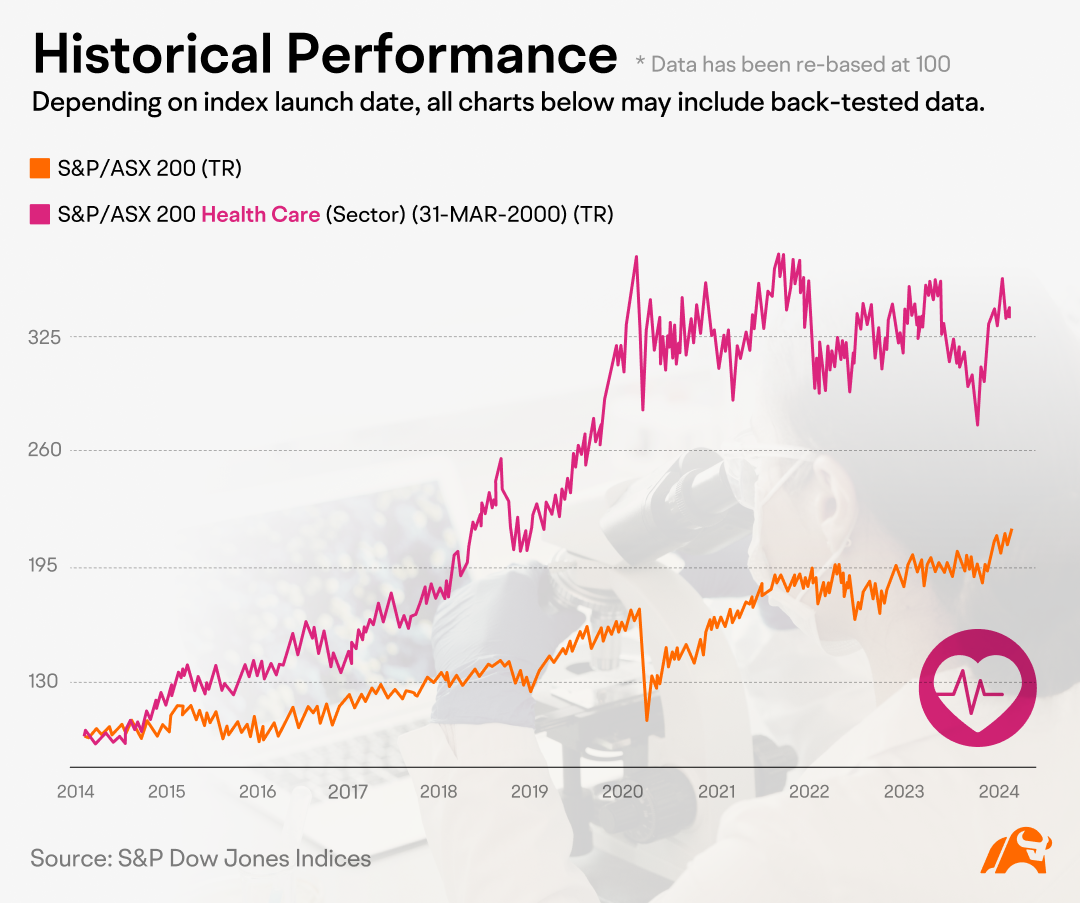
The S&P/ASX 200 health care sector has a total annualized return of 13.09% over the past 10 years.
Financials
The financials sector is the largest sector in the ASX, on the basis of market cap. It contains companies engaged in banking, financial services, consumer finance, capital markets and insurance activities. It also includes Financial Exchanges & Data and Mortgage REITs.
The big four Australian banks, Commonwealth Bank Australia (CBA), National Australia Bank Ltd (NAB), Westpac Banking Corp (WBC), and ANZ Group Holdings Ltd (ANZ), dominate this sector. The S&P/ASX 200 financials sector has a total annualized return of 7.22% over the past 10 years.
Information Technology
The information technology sector comprises companies that offer software and information technology services, manufacturers and distributors of technology hardware & equipment such as communications equipment, cellular phones, computers & peripherals, electronic equipment and related instruments, and semiconductors and related equipment & materials.
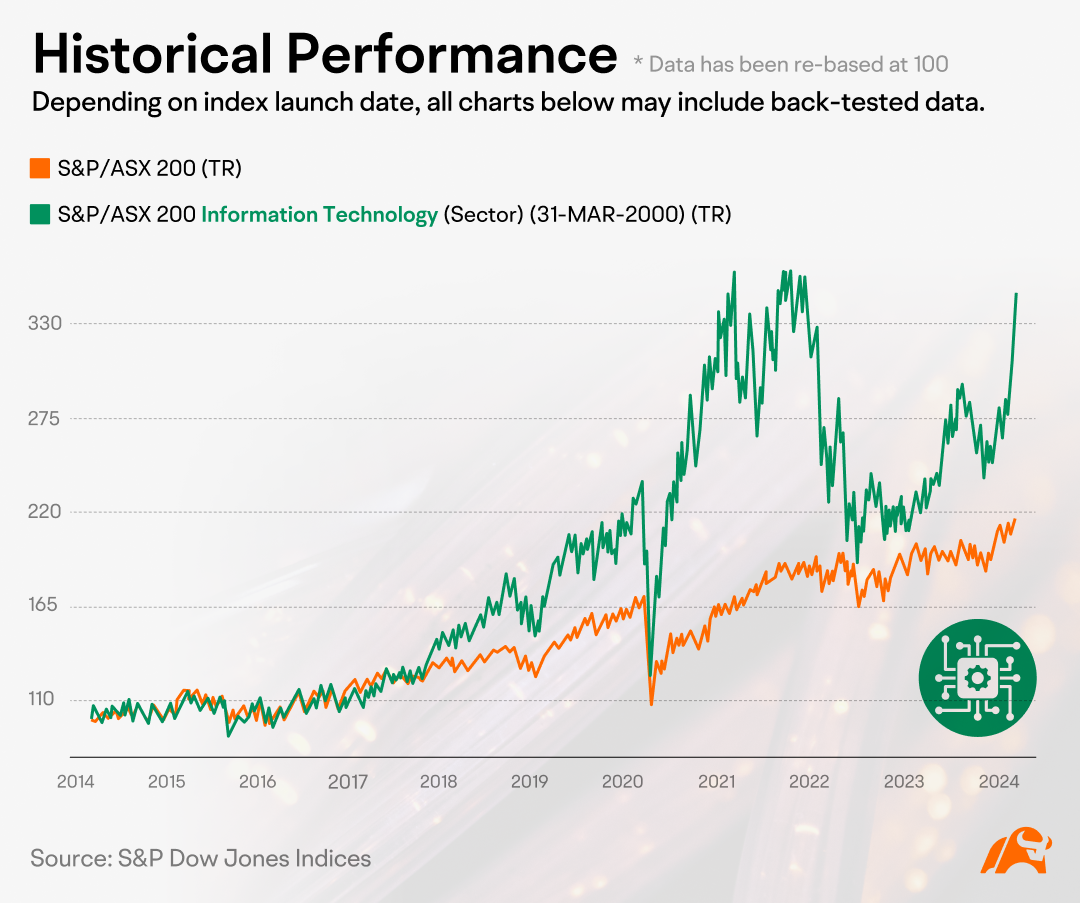
The IT sector typically has high growth potential in a booming economy. The S&P/ASX 200 information technology sector has a total annualized return of 12.96% over the past 10 years.
Communication Services
The communication services sector comprises businesses that enable communication and provide content and information through different channels. This includes telecom operators, media and entertainment firms, interactive gaming producers, and entities that create or distribute content via their own platforms.
Telstra Group Limited (TLS) is Australia's largest telecommunications company by market share, offering a full range of communications services. The S&P/ASX 200 communication services sector has a total annualized return of 3.36% over the past 10 years.
Utilities
The utilities sector includes companies providing essential services like electricity, gas, and water, as well as those involved in generating and distributing electricity from renewable sources.
Utility companies, focusing on delivering essential services to consumers and businesses, are known for their stable dividends and lower price fluctuations compared to the overall market. Investors often favor utilities for long-term holdings due to their resilience during economic downturns.
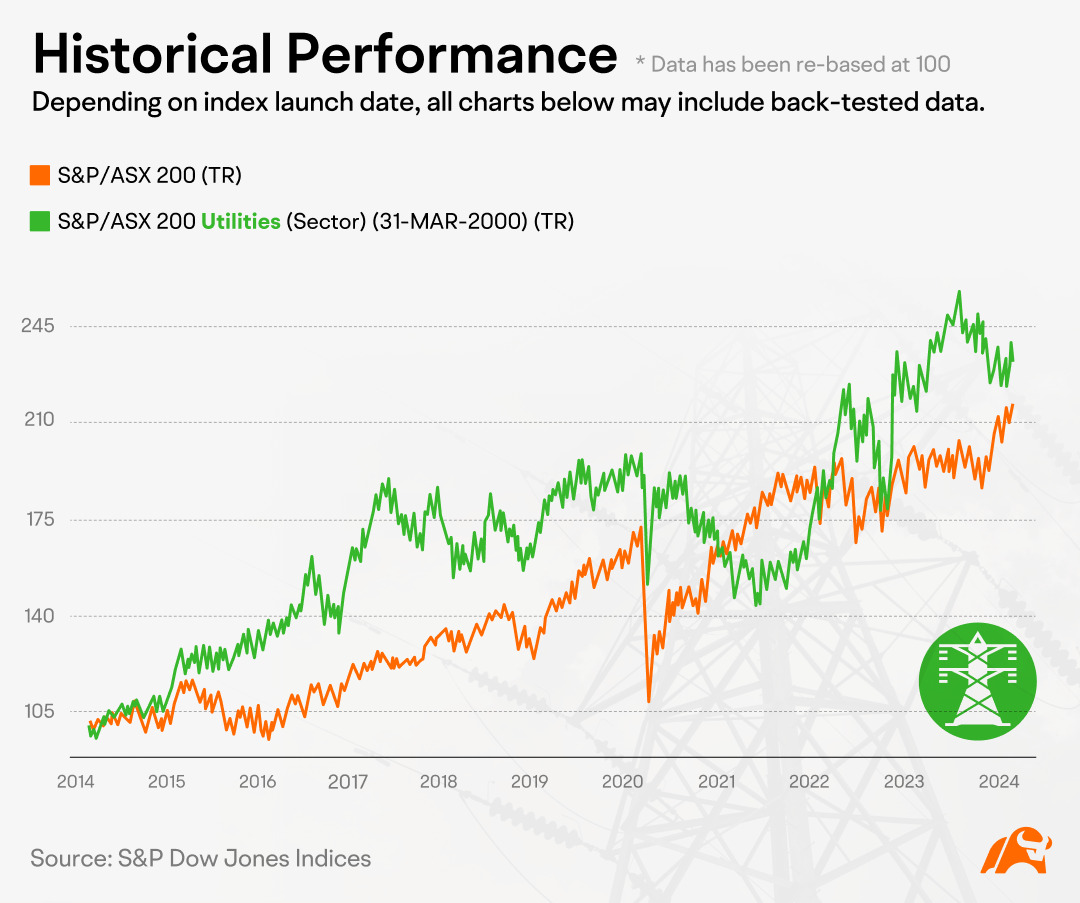
The S&P/ASX 200 utilities sector has a total annualized return of 8.82% over the past decade.
Real Estate
The real estate sector encompasses firms involved in property development and management, real estate services, and Equity Real Estate Investment Trusts (REITs).
It's an asset class known for providing a steady income, making it appealing for investors interested in passive earnings.
Over the last decade, the S&P/ASX 200 real estate sector has delivered an annualized return of 8.56%.
Moomoo AU: One Stop Solution for AU stocks!
>> Click to open an account and claim your welcome rewards!
>> Click to open an account and claim your welcome rewards!
How can I find sector classification of ASX stocks on moomoo?
Want to see which sectors are leading or lagging in the Australian market? Moomoo makes it easy to explore ASX stock sector classifications and visualise market trends at a glance.
Simply open the Heat Map feature in the moomoo app — you’ll find it under the “Markets” tab. The Heat Map groups ASX stocks by sector (such as Financials, Materials, or Healthcare) and shows how each stock is performing in real time. Colour coding helps you instantly spot which sectors are gaining momentum and which are cooling off.
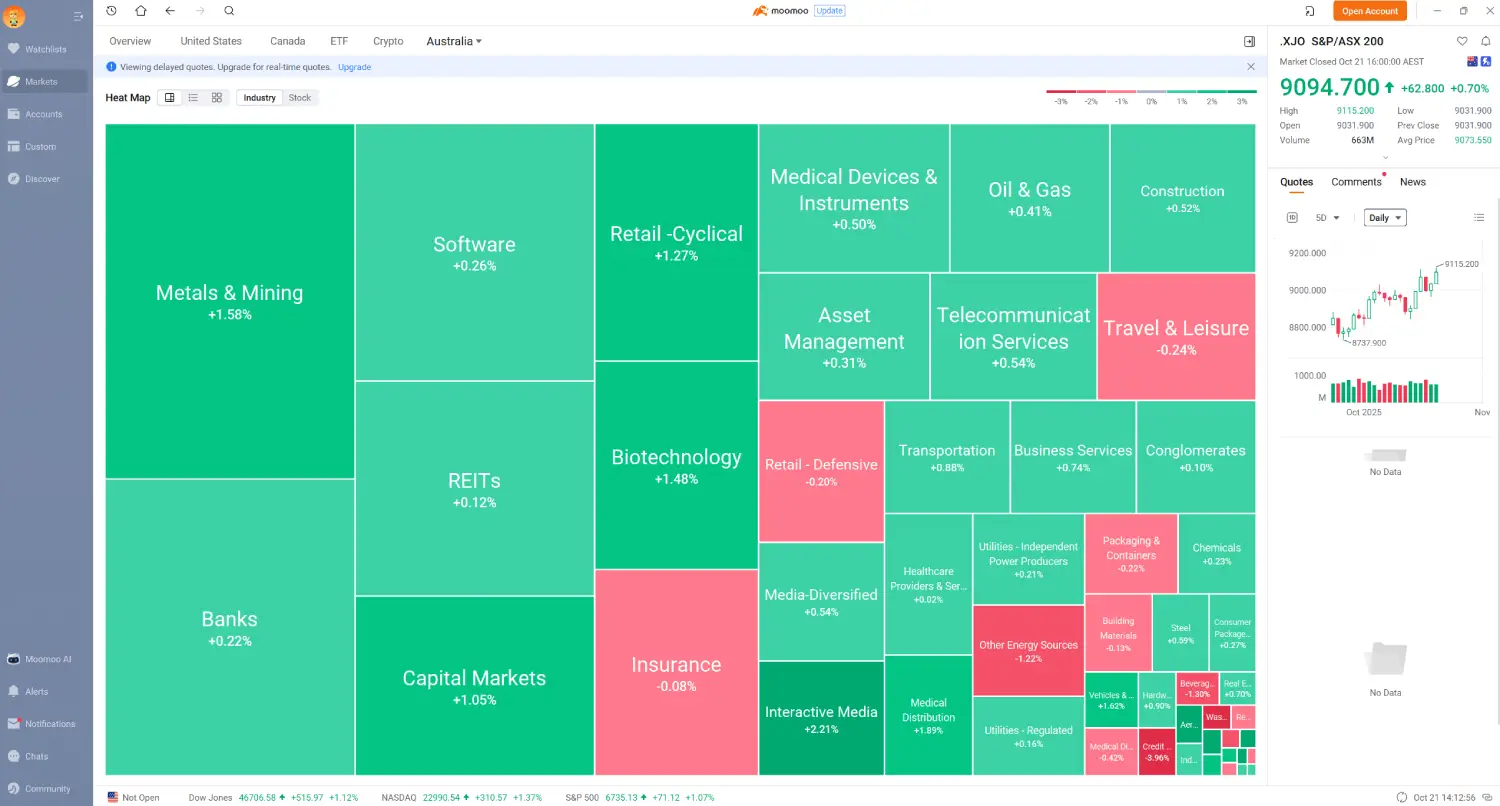
Tap any sector on the Heat Map to drill down into individual company performance, market capitalisation, and price movements. It’s an intuitive way to track market sentiment and identify potential opportunities across the ASX.
Final thoughts on ASX sectors performance
To wrap up, when we look at the various sectors on the ASX, it's like checking the pulse of Australia's economy. Each sector tells its own story—mining might surge when commodity prices are up, while tech could buzz with innovation. By watching how these parts of the market do, investors get clues on where the economy might be headed. It's like having a map for your investment journey that helps you decide which turns to take as you navigate through Australia's financial landscape. Keep an eye on these sectors, and you'll be better equipped to ride the waves of the market.
This presentation is for informational and educational use only and is not a recommendation or endorsement of any particular investment or investment strategy. Investment information provided in this content is general in nature, strictly for illustrative purposes, and may not be appropriate for all investors. Read more