What Is an RRSP (Registered Retirement Savings Plan)?

Despite the challenges of high inflation and increasing living costs in Canada, the Registered Retirement Savings Plan (RRSP) remains a popular and effective tool for retirement savings. In 2022, Canadians contributed $54.2 billion to their RRSPs — a slight decrease of 3.4% from 2021,* but still a significant commitment to securing their financial futures.
Since their introduction in 1957, RRSPs have been a cornerstone of retirement planning for many Canadians. These government-registered accounts are designed to help you save for retirement through a range of tax benefits and investment options.
What is an RRSP?
An RRSP is a tax-advantaged savings account to help Canadians save for retirement. Contributions to an RRSP are tax deductible, and the investment growth within the account will be tax-free until withdrawal. The main goal of an RRSP is to encourage long-term savings by offering immediate tax relief and deferring taxes on investment gains.
How does an RRSP work?
An RRSP allows individuals to contribute a portion of their income into a registered account. These contributions are then deducted from taxable income, reducing the tax owed in the year of the contribution. The funds within the RRSP can be invested in different assets, such as stocks, bonds, mutual funds, and ETFs. The growth of these investments is taxed when you withdraw the money during retirement, generally at a lower tax rate.
If you have a spouse, you might want to consider a Spousal RRSP. For more details, please read: What Is a Spousal RRSP and How Does It Work?
Types of RRSPs
RRSPs come in several forms to cater to different needs and situations:
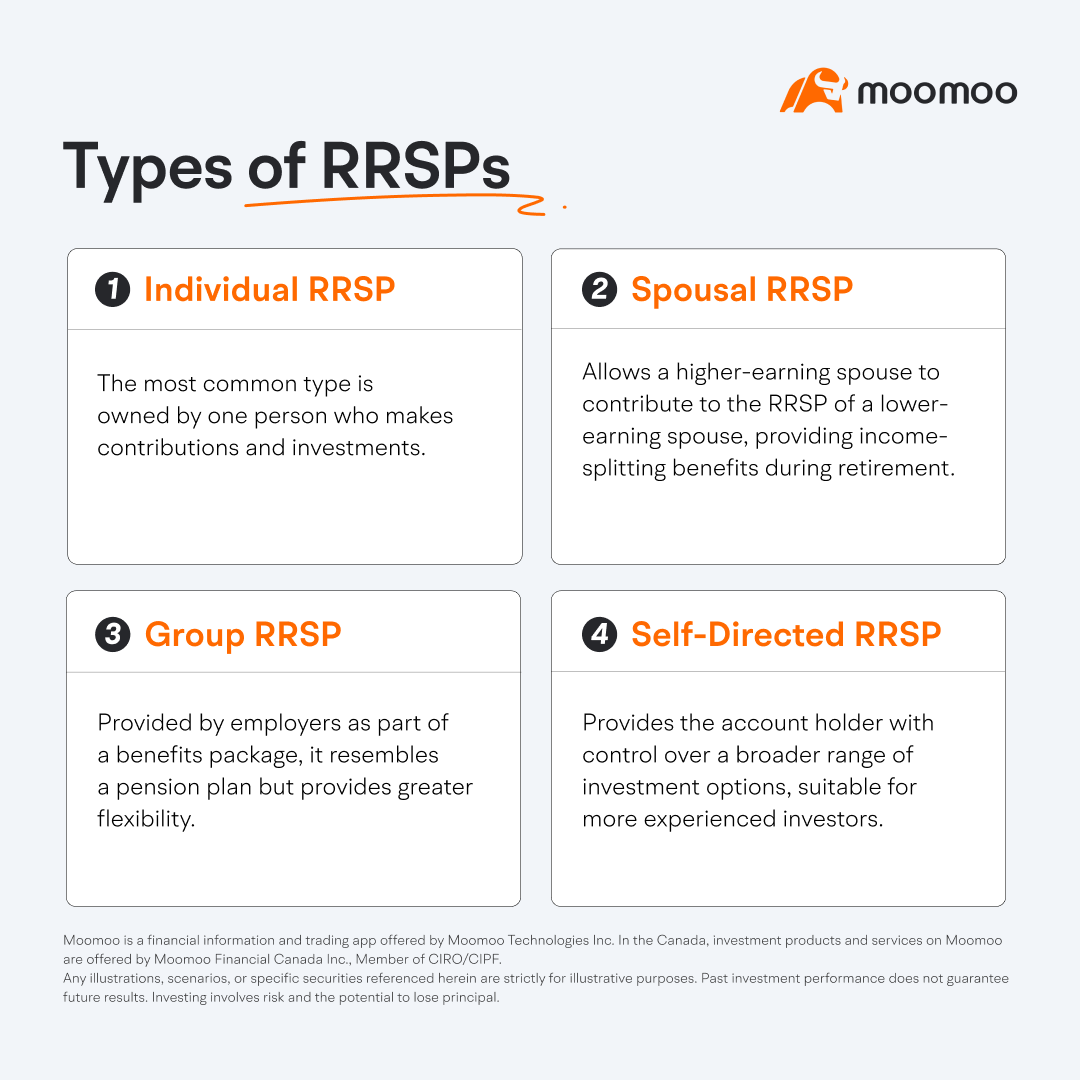
RRSP contribution limits
The contribution limit for an RRSP is the lesser of 18% of your previous year's earned income or the annual maximum set by the Canada Revenue Agency (CRA). For 2024, the annual limit is CAD 31,560. You can carry forward the unused contribution room to future years. For 2025, the limit is increased to CAD 32,490.
RRSP contribution deadline
The RRSP contribution deadline for a given tax year is typically 60 days after the end of that calendar year. For instance, the deadline for the 2024 tax year was March 1, 2025.
The investment options of RRSP
With an RRSP, you have the flexibility to invest in a variety of assets. Here ’s a breakdown of your options:
Cash: Keep your money in your RRSP account to earn interest.
Savings accounts: These offer a modest interest rate, and the interest earned is tax-deferred within your RRSP.
Guaranteed Investment Certificates (GICs): Secure investments that lock in your money for a fixed term, offering a guaranteed interest rate.
Stocks: Invest in shares listed on exchanges, becoming a partial owner of those companies.
Bonds: Invest by lending money to a company or government in exchange for regular interest payments and the return of your initial investment at maturity.
Mutual funds: Investment pools that buy a diversified portfolio of stocks, bonds, or other securities with money from many investors. They are "open-ended," creating new shares as more people invest.
Exchange-Traded Funds (ETFs): Funds that track specific market indexes (e.g., stocks or bonds) and trade on stock exchanges like individual stocks.
Real Estate Investment Trusts (REITs): Companies that own, operate, or finance real estate properties. Investing in REITs involves buying shares in these companies, which distribute most of their profits as dividends.
Good news! moomoo Canada supports open an RRSP/Spousal RRSP within a few minutes. You can easily trade US stocks, Canadian stocks, bonds, ETFs, etc with your RRSP on moomoo.

The Benefits of RRSP
Tax reduction: Contributions to an RRSP are tax deductible, reducing your taxable income for the year.
Tax-deferred growth: Investments grow tax-free until withdrawal, allowing for potentially greater compound growth.
Income splitting: Spousal RRSPs enable income splitting, which can reduce overall tax liability during retirement.
Flexibility: Various types of RRSPs and investment options provide flexibility to suit different financial situations and goals.
Retirement income: Provides a source of income during retirement, supplementing other retirement benefits like the Canada Pension Plan (CPP) and Old Age Security (OAS).
RRSP Withdrawal Rules
You can withdraw from your RRSP at any time. While withdrawals before retirement are discouraged due to tax implications and potential penalties, two specific programs allow for penalty-free withdrawals:
Home Buyers' Plan (HBP): Allows first-time homebuyers to withdraw up to $35,000 to purchase or build a home. The withdrawn amount must be repaid over 15 years, starting the second year after the withdrawal.
Lifelong Learning Plan (LLP): Permits withdrawals of up to $20,000 for full-time education or training, with a repayment period of 10 years and at least 10% of the borrowed amount repaid each year.
How to Convert Your RRSP to a RRIF
By the end of the year in which you turn 71, you must convert your RRSP into a Registered Retirement Income Fund (RRIF) or another retirement income option. An RRIF allows you to withdraw a minimum amount each year, which is subject to tax. The conversion process involves transferring your RRSP assets to the RRIF, where they continue to grow tax-free until withdrawn. RRIFs offer flexible withdrawal options, which means you can choose how much to withdraw beyond the minimum required amount.
RRSP vs RSP
An RRSP is a type of Registered Savings Plan (RSP). While "RSP" is a general term that can refer to any registered savings plan, including RRSPs, Registered Education Savings Plans (RESPs), and Tax-Free Savings Accounts (TFSAs), an RRSP specifically refers to a retirement-focused savings account with distinct tax advantages and rules.
RRSP vs TFSA
Both RRSPs and TFSAs (Tax-Free Savings Accounts) offer tax advantages but serve different purposes:
RRSP: Your contributions are tax deductible, meaning you can reduce your taxable income for the year. However, when you withdraw funds, those withdrawals are taxed. RRSPs are best for long-term retirement savings.
TFSA: Contributions to a TFSA are not tax deductible, but any money you take out — including interest, dividends, and capital gains — is completely tax-free. TFSAs are versatile for both short-term and long-term savings goals.
RRSP vs. TFSA vs. FHSA: What’s the difference?
Both RRSPs and TFSAs offer tax benefits, but they cater to different financial needs:
RRSP (Registered Retirement Savings Plan): Your contributions are tax deductible, meaning you can reduce your taxable income for the year. However, when you withdraw funds, those withdrawals are taxed. RRSPs are best for long-term retirement savings.
TFSA (Tax-Free Savings Account): Contributions to a TFSA are not tax deductible, but any money you take out — including interest, dividends, and capital gains — is completely tax-free. TFSAs are versatile for both short-term and long-term savings goals.
FHSA (First Home Savings Account): Launched in 2023, this new account helps you save for your first home with tax-deductible contributions and tax-free withdrawals for eligible home purchases.
Do you want to dive deeper into the differences between RRSP, TFSA, and FHSA? Learn more.
Good news!
Moomoo Canada offers robust customer support and local service options to make managing your RRSP and your entire investing experience as smooth as possible.
![]() You can get help 24/7 through in-app chat or email, so whether you have a quick question about account setup, trading, or technical issues, support is always just a message away.
You can get help 24/7 through in-app chat or email, so whether you have a quick question about account setup, trading, or technical issues, support is always just a message away.
![]() In addition to online support, Moomoo has opened its first physical store in Toronto, Canada — the Moomoo Store. If you prefer face-to-face help, you’re welcome to visit in person for guidance on account questions, product features, or even educational resources.
In addition to online support, Moomoo has opened its first physical store in Toronto, Canada — the Moomoo Store. If you prefer face-to-face help, you’re welcome to visit in person for guidance on account questions, product features, or even educational resources.
Moomoo Canada offers robust customer support and local service options to make managing your RRSP and your entire investing experience as smooth as possible.
 You can get help 24/7 through in-app chat or email, so whether you have a quick question about account setup, trading, or technical issues, support is always just a message away. In addition to online support, Moomoo has opened its first physical store in Toronto, Canada — the Moomoo Store. If you prefer face-to-face help, you’re welcome to visit in person for guidance on account questions, product features, or even educational resources.
How do I open an RRSP in Canada?
Opening an RRSP in Canada involves several steps:
Choose a financial institution: Select a bank, credit union, or financial services provider.
Select the type of RRSP: Decide between an individual, spousal, group, or self-directed RRSP.
Complete the application: Provide personal information, including your Social Insurance Number (SIN), and complete the required forms.
Fund the account: Make an initial contribution and set up regular contributions if desired.
Select investments: Choose from the various investment options available to grow your savings.

An RRSP is a powerful tool for Canadians looking to secure their financial future. By understanding how RRSPs work, the benefits they offer, and the rules governing contributions and withdrawals, you can make informed decisions to maximize your retirement savings. Whether you are just starting your career or nearing retirement, an RRSP can play a crucial role in your overall financial strategy.
*Source: Statistics Canada: Registered retirement savings plan contributions, 2022
This presentation is for informational and educational use only and is not a recommendation or endorsement of any particular investment or investment strategy. Investment information provided in this content is general in nature, strictly for illustrative purposes, and may not be appropriate for all investors. Read more