What Is a Margin Account and How to Open a Margin Account in Canada?

In the financial market, margin accounts provide a powerful tool for investors seeking higher returns and more flexible investment strategies. By borrowing funds from brokerage firms, investors can make larger-scale investments on a limited amount of their own capital, potentially achieving higher returns. However, margin trading also comes with higher risks and is suitable for investors with certain market knowledge and risk tolerance. This article will provide a detailed introduction to what a margin account is and how to open a margin account in Canada, helping individuals who are interested in using leverage for investment to better grasp this financial tool and make wise investment decisions.
What is a margin?
In stock trading, when investors need to use leverage, they will involve the use of margin. Margin refers to the funds or securities that investors must deposit into their brokerage accounts to cover potential losses. The margin system is designed to ensure market stability and fairness, while also protecting brokers from the risk of clients failing to fulfill their contractual obligations. Margin is divided into two main types: Initial Margin and Maintenance Margin.
Initial margin
Initial Margin refers to the minimum amount or value that investors must provide to brokers before opening a new position. This is to ensure that investors have sufficient funds to bear the potential risks of market fluctuations. In Canada, the initial margin rate is set by the IIROC( Investment Industry Regulatory Organization of Canada) and TSX(Toronto Stock Exchange). Investors should carefully read the specific regulations of the relevant authorities and brokers when engaging in margin trading to ensure compliance and manage their risks effectively.
Maintenance margin
Maintenance margin refers to the minimum equity amount that an investor must maintain in their account while holding a position. Maintenance margin is a portion of the investor's own assets, excluding liabilities. If the account equity falls below the maintenance margin requirement due to market price fluctuations of securities, the investor will receive a margin call, requiring them to deposit additional funds or sell some securities to restore the maintenance margin level; otherwise, the broker has the right to liquidate the position. The amount of maintenance margin is generally lower than the initial margin, providing investors with a certain buffer space and allowing for some degree of price fluctuation without immediately facing a margin call situation.
What is margin trading?
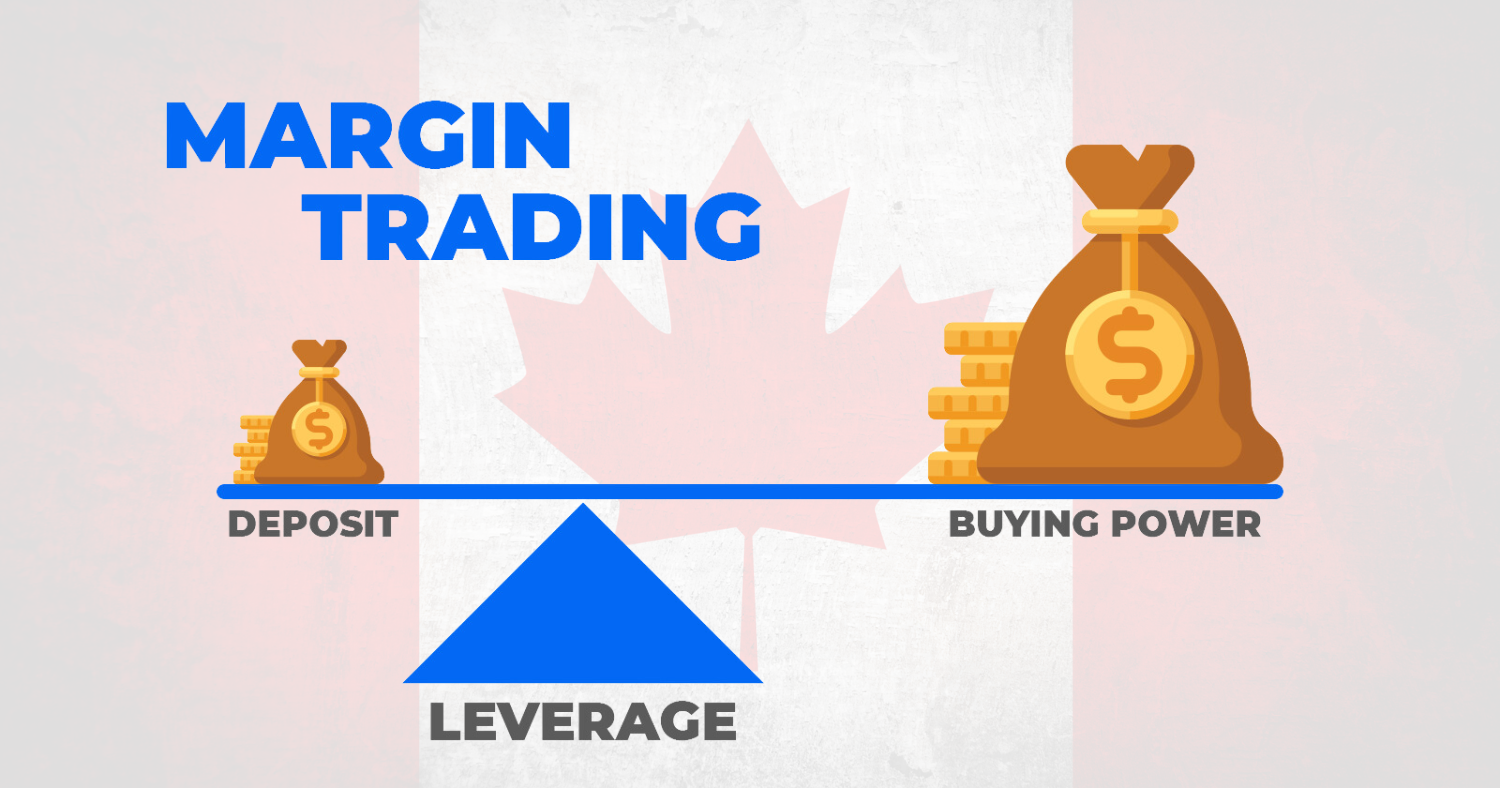
After understanding the definition of margin, margin trading becomes quite clear. Margin trading refers to the practice where investors deposit an initial margin and then borrow funds from brokers to purchase securities or other financial instruments, or borrow securities to sell short. This method allows investors to utilize leverage to control positions with a larger amount of capital with a smaller amount of their own funds, thereby amplifying the potential gains and losses.
What is a margin account?
A margin account is a type of brokerage account that facilitates margin trading for investors. Through such an account, investors can leverage financing to amplify their long positions or engage in short selling by borrowing securities. It is important to be aware that there are interest charges associated with borrowing funds or securities through a margin account, and these margin rates can vary among different brokerage firms. Larger brokerage firms may offer more competitive interest rates, whereas smaller firms might have comparatively higher rates.
You may also like: How to Open a Brokerage Account in Canada?
How does a margin account work?
When using a margin account to go long or short, investors need to closely monitor the initial margin and maintenance margin, as these are key to the operation of the margin account.
Long position
Investors borrow funds to purchase securities, anticipating that the price of the securities will rise, and then sell them to profit from the difference.
For example
Depositing initial margin:
Assuming the initial margin requirement is 50%, if an investor plans to purchase stocks worth $10,000, they need to deposit $5,000 in cash or equivalent securities.
Borrowing and buying stocks:
The investor borrows $5,000 from the brokerage firm, adding to their own $5,000, for a total of $10,000 to buy stocks.
Stock price increase:
If the stock price rises to $12,000, the investor can sell the stocks at $12,000.
The investor's profit is $12,000 (selling price) - $10,000 (purchase price) = $2,000.
Stock price decrease:
Assuming the maintenance margin requirement is 30%, investors must maintain at least $3,000 in equity for a position of $10,000.
If the stock price falls to $9,000, the investor's account equity is $5,000 (initial margin) - $1,000 (paper loss) = $4,000, which is above the maintenance margin requirement of $3,000, so there is no risk of a margin call.
If the stock price continues to fall to $7,000, the investor's account equity is $5,000 (initial margin) - $3,000 (paper loss) = $2,000, which is below the maintenance margin requirement of $3,000, and the investor will receive a margin call, requiring them to deposit additional funds or reduce their position.
Short position
Investors borrow securities and sell them immediately, expecting the price of the securities to fall, and then buy them back to return, earning the difference.
For example
Depositing initial margin:
Assuming the initial margin requirement is 50%, if an investor plans to short sell stocks worth $10,000, they need to deposit $5,000 in cash or equivalent securities.
Borrowing and selling stocks:
The investor borrows $10,000 worth of stocks from the brokerage firm and immediately sells them at the current market price of $10,000.
Stock price decline:
If the stock price falls to $8,000, the investor can buy back the same amount of stocks at $8,000 and return them to the brokerage firm.
The investor's profit is $10,000 (selling price) - $8,000 (buying price) = $2,000.
Stock price increase:
Assuming the maintenance margin requirement is 30%, the investor must maintain at least $3,000 in equity for the short position of $10,000.
If the stock price rises to $12,000, the investor's account equity is $5,000 (initial margin) - $2,000 (paper loss) = $3,000, which just meets the maintenance margin requirement.
If the stock price continues to rise to $13,000, the investor's account equity is $5,000 (initial margin) - $3,000 (paper loss) = $2,000, which is below the maintenance margin requirement of $3,000, and the investor will receive a margin call, requiring them to deposit additional funds or reduce the position.

Benefits and potential risks of using a margin account
Margin accounts allow investors to amplify their investment scale through borrowing, which brings both potential profit opportunities and higher risks. Here are the main benefits and potential risks of using a margin account:
Benefits
Leverage effect: If the initial margin requirement is 50%, an investor depositing $5,000 can buy $10,000 worth of stocks or borrow $10,000 worth of stocks to short sell. This is equivalent to providing the investor with 2x leverage, allowing them to make larger-scale investments with less capital, thus amplifying the potential gains.
Improved capital utilization: Through a margin account, investors need to invest less of their own money for the same scale of investment, and the remaining funds can be used for other investments or purposes. This not only improves the efficiency of capital utilization but also makes more diversified investments possible.
Short selling opportunities: Margin accounts allow investors to borrow securities and sell them, expecting to profit by buying them back after the price falls. This is a function that ordinary cash accounts cannot achieve.
Potential risks
High leverage risk: The leverage effect not only amplifies gains but also losses. The same magnitude of adverse fluctuations can lead to greater paper losses.
Interest costs: Whether it is borrowing money or securities, interest charges must be paid, which increases the investment costs for investors engaging in margin trading.
Forced liquidation risk: With a regular cash account, position management is entirely up to the investor. However, with a margin account, investors are subject to maintenance margin restrictions. If investors cannot meet the margin call, the brokerage firm has the right to forcibly liquidate the position without further notice, which may result in greater losses.
How to use margin account properly?
After understanding the benefits and potential risks of using a margin account, investors need to develop a clear investment plan and use the correct trading strategies to use a margin account properly for margin trading.
Developing a clear investment plan
Investors need to clarify their investment objectives, whether they are short-term trading or long-term investing. At the same time, they should assess their risk tolerance to ensure they are not taking excessive risks with margin trading.
Correct trading strategies
Set stop-loss orders to limit potential losses. Stop-loss orders can automatically close positions when the market price reaches the preset stop-loss point, reducing losses. Also, adjust the stop-loss points dynamically according to market conditions and investment strategies.
Combine various investment strategies, such as value investing, growth investing, and technical analysis, to manage positions flexibly. Avoid concentrating all funds in one stock; diversifying investments can reduce the risk associated with a single stock.
How to open margin account on moomoo?
Canadian investors can open individual margin accounts in moomoo Canada. An individual margin account is held by one person who is the sole owner of the assets, which allows you to trade using cash, margin, or portfolio margin.
An individual margin account offers the following benefits for Canadian investors:
Deposit US and Canadian dollars.
Trade US stocks and CA stocks directly.
Low market margin loan rates.
Use cash or securities in the account as margin to enlarge your buying power.
Margin accounts are not subject to PDT (pattern day trading) restrictions.
Start margin trading
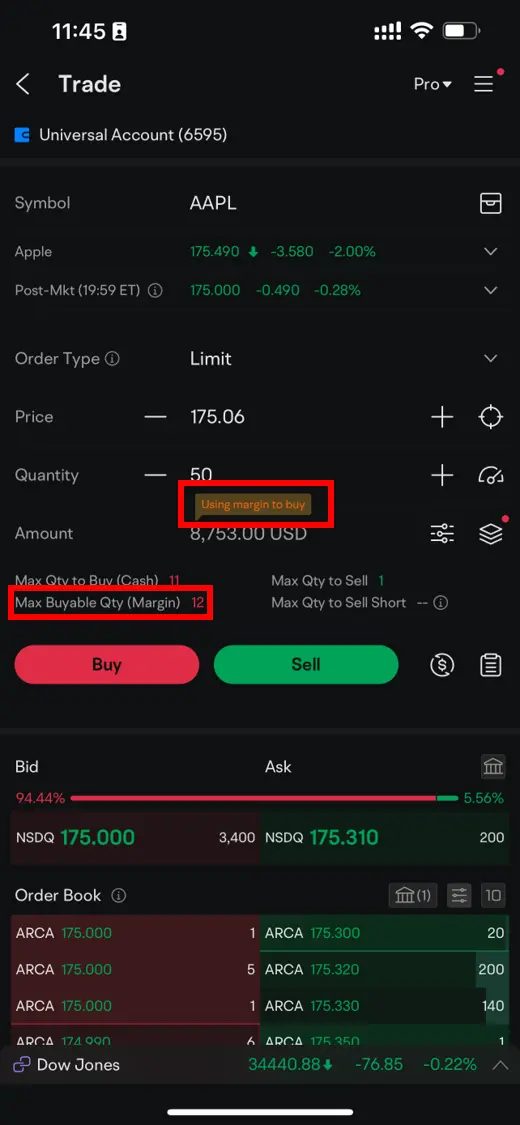
Margin will be used by default if you do not have enough cash when buying a stock.
Start short selling
Short sell by tapping Sell on the Trade page when you do not have a long position in a stock.

This presentation is for informational and educational use only and is not a recommendation or endorsement of any particular investment or investment strategy. Investment information provided in this content is general in nature, strictly for illustrative purposes, and may not be appropriate for all investors. Read more