How to Check If a Trading Platform Is Legit in Canada
Accolades are not indicative of future performance. Moomoo Technologies Inc. is not affiliated with Benzinga. For additional information, please visit here.
If you want to know how to check if a trading platform is legit, start outside the platform's own website. Find the legal company behind the brand, search that exact name in Canadian regulatory records and confirm any investor-protection membership independently. A polished app, an HTTPS padlock or a page of five-star reviews cannot replace those checks.
For a Canadian securities broker, I would not deposit money until three records line up: the Canadian Securities Administrators' registration search, the CIRO dealer directory and, where claimed, the CIPF member directory. The legal name, status and official contact details should all point to the same business.
The 60-second legitimacy check
Use this table before opening an account. If the platform fails the first two rows, stop. Security features cannot make an unregistered operator legitimate.
Check | Independent source | Pass signal | Stop signal | Is moomoo legit? |
Legal operator | Client agreement or privacy policy | Full company name and Canadian address | Only a brand, no contracting entity | Yes, Moomoo Financial Canada Inc.¹ |
Registration | CSA NRS and CIRO | Exact entity, active category, correct province | No result, wrong entity or restrictive conditions | Yes, listed by NRS and CIRO² |
Investor protection | CIPF member directory | Exact entity appears as a current member | Logo shown, but no matching member record | Yes, current CIPF member³ |
Official channel | Regulator/member record | Domain and contact details match | Look-alike URL, private chat only | Yes, moomoo.com/ca³ |
Account controls | Official help/security pages | MFA, device controls, activity records, reachable support | Password-only access or requests for remote control | Yes, device verification and account locks¹ |
¹ Moomoo Canada's security page identifies the legal entity and describes new-device verification, Manage Devices, Trade Lock and Asset Info Lock.
² Search “Moomoo” in CIRO's Dealers We Regulate directory and NRS.
³ CIPF's member record lists Moomoo Financial Canada Inc. and links to the official Canadian domain.
Registration is the foundation, not a guarantee of returns. A legitimate broker can still have outages, complaints or products that lose money. The point of this check is to confirm that a real legal operator is accountable to Canadian rules and that you reached its genuine website.
How to verify a trading platform step by step
Step 1. Find the legal entity behind the brand
Search the website footer, client agreement, privacy policy and account-opening documents for the contracting party. You need a full legal name such as “Example Securities Canada Inc.,” not just an app name.
This distinction matters because marketing brands and regulated entities often differ. It also exposes a common scam. A fake site may copy the name and licence number of a real dealer while using a different domain, email or payment destination.
Write down:
the legal entity name;
its Canadian address and phone number;
the claimed regulator and registration category;
the website domain used for account opening;
the name on the bank or transfer instructions.
Do not upload identity documents merely to discover who operates the platform. A legitimate online trading platform should disclose its contracting entity and legal terms before it asks for a deposit.
Step 2. Search the CSA and CIRO records yourself
Open the regulator's website through your own browser or bookmark. Do not rely on a “verify our licence” link sent through a chat message.
The CSA's National Registration Search covers firms and individuals registered with provincial and territorial securities regulators. Search the legal name, then review the registration category, provinces and any terms or conditions. The BCSC explains that NRS can show whether a firm is registered, where it is registered and whether conditions apply.
For an investment dealer, check CIRO's Dealers We Regulate directory as a second source. If a person is recommending investments or presenting themselves as an advisor, CIRO's AdvisorReport can show approval categories and certain disciplinary disclosures. CIRO also publishes enforcement records and investor alerts.
A name match alone is not enough. Confirm that the entity is current, that the category fits the service offered and that the contact information belongs to the business you are dealing with.
Step 3. Confirm CIPF membership and understand its limits
Canadian Investor Protection Fund coverage is another independently verifiable record. Search the legal entity in the CIPF member directory. A CIPF logo on a website is a claim; the directory is the evidence.
CIPF is often described too loosely. It provides limited protection for eligible property that a member firm fails to return after becoming insolvent. Eligible property can include cash and securities. For an individual, the general limits are:
CA$1 million for all general accounts combined, including cash, margin, TFSA and FHSA accounts;
CA$1 million for all registered retirement accounts combined, including RRSP, RRIF and LIF accounts;
CA$1 million for all RESP accounts combined where the client is the subscriber.
The complete policy determines each claim. CIPF does not cover a decline in an investment's value, unsuitable investments, misleading information, poor advice or the failure of a company whose shares you own. Its coverage page also excludes crypto assets.
That difference is central to platform security. Regulation and insolvency protection address the broker and custody layer. They do not remove investment risk.
Step 4. Match the official domain and contact details
Scammers can clone a real firm's name, logo and registration number. They cannot make a different domain become the official domain in an independent member record.
Reach the firm's website from the CIRO or CIPF directory when a link is available. Compare the spelling character by character. Check the support email domain and phone number against an official source. Be cautious when a “broker” communicates only through WhatsApp, Telegram, a dating app or a personal email address.
HTTPS is expected, but it proves only that the connection to that website is encrypted. It does not prove that the operator is registered. The same is true of app-store availability. The Nova Scotia Securities Commission warns that an app appearing in the Apple App Store or Google Play Store does not guarantee regulatory registration.
Reviews deserve similar caution. Look for repeated wording, sudden bursts of ratings and reviewers who discuss returns rather than the actual product. Even a long review history should remain supporting evidence, never the core legitimacy test.
Step 5. Review funding, withdrawals and account-security controls
Read the funding and withdrawal rules before sending money. Confirm which legal entity receives the funds, which currencies and methods are supported, what fees apply and whether a normal verification hold could occur. The beneficiary should not suddenly change to an unrelated person or an unexplained crypto wallet.
A request to send more money to release a withdrawal is different from a disclosed fee deducted from an account balance. Demands for an advance “tax,” “insurance,” “liquidity” or “unlock” payment are serious warning signs.
Then assess account security. At minimum, look for multi-factor authentication, unique login credentials, device or session management, activity records and a support route for unauthorized access. The Canadian Centre for Cyber Security recommends MFA for high-value services and advises using a unique password or passphrase.
No security feature works well if you reuse passwords or approve an unexpected login prompt. Use the official app or a saved bookmark, keep devices updated and review trade confirmations and statements.
Is moomoo a legitimate trading platform in Canada?
Yes. Search “Moomoo” in CIRO's Dealers We Regulate directory and the result is Moomoo Financial Canada Inc., the legal entity that provides financial services in the Canadian app.
CIPF's independent directory also lists Moomoo Financial Canada Inc. as an Investment Dealer member. Coverage depends on the CIPF policy and account category described earlier; it does not reimburse trading losses.
Moomoo is a subsidiary of Futu Holdings Limited, whose American depositary shares trade on Nasdaq under the ticker FUTU. Nasdaq also documents its global strategic partnership with Moomoo, focused on investor education, market access and Nasdaq market data.
Moomoo also publishes account controls that address unauthorized access. Its Canadian security page describes new-device identity verification, Manage Devices, Trade Lock and Asset Info Lock. Trade Lock requires the trading password before orders can be placed, while Asset Info Lock adds that password before selected account information can be viewed. The same page states that Moomoo Canada follows PIPEDA for personal-information handling.
These checks make a stronger case than a review score or brand claim. You can connect the app to a named Canadian entity, verify that entity through CIRO and CIPF, and inspect the account controls before funding.
Review the platform, account options and official Canadian support channels before opening an account.
How to open and fund a moomoo account in Canada
The application is completed online. Before starting, have your Social Insurance Number, government-issued identification, home address, tax residency and employment information ready.
Step 1. Register through the official moomoo app or website.
Use an email address or mobile number. Review the current welcome offer before applying if you intend to participate, since eligibility and funding conditions can change.
Step 2. Select the account.
Canadian applicants can choose cash, margin, TFSA, RRSP or spousal RRSP accounts. Check your personal contribution room before funding a registered account; margin and options require separate approval.
Step 3. Complete identity verification.
Enter the requested personal and financial details, upload your identification and submit the application for review.
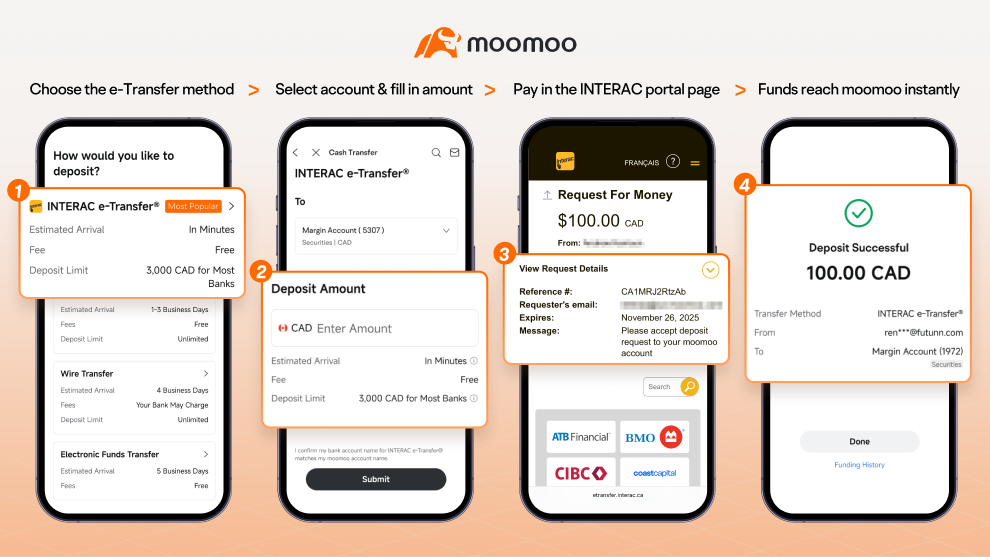
Step 4. Fund the approved account.
Send money from an account held in your name and follow the method-specific instructions in the deposit guide. Processing times vary.
Step 5. Transfer an existing account when appropriate.
In the app, go to Accounts → More → Stock Transfer and select the sending brokerage. Check supported account types and the live transfer terms before starting.
After funding, enable the account-security controls and review the currency, quantity and order type before placing the first live order.
Trading platform scam red flags
One red flag may have an innocent explanation. Several together should end the conversation.
Guaranteed or unusually steady returns.
Markets do not produce guaranteed profits. A salesperson who minimizes risk while promising a fixed daily or weekly return is selling certainty that a real market cannot provide.
An unsolicited relationship becomes an investment pitch.
The Canadian Anti-Fraud Centre warns about romance and social-media contacts that gradually steer victims to fake crypto or trading platforms.
Pressure to deposit immediately.
“Limited access,” secret tips and a coach waiting for your transfer are designed to prevent independent checks.
Crypto-only funding to an address supplied in chat.
A scammer may direct you to buy crypto at a real exchange and then send it to a wallet they control. The legitimate exchange does not make the destination legitimate.
A dashboard shows gains that cannot be withdrawn.
Numbers on a private website are not proof of executed trades or held assets. CAFC reports that fake platforms sometimes allow a small withdrawal to build trust before blocking a larger one.
You must pay to unlock your balance.
Do not send a new deposit for supposed taxes, compliance, verification or liquidity. Contact your bank and regulator through independently sourced details.
Someone requests remote access to your device.
A person who can control your screen may access banking, email, passwords and authentication codes.
A recovery service wants an advance fee.
Victims are often targeted again. CAFC and CIRO warn that recovery scams may demand money or remote access while claiming they can retrieve previous losses.
What to do if a platform looks suspicious
If you have not deposited, pause. Do not send identity documents, install remote-access software or keep negotiating with the person who approached you.
If money or information has already been sent:
Stop further payments. Do not pay an unlock fee or a recovery service.
Contact your bank, card issuer or legitimate crypto exchange immediately. Ask what transfer, recall or account-security options remain available.
Preserve evidence. Save the exact URLs, app listing, messages, phone numbers, emails, payment instructions, wallet addresses, transaction IDs and screenshots.
Secure connected accounts. Change reused passwords, enable MFA, revoke unknown sessions and review bank and email activity.
Report the incident. Contact your provincial or territorial securities regulator and the Canadian Anti-Fraud Centre. Report theft or fraud to local police. If the concern involves a CIRO-regulated dealer or advisor, use CIRO's complaint process.
Reporting does not guarantee recovery, but acting quickly can preserve options and help authorities connect related complaints.
Summary
The best answer to “is this trading platform legit?” should come from records the platform does not control. Identify the legal entity, verify its registration and dealer status, check CIPF membership, then match the official domain and review the account controls.
Moomoo Canada passes that test through independently searchable CIRO and CIPF records. It also gives clients device management and separate locks for trading and selected asset information. Those controls add useful protection, while the usual responsibilities still apply: use unique credentials, enable available verification features and treat every investment as capable of losing value.
Frequency Asked Questions
Does an App Store listing prove that a trading app is legitimate?
No. An app-store review checks different matters from securities registration. Canadian regulators advise investors to verify the firm through official registration records and confirm they downloaded the app offered by that firm.
What does CIPF protect?
CIPF provides limited protection for eligible property that a member firm fails to return after insolvency. It does not cover market losses, bad advice, unsuitable investments or crypto assets. Coverage limits and eligibility depend on CIPF policy and account category.
Is moomoo legit in Canada?
Yes. Moomoo Financial Canada Inc. is a CIRO-regulated investment dealer and appears in CIPF's current member directory. Canadian users should use the official moomoo.com/ca site or official app and review the applicable account documents.
This presentation is for informational and educational use only and is not a recommendation or endorsement of any particular investment or investment strategy. Investment information provided in this content is general in nature, strictly for illustrative purposes, and may not be appropriate for all investors. Read more