Top 10 Canadian REITs to Watch in 2024 During a Rate-Cut Cycle
Amid the complex backdrop of the global economy, the role of monetary policy has become increasingly significant. Since June 2024, the Bank of Canada has lowered its benchmark interest rate three times. In the cycle of interest rate cuts, the real estate industry, which relies on borrowing for expansion, may face opportunities, and for many Canadian investors, investing in REITs could be a good choice to participate in this sector.
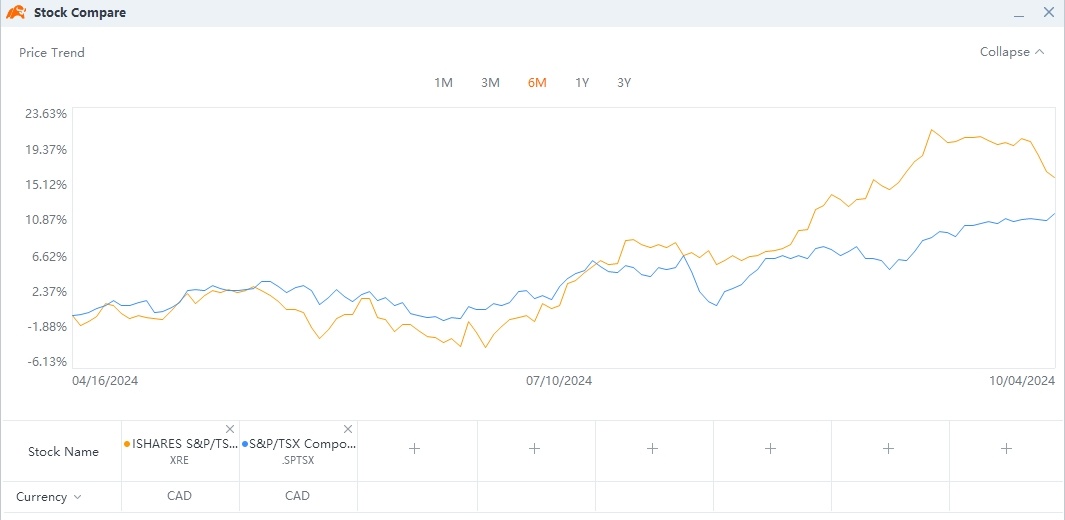
Since the Bank of Canada announced its decision to cut interest rates in June, REITs in the Canadian market have performed well, showing an overall upward trend. The XRE (iShares S&P/TSX Capped REIT Index ETF) has risen by about 15% in the past six months, outperforming the S&P/TSX Composite Index (.SPTSX).
However, how do interest rate cuts affect REITs? This article aims to explore this question while introducing 10 REITs for investors as a reference.
Effects of rate cuts on Canadian REITs
REITs (Real Estate Investment Trusts) are a special type of investment vehicle that allows individual investors to indirectly invest in a diversified portfolio of real estate assets by purchasing shares or units of REITs, thereby sharing the benefits from rental income and asset appreciation. REITs are mainly divided into equity type (directly owning and operating properties, such as shopping centers, office buildings, etc.), mortgage type (earning interest by providing real estate mortgage loans or purchasing mortgage-backed securities), and hybrid type (combining the characteristics of both equity and mortgage types). REITs are typically managed by professional teams and are required to distribute most of their annual earnings to investors in the form of dividends. To learn more about REITs, you can click here :What is a REIT?
The impact of a rate-cut cycle on Canadian REITs mainly includes:
Enhanced investor appeal
During a rate-cut cycle, the return on bonds and other fixed-income investments decreases, while REITs can offer stable and higher dividend income, which is more attractive to investors. This is because the dividends of REITs usually come from the rental income and capital appreciation of the real estate projects they hold, and these incomes are usually stable. Moreover, investors may shift funds from bonds to REITs, which could push up the prices of REITs.
Lower financing costs
In a rate cut cycle, as the benchmark interest rate is reduced, REITs can obtain loans at a lower interest rate and reduce financing costs. This helps REITs improve profitability, as reduced interest expenses may increase the income available for distribution to shareholders.
Stimulating real estate demand
Rate cuts usually stimulate activity in the real estate market because lower interest rates make it easier for homebuyers to obtain loans, thereby increasing demand for housing. In terms of the residential market, rate cuts help increase the activity of second-hand housing transactions because lower mortgage loan costs make it easier for sellers to find buyers and complete replacement. This active trading environment can drive up rents and housing prices, which is good for the performance of REITs.
In the commercial real estate sector, rate cuts also help increase the activity of the leasing market, increase the occupancy rate and rental income of commercial properties, and further promote the performance growth of REITs.
Potential risks
Although rate cuts bring many benefits to REITs, some potential risks should not be ignored. If an extended period of a rate-cut cycle leads to an overly accommodative monetary environment, it may cause a price bubble in real estate-related assets. At the same time, the relative depreciation of the domestic currency and high inflation pressure that may occur during this period also pose challenges to the performance of REITs.
Top 10 Canadian REITs to watch during a Rate-Cut Cycle
Here, based on market value and year-to-date performance, we list 10 REITs with a market value of over 1 billion Canadian dollars, which have achieved good returns in the Canadian market.
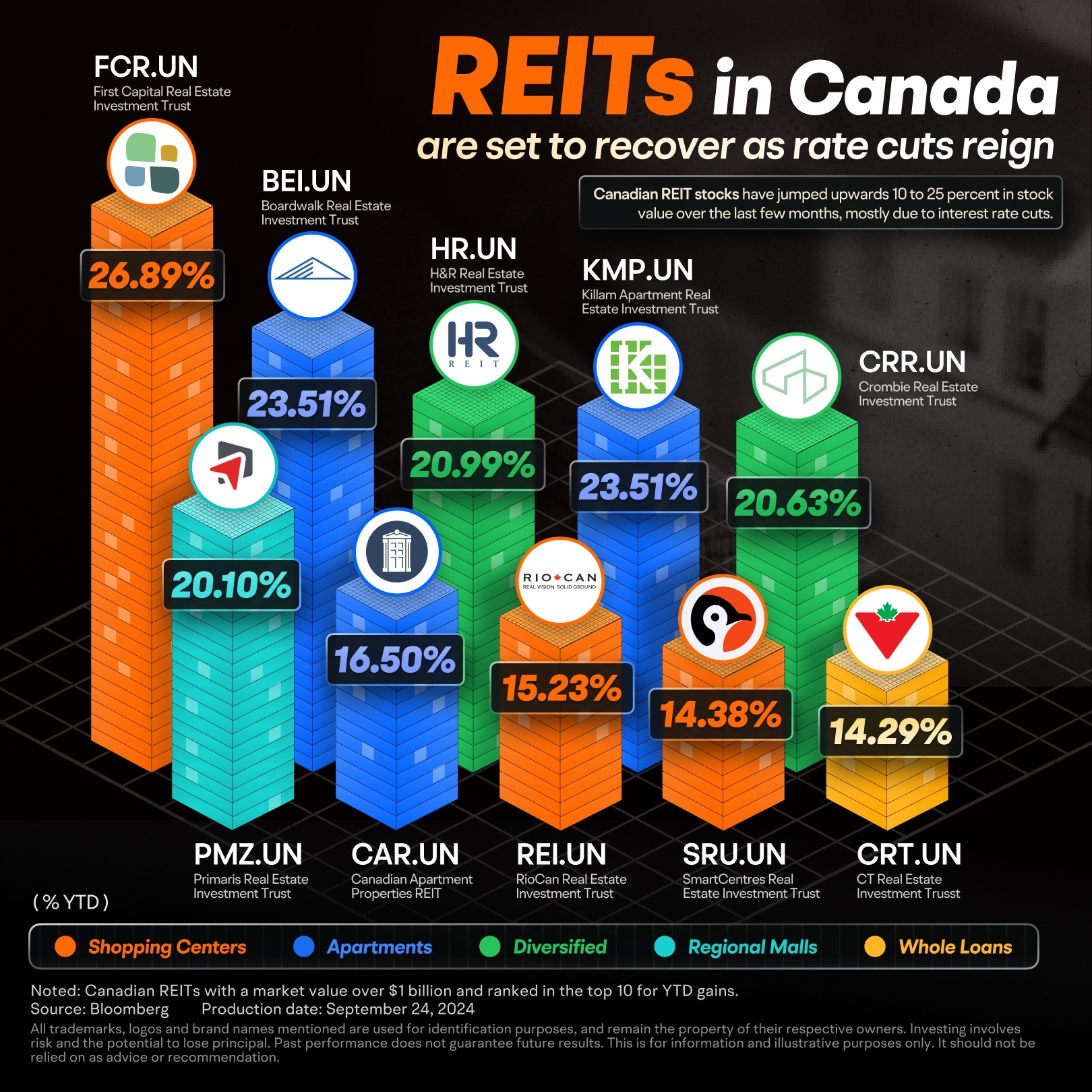
First Capital REIT (FCR.UN)
Core Business: Primarily invests in urban retail and mixed-use properties, including shopping centers, office spaces, and residential units.
Geographic Focus: Concentrated in major Canadian cities such as Toronto, Vancouver, Montreal, and others.
Features: Emphasizes community-centered locations, focuses on sustainable development, and social responsibility.
Market Cap:3.81B (As of October 8, 2024, market cap fluctuates frequently with stock prices and is for comparison purposes only)
Boardwalk Real Estate Investment Trust (BEI.UN)
Core Business: Focuses on the acquisition, development, and management of residential communities, specifically mid-to-high-end apartments.
Geographic Focus: Has a significant presence in provinces such as Alberta, Saskatchewan, Ontario, and Quebec.
Features: Provides quality living environments and focuses on tenant satisfaction.
Market Cap:4.39B (As of October 8, 2024, market cap fluctuates frequently with stock prices and is for comparison purposes only)
H&R Real Estate Investment Trust (HR.UN)
Core Business: Diversified portfolio including office, retail, industrial properties, and residential.
Geographic Focus: Canada, the United States, and parts of Europe.
Features: Has an international perspective, pursuing long-term stable growth.
Market Cap: 2.89B (As of October 8, 2024, market cap fluctuates frequently with stock prices and is for comparison purposes only)
Killam Apartment Real Estate Investment Trust (KMP.UN)
Core Business: Focuses on the acquisition, management, and development of residential apartment buildings and Manufactured Housing Communities (MHC), as well as commercial real estate.
Geographic Focus: Primarily on the East Coast of Canada (Nova Scotia, New Brunswick) and Ontario.
Features: Offers affordable housing and values community development.
Market Cap:2.38B (As of October 8, 2024, market cap fluctuates frequently with stock prices and is for comparison purposes only)
Crombie Real Estate Investment Trust (CRR.UN)
Core Business: The main investment focuses on revenue-generating retail, retail-related industries, mixed-use, and office properties.
Geographic Focus: Across Canada.
Features: Has a partnership with Sobeys supermarkets, ensuring stable rental income.
Market Cap:2.81B (As of October 8, 2024, market cap fluctuates frequently with stock prices and is for comparison purposes only)
Primaris REIT (PMZ.UN)
Core Business: Large shopping centers and retail properties.
Geographic Focus: Major cities in Canada.
Features: Owns some of Canada's most famous shopping destinations, such as Square One Shopping Centre.
Market Cap:1.51B (As of October 8, 2024, market cap fluctuates frequently with stock prices and is for comparison purposes only)
Canadian Apartment Properties Real Estate Investment Trust (CAR.UN)
Core Business: Focuses on multi-residential properties, including apartments, student housing, and seniors' residences.The company derives nearly all of its revenue from rental income generated by leasing its properties to tenants.
Geographic Focus: Covers the entirety of Canada.
Features: One of the largest residential REITs, with a diversified portfolio ensuring stable cash flow.
Market Cap:8.64B (As of October 8, 2024, market cap fluctuates frequently with stock prices and is for comparison purposes only)
Riocan Real Estate Investment Trust (REI.UN)
Core Business: Retail properties, especially shopping centers.
Geographic Focus: Major city centers and surrounding areas in Canada.
Features: Owns several landmark properties, such as Yorkdale Shopping Centre.
Market Cap:5.94B (As of October 8, 2024, market cap fluctuates frequently with stock prices and is for comparison purposes only)
SmartCentres Real Estate Investment Trust (SRU.UN)
Core Business: The company is engaged in the development, leasing, construction, and management of a diverse range of properties, including shopping centers, office buildings, high-rise and low-rise apartments, rental homes, senior living accommodations, townhouse units, self-storage rental facilities, and industrial complexes.
Geographic Focus: Across Canada.
Features: Includes large shopping centers and office buildings, with partnerships with retailers like Walmart.
Market Cap:4.39B (As of October 8, 2024, market cap fluctuates frequently with stock prices and is for comparison purposes only)
CT Real Estate Investment Trust (CRT.UN)
Core Business: Primarily invests in properties that support the Canadian Tire retail network.
Geographic Focus: Across Canada.
Features: Closely associated with Canadian Tire, with assets mainly including retail stores and warehouses.
Market Cap:3.66B (As of October 8, 2024, market cap fluctuates frequently with stock prices and is for comparison purposes only)
Final thoughts on Canadian REITs during a Rate-Cut Cycle
Since June of this year, when the Bank of Canada announced a rate cut, benefiting from this positive impact, Canadian REITs have generally shown an upward trend. The rate cut not only reduced the financing costs for REITs but also increased their attractiveness to investors seeking stable returns. With lower interest rates, REITs can obtain funds on more favorable terms, which is beneficial for them to expand their portfolios and improve operational efficiency. At the same time, the rate cut has also stimulated activities in the real estate market, providing momentum for the performance growth of REITs.
However, the potential risks involved should not be overlooked. These include a series of risks that may arise from a prolonged loose monetary policy, as well as potential risks that may be brought about by changes in the international market. Therefore, investors should carefully assess the potential risks before investing and choose REITs with a robust asset portfolio, a good management team, and strong cash flow as investment targets.
This article is for reference only and does not constitute any investment advice.

This presentation is for informational and educational use only and is not a recommendation or endorsement of any particular investment or investment strategy. Investment information provided in this content is general in nature, strictly for illustrative purposes, and may not be appropriate for all investors. Read more