Three Investment Strategies

With thousands of stocks listed on the market, selecting an appropriate investment strategy is crucial.
How should one select stocks, and how can the optimal timing for buying and selling be determined?

We can find answers by examining the investment philosophies of three renowned investors: Warren Buffett, William Gann, and John Bogle.

Many are likely familiar with their investment styles, or more precisely, their investment strategies.
They represent distinct schools of investment strategy: value investing, technical analysis, and passive investing, respectively.

Buffett is one of the most respected value investors, focusing on corporate fundamentals and intrinsic value.
This approach is also known as fundamental analysis.

A stock is considered undervalued if its market price is lower than its intrinsic value.
This presents investors with the opportunity to profit by purchasing stocks at a discount.
This is why value investors are often referred to as bargain hunters.

Identifying undervalued stocks is highly appealing.
However, as corporate information becomes increasingly transparent in the market, the share prices of high-quality companies often already reflect their intrinsic value.

Charlie Munger, Warren Buffett’s partner, once stated, “It is far better to buy a wonderful company at a fair price than a fair company at a wonderful price.”

Consequently, value investors tend to seek out high-quality companies at reasonable valuations rather than strictly pursuing undervalued stocks.

How does one become a value investor?
First, focus on the company’s fundamentals, including its business model, competitive advantages, and growth potential.

In addition, valuation is also crucial.
Recall what Munger has taught us:
Even for excellent companies, we should acquire them at reasonable prices.

There are numerous methods for valuing a company.
The P/E and P/B ratios are the most commonly used indicators. These will be explained in detail in subsequent chapters.

When discussing investment strategies, technical analysis is indispensable.
Unlike fundamental analysis, technical analysis focuses primarily on chart analysis.

Technical analysts believe that future stock price performance can be predicted by analyzing past trading activity and price movements.
Consequently, they seek trading opportunities within price trends and patterns.

Technical analysis is generally employed to address timing challenges, helping investors decide when to buy, sell, or hold cash.

To become a technical analyst, you need to master three skills: interpreting candlestick charts, understanding support and resistance levels, and identifying market trends.

Finally, there is passive investing.
John Bogle, the father of passive investing, argued that beating the market is difficult; a better approach is to track the market to capture average equity returns.

In simple terms, passive investing is a highly accessible strategy for most investors, especially beginners. It does not require extensive time spent on company research or analyzing complex price movements.

In summary, we have introduced three methods for investing in stocks.
Next, we will discuss how to practically apply these three strategies.

As mentioned above, value investors are generally more inclined to invest in high-quality companies at reasonable prices.

The question is: how does one determine a company's value?
For many investors, screening through thousands of stocks in the market is no easy task.

Warren Buffett is one of the most successful value investors in the world.
He considers Return on Equity (ROE) to be a very important factor.

On one hand, ROE is a financial ratio used to assess the extent to which a company converts shareholders' equity into profits, serving as an indicator of operational efficiency.

On the other hand, ROE serves as a measure of potential returns for shareholders.

For example, suppose you purchased some Apple shares at $2 per share in 2006.
At the end of 2020, the stock closed at $130 per share.

Notably, Apple’s average return on equity (ROE) over the past 15 years has been 39%.
The similarity between these two ratios highlights the reference value of ROE.
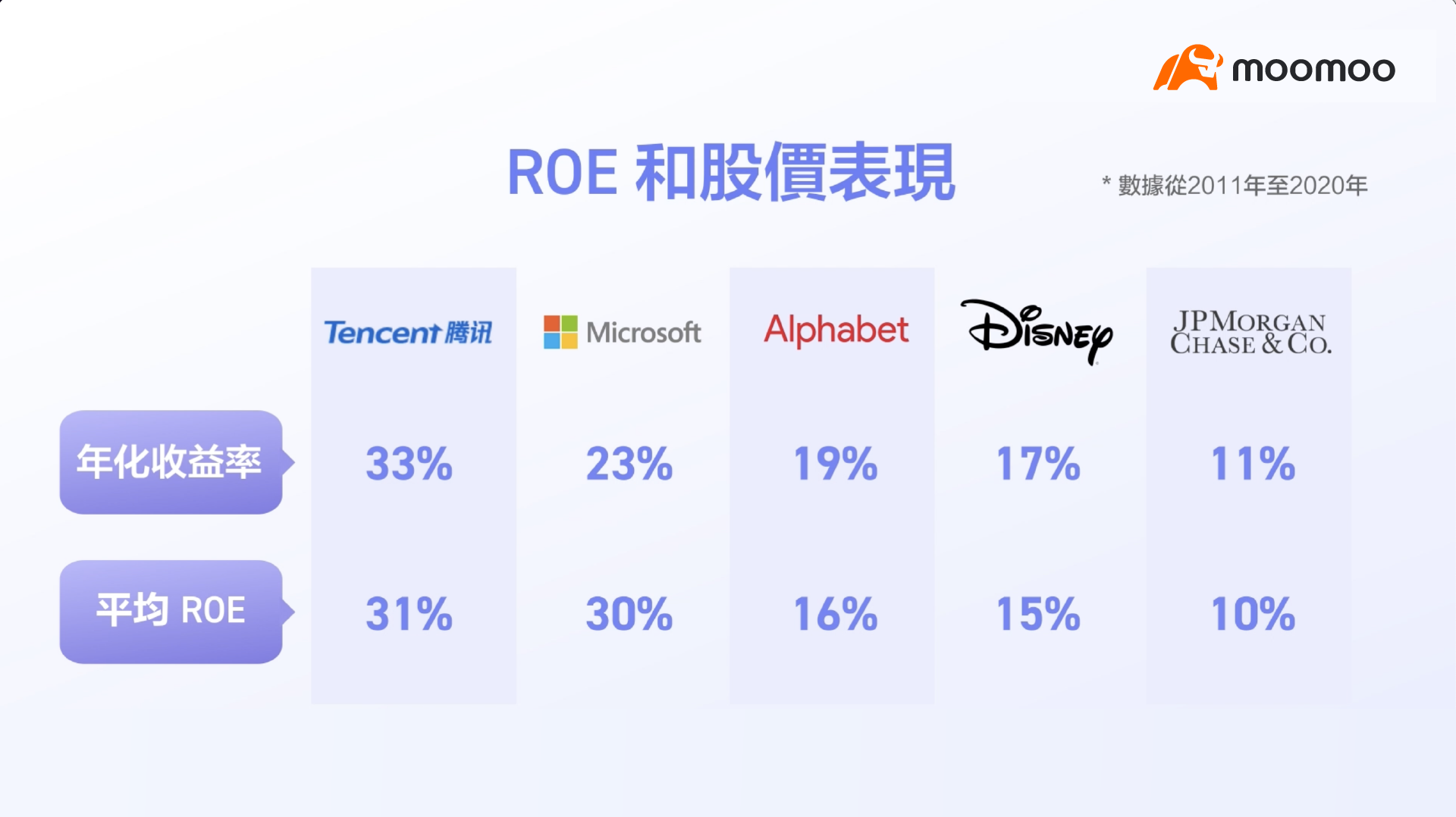
In fact, many companies exhibit similar trends.
Over the past decade, their annualized investment returns have mirrored their average ROE, as seen in companies such as Tencent, Microsoft, Alphabet, Disney, and JPMorgan, to name a few.
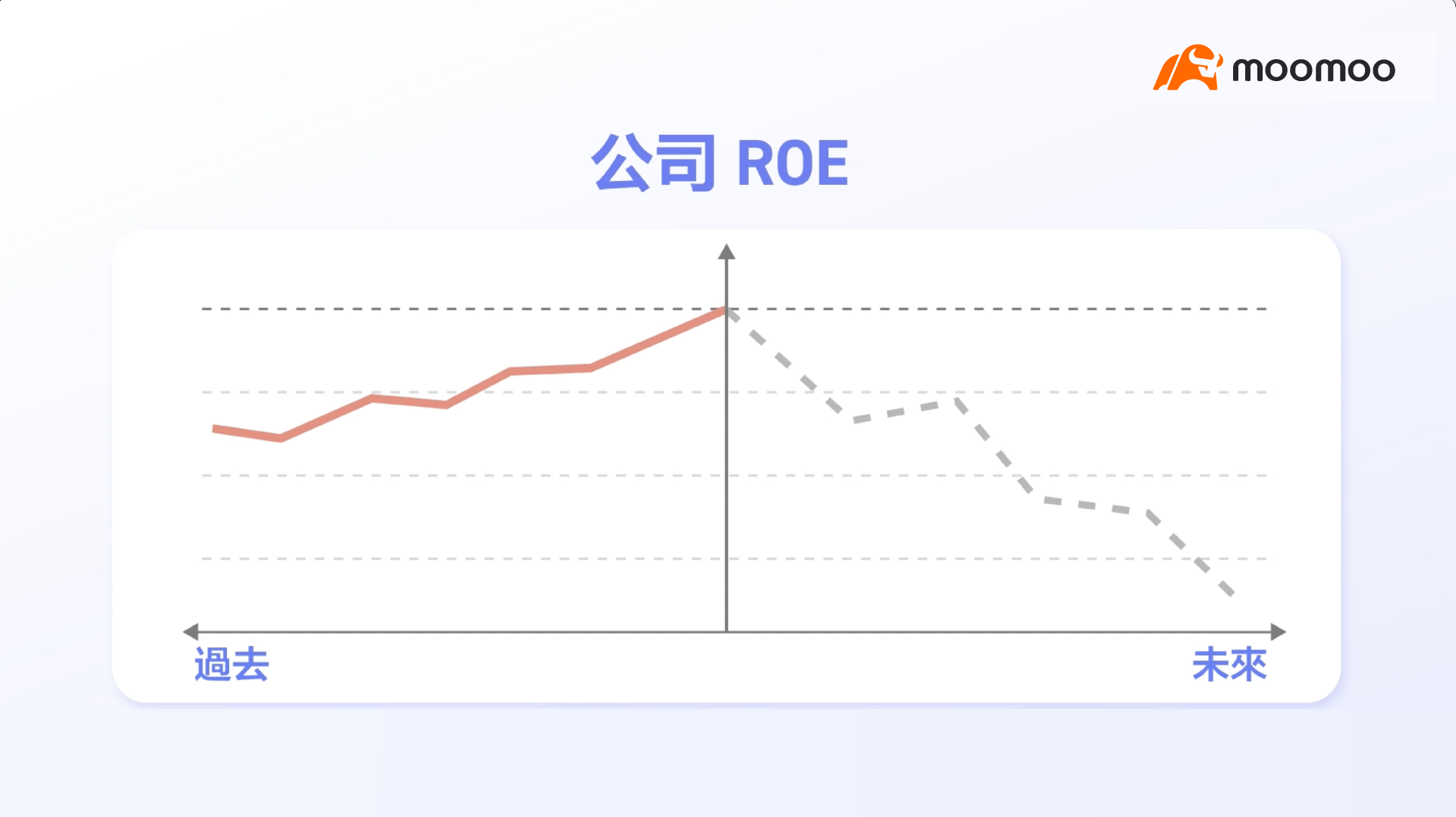
However, historical data reflects only past performance and does not guarantee future results.

Therefore, while ROE can help narrow down your choices, it should not be the sole criterion for identifying quality stocks.

Many other factors warrant consideration.
Business model, competitive advantage, and growth potential are among the most critical aspects.

First is the business model.
When evaluating a company, you can conduct research from three perspectives: products, customers, and corporate profitability.

Take Apple as an example once again.
The smartphone manufacturer divides its business into five segments: iPhone, iPad, Mac, Services, and Accessories.
While the majority of revenue comes from iPhone sales, the Accessories and Services segments are growing at a much faster rate than the iPhone segment.

Apple sells its products to customers around the world.
Consequently, in terms of customer base, Apple is more competitive than companies that focus solely on specific regions.

Profitability is a key indicator for measuring a company's operational efficiency.
Apple's net profit margin exceeds 20%. This means that for every $1,000 in revenue, it generates $200 in net profit.

Having discussed the business model, let us now turn to competitive advantages.
Competitive advantages are reflected in brand effects, patent effects, and network effects.
Brand building is akin to affixing a Coca-Cola label to a glass of soda, enabling it to be sold globally at a premium price.

Patents grant companies the exclusive right to manufacture and sell specific products.
This is common practice in the pharmaceutical industry.
If a pharmaceutical company holds a patent for a prescription drug, it can generate profits from it for many years.

Network effects originated in the internet era.
It refers to the phenomenon whereby an increase in the number of users enhances the value of a platform.

For example, Facebook, which recently changed its corporate name to Meta, sees 2.8 billion users access its flagship app daily.
With its massive user base, this social media company is one of the most valuable in the world.

The quest to identify the ideal company is not yet over.
The growth potential of the industry is also crucial.
Typically, emerging industries offer more investment opportunities than declining sectors.

For example, Amazon initially started as an online bookstore.
As demand for e-commerce surged, Amazon expanded its offerings to include electronics, apparel, furniture, food, and cloud services.
These efforts brought about significant transformations at Amazon.
To some extent, they reshaped the company into a new Amazon.

In contrast, Kodak tells a completely different story.
Kodak dominated the photographic film industry for much of the 20th century, with its market capitalization once peaking at $30 billion.

Unfortunately, as the film industry was disrupted by the rise of digital photography, Kodak’s photographic empire ultimately collapsed.
This presentation is for informational and educational use only and is not a recommendation or endorsement of any particular investment or investment strategy. Investment information provided in this content is general in nature, strictly for illustrative purposes, and may not be appropriate for all investors. Read more