Advanced Micro Devices
AMD
Broadcom
AVGO
Micron Technology
MU
4
Tesla
TSLA
5
Oracle
ORCL
The vast majority of exercises are automatically carried out based on the closing settlement price on the contract expiration date. If you, as the option purchaser, need to exercise early or waive your rights to exercise, please refer to [How can I early exercise stock options or waive my exercise rights]
As the option purchaser, if the option is out of the money on the expiration date, the expired option will have no value and there will be no exercise taken place; if the moneyness of the option is equal to or higher than $0.01, the option will be automatically exercised, which will be completed in the form of a physical delivery.
As the option seller, when the option is exercised by the purchaser, the option clearing house will randomly match the open short position with the exercised option. If your account is assigned, you must either deliver the underlying stock (in case of a call option) or buy the underlying stock (in case of a put option).
Generally speaking, in-the-money options are exercised when they expire. If you are short an in-the-money option on the expiry date, you will most likely be assigned. The purchaser may also choose to waive the exercise rights or early exercise the option regardless of the actual moneyness.
If you need to early exercise options or waive your exercise rights, please email your instruction to optionstrading@au.moomoo.com and ensure the following information is provided:
1. Account ID
2. Option Symbol
3. Number of contracts
4. Action (Exercise/Waive)
**Note that we can only process options waiver requests on the expiration date itself.
**Instructions need to be received before US regular session close, 4pm ET, for same day processing.
**Moomoo AU will proceed once satisfied with the investor's intention to exercise, and confirming the account purchasing power required for the exercise.
Our system will assess the risks to your cash account by simulating the exercise of 0DTE (0 days to expiration) options that expire that day, starting at 1:00 PM ET, which is three hours before the market closes, on the expiration date.
We reserves the right to liquidate or let the 0DTE options lapse if any of the following cases occur after the simulation:
Exercising in-the-money put options will result in a short position of the underlying stock.
The available cash in the account is insufficient to cover the exercise of in-the-money call options.
To help avoid potential losses from forced liquidation or options lapsing, please ensure you have sufficient cash or underlying shares for the option exercise. Keep in mind that managing your open options positions into the expiration date, including taking proactive steps to help manage risk, is ultimately your responsibility.
Close-to-Expiry options are options that are within 5 trading days to expiry.
Generally at expiry, your option position may undergo the following changes:
When you have a long call position that is exercised, it will become a long position of the underlying stock, and the account will deduct the cash required to establish the position.
When you have a long put position that is exercised, it will become a short position of the underlying stock, and the account will increase the amount of cash corresponding to the short position.
When you have a short call position that is assigned, it will become a short position of the underlying stock, and the account will increase the amount of cash corresponding to the short position.
When you have a short put position that is assigned, it will become a long position of the underlying stock, and the account will deduct the cash required to establish the position.
To better monitor the risks associated with the possible option exercises on the expiration day, we begins to calculate the margin and settlement requirements for options that are in-the-money or close to in-the-money (close meaning within 1% of the exercise price) on the day of expiration usually 3 hours before market close. Not having enough funds for the potential exercise, will lead to the account being marked as "dangerous" from a risk control perspective. Customers should ensure the account has sufficient liquidity for option exercise via closing positions or injecting more funds.
In the case that your account is marked as "dangerous", we reserves the right to perform the following actions: 1) liquidate your option positions; 2) waive your right to option exercises; 3) execute the option exercise but close the corresponding stock positions afterwards, etc.
Pin risk is the risk of uncertainty an option investor faces at expiration when the underlying asset's price is at or near the strike price. The investor is uncertain whether the option will be exercised, assigned, or expire worthless. As a result, a previously hedged position may become unhedged, potentially exposing the account to a significant underlying stock position when the market reopens.
Standard anticipated exercise calculations typically offset long and short exercise results, which overlooks real one-sided risk. Therefore, for strategies with significant pin risk, we add extra margin starting at unspecified times before market close on the expiration date.
Pin Risk Example
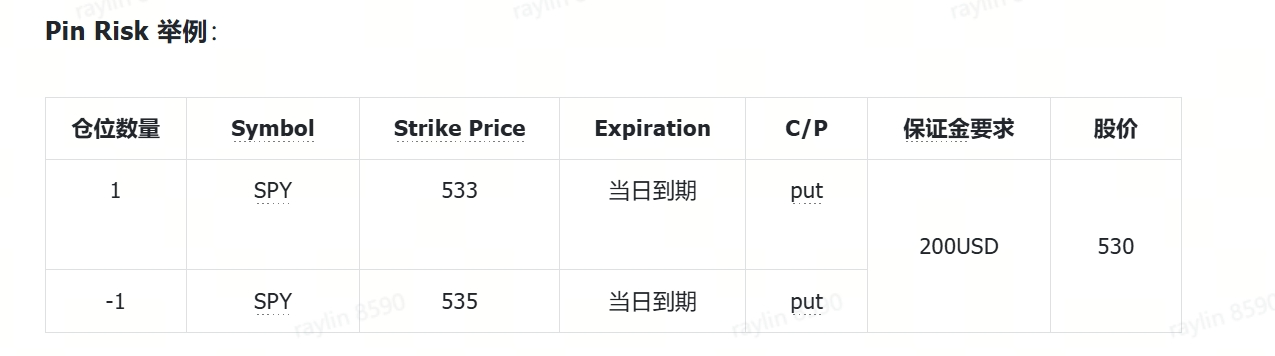
If you hold the SPY put vertical spread described above and your account equity (ELV) is $250, your account meets the margin requirement and is considered safe.
At expiration, if both legs are in-the-money, they would normally be auto-exercised and offset each other. However, the counterparty to your short put (the holder of the long put at the same strike) may choose not to exercise when slightly in-the-money, based on their judgment of after-hours movement, overnight risk, or exercise costs.
In this scenario, even though the option is in-the-money, the counterparty chooses not to exercise. However, your long put at $533 is in-the-money and will be auto-exercised, breaking the original hedge. As a result, you sell 100 shares of SPY at $533 per share, resulting in a short position of 100 shares.
After exercise, if SPY rises to $550, your short position will incur a $1,700 loss ($17 per share × 100 shares), resulting in a $1,450 account deficit.
Conversely, when both legs are out-of-the-money, long holders may also choose to exercise.
Since spread strategies typically have low initial margin when hedged, we calculate additional pin risk margin for spread strategies. These include: vertical spreads, butterfly spreads, condor spreads, iron butterflies and iron condors, calendar and diagonal spreads.
The additional margin percentage depends on the underlying asset's volatility and our risk management policy, but generally won't exceed the maintenance margin of the underlying asset after exercise/assignment ( the greater of long and short maintenance margin).
If your account equity (ELV) falls below the maintenance margin after adding the extra margin and your account status is "Margin Call", you may face forced liquidation.
Assume that the customer holds an option position FUTU 210514 150C, and there is no other positions or excess cash. On the expiration date, the underlying price of FUTU is $200. Assuming that the option has no time value, then the value of the client's option holding at this moment is: (current price - exercise price) * contract size * number of positions = (200 - 150) * 100 * 1 = $5000.The client's equity loan value (ELV) = initial margin requirement (IM) = $5000, where all of the ELV comes from the option holding.
Exercising this in-the-money option at expiry means that the value of the option goes to zero, and correspondingly a position of the underlying stock is opened at the exercise price.
In the above example, the option value of $5,000 goes to zero, and 100 shares of FUTU are bought at a price of $150, therefore:
● The purchase price of the underlying shares is $150 * 100 = $15000. since the market price of those shares is $200 * 100 = $20000,the account will have an ELV balance of 20,000 - 15,000 = $5,000, which remains unchanged before and after the exercise.
● The initial margin requirement has changed from $5,000 for a single option to the initial margin requirement for 100 shares of the underlying stock, which is 20,000 * 50% = 10,000 (assuming the stock margin requirement is 50%).
Because of this increase in the margin requirement, the account is deemed "insufficient" in funds needed for the exercise.
Therefore, the client needs to make up the difference here which is 10,000 - 5,000 = $5,000 in order to ensure a successful option exercise.
If you have open orders for 0DTE (0 days to expiration) options that are in the money, we will calculate the required buying power by assuming the orders are filled and the options exercised or assigned. If this calculation triggers a margin call on your account, we may cancel these orders at any time to ensure that your account remains in good standing.
Additionally, if you attempt to open 0DTE options and the orders remain unfilled one hour prior to market close on the expiration date, we reserve the right to cancel these orders at any time.