What you need to know before trading in Canada - the basics Ⅱ
With the introduction of the Canadian stock market in the previous article, I'm sure you've probably jumped at the chance to try investing in it yourself. But before you get started, it’s important to learn key steps that will help you research your potential investments.
So in this post, we'll cover the detailed steps to buying stocks, including how to open an account, pick stocks and optimize your portfolio.
Step 1: Open an online brokerage account
To initiate stock trading, the first step is securing a brokerage account. When selecting an online stock brokerage, evaluate 3 key factors:
Brokerage Offerings: Assess whether the firm provides all the necessary products and services. Some brokerages excel in offering educational resources for novice investors, while others grant access to stock research and analytical tools.
User-Friendly Platform: Evaluate the ease of navigating the brokerage platform, especially if you intend to trade using a mobile device. Many major brokerages permit the use of simulated funds for a hands-on experience with their trading platforms.
Low-fee Brokerage Accounts: Compared to other traders, moomoo has more competitive prices.
Once you pick an online brokerage, you’ll need to fill out an application to open an account. Typically, you’ll need to give your Social Insurance Number, bank account information, and an image of a valid government-issued ID.
>>Need a brokerage account? Check Moomoo Stocks Trading Platform
Step 2: Choose a direct investing account
Equally important in the process of setting up your investment account is deciding what type of account to establish. There are several different types of accounts to consider, depending on your goals.
Some of the most popular investment accounts include:
RRSPs (Registered Retirement Savings Plan) are typically used to save for retirement. Contributing to an RRSP can allow you to defer taxes on the returns you earn on the investments in the plan and to access the funds in retirement years when you may potentially be in a lower income tax bracket.
>>Learn more about RRSP? Check An Overview of the RRSP Account for New Canadian Investors
TFSA (Tax-Free Savings Account) can be used to save for short- or long-term goals because it lets your savings grow tax-free. A TFSA can be used to save for various types of goals, like an upcoming vacation or large purchase.
>>Learn more about TFSA? Check
An Overview of the TFSA Account for New Canadian Investors
Advanced Strategy: How to Maximize Your TFSA Benefits in 2024?
Margin accounts can help you boost your buying power by leveraging value in your portfolio. You can borrow against value in the securities you already own to make additional investments and access sophisticated investment strategies, including option trades and short selling. However, leveraged trades are not for everyone. Along with the potential for greater returns, comes the flip side of increased exposure and risk.
A cash account could be used to save for a variety of goals, can provide flexibility to easily access available cash in the account and you can trade a variety of securities on North American markets.
Investors could choose the corresponding account type according to their long and short term needs.
Now that you have an overview of some of the types of accounts available to you, the next step is to consider what types of stocks and companies you want to invest in.
Step 3: Pick stocks you want to buy
So how to find and buy stocks that have long-term growth potential, solid business models, and strong financial footing?
Tips for stock picking
Here are some key terms you need to know about stock charts:
Description
Ticker symbol: Abbreviation of a company name for stock exchange representation.
Previous close: The last-traded price of security, also known as the market price.
Change: The change between current price and yesterday's closing price.
52-Week high/low: The highest and lowest values of the stock in the last year. These spread between them can be a measure of the stock’s overall volatility.
Volume: The number of shares traded in a period of time. A higher volume means more people are buying and selling that stock.
Take Celestica Inc. (TSX:CLS) stock as an example:
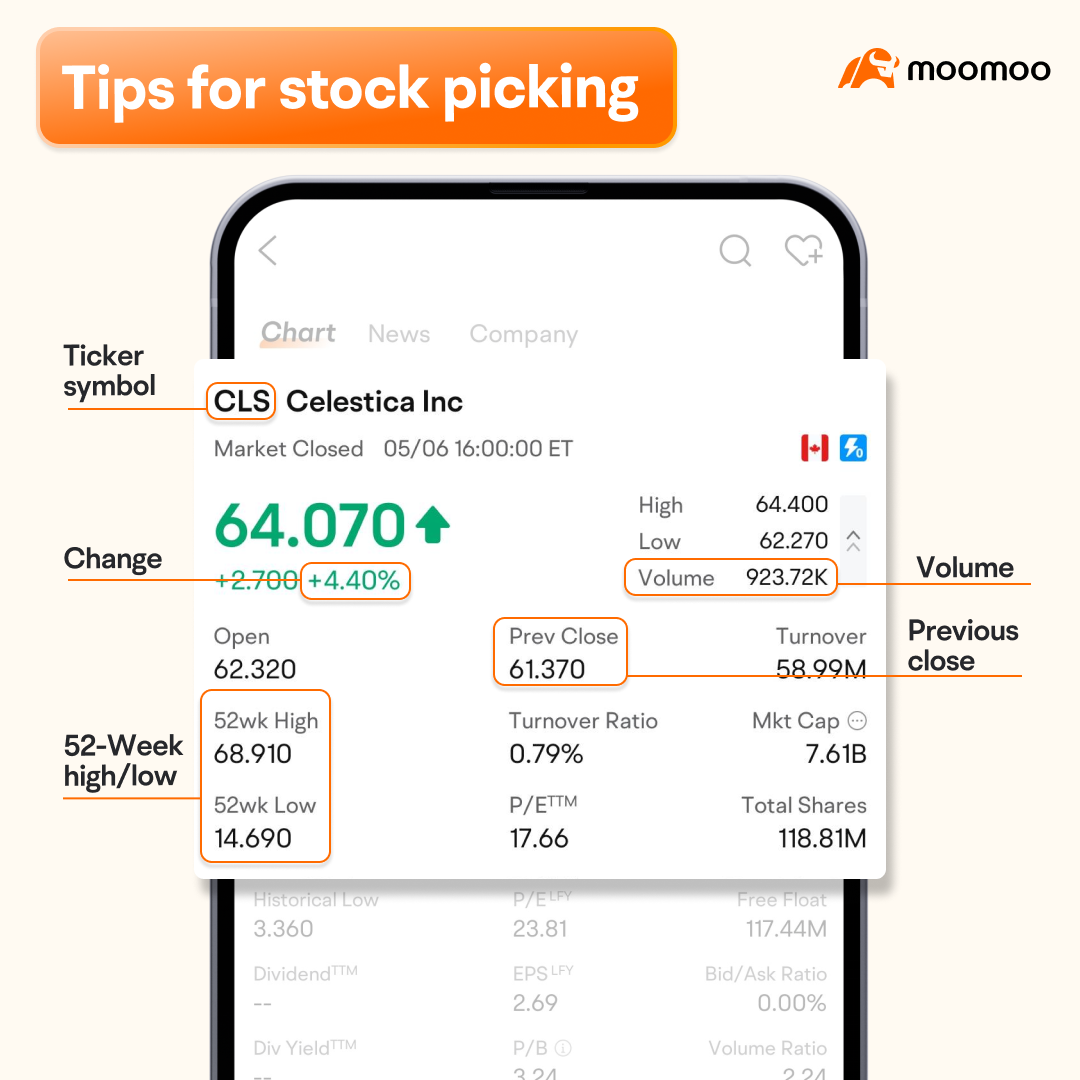
The screenshot below presents Celestica closed at CAD 173.50, seeing a significant increase of 4.40% from the previous close. With a market capitalization of approximately CAD 7.61 billion, Celestica is considered a mid-cap company, offering a blend of growth potential and stability. Key financial metrics such as a P/E ratio of 17.66 (which indicates a 17.66 times increase in market capitalization from the stock's EPS) and EPS of CAD 3.63 suggest that the stock is reasonably valued compared to its earnings.
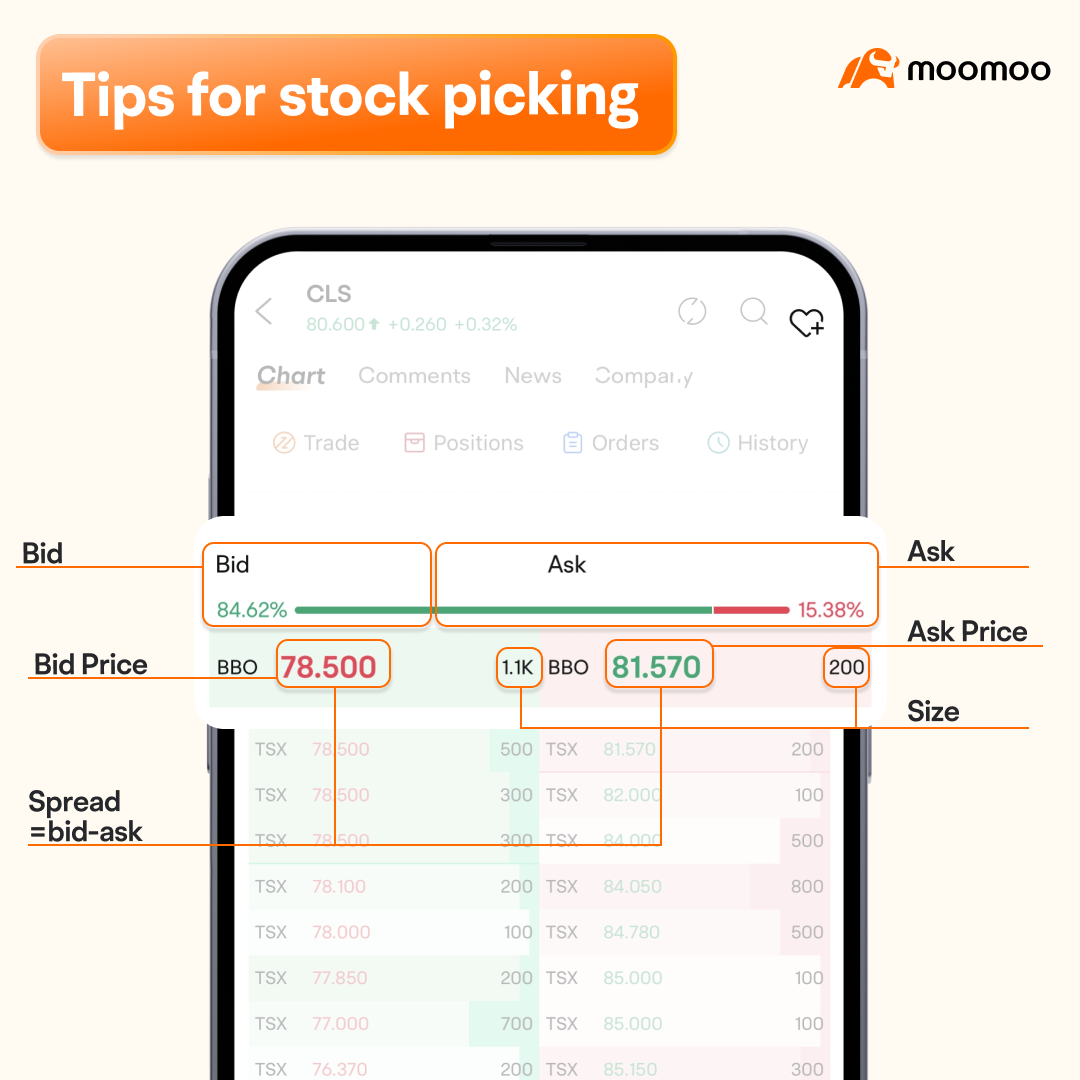
Bid: The highest price someone is willing to pay to buy the stock right now.
Ask: The lowest price someone is willing to accept for the sale right now.
Spread: The difference between the highest bid and the lowest ask is known as the spread.
Size: The number of shares that can be traded at bid/ask prices.
As the chart shows below, we can see that the bid price is $69.60 and the Ask price is $70.00. Additionally, The Bid size is 5 shares and the Ask size is 12 shares. A larger Bid size suggests that more buyers are willing to purchase the stock at the bid price, indicating strong buyer interest or demand. The proportion of buyer in this case is comparatively lower than the seller, which is 29.41% and 70.59% respectively. It is likely to indicate that more investors are trying to sell their positions in the hand with the insufficient upward momentum.
The spread in this case is $0.40 ($70.00 - $69.60). A lower spread often indicates a more liquid market or higher trading volume, while a wider spread can indicate lower liquidity. This spread of $0.40 in the screenshot suggests a moderately active market.
Fundamental and technical indicators
Selecting stocks is a challenging task, and even seasoned investors may not always make the right choices given the multitude of factors to consider, including management, valuation and technical indicators, profitability, growth potential, liquidity, and more.
As a result, ordinary investors may struggle to sift through all of these indicators. However, the moomoo stock screener function can help you quickly identify a pool of stocks that meet your criteria, and investors can even utilize pre-screened filters that we have carefully prepared.
Step 4: Deciding how many shares to buy
Once you do identify good long-term stocks, you'll want to decide how many shares to buy. A prudent approach is to commence with paper trading, utilizing a stock market simulator, to gain initial experience. Through paper trading, one can practice buying and selling stocks using simulated funds.
Alternatively, if ready for actual investments, starting with a minimal amount is advisable. Initiating with just a single share allows individuals to acquaint themselves with stock ownership dynamics and assess their ability to withstand market fluctuations with minimal stress. As proficiency in navigating the market grows, investors can gradually diversify their stock holdings.
Step 5: Buying stocks using the right order type
Gaining expertise in stock purchasing requires comprehension of two important order types: basic orders (inclusing market orders and limit orders) and conditional orders(a series of orders derived from stop-loss order).
Basic orders
A market order executes immediately at the prevailing market price, ensuring quick transaction but possibly at varying prices. It allows rapid access to the stock market, ideal for investors who value speed over exact pricing. However, there is a possibility that the actual execution price may vary from the anticipated price.
A limit order sets a specific price for buying, offering control over the transaction price but may delay the execution. This type of order is advantageous for investors who seek precise pricing and wish to avoid paying above a set limit for a stock. Nevertheless, there is a risk that the order may not be executed if the stock never hits the specified price. Understanding these nuances enables investors to make more strategic decisions based on their specific investment needs.
Conditional orders
A stop order, which includes stop-loss, stop-entry, and trailing stop-loss orders, instructs you to buy or sell a security once it reaches a pre-set price level, known as the stop price. Upon reaching the stop price, the order becomes a market order. One difference between limit order and conditional order is the purpose: limit order is set to trade at an appropriate price while conditional order is placed to control risks and ensure that you don't lose too much money.
Step 6: Make your trades
There are two ways to place an order:
In the moomoo app, tap Accounts > Trade, enter order information, tap Buy or Sell, and enter your transaction password in the Unlock Trade pop-up window;
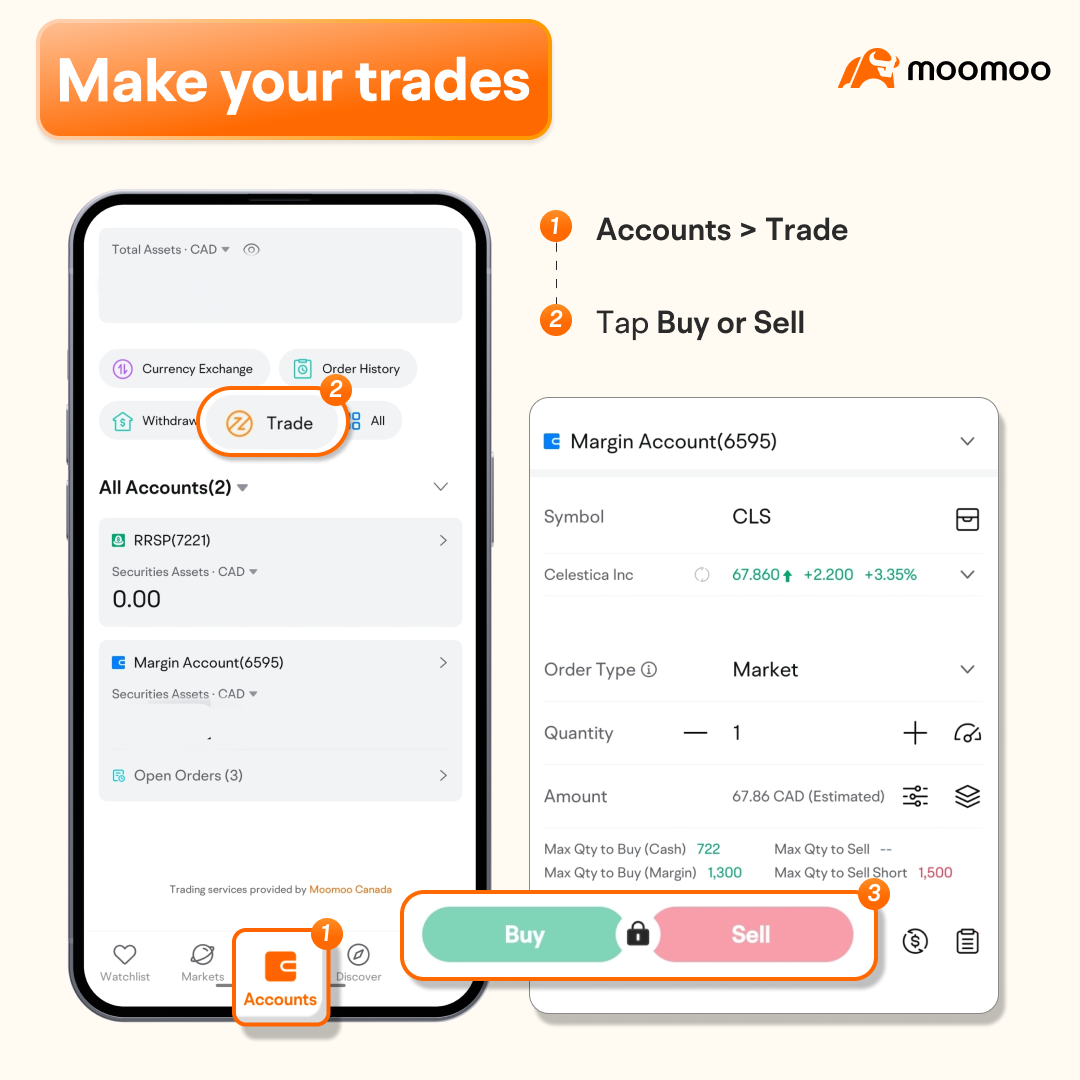
2. In the moomoo app, tap a stock to access the Quotes page, tap Trade, enter order information, tap Buy or Sell, and enter your transaction password in the Unlock Trade pop-up window.

Step 7: Optimize your portfolio over time
It's impossible to consistently pick winners or time the market perfectly, even as an expert investor. If you trust in the fundamental strength of the company you're investing in, you must accept short-term fluctuations. Diversifying your investments across various industries and sectors is the most effective way to stabilize your portfolio over time.
Another way to diversify your investments and gain access to the stock market without having to research every company ad nauseam is to invest in ETFs or in mutual funds. These are like mini-portfolios of stocks and other investments.
This presentation is for informational and educational use only and is not a recommendation or endorsement of any particular investment or investment strategy. Investment information provided in this content is general in nature, strictly for illustrative purposes, and may not be appropriate for all investors. Read more