China Consumer and Tech Stocks Surge: How Long Will the Rally Last?
Three key Chinese authorities—the People’s Bank of China (PBOC), the China Securities Regulatory Commission (CSRC), and the Ministry of Housing and Urban-Rural Development—introduced a series of stimulus policies. These measures include lowering interest rates, reducing reserve requirements, decreasing mortgage rates, and injecting medium- and long-term funds to manage short-term market fluctuations.
As a result of these significant monetary and fiscal stimulus initiatives, the markets in China and Hong Kong experienced substantial gains, with their market capitalizations increasing by over $2 trillion and $1.2 trillion, respectively, in just 15 trading sessions.
Chinese tech and consumer US-listed stock surge
US-listed Chinese stocks have seen a notable rise this month, especially in sectors like consumer discretionary, internet, and brokerage, which have demonstrated consistent gains over several days. Leading the trend is Bilibili Inc. (BILI), whose stock price surged by 100% in just 10 trading days.
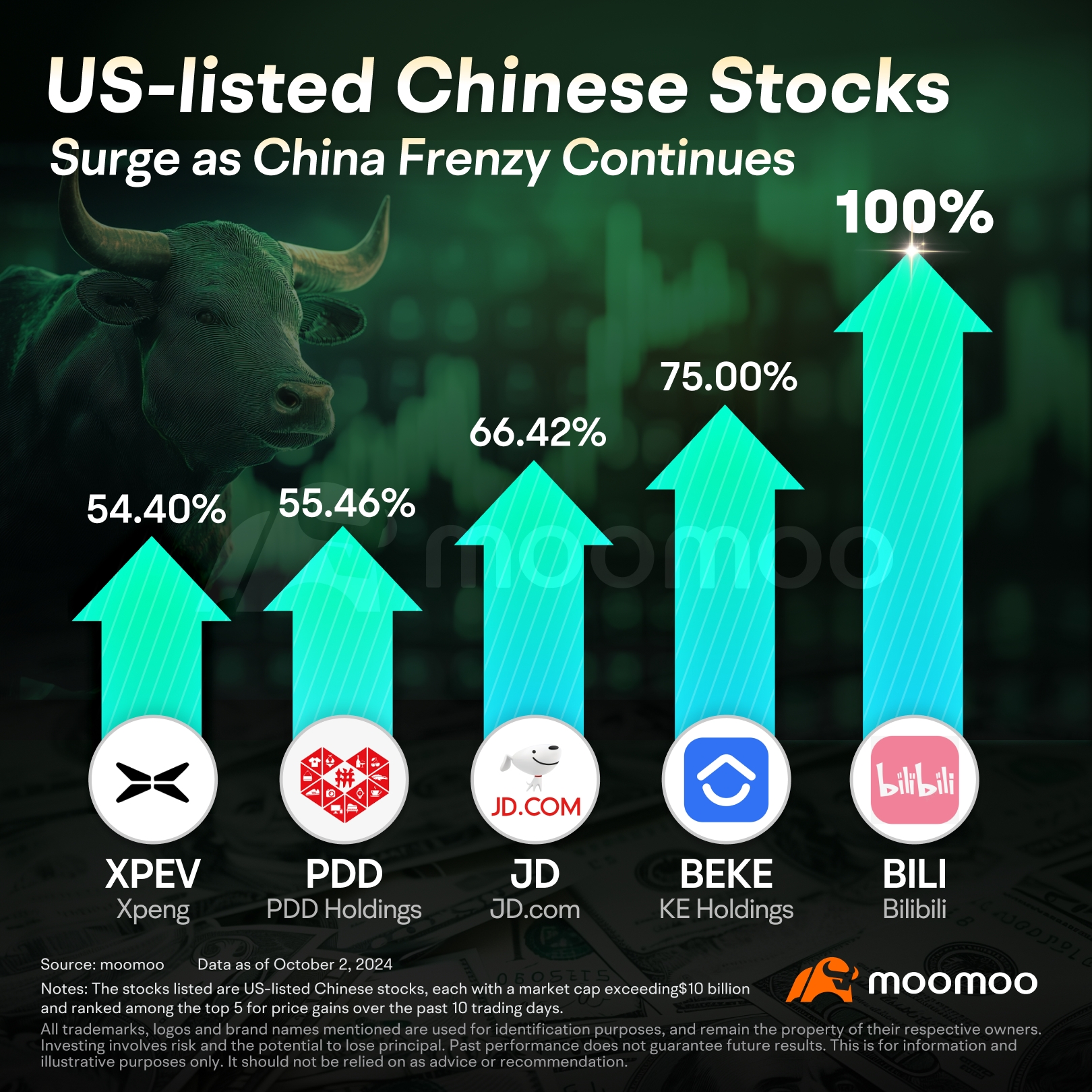
Surge in Chinese Concept Stocks: How Long Will This Trend Last?
The next question for investors is: how long will the surge of the China Rally last, and how will it benefit US-listed Chinese stocks?
Continuous Implementation of Stimulus Measures
With a lackluster economy over the past few years, concerns are growing about deflationary pressures in China. JPMorgan believes that the comprehensive stimulus measures introduced by the central bank on Tuesday represent the most extensive loosening of policy since 2015. Bank of America pointed out that the series of measures launched provides immediate liquidity to the markets. If the market continues to perform well and economic data shows improvement, this will further encourage the return of individual and overseas investors, helping to stabilize the market.
Foreign capital remains significantly underweight in Chinese assets due to concerns over a worsening economy. Hedge funds' allocation to the Chinese stock market is only 6.8%, hitting a five-year low, which is lower than in February this year and about 1% lower than the peak in April-May. There is still considerable room for increased shareholding.
Low Valuation Might Drive Capital Inflow
Following the China Rally, the Hong Kong stock market's P/E ratio jumped significantly to 17 times, with technical indicators suggesting that the Hong Kong market is "overbought." However, both the Hong Kong and Chinese stock markets have experienced a prolonged period of low valuation. With the implementation of a range of stimulus measures, there is potential to restore market confidence and consumer sentiment. Some investment banks have begun to reconsider the undervalued market.
Indeed, the current valuations of leading Chinese e-commerce and technology enterprises are around 8 times and 15 times, respectively. In comparison, the Magnificent Seven stocks, such as Nvidia, have a P/E ratio of about 58 times. Chinese technology stocks remain significantly lower, which may attract some revaluation.
Hedge funds have "sharply" accelerated their allocations in purchasing Chinese equities during the week of September 23-27, reaching their highest level since Goldman Sachs began recording in 2016. The inflow was driven by long positions, particularly in individual stocks, focusing on consumer, industrials, financials, and information technology sectors.
How to Deploy in the Chinese Concept Stock Market Before the Breakout?
Looking at the list of top gainers, industry preferences for funding are quite clear, including consumer, high dividends, and internet sectors.
JPMorgan suggests focusing on the real estate, discretionary consumer, and materials sectors, especially companies benefiting from lower down payments and mortgage rates, such as KE Holdings (BEKE.US) and JD.com (JD.US). Additionally, leading companies in the education sector, such as TAL Education (TAL.US), may see their market position solidify following industry integration.
Another focus may be on Chinese Large Cap ETFs and options. Recently, the US stock market has also seen heightened interest in Chinese concept ETFs and related options. The volume of iShares China Large-Cap ETF (FXI.US) soared nearly 10%, with turnover exceeding $5 billion—three times as much as the previous day—ranking it tenth in the entire US stock market. Furthermore, a triple long position in the Direxion Daily FTSE China Bull 3X Shares ETF (YINN.US) showed growth approaching 30%, leading the entire US stock ETF market in daily return rates, while a double long position in the Direxion Daily CSI China Internet Index Bull 2x Shares ETF (CWEB.US) rose by over 20%.
The options market is also very active. Multiple call options for iShares China Large-Cap ETF (FXI.US) expiring this Friday have all generated significant profits, with premiums rising up to 75 times. According to a previous report by Futu, before this round of the Chinese concept stock market boom, 'smart money' had quietly accumulated a large number of call options for this ETF. Approximately 30,000 FXI call option contracts changed hands on Monday, allowing holders to purchase 3 million shares at a price of $29.50 per share before October 18. The trading volume of call options that day reached the highest level since July, at 3.5 times the volume of put options.
As the market gains momentum, the potential for a sustained rally hinges on the effectiveness of the implemented stimulus measures and the ability to restore investor confidence. With low valuations and targeted investment strategies focusing on key sectors, there is considerable opportunity for growth. However, ongoing vigilance will be essential as investors navigate the complexities of the Chinese economy and global market dynamics. The unfolding developments will undoubtedly shape the trajectory of Chinese equities, making this an opportune time for stakeholders to reassess their positions and strategies.

This presentation is for informational and educational use only and is not a recommendation or endorsement of any particular investment or investment strategy. Investment information provided in this content is general in nature, strictly for illustrative purposes, and may not be appropriate for all investors. Read more