What is the S&P 500 Index and how to Invest in Singapore
The S&P 500 Index is a crucial benchmark in the global financial markets. It represents a significant portion of the U.S. economy and is widely regarded as a key indicator of market health. The S&P 500 also serves as a barometer for the overall performance of the US stock market, reflecting the trends and sentiments of a wide range of industries.
For investors in Singapore, understanding what the S&P 500 Index is and how to invest in it can open up opportunities for portfolio diversification and potential growth. In this article, we will explore the ins and outs of the S&P 500 Index and provide practical guidance on how Singapore-based investors can get involved.
What is the S&P 500 Index?
The S&P 500 is a market capitalization-weighted index of 500 large-cap publicly traded businesses listed on the NYSE. It was introduced in 1957 and has become one of the most popular global stock market indexes. It's often used as a gauge for the economy.
The companies in it are selected by an expert committee at Standard & Poor's, and they must meet requirements like having a market cap of at least $8.2 billion, sufficient share float, and a stable financial performance record.
Want to know more about the S&P 500 in Singapore?
With Moomoo Singapore, investors can gain a more comprehensive understanding of the S&P 500 Index and increase their chances of successful investment.
Register and download moomoo today to immediately access the latest news and details regarding the S&P 500 index!
With Moomoo Singapore, investors can gain a more comprehensive understanding of the S&P 500 Index and increase their chances of successful investment.
Register and download moomoo today to immediately access the latest news and details regarding the S&P 500 index!
What Companies are in the S&P 500 Index?
The S&P 500 index is a significant financial benchmark that encompasses over 500 stocks. Some of the key sectors represented include energy, materials, etc. Information technology (IT) stocks hold a dominant position within the S&P 500. Among the top 5 companies in this index are well-known technology giants.
How to Invest in a Stock Listed on the S&P 500 Index Easily?
Open Account on Moomoo SG> Deposit Money into Your Account> Navigate the Page of "S&P 500 Index"> Buy Stocks with 0 Commission*
Don't forget that moomoo SG offers extremely generous rewards for newcomers! Visit this link to learn more about the welcome rewards.
Open Account on Moomoo SG> Deposit Money into Your Account> Navigate the Page of "S&P 500 Index"> Buy Stocks with 0 Commission*
Don't forget that moomoo SG offers extremely generous rewards for newcomers! Visit this link to learn more about the welcome rewards.
Top 10 Companies in the S&P 500 by Weight
Apple Inc. (7.41% Weightage)
The company has revolutionized the technology industry with its sleek and user-friendly devices. It has a strong ecosystem of products and services, which offers a vast array of applications for its devices. For investors interested in its stock performance, Apple share price prediction has become a key focus—wall street analysts currently hold a consensus target. You can check the latest information on moomoo app. How to buy Apple stock?
Microsoft Corp (6.51% Weightage)
It operates within the Information Technology sector. Microsoft has a long-standing reputation for its technological advancements and continues to expand its reach in areas such as cloud computing with Azure and software development tools.
Nvidia Corp (6.30% Weightage)
Its GPUs are not only essential for high-end gaming but also play a crucial role in powering deep-learning algorithms and high-performance computing, making it a vital company in the emerging fields of AI and data analytics. The performance and outlook of Nvidia stock have attracted significant attention from investors in the technology and financial sectors alike. For those eyeing its investment value, Nvidia share price prediction is a core concern—Wall Street analysts have varied forecasts.
Amazon.com Inc (4.22% Weightage)
Amazon's e-commerce platform is one of the largest in the world, offering a seemingly endless variety of products. Its expansion into other areas, like streaming services with Amazon Prime Video and grocery delivery with Amazon Fresh, has further solidified its market presence. For investors monitoring its growth trajectory, Amazon share price prediction is a key consideration.
Meta Platforms, Inc. Class A (2.65% Weightage)
Meta owns some of the most popular social media platforms, such as Facebook, Instagram, and WhatsApp. These platforms have billions of users worldwide and are constantly evolving to incorporate new features like augmented reality and virtual reality experiences.
Tesla, Inc. (2.49% Weightage)
Tesla is a pioneer in the electric vehicle (EV) industry. It has not only revolutionized the automotive market with its stylish and high-performance EVs but also made significant advancements in battery technology and autonomous driving capabilities. Meanwhile, market analysts and investors closely follow Tesla share price prediction as its valuation is closely tied to its progress in EV production, autonomous driving technology, and long-term growth potential.
Broadcom Inc (2.26% Weightage)
The company specializes in semiconductor and infrastructure software solutions. Its products are used in a wide range of applications, from wireless communications to networking equipment.
Alphabet Inc. Class A (2.24% Weightage)
Alphabet Inc. Class A is part of Google's corporate structure. It contributes to Google's dominance in online search, digital advertising, and emerging technologies.
Alphabet Inc C (1.85% Weightage)
Alphabet, Google's parent company, is a dominant force in the digital world. Google's search engine is the most widely used globally, and the company also has significant interests in areas like self-driving cars with Waymo and life-sciences research with Verily.
Berkshire Hathaway B (1.62% Weightage)
Berkshire Hathaway is a conglomerate led by renowned investor Warren Buffett. The company has a diverse portfolio of investments, including holdings in various industries such as insurance, railroads, and utilities.
(Source: Slickcharts Website, as of 18 December 2024)
How is the S&P 500 Calculated?
The S&P 500 index is computed through a free-float method. This means that the weight of each company in the index is determined by its market capitalization. However, only freely tradable shares are taken into account. Shares that cannot be traded, such as those owned by the government, are excluded from the calculation.
To find out the specific weight of a particular company, the S&P uses a simple formula. It divides the market capitalization of that company by the total market capitalization of the entire S&P 500 index. The market-capitalization weighted method of the S&P 500 gives larger weights to bigger companies, mirroring their significant influence in the market.
The principle of market-capitalization weighting is straightforward. Just by knowing a company's market value and the total index market value, one can calculate its weight. For example, if Company A has a market value of $100 billion and the total index market value is $1000 billion, Company A's weight is 10%.
What Affects the S&P 500's Price?
The price of the S&P 500 is influenced by a variety of factors. Basic economic indicators play a crucial role.
Basic Economic Indicators
As a key US index, the S&P 500 closely follows the performance of the US market.
Inflation: High inflation can reduce profit margins. When inflation rises, investors may sell their stocks, causing the S&P 500 to decline.
Employment Situation: Higher employment means people have more income to spend, which is good for businesses. However, it may also lead to stricter monetary policies, resulting in higher interest rates and a decrease in the S&P 500.
Interest Rates: Low interest rates are beneficial for companies. They can easily borrow money for growth. Consumers are also more likely to spend, and investors tend to prefer stocks over bonds.
Corporate-level Factors
With 500 companies in the index, a single company is less likely to have a significant impact on the S&P 500 compared to other benchmarks. For example, Apple accounts for about 6% of the index. Nevertheless, FAAMG stocks (Meta, Apple, Amazon, Microsoft, and Google) have a large influence on the index's movements.
Significant Market Downturns
Events beyond the control of companies can trigger widespread fear and lead to large-scale selling in the market. For example, on "Black Monday" in 1987, the S&P 500 lost 20% of its value in one day.
After a long period of rising prices (a bull run), market corrections may occur due to analysts' predictions. However, trying to predict and trade during market crashes is risky because markets can remain irrational for extended periods.
Why Invest in the S&P 500 in Singapore?

The S&P 500 is among the most famous and widely-tracked stock market indices globally. For investors, it represents a prime opportunity with several compelling reasons to consider. There are several reasons to invest in the S&P 500:
Diversification
The S&P 500 consists of 500 large-cap U.S. companies across various sectors. This provides a high level of diversification. You spread your risk across a broad range of businesses by investing in the S&P 500, reducing the impact of a single company's poor performance on your portfolio. Building a diversified portfolio by including a mix of ETFs and individual stocks can help reduce overall risk and enhance potential returns.
Historical Performance
Historically, it has delivered strong returns for investors. From 1957 to the end of 2021, it had an average annual return of around 11.88%. However, the stock market is volatile and its value can fluctuate greatly in shorter periods. On average, it outperformed the average annual returns of hedge funds and is the most popular index fund on the NYSE.
Low Cost
Many investment vehicles that track the S&P 500, such as index funds and exchange-traded funds (ETFs), have relatively low expense ratios. This means that investors can gain exposure to a broad market portfolio without incurring high management fees.
Liquidity
The S&P 500 is highly liquid. There are numerous ways to invest in it, such as through ETFs and mutual funds. High liquidity ensures that investors can enter or exit their positions with relative ease, without significant price impacts due to a lack of trading volume.
Benchmark for the Market
The S&P 500 is widely regarded as a benchmark for the U.S. stock market. It reflects the overall health and performance of the corporate sector in the country. Individual investors can align their investment performance with broader market trends.
Why Invest in the S&P 500 Index on Moomoo Singapore?
Moomoo Singapore offers several advantages for investing in the S&P 500. Firstly, moomoo offers comprehensive research and analysis tools. Moreover, Moomoo Singapore has competitive trading fees and costs. When investing in S&P 500 index funds or ETFs, the relatively low expense ratios and minimal transaction fees on the platform can enhance your overall investment returns.
You can find the methods of How to Buy the S&P 500 Index with Mooomoo at the end of this article.
How to Invest in the S&P 500 Index in Singapore?
Understanding how to invest in the S&P 500 Index can be a crucial step toward building a diversified and potentially profitable investment portfolio. In this section, we will explore the essential steps and considerations for investing in the S&P 500 Index.
Step 1: Decide on an Investment Medium
Beginning the journey of investing in the S&P 500 index demands careful consideration of the investment medium. Index funds are frequently favored. These are mutual funds crafted to duplicate the performance of a specific index, and the S&P 500 is a top contender. They generally have lower costs compared to actively managed funds because they don't rely on a group of experts to pick stocks. Exchange-traded funds (ETFs) are another excellent option. ETFs resemble index funds but can be traded on an exchange just like regular stocks during trading hours.
Step 2: Choose the Right ETF or Individual Stock
When it's time to select an ETF or individual stock that tracks the S&P 500, several key factors should be considered.
Expense Ratio: Hunt for S&P ETFs with the lowest expense ratios. This is the yearly fee the fund charges for handling your investment. A smaller expense ratio means more of your money stays in your pocket. For S&P 500 ETFs, typical expense ratios usually fall between 0.03% and 0.09%.
Liquidity: Higher liquidity is a plus as it makes it easy to buy and sell ETF shares without wild price swings. Check the average daily trading volume of the ETF. Larger trading volumes usually mean better liquidity.
Tracking Error: This measures how closely the ETF follows the S&P 500 index. The less the tracking error, the better, as it shows the ETF is doing a good job of matching the index's returns.
Dividend Withholding Tax: Think about tax implications. Singapore doesn't tax dividends of local-listed ETFs. U.S. ETFs have a 30% dividend withholding tax. In contrast, ETFs domiciled in Ireland have a lower tax rate of 15% because of tax treaties.
Foreign Currency Risk: If the ETF is denominated in a foreign currency, be aware of the potential exposure to currency fluctuation risks.
Accumulating vs. Distributing ETFs: Decide whether you prefer accumulating ETFs, which reinvest dividends to increase the fund's value and are suitable for long-term growth, or distributing ETFs, which pay dividends to investors, providing a steady income stream.
Moomoo Singapore provides comprehensive tools and detailed information that can assist you in analyzing different ETFs. With Moomoo Singapore, you can have better access to choosing the right ETFs.
Step 3: Select an Online Broker and Fund Account
After identifying the suitable ETF or stock, the next important step is to select a stock broker in Singapore for executing your trades. Here are some things to think about when making this choice:
Fees: Examine the commission fees that the broker asks for when trading ETFs. Some brokers offer free trades for certain ETFs, which can save you cash.
Trading Platform: Evaluate the broker's trading platform. It should be easy to use and come with useful features like up-to-date market data, advanced graphing tools, and a smooth order placement system.
Moomoo Singapore offers competitive commission fees, especially for ETF trading. It provides a cost-effective solution for investors looking to minimize their trading expenses. Additionally, moomoo's trading platform is highly intuitive. It offers real-time market data, allowing you to stay on top of the latest price movements. The advanced graphing tools enable you to analyze trends and make informed decisions. With its seamless order placement system, you can execute trades quickly and efficiently, enhancing your overall trading experience.
Which S&P 500 Investment Should Singaporeans Choose?
For Singaporeans venturing into the world of investments, the S&P 500 presents a lucrative yet complex landscape. In this part, we will explore and analyze the different investment choices that Singaporeans can consider when it comes to the S&P 500.
S&P 500 Exchange-traded funds (ETFs)
Low Cost: The SPDR S&P 500 ETF (SPY) is popular with a low expense ratio of around 0.09%. Low cost helps investment growth.
Liquidity: High-volume ETFs like SPY have good liquidity. A narrow bid-ask spread reduces trading costs.
Tax: Singaporeans should note tax. U.S.-domiciled ETFs may have a 30% dividend withholding tax. Irish-domiciled ones have a more favorable 15% rate.
In addition, when considering investment options, it's essential to weigh the pros and cons of ETFs vs. Individual Stocks.
How to Buy S&P 500 ETFs in Singapore on Moomoo App?
Open Account on Moomoo SG> Deposit Money into Your Account> Navigate to "Market" - "US ETF" - "S&P 500" Section > Make Your Choice
Fund your account with the latest rewards for newcomers! Click this link to learn more!
Open Account on Moomoo SG> Deposit Money into Your Account> Navigate to "Market" - "US ETF" - "S&P 500" Section > Make Your Choice
Fund your account with the latest rewards for newcomers! Click this link to learn more!
S&P 500 Index Funds
Diversification: They mirror the S&P 500 for broad diversification. Limit single-stock impact.
Cost-Efficiency: Expense ratios can be as low as 0.03% - 0.05%. Low cost due to passive tracking.
Long-Term: Ideal for long-term goals like retirement. Benefit from S&P 500's long-term growth.
Contracts for Difference (CFDs)
Leverage: CFDs offer leverage like 1:10. But amplify losses too.
Short-Selling: Enable profiting from a falling S&P 500.
Risk Management: Need a good strategy with stop-loss and take-profit levels due to high risk.
Top S&P 500 ETFs for Singapore Investors
*T&Cs and other fees apply.
For Singapore investors seeking exposure to the renowned S&P 500, ETF investments have emerged as a popular choice. In this section, we will delve into and analyze some popular S&P 500 ETFs. To learn about risk management, you may refer to Risks Management for ETFs in Singapore.
SPDR S&P 500 ETF (S27)
SPDR S&P 500 ETF (S27) offers exposure to the well-known index and the associated basket of U.S. large-cap stocks. As a U.S.-domiciled ETF, it is subject to a 30% withholding tax on dividends for Singapore investors. This tax aspect needs to be carefully considered in the context of an overall investment strategy.
Expense Ratio: It has an expense ratio that is comparable to some of the other S&P 500 ETFs in the market, around 0.09%.
SPDR S&P 500 ETF (SPY)
SPDR S&P 500 ETF (SPY) is one of the most well-known and oldest S&P 500 ETFs. It was launched in 1993 and has since been a staple in many investors' portfolios. SPY is highly liquid. It has a large trading volume, which means you can easily buy and sell shares without significantly affecting the market price.
For Singapore investors, if you invest in SPY, you need to be aware of the dividend withholding tax. As a U.S.-domiciled ETF, it's subject to a 30% withholding tax on dividends. This means that when the ETF distributes dividends, 30% of the dividend amount will be withheld by the U.S. tax authorities.
Expense Ratio: It has an expense ratio of around 0.0945%.
Vanguard S&P 500 ETF (VOO)
Vanguard S&P 500 ETF (VOO) may be another excellent option for those looking to invest in the S&P 500. It's offered by Vanguard, a well-respected name in the investment industry. The fund's objective is to track the performance of the S&P 500 Index. VOO is subject to a 30% withholding tax on dividends for Singaporean investors.
Expense Ratio: VOO has an expense ratio of around 0.03%.
iShares S&P 500 (IVV)
iShares S&P 500 (IVV) is designed to track the investment results of the S&P 500 Index. It also enjoys good liquidity. Similar to SPY, as a U.S.-domiciled ETF, it's subject to a 30% withholding tax on dividends for Singaporean investors.
Expense Ratio: IVV has a relatively low expense ratio of around 0.03%.
SPDR S&P 500 UCITS ETF (SPY5)
SPDR S&P 500 UCITS ETF (SPY5) is a UCITS-compliant ETF, which makes it more accessible and regulated in a way that may be appealing to some Singaporean investors. It offers decent liquidity.
Expense Ratio: It typically has an expense ratio in a competitive range, often around 0.09%.
Vanguard S&P 500 UCITS ETF (VUSD)
Vanguard S&P 500 UCITS ETF (VUSD), being a Vanguard offering and a UCITS ETF, combines the reputation of Vanguard with the regulatory advantages of UCITS. It aims to replicate the performance of the S&P 500 Index, providing Singaporean investors with a reliable way to access the U.S. equity market.
Expense Ratio: It has a relatively low expense ratio, usually around 0.07%.
Key Factors to Consider When Investing in the S&P 500 Index

Investing in the S&P 500 Index can be a lucrative strategy, but it's essential to approach it with careful consideration. In this section, we will explore several vital aspects to help you make informed investment choices in the Singapore stock market.
Investment Goals and Time Horizon
Short-term vs. Long-term: For short-term goals (<1 year), the S&P 500 can be volatile. But for the long-term (5-10+ years), it has a historical upward trend with an average annual return of around 7 - 10% (including dividends).
Income vs. Growth: For income, look at dividend-paying stocks. For growth, sectors like technology have high potential.
Risk Tolerance
Volatility: The S&P 500 is volatile. During the 2008-2009 crisis, it lost over 50% of its value. Risk-averse investors may limit exposure or hedge; risk-tolerant investors may see downturns as buying opportunities.
Diversification: The S&P 500 is broad but still has sector biases. Consider diversifying with other asset classes like bonds, international stocks, or REITs.
Effective risk management is crucial in both ETFs and individual stock investments to safeguard your portfolio and achieve long-term financial goals.
Cost and Fees
Expense Ratios: For S&P 500 funds/ETFs, lower expense ratios are better. Small differences in ratios can impact returns over time.
Transaction Costs: If trading ETFs frequently, consider brokerage commissions and bid-ask spreads.
Understanding the Moomoo Singapore Fees and Pricing is essential for investors to accurately assess the cost-effectiveness of their trading activities.
Market and Economic Conditions
Economic Indicators: Watch GDP growth, inflation, and employment data. GDP growth is good for the S&P 500; high inflation and rising interest rates can be negative.
Market Sentiment: Bullish sentiment can drive up prices; bearish sentiment can cause them to fall. Sentiment is influenced by news, reports, and social media.
How to Buy the S&P 500 Index with Mooomoo Singapore
Using Mooomoo Singapore offers a convenient way to buy the S&P 500 Index. In this part, we will walk you through the steps on how to buy the S&P 500 Index with mooomoo Singapore.
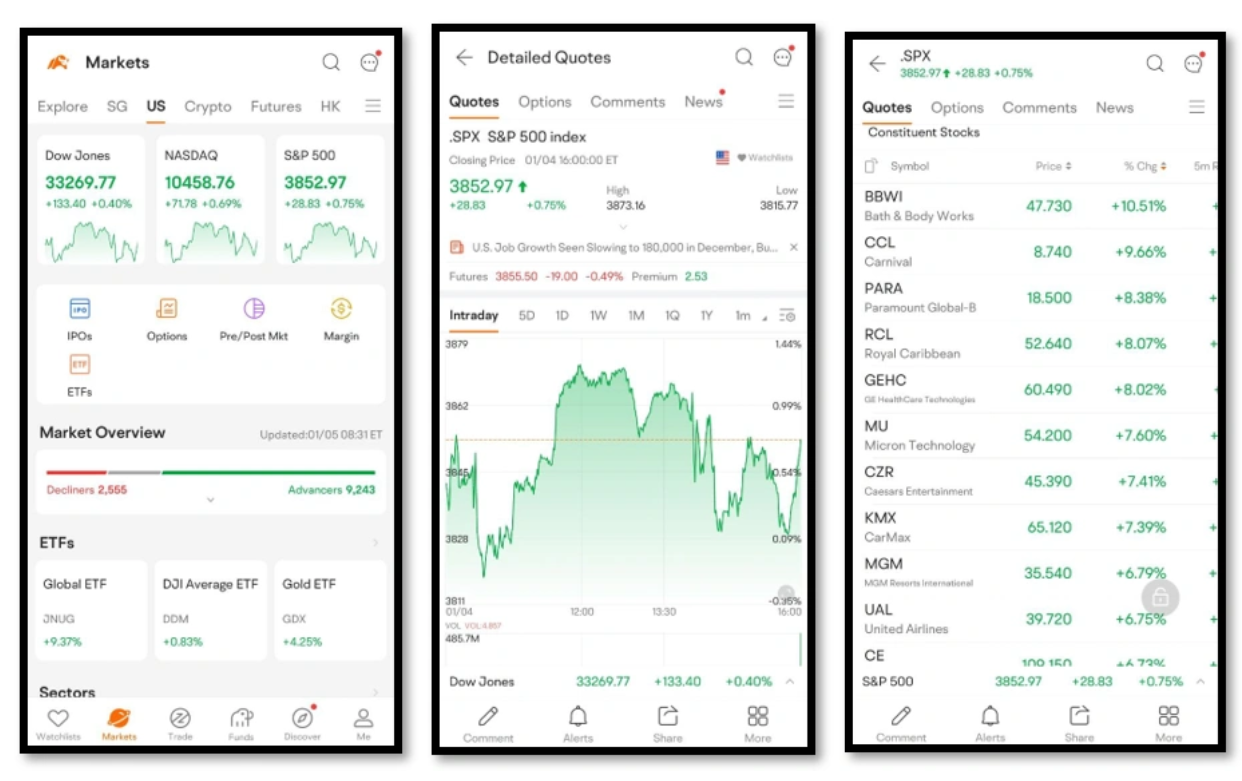
Step 1: Navigate to the S&P 500 Index Information
Open the moomoo app and click the ‘Markets’ tab.
Navigate to the US market section and find the S&P 500 option. If you don't immediately see the S&P 500 option, scroll down the screen to find it.
Review details like price movements, daily highs/lows, percentage-based changes, and constituent companies.
Step 2: Check News and Updates
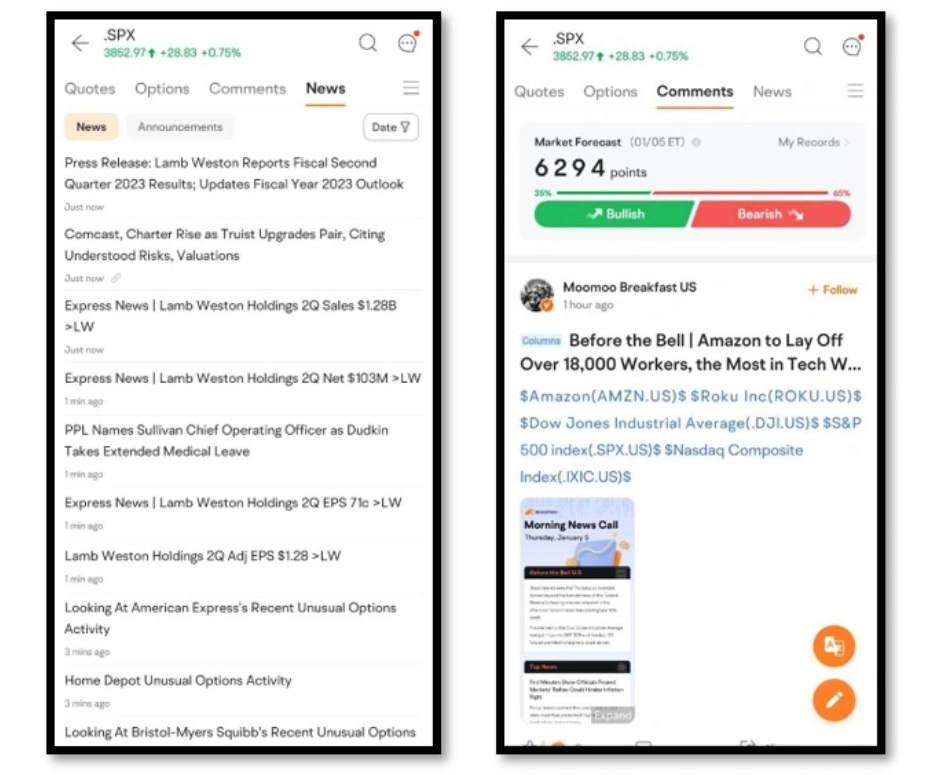
Click the ‘News’ tab to find relevant US economy-related news.
Use the news to understand the market outlook.
Step 3: Look at User Comments and Forecast
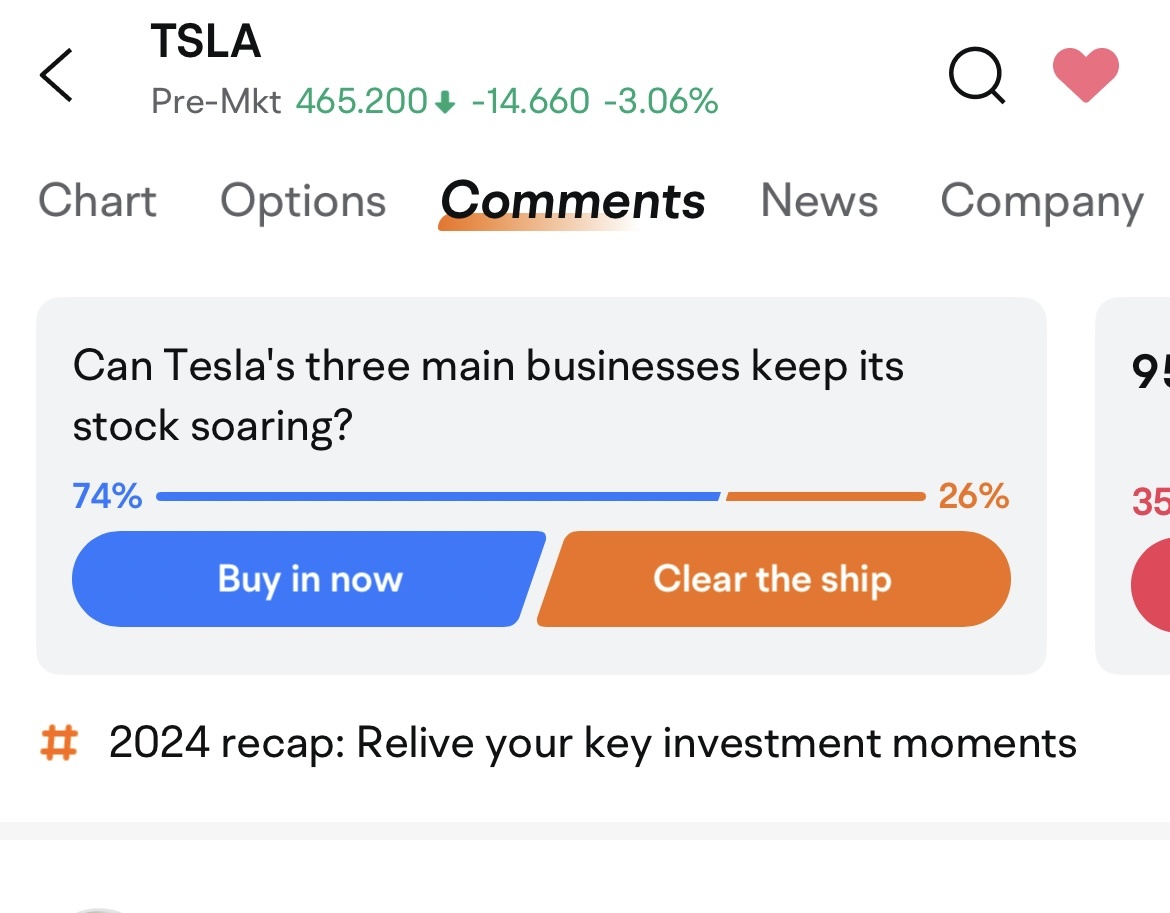
Access the ‘Comments’ section
Read user comments and check the ‘Market Forecast’ vote.
Step 4: Place an Order
Return to the trading interface.
Select the S&P 500 and choose the order type (market or limit).
Set parameters if needed and execute the order.
Invest in the S&P 500 in Singapore: FAQs
Is the S&P 500 good for beginners in Singapore?
For certain beginners in Singapore, the S&P 500 could be an excellent starting point. It offers diversification benefits and has a solid track record in terms of historical performance. Investing in the S&P 500 enables you to gain exposure to a wide segment of the market, eliminating the need to select individual stocks.
How can you invest in the S&P 500 without relying on a broker?
You don't have to use a traditional broker to invest in the S&P 500. Instead, you can utilize online trading platforms or mobile apps, for example, Moomoo Singapore. Moomoo Singapore makes it simple to directly invest in S&P 500 ETFs or individual stocks. Moomoo app is user-friendly, allowing you to trade S&P 500 stocks or ETFs. It also equips you with various tools to assist you in effectively managing your investment portfolio.
Are Nasdaq stocks included in the S&P 500?
Yes, the S&P 500 consists of 500 of the largest-sized companies that are traded on multiple major exchanges, such as the New York Stock Exchange (NYSE), the Nasdaq, and the Chicago Board Options Exchange (CBOE).
Is it possible to only invest in the S&P 500?
If you intend to invest in the S&P 500 as a whole, there's no need to buy each of the 500 stocks separately. There are numerous index funds and exchange-traded funds (ETFs) accessible to investors. These funds are crafted in a way that they mirror the performance of the S&P 500 index.
Who monitors the components of the S&P 500?
The S&P Dow Jones Indices, which is a part of S&P Global, is responsible for deciding which companies are included in the index. It establishes the criteria and continuously checks whether the constituent companies are meeting those criteria.
Conclusion: Invest in the S&P 500 in Singapore
In conclusion, the S&P 500 Index offers Singapore investors a gateway to the U.S. stock market. By carefully considering key factors such as investment goals, risk tolerance, and the choice of suitable ETFs, investors can make informed decisions. Whether you are a novice or an experienced investor, the S&P 500 Index has the potential to be a valuable addition to your investment portfolio, providing exposure to a broad range of leading U.S. companies. Start exploring your options today and take advantage of the opportunities that the S&P 500 Index presents.
This presentation is for informational and educational use only and is not a recommendation or endorsement of any particular investment or investment strategy. Investment information provided in this content is general in nature, strictly for illustrative purposes, and may not be appropriate for all investors. Read more