Options Trading Trap: More Premium = More Profit?
Sound Familiar?
You've read a few articles about selling options. The concept clicks — collect premium, let time work for you, rinse and repeat. Sounds like a smarter way to generate income than waiting for stocks to go up.
So you open a screener. You sort by premium. The highest-paying contracts float to the top. You pick one — maybe a stock you've barely heard of, but the number looks great. $2.80 premium on a 30-day put. That's almost $300 for doing nothing, right?
Two weeks later, the stock gaps down 18% after a surprise earnings miss. Your $280 in premium is now sitting next to a $1,400 unrealized loss.
What went wrong?
You fell into the most common trap new options sellers face: assuming high premium means good trade.
Why It Feels Right
Premium is the money you receive upfront. It's tangible, immediate, and easy to compare. When you're learning to sell options, premium feels like the one number that directly answers "how much will I make?"
And every YouTube video or Twitter post about options income shows big premium numbers. Nobody screenshots a $0.35 contract. So naturally, some beginners sort by premium and pick from the top.
Why It's Wrong
The market isn't giving you free money. A high premium is the market's way of saying: "This stock might move a lot, and if it does, you're on the hook."
A high premium usually means one or more of the following:
1. The stock is extremely volatile
A biotech awaiting FDA approval. A meme stock that swings 10% on a Reddit post. These pay high premiums because there's a real chance the stock moves 20-30% against you in days.
That $3.00 premium won't feel like income when the stock drops $15.
2. The strike price is dangerously close to the current price
A contract with a near-the-money strike will always pay more — because you're almost certain to get assigned. You're being paid more because you're taking on more obligation.
3. There's a major event before expiration
Earnings, FDA decisions, mergers — these inflate implied volatility temporarily. The premium looks rich, but it's priced that way because the stock could gap 10%+ overnight.
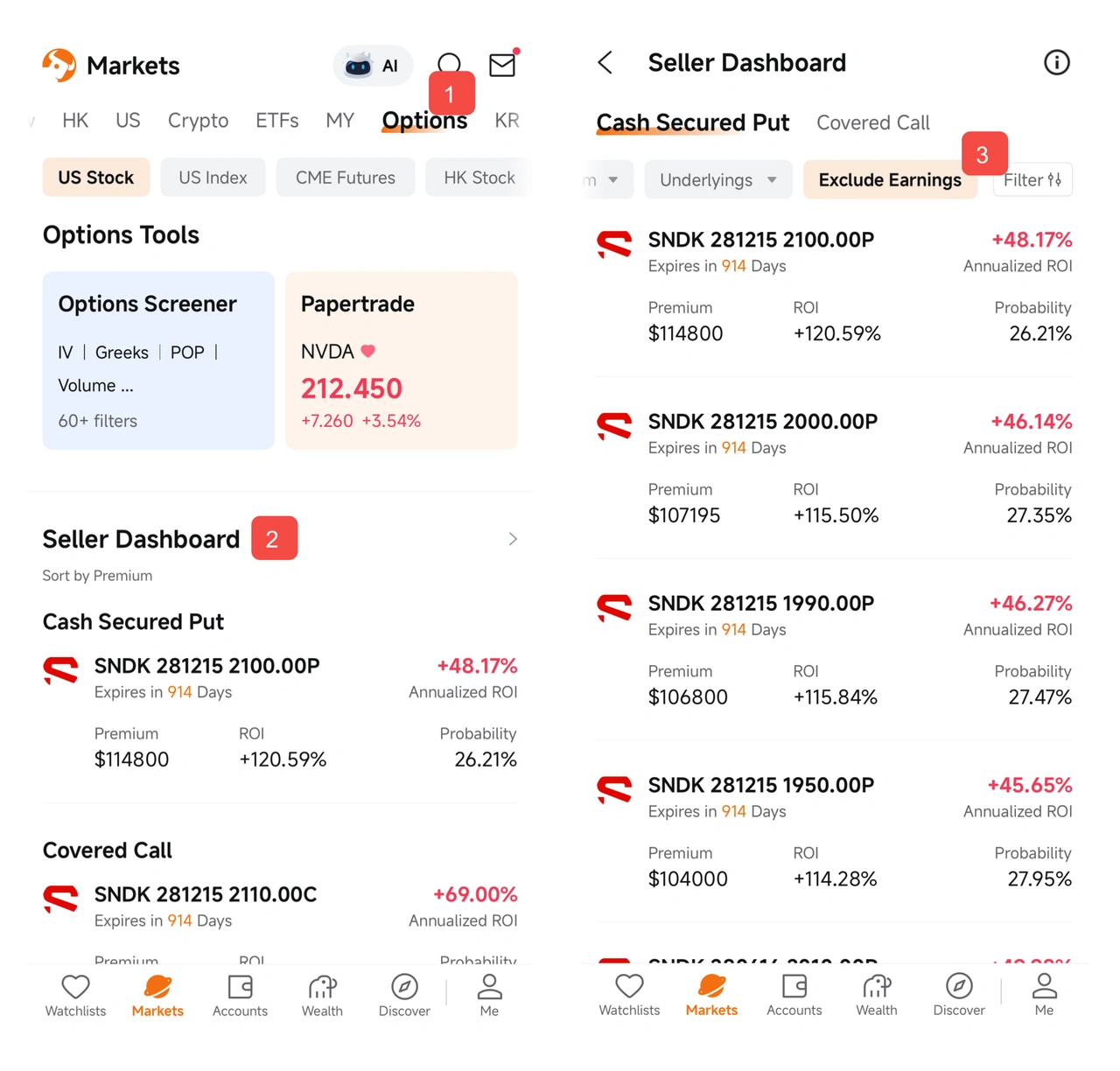
? The Dashboard includes an Earnings filter, letting you quickly see which stocks have announcements before your contract expires. For most new sellers, the simple rule is: if there's earnings before expiration, skip it.
In every case, the market is paying you more because the risk is higher. If premium were free money, everyone would be rich.
What Actually Matters
Premium alone tells you almost nothing about whether a trade is good. Here's what to look at instead:
Probability of OTM: "What are the odds I keep this money?"
? OTM stands for "Out of The Money."
When an option expires OTM, the buyer has no reason to exercise — This means you, as the seller, get to keep the entire premium you collected. Simple as that. The higher the OTM probability, the higher your chance of winning the trade.
An 85% OTM probability contract with a modest premium is often a better trade than a 55% OTM probability contract with a fat premium.
Think of it this way:
– Trade A: Premium $1.00, OTM probability 85%. You have an 85% chance of keeping that money — no drama, no assignment.
– Trade B: Premium $3.00, OTM probability 50%. Sure, the payout is bigger — but you're basically flipping a coin on whether you get to keep it.
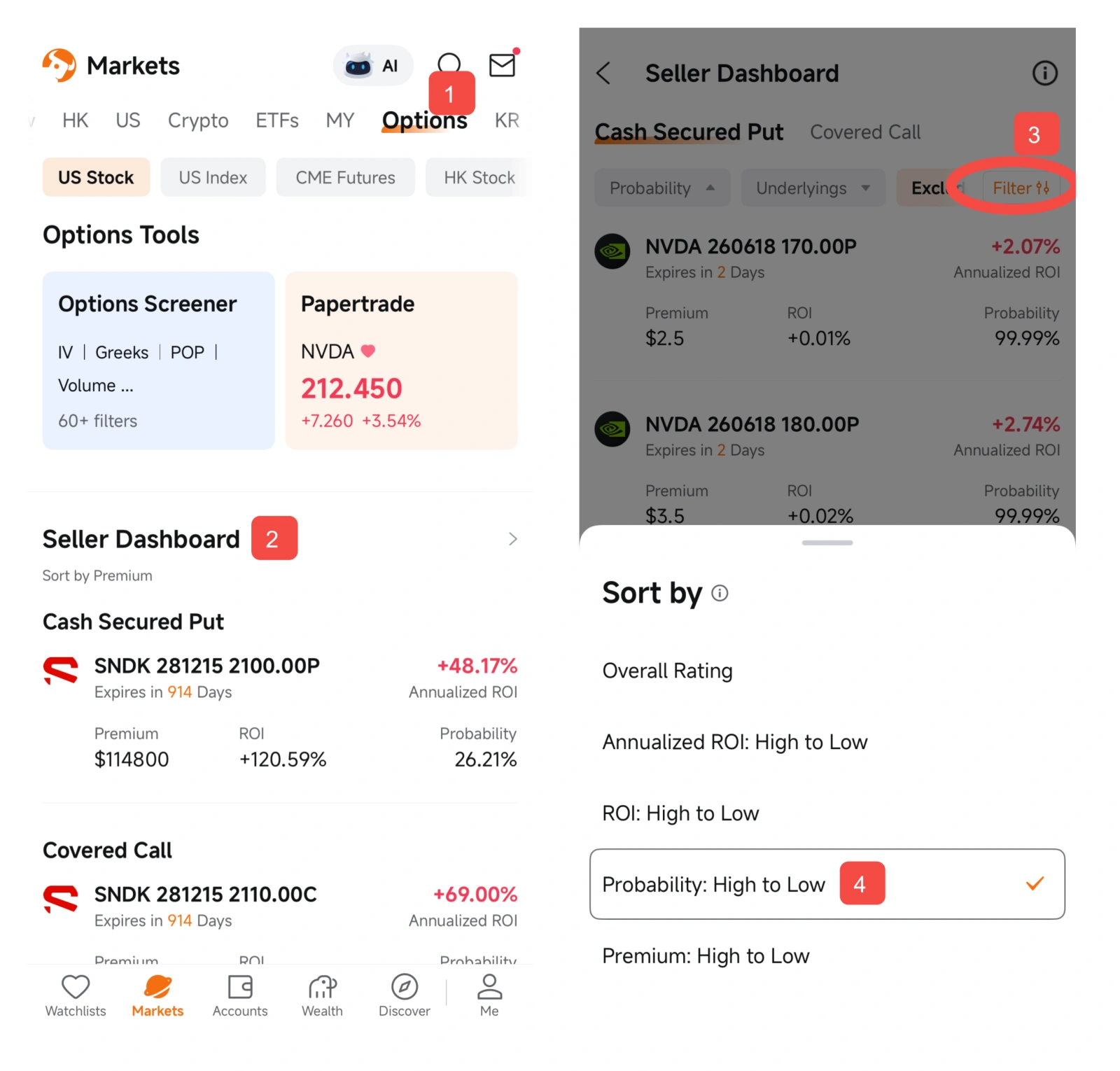
? On the Dashboard, you can sort the entire list by OTM Probability.
IV Rank: "Is this premium actually rich — for this stock?"
New sellers often compare premiums across different stocks — Stock A pays $0.50, Stock B pays $3.00, so B must be better. But this horizontal comparison is misleading. Stock B might always pay $3.00 because it's perpetually volatile. You're not getting a deal; you're getting the normal price for a risky stock.
The more important comparison is vertical — against the stock's own history. That's what IV Rank measures:
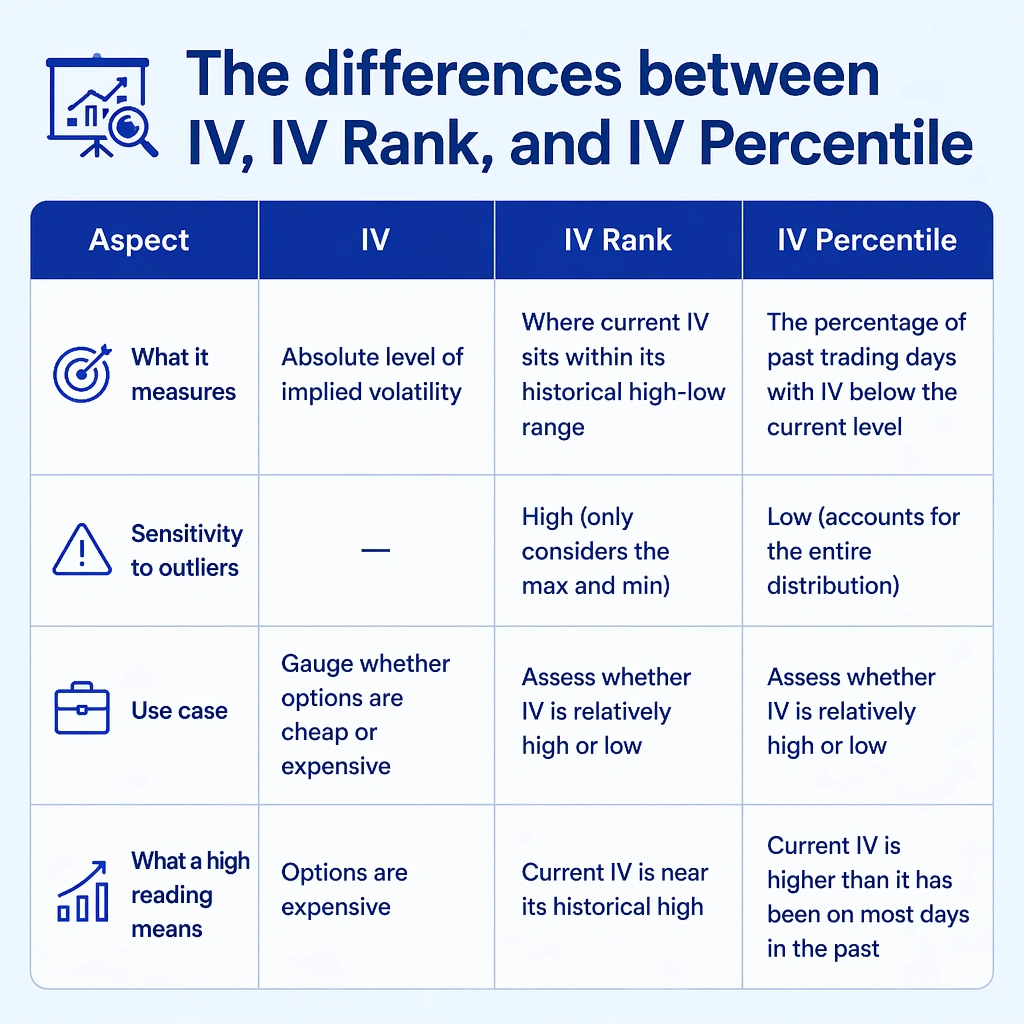
?Why is it called "IV Rank"? You also need to understand the differences between IV, IV Rank, and IV Percentile:
– IV Rank > 50% → this stock's premiums are in the upper half of its own 12-month range. You're selling at a relatively rich level.
– IV Rank < 20% → premiums are near the bottom of this stock's own range, even if the absolute dollar amount looks decent.
A quick example: $Tesla (TSLA.US)$ might show IV of 55%, while $Coca-Cola (KO.US)$ shows 18%. But if TSLA's range is 45%-90%, that 55% is actually low for TSLA (IV Rank ~20%). If KO's range is 12%-25%, that 18% is elevated for KO (IV Rank ~50%). The "boring" KO contract is actually the better-timed sell.
Bottom line: sell when a stock's IV is high relative to itself — not just when it's higher than other stocks.
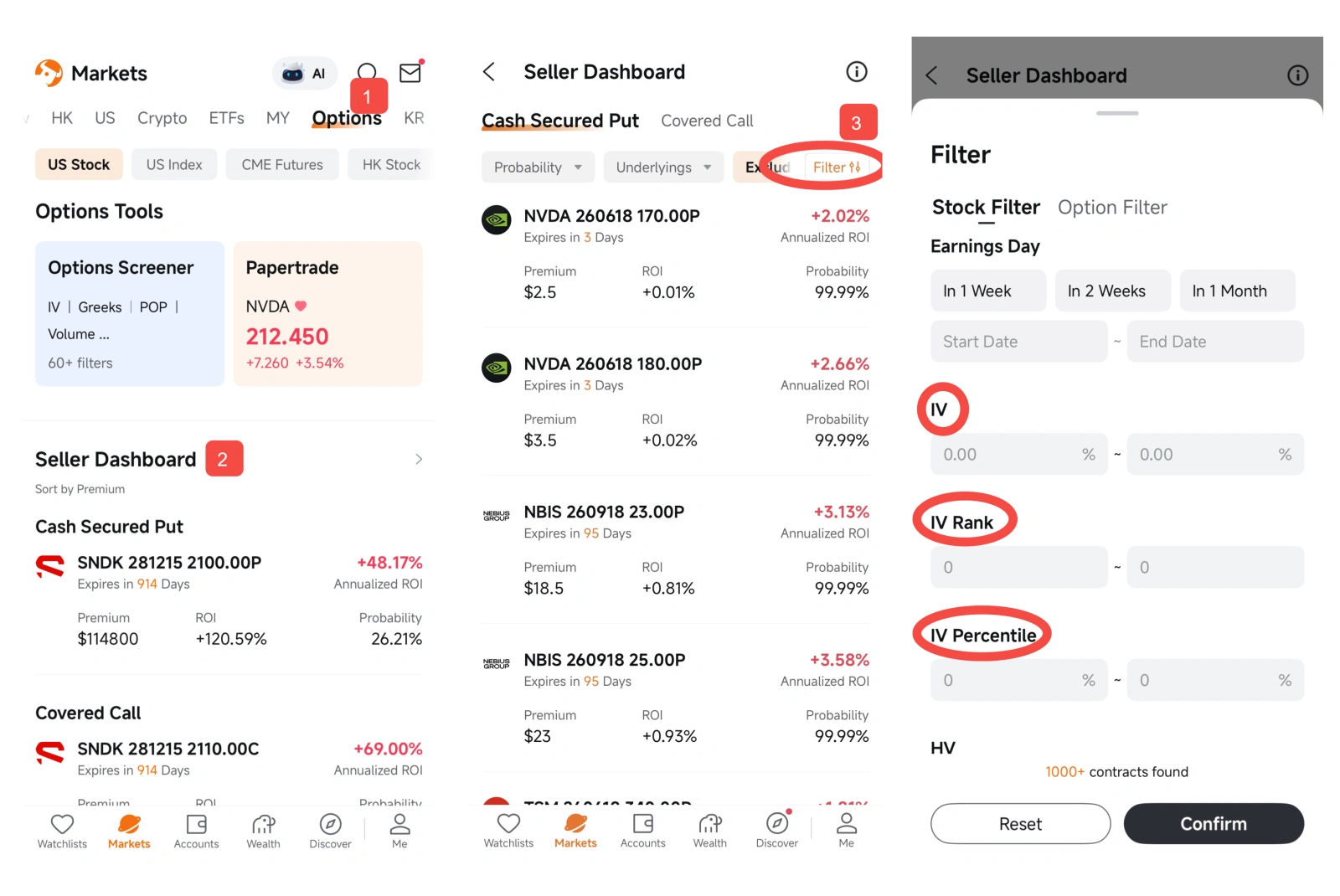
? The Dashboard lets you filter by IV Rank directly. Setting a minimum of 30% ensures you're only seeing stocks where premiums are relatively elevated for that specific underlying — not just expensive-looking in absolute terms.
The Ownership Question: "Would I hold this stock if things go wrong?"
This one gets skipped the most.
– Selling a put = you might be forced to buy this stock
– Selling a covered call = you already own it and might have to sell
If the stock drops 10% and your instinct is to panic, not hold — you shouldn't be selling puts on it, regardless of the premium.
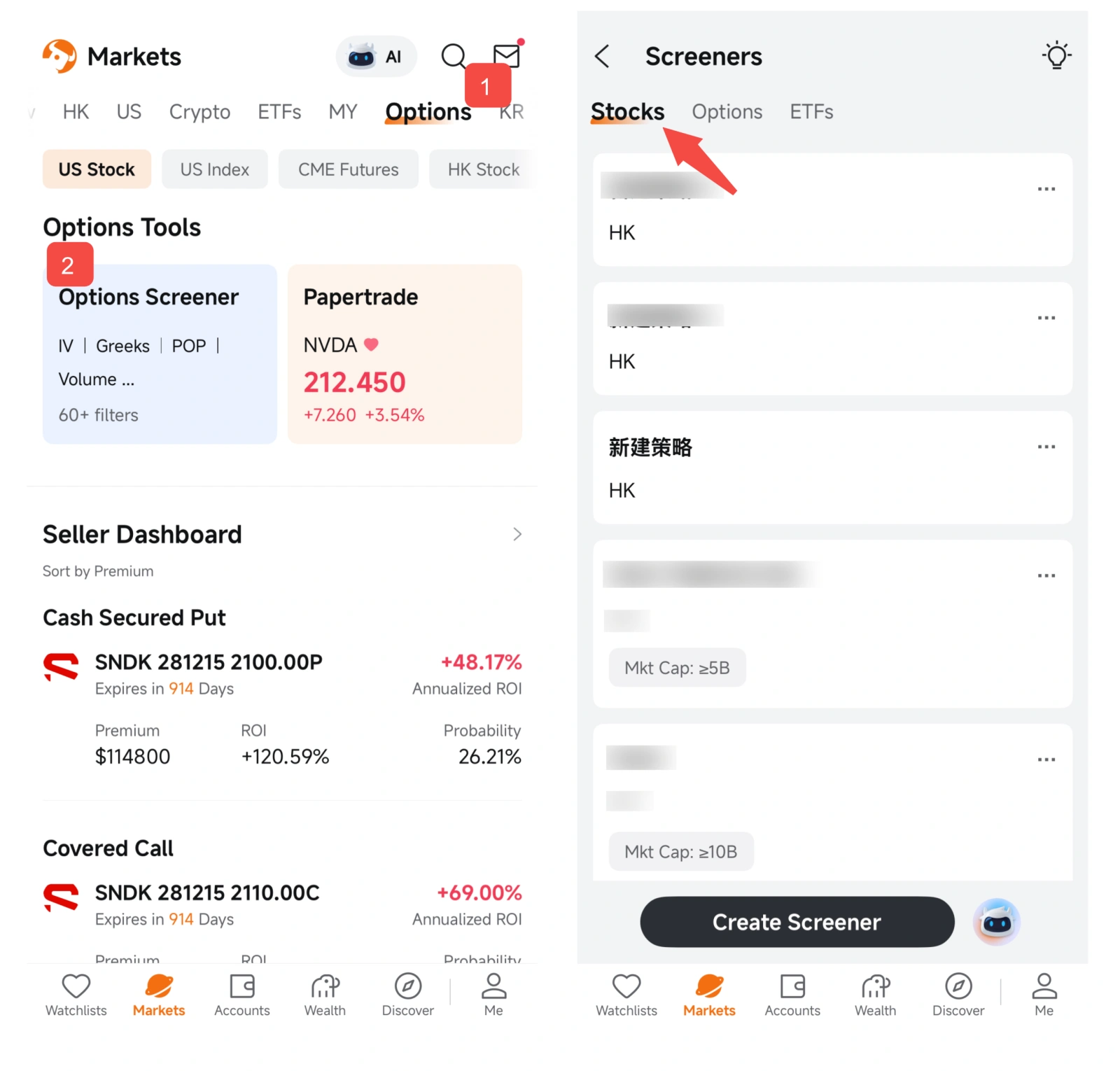
? The Dashboard's stock filter lets you narrow results to your Watchlist or Holdings. Names like $Tesla (TSLA.US)$, $NVIDIA (NVDA.US)$, $Apple (AAPL.US)$, $Intel (INTC.US)$, $Micron Technology (MU.US)$, and $SpaceX (SPCX.US)$, among others. Starting from stocks you already know and believe in removes the temptation to chase premium on unfamiliar names.
If You're Unsure, Consider Starting with ETFs
Not sure which individual stocks you'd want to hold through a downturn? That's normal — and it's exactly why many experienced options sellers use ETFs as their primary underlying.
ETFs like $SPDR S&P 500 ETF (SPY.US)$, $Invesco QQQ Trust (QQQ.US)$, $Vanguard S&P 500 ETF (VOO.US)$, or $iShares Russell 2000 ETF (IWM.US)$ give you:
– Diversification by default — no single earnings report or FDA decision can blow you up
– High liquidity — tight bid-ask spreads, easy to enter and exit
– Predictable behavior — broad indices don't gap 20% overnight (individual stocks do)
– Lower "panic factor" — if SPY drops 5%, you're more likely to hold calmly than if a single stock does
The tradeoff? ETF premiums are usually lower in absolute dollar terms than high-flying individual stocks. But that loops right back to our main point — lower premium, lower risk, more repeatable.
For new sellers, starting with ETF options is a way to practice the mechanics, build confidence, and generate income without constantly worrying about single-stock blowups.
? On the Dashboard, you can filter specifically for ETFs to see only broad-market and sector ETFs. This is a good starting point if you're still building your comfort with individual stock selection.
A Practical Workflow
Instead of sorting by premium and picking the highest number, try this:
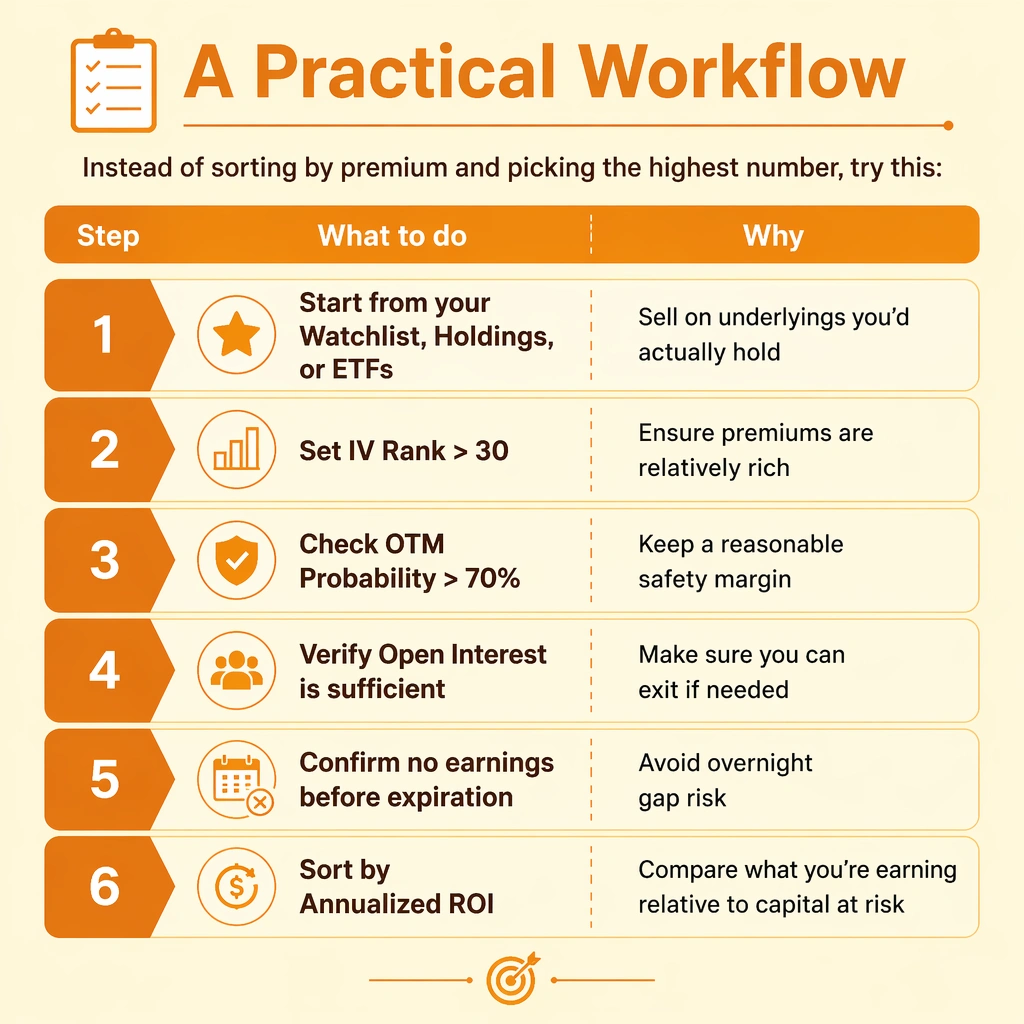
This won't give you the fattest premium on the screen. But it gives you trades that are more likely to work over 10, 20, 50 repetitions — and that's what options selling is actually about.
? This entire workflow can be done in the Options Seller Dashboard (Markets > Options > Seller Dashboard) in under 2 minutes. The filters and sorting options are built for exactly this process.
The Takeaway
High premium is not a signal. It's a warning label.
When the market offers you unusually high income for selling a contract, it's telling you something. Your job is not to chase the highest number — it's to find trades where the odds and the payout are both in your favor.
The best income trades often look boring. Moderate premium, high OTM probability, a stock or ETF you know well, no surprises on the calendar. Repeat 50 times. That's how options selling actually generates income.
This presentation is for informational and educational use only and is not a recommendation or endorsement of any particular investment or investment strategy. Investment information provided in this content is general in nature, strictly for illustrative purposes, and may not be appropriate for all investors. Read more