How to Generating Income While Waiting for a Better Price
How to Generating Income While Waiting for a Better Price
Imagine this. You're bullish on Nvidia, but the current price feels a bit rich. You set a mental target price and wait. Three months later, the stock hasn't pulled back—it's actually up 15%. You didn't buy a single share, and you didn't earn a single dollar during those three months.
There's nothing wrong with waiting for a good price. Patience is, after all, a huge part of value investing. But the problem is that during this waiting period, your cash generated zero return.
Is there a way to make that waiting period itself worthwhile?
Warren Buffett figured out the answer decades ago. At a shareholder meeting, he once said: "If you're willing to buy a stock at a certain price, why not sell a put option and get paid for it? You get the same outcome, plus an extra income."
That strategy is called Sell Put (selling a put option).
How Buffett Used This Strategy
In 1993, Buffett was already a major Coca-Cola shareholder. He remained bullish on the company's long-term value and wanted to add more shares at a lower price. At the time, Coca-Cola was trading around $40, and Buffett considered $35 a very attractive entry point.
Rather than simply placing a limit buy order and waiting, he chose to sell 50,000 put option contracts on Coca-Cola, covering 5 million shares, with a strike price of $35—the price at which he was willing to buy.
Two quick definitions before we go further: in options trading, one contract represents 100 shares. The strike price is the agreed-upon price at which the transaction would occur. So 50,000 contracts × 100 shares = 5 million shares.
This meant Buffett was making a promise to the market: if Coca-Cola's stock price fell to $35 before expiration, he would buy all those shares at that price.
Why would anyone take the other side of this trade? Because on the other side were investors worried that Coca-Cola's price might drop. They needed "insurance"—a guarantee that if the stock did fall, someone would be there to buy at $35.
Buffett was that buyer. Think of him as an insurance company—someone is worried about a price decline and is willing to pay him a fee in exchange for his promise to step in and buy if the price hits a certain level. If the "accident" never happens, the fee is his to keep as pure income. Buffett himself has said, "Selling options is essentially selling insurance." Fittingly, one of Berkshire Hathaway's core businesses is, of course, insurance.
Since Buffett was taking on this obligation, the counterparty had to pay a fee—called the premium. Think of it as compensation Buffett collected for making that "promise to buy." According to public records, this trade brought him approximately $7.5 million in premium income, and that money hit his account the moment the deal was struck.
The commitment stayed in effect for several months. Throughout that period, Coca-Cola's stock price never dropped to $35. The options expired worthless, meaning Buffett's obligation was automatically released. He didn't buy a single share—yet he pocketed $7.5 million during the wait.
What if the stock had fallen to $35? Buffett would have been just as happy, because that was already his ideal price to add shares. Better still, his actual cost basis would have been $35 minus the premium already received—effectively buying a great company at an even cheaper price.
This was no one-off trade. Buffett has used the Sell Put strategy multiple times throughout his investing career. In his view, Sell Put is not a speculative tool but a natural extension of value investing—making a commitment at a price you're happy to pay, while earning fair compensation for the wait.
The Core Logic of Sell Put
At its essence, a Sell Put can be understood as "a promise to buy—with pay."
Here's how it works: you pick a stock, set a price you'd be willing to buy it at (the strike price), and choose how long that promise lasts (the expiration date). In return for making that commitment, the market immediately pays you a premium.
At expiration, there are only two outcomes:
? Stock price is above the strike: Your commitment is automatically released, and the premium is yours to keep. That's your earnings for the waiting period.
? Stock price falls to or below the strike: You buy the stock at the agreed strike price, and your actual cost basis equals the strike price minus the premium received. In other words, you've lowered your entry price even further below your ideal buy level.
For high-quality companies you're already watching and willing to hold for the long term, both outcomes fall squarely within your investment plan.
Placing Your First Sell Put Trade
Step 1: Pick the Stock
The prerequisite for a Sell Put is thorough understanding of the underlying company and a genuine willingness to own it long term. Ideal candidates typically meet one core criterion: the fundamentals are solid enough that a price drop feels like an opportunity, not a threat. If your first instinct when a stock falls is to sell rather than add, this strategy is not for it.
One additional tip: prioritize large-cap stocks with liquid options markets. These tend to have tighter bid-ask spreads, which means lower transaction costs—much more forgiving for beginners.
Step 2: Choose the Strike Price
The strike price represents "At what price am I willing to buy this stock?" This is a personal decision, and the key question is: at this price, do I feel there's a sufficient margin of safety?
The further the strike is set below the current price, the lower the probability of being assigned and the smaller the premium collected. The closer the strike is to the current price, the higher the premium—but also the greater the chance of being required to buy. The trade-off comes down to your valuation of the company and your personal risk appetite.
Step 3: Choose the Expiration Date
The expiration date determines how long your "promise to buy" stays in effect. A longer duration means more uncertainty, so the market pays a higher premium; a shorter duration offers greater certainty, but the premium is thinner. The goal is to find a comfortable balance between income potential and predictability.
How Much Capital Do You Need?
This is a question many investors ask. Selling a put option doesn't require you to "spend money"—on the contrary, you receive money. However, your account needs to hold a margin requirement—funds that your broker freezes to ensure that if the price does drop and you're required to buy, you actually have the ability to do so.
A Hypothetical Example
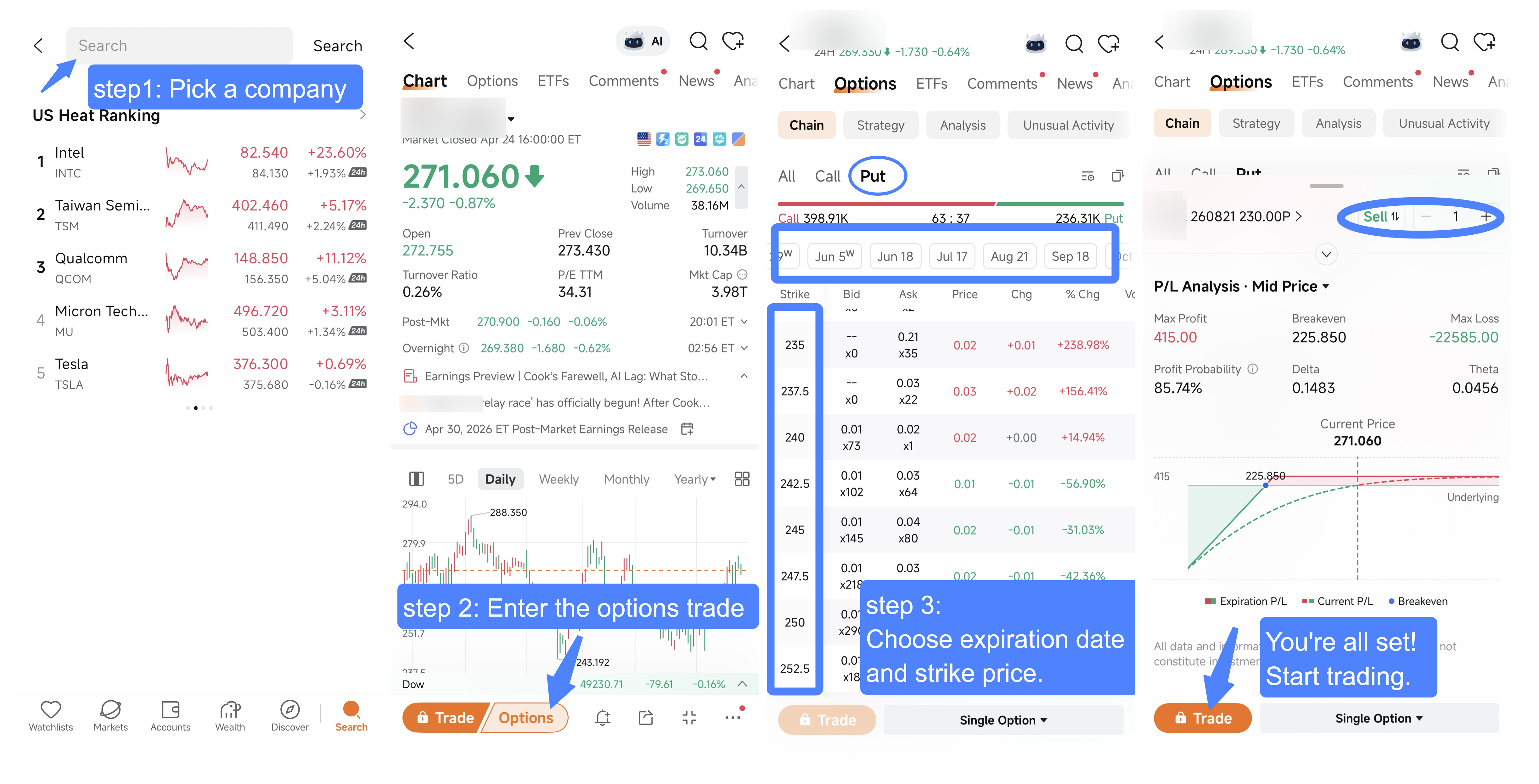
(This section will include platform screenshots and a step-by-step walkthrough)
Suppose you're a long-term bull on Apple, currently trading at $260, and you believe $230 would be an ideal entry point.
You sell one put option with a $230 strike, expiring in 90 days, and collect a premium of $3.30 per share. Since each contract covers 100 shares, your total premium income is $330.
90 days later:
? Stock stays above $230: The option expires worthless. The $330 premium is your net profit. You can then open a new position and keep generating returns while you wait.
? Stock falls below $230: You buy 100 shares at $230. After deducting the $3.30 premium received, your actual cost basis is $226.70 per share—approximately 12.8% below the current market price of $260. You've acquired a company you believe in for the long run, at a price with a substantial margin of safety.
What if you change your mind midway? You can buy back the option at any time ("Buy to Close") to exit the trade early and release your capital. For instance, if Apple rallies and the put's price drops from $3.30 to $1.00, you buy it back for $100, pocket a net gain of $230, and free up your funds for the next opportunity. The whole process is highly flexible.
Final thought
To sum up, the Sell Put strategy is well suited for these scenarios:
✅ You have long-term conviction in a stock and are waiting for a better entry price.
✅ You have idle cash in your account and want it to generate income while you wait.
✅ Your investment style leans conservative, with a focus on margin of safety.
At the same time, it's important to understand the risks:
⚠️ Downside risk: If a stock experiences a steep decline far beyond the strike price, you may face a significant unrealized loss after purchasing. This is essentially the same risk as buying the stock outright—but with Sell Put, you can't simply "stand aside" when the price plunges. Your commitment to buy is binding.
⚠️ Opportunity cost: If the stock rallies sharply, you only earn the premium and miss out on the full upside. Sell put generates income from waiting, rather than returns from price appreciation.
The core discipline of Sell Put is this: only use it on companies you truly understand and are genuinely willing to hold for the long term. This is exactly the precondition Buffett has emphasized time and again.
As Buffett's own practice shows, Sell Put is not a speculative gamble—it's a way for value investors to put their capital to work more efficiently while waiting for the right price.
In investing, even the act of waiting can create value.
So, if there's a company on your watchlist that you'd love to own at a lower price—while earning income during the wait—consider trying Sell Put for your first options trade.
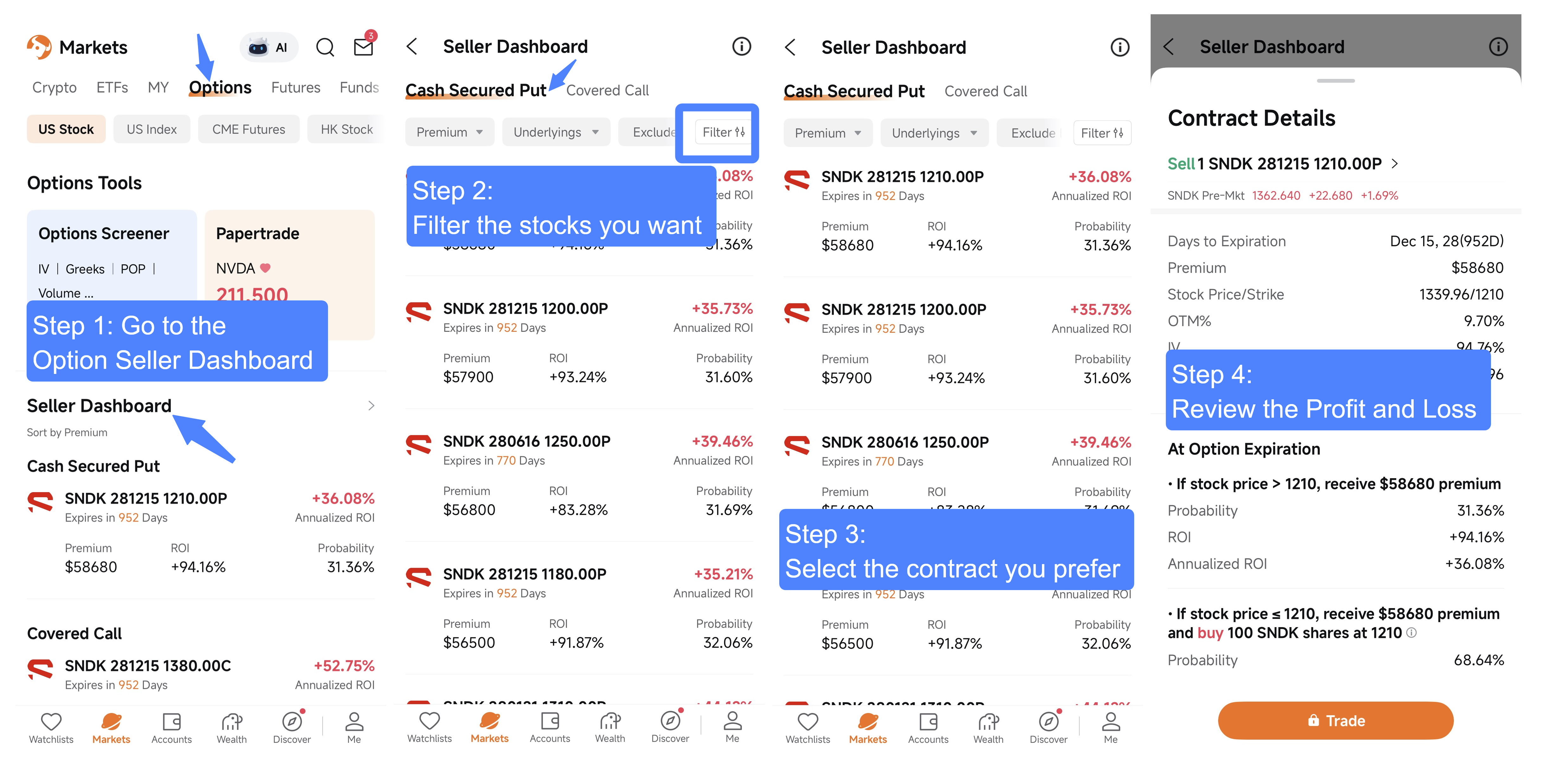
Moomoo also offers an Option Seller Dashboard. Simply go to Market > Options, filter stocks and set your preferences, select the contract you're interested in, and review the profit and loss scenarios. It's another easy way to start trading options!
The above content is for educational purposes only and does not constitute investment advice.
Options trading involves significant risk and is not suitable for all investors. Full disclaimers at www.moomoo.com/sg/support/topic5_510. This advertisement has not been reviewed by the Monetary Authority of Singapore.
This presentation is for informational and educational use only and is not a recommendation or endorsement of any particular investment or investment strategy. Investment information provided in this content is general in nature, strictly for illustrative purposes, and may not be appropriate for all investors. Read more