How to Find Winning Options Selling Trades in 3 Minutes Using Screeners
30 Seconds to Understand Selling Premium
The concept is simple: as an options seller, you write a contract and the buyer immediately pays you a premium. This money is yours the moment it arrives — much like a landlord receiving monthly rent.
The two most common income strategies:
– Covered Call: You already own stock, and sell a call option to collect premium
– Cash-Secured Put: You set aside cash, and sell a put option to collect premium
Regardless of which strategy you use, the first question is always the same: which underlying should I choose?
4 Hard Criteria for Choosing Your Underlying
Criterion 1: Good Liquidity
Here's what to pay attention to:
Bid-Ask Spread — the tighter, the better.
This is the gap between what buyers are willing to pay (the bid) and what sellers are asking for (the ask).
For example, if a contract shows a bid of $1.00 and an ask of $1.10, the spread is $0.10. When you sell to open, you typically receive closer to the bid; when you buy to close, you pay closer to the ask.
Wide spread means you're losing money on both ends. If the spread is $0.30 on a $1.00 premium, you could be giving up 30% of your income to friction alone — before the trade even has a chance to work.
Open Interest — the higher, the better.
This tells you how many contracts that are currently "alive" in the market — meaning they have been opened (bought or sold) but have not yet been closed, exercised, or expired.
Higher open interest generally means tighter spreads and easier execution. Low open interest is a warning sign: when you need to exit, there may not be enough buyers on the other side, forcing you to accept a worse price or wait longer than you'd like.
Average Daily Volume of the underlying — the more active, the better.
While open interest shows how many positions exist in total, volume confirms that people are actively trading right now.
A contract might have decent open interest from weeks ago but near-zero volume today — meaning it's gone stale and you may have trouble getting a fill.
A contract might display $1.00 in premium, but if the bid-ask spread is $0.20, you're realistically collecting $0.80 at best — and possibly worse if you need to close early.
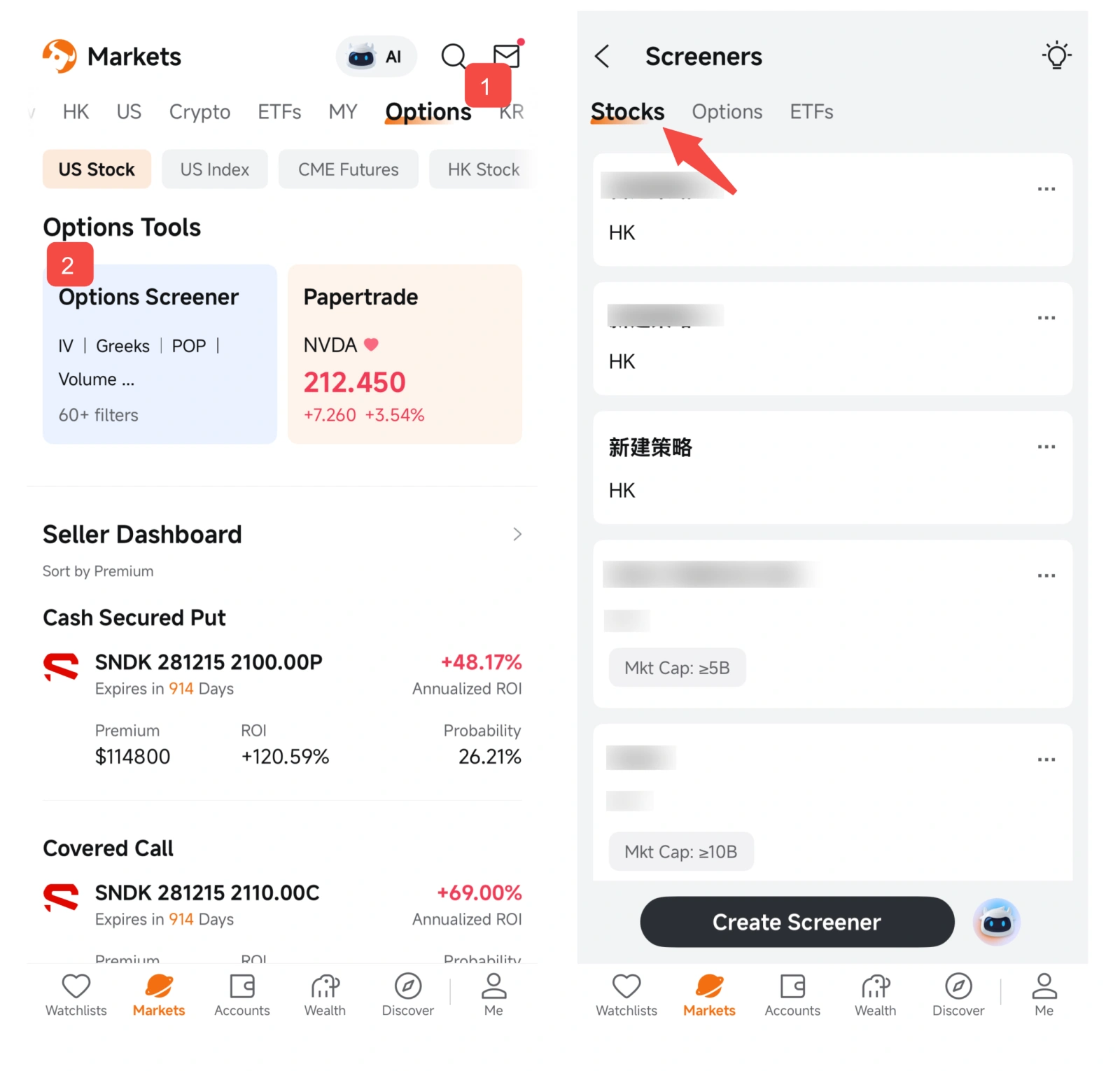
? Under the Options tab, you can use the options screener to filter by volume and other metrics, identifying actively traded contracts. You can further refine by expiration date, strike price, and implied volatility to find contracts that match your criteria.
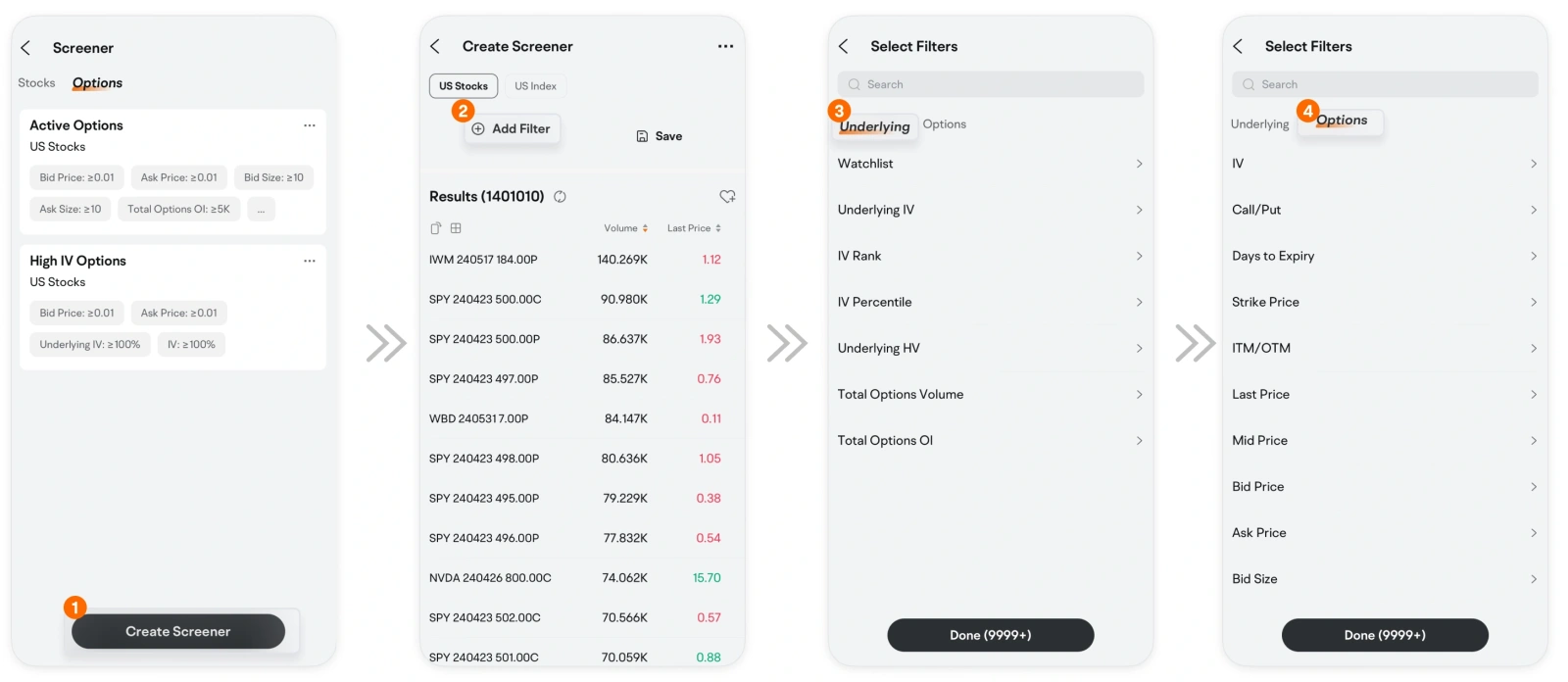
Meanwhile, well-known names like $Tesla (TSLA.US)$, $NVIDIA (NVDA.US)$, $Apple (AAPL.US)$, $Intel (INTC.US)$, $Micron Technology (MU.US)$,and $SpaceX (SPCX.US)$ also offer strong liquidity in the options market.
Criterion 2: You'd Be Willing to Hold This Stock
Many beginners skip this, but it's the foundational logic of the entire strategy.
– Selling a Put = you may be assigned and required to buy this stock
– Selling a Covered Call = you already own this stock and may be called away
So ask yourself: If this stock drops 10%, would I hold it calmly — or panic?
If the answer is "not sure" or "I'd want out," don't touch it regardless of the premium. That's not generating income — that's speculation.
? The Dashboard's stock filter supports filtering by Watchlist, starting from stocks you already know and follow eliminates the temptation to chase unfamiliar high-IV names.
Criterion 3: Implied Volatility (IV) Is Relatively Elevated
Implied Volatility reflects the market's expectation of how much a stock might move in the future.
Higher IV → more expensive premiums → more income for you.
But "high" compared to what? This is where IV Rank comes in:
– IV Rank tells you where current IV sits within the stock's own range over the past year
– IV Rank> 70 = current premium is relatively rich for this stock — favorable for sellers
– IV Rank < 70 = premium is on the thin side — may not justify the risk
? You can use the Popular Stocks screener under the Options tab to filter by implied volatility.
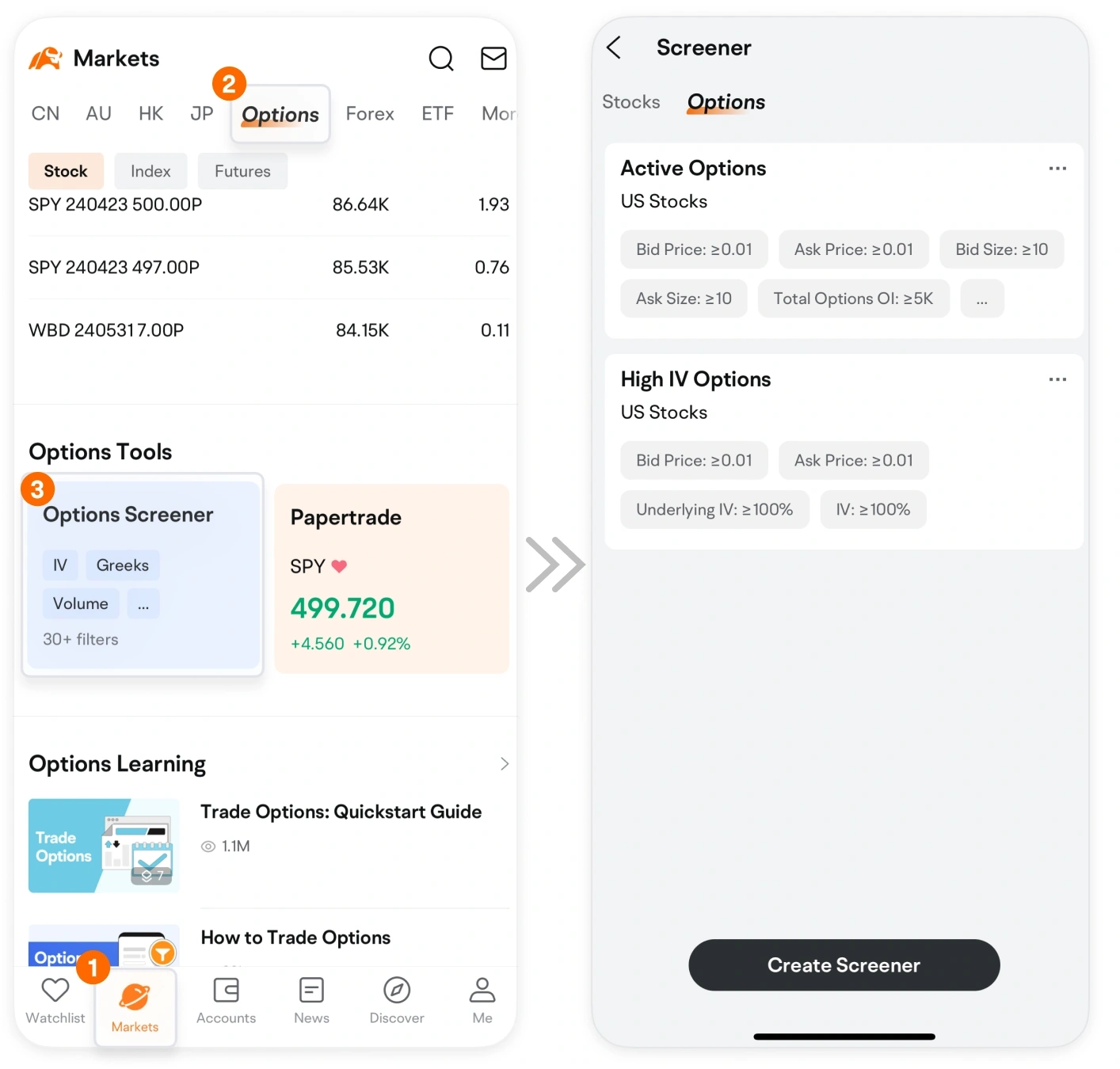
The Dashboard also supports sorting and filtering by IV, IV Rank, and IV Percentile. Set a minimum IV Rank threshold and the system automatically surfaces underlyings where premiums are relatively elevated.
Criterion 4: No "Ticking Time Bombs" Before Expiration
The following situations — skip them entirely as a beginner:
– Upcoming earnings announcement
– Pending FDA approval, merger, or other major catalyst
– Any event that could cause a single-day 10%+ move
These events temporarily spike IV, making premiums look irresistible. But this isn't rich premium — it's the market pricing in that something might blow up.
The rule is simple: if there's a binary event before your expiration date, skip this underlying for this cycle.
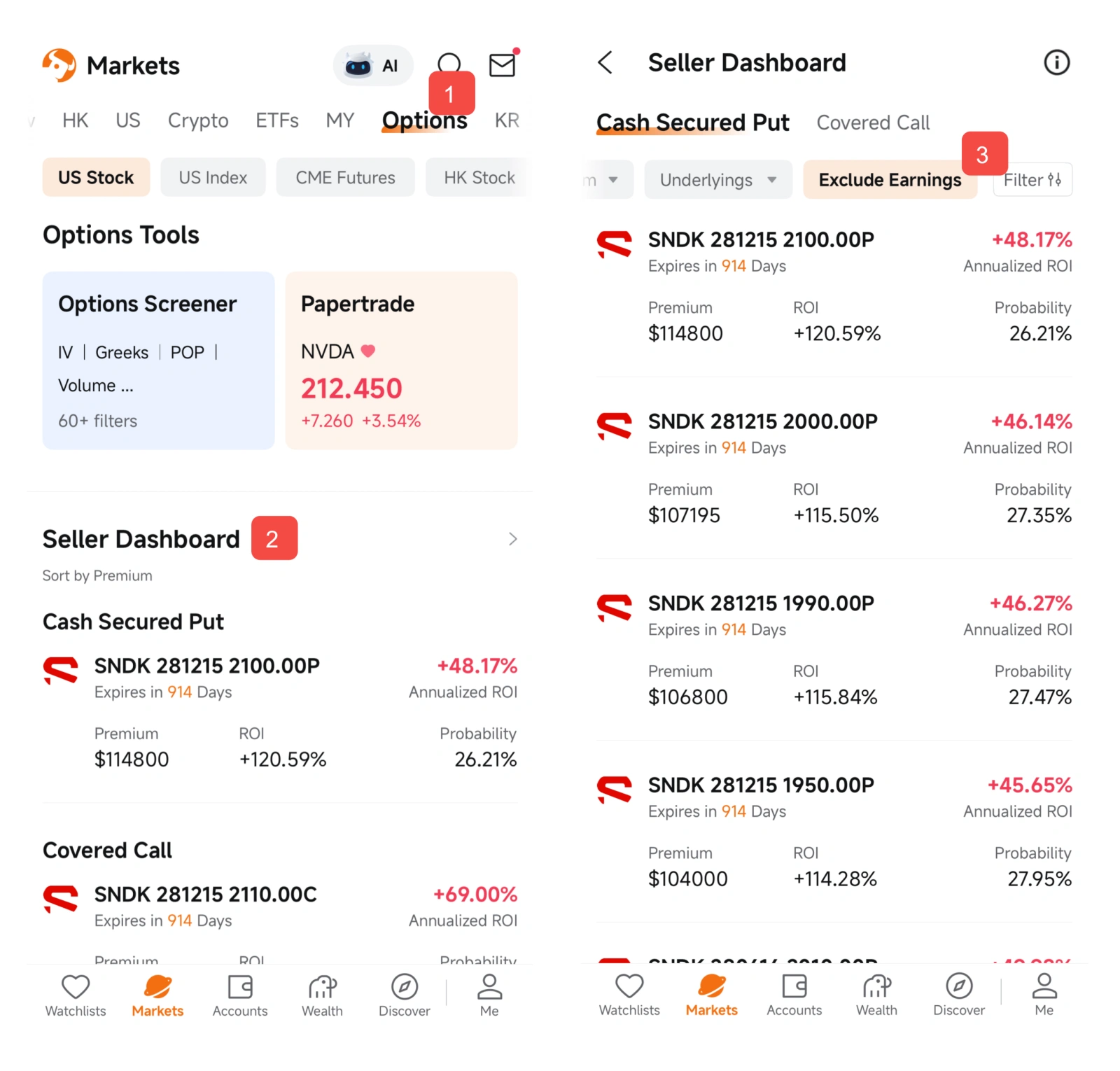
? The Dashboard provides an Earnings date filter — quickly identify which underlyings have announcements coming. Either avoid them entirely, or wait until you have enough experience with earnings-specific strategies.
Beginner's Starting Point: ETFs
If you're just getting started and unsure which individual stocks to pick, start with broad ETFs:
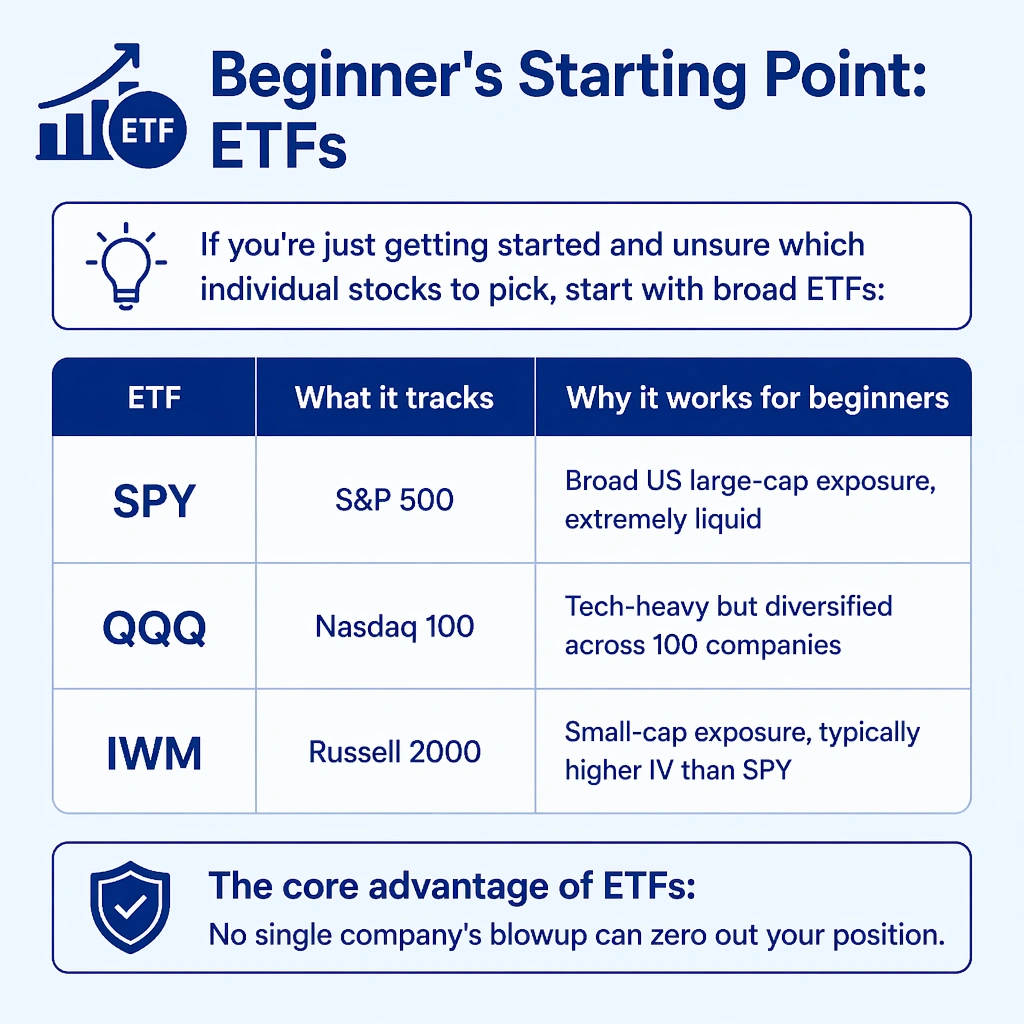
The core advantage of ETFs: No single company's blowup can zero out your position. For beginners, broad market ETFs like $Invesco QQQ Trust (QQQ.US)$, $SPDR S&P 500 ETF (SPY.US)$, $iShares Russell 2000 ETF (IWM.US)$ , and $Vanguard S&P 500 ETF (VOO.US)$ tend to be more forgiving choices.
? In the Dashboard's Stock Filter, set Type to "ETFs" to view only ETF-based selling opportunities.
Once you've completed 10–20 trades and developed a feel for the rhythm, gradually add individual stocks you know well.
Practical Workflow: Screen Candidates in 5 Minutes with the Seller Dashboard
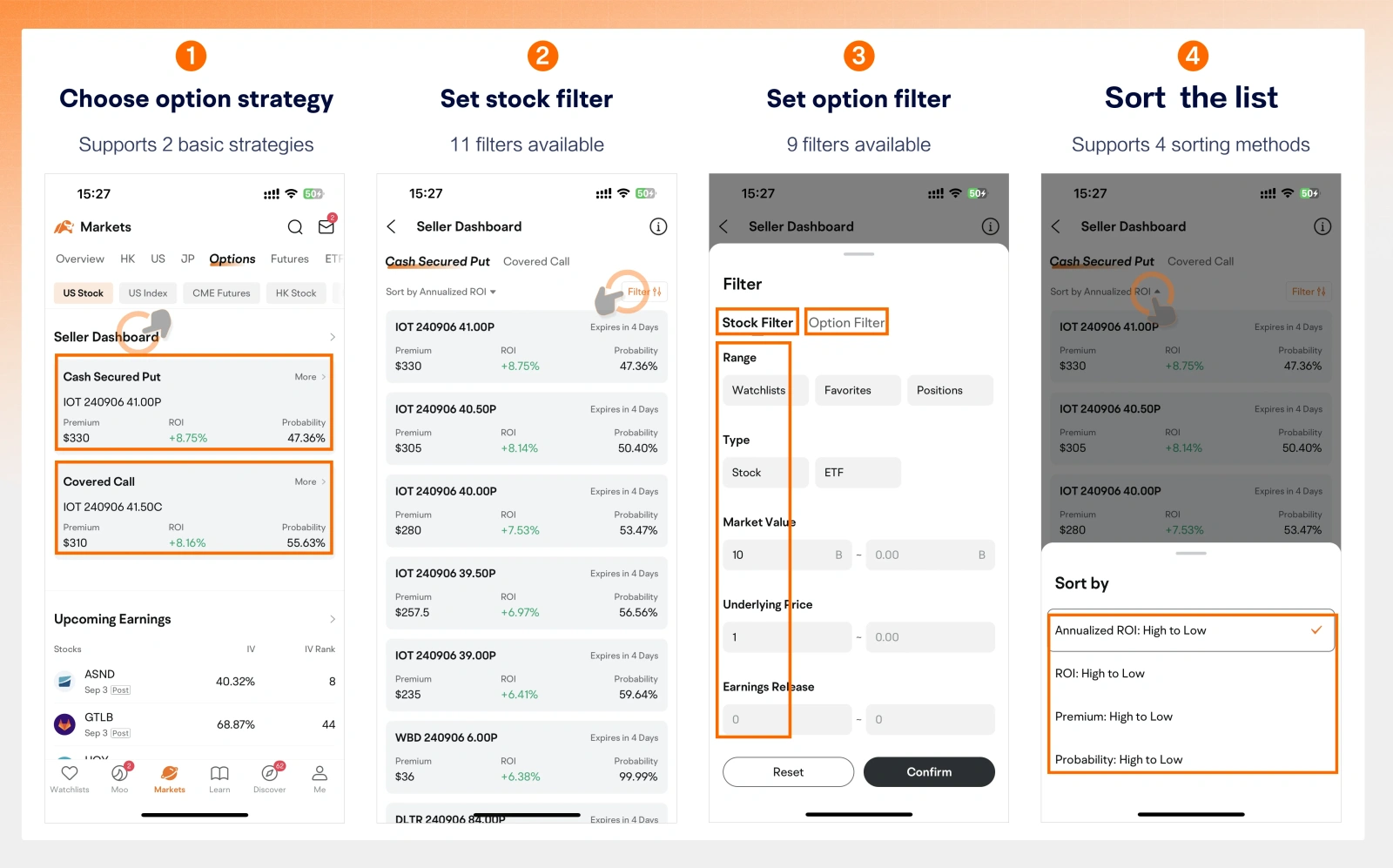
1. Navigate to Markets > Options > US Stock > Seller Dashboard
2. Select your strategy type (Cash-Secured Put or Covered Call)
a. Scope: Watchlist or Holdings (start with what you know)
b. Type: ETFs (more beginner-friendly) or Stocks
c. IV Rank: set a minimum threshold (suggested > 30%)
d. Exclude underlyings with upcoming Earnings
3. Configure the stock filter:
a. Open Interest: set a minimum threshold (ensures liquidity)
b. OTM Probability: set a higher value (reduces assignment risk)
4. Configure the options filter:
5. Sort by Annualized ROI or OTM Probability
6. Select 2–3 candidates from the results and click through for detailed strategy information
You don't need to cast a wide net. Premium selling rewards repetition and discipline — not picking a dozen names every cycle.
Common Mistakes
❌ "High premium = good underlying"
High premium usually means high risk. The market isn't giving away free money — it's paying you more because this position carries elevated risk.
The OTM Probability metric in the Dashboard helps you evaluate how likely your trade is to expire worthless (in your favor). We'll cover this in more depth in upcoming content.
Options Trading Trap: More Premium = More Profit?
❌ "Only look at IV, ignore the stock itself"
Even if IV is sky-high, if you know nothing about the company, you won't know whether to hold or cut losses when it drops — and you'll most likely exit at a loss. Start from your Watchlist, not from an IV leaderboard.
❌ "Individual stocks pay more, so skip ETFs"
Individual stocks do offer higher absolute premiums — but they can also drop 20% in a single day. Build your intuition with ETFs first, then graduate to individual names.
The Core Principle
A sound underlying for premium selling = a stock you'd willingly hold + strong liquidity + relatively elevated IV + no imminent catalysts.
These four criteria are not optional enhancements — they are core screening criteria. Any candidate that fails a single one of them should be set aside, regardless of how attractive the premium appears.
Establishing rigorous screening discipline at the underlying selection stage is what separates a sustainable income strategy from episodic speculation.
This presentation is for informational and educational use only and is not a recommendation or endorsement of any particular investment or investment strategy. Investment information provided in this content is general in nature, strictly for illustrative purposes, and may not be appropriate for all investors. Read more