How to Boost Returns with Covered Calls
How can you put your existing stock holdings to work?
If you own US stocks like $Apple (AAPL.US)$, $NVIDIA (NVDA.US)$, or $Microsoft (MSFT.US)$ and have no plans to sell in the near term — but feel your capital is just sitting idle — a Covered Call could be your first sensible step into options trading.
It's not about betting on direction. It's about saying, "I'd be willing to sell at a higher price" and getting paid for that willingness upfront.That's the essence of the Covered Call strategy.
You hold the stock and sell a call against it. Despite being an options strategy, it's far from a high-risk speculative gamble. At its core, it follows the same "insurance-style" thinking that Buffett has championed for decades.
That said, it's not a free lunch. If the stock rallies well beyond your strike price, your upside is capped — you'll have locked in a sale at a lower level. Like any strategy, Covered Calls work best in certain market conditions, and understanding the trade-offs is key before you get started.
01 The Other Side of Buffett's Sell Put
There's a Buffett quote that gets cited endlessly: "Selling options is essentially selling insurance."
The key word isn't "options" — it's selling, meaning you're on the seller's side of the trade. The seller's job is straightforward: take on a clearly defined obligation in exchange for an upfront payment. The buyer pays for protection; the seller collects a fee for bearing risk. Most of the time, nothing happens — and the seller simply pockets the premium.
Buffett's most well-known example involves Coca-Cola. He wanted to add shares at a lower price, so he sold put options — agreeing to buy the stock if it dropped to his target level — and collected a handsome premium just for being willing to wait. That's a Sell Put.
But being the seller doesn't come in just one flavor. Sell Put is for investors who don't yet own a stock and are willing to buy at a lower price. There's another tool designed for investors who already own a stock and are willing to sell at a higher price: Sell Call.
What Is Sell Call?
A Sell Call can be understood this way: you set a price in advance at which you're willing to sell your shares, and in return for that commitment, you receive an upfront payment known as the premium.
On expiration day, if the stock price is above the agreed strike price, you sell your shares at that price while keeping the premium. If the stock doesn't reach the strike price, you keep both your shares and the premium.
Simple enough. But if you don't actually own the stock, things get dangerous fast.
This is where the infamous phrase "unlimited risk" comes from — and the strategy has its own name: Naked Sell Call. If the stock skyrockets past the strike, you'd have to buy shares at the current market price and sell them at the much lower strike. The higher the stock goes, the bigger the loss — with no theoretical ceiling.
The Covered Call eliminates that problem entirely: you hold 100 shares before selling the call.
If you get assigned, you simply hand over the shares you already own — no scrambling to buy on the open market, no chasing a runaway stock. Your obligation is fully covered by shares already in your account. That's exactly where the name comes from.
So the precise definition:
Covered Call = Sell Call + 100 shares of the underlying stock already in your account
It's that existing position that makes the seller's obligation safe.
02 How a Covered Call Actually Works
Once you understand that, the mechanics become crystal clear:
1. You already own 100 shares — that's the "covered" part.
2. You expect the stock to rise modestly or trade sideways in the near term.
3. You sell 1 call at a strike price where you'd be comfortable selling.
4. You collect the premium immediately.
At expiration, one of three things happens:
? Stock rises slightly but stays below the strike price: The contract expires worthless. You pocket the premium, and the shares remain in your hands. Next month, you can sell another call.
? Stock dips slightly: The contract also expires worthless. You keep the full premium, and the shares are still yours. While your position may show an unrealized loss, the premium acts as a cushion — effectively lowering your cost basis.
? Stock surges well above the strike price: The contract gets exercised, meaning you must sell your 100 shares at the predetermined strike price. You do keep the premium, but any gains above the strike are no longer yours. That's the "opportunity cost" you pay in exchange for collecting the premium.
So here's the takeaway: Covered Calls work best in markets that are mildly bullish, range-bound, or even slightly bearish. In a sharp rally, the premium caps your upside, meaning this strategy would actually underperform simply holding the stock outright.
03 How to Place Your First Covered Call
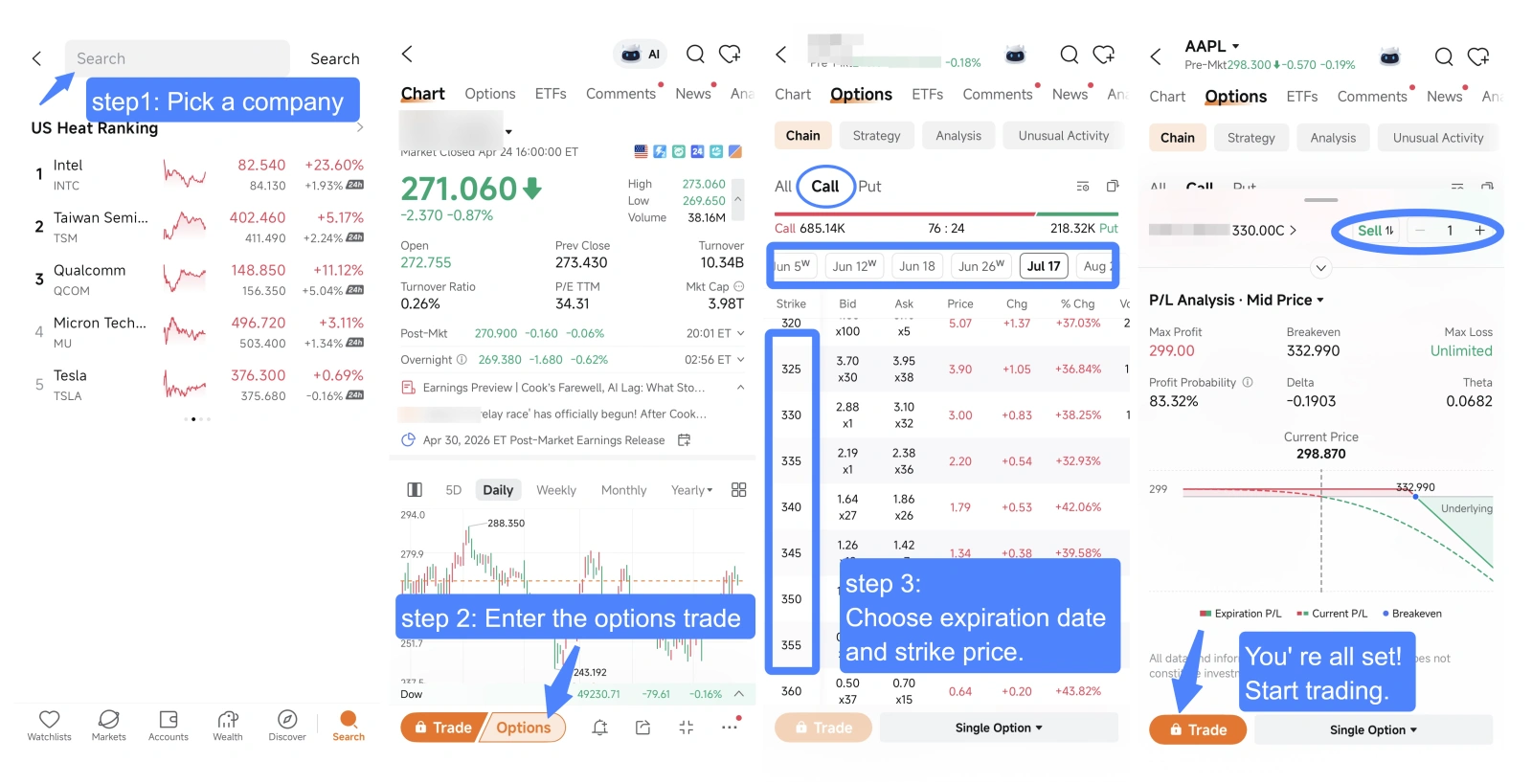
Step 1: Pick the Stock
You need to already own at least 100 shares of a company you'd like to earn extra income on — and be willing to sell at a higher price.
Stick with large-cap, highly liquid names (think AAPL, MSFT, NVDA). Tighter bid-ask spreads mean lower transaction costs and a friendlier experience overall.
Step 2: Choose the Strike Price
The strike is your selling price. The trade-off is intuitive:
Closer to current price → higher premium, higher chance of assignment
Further from current price → lower premium, higher chance of keeping shares
For beginners, choose a strike price at which you'd genuinely be happy to sell.
Step 3: Choose the Expiration Date
Longer-dated → higher premium, but you're locked in longer
Shorter-dated → lower premium, but greater flexibility
Most practitioners gravitate toward the 30- to 45-day window. Within this range, premiums are meaningful relative to the commitment, and the option experiences noticeable time decay — the natural erosion of an option's value as expiration approaches — which works in the seller's favor.
How Much Capital Does This Require?
Since your 100 shares serve as the collateral, there's no additional cash margin required and no scenario where you're on the hook to deliver shares you don't have.
A Concrete Example
Say you own 100 shares of $Apple (AAPL.US)$, currently trading at $290. Your read is that a sudden surge is unlikely in the near term — and if the stock climbs to $335, you'd be happy to sell. A 15.5% move to the upside is more than acceptable.
You sell 1 call expiring in 30 days with a $335 strike and immediately collect $1.25 × 100 = $125 in premium.
What happens 30 days later?
? Apple stays at or below $335 — sideways, a modest gain, or a slight dip:
The contract expires worthless. You pocket the $125, which works out to roughly 5.2% annualized on your $29,000 position. Your 100 shares remain untouched. Rinse and repeat next month.
? Apple rises above $335 — say it surges to $350 (a big rally)
You sell your 100 shares at the agreed strike of $335 and keep the $125 premium. Your total profit = ($335 - $290) × 100 + $125 = $4,625. You still made money, but you missed out on the ($350 - $290) × 100 = $6,000 gain you would have captured by simply holding the stock.
? Apple drops to $260 (a decline)
The contract expires worthless. You keep your 100 shares and the full $125 premium. Your unrealized loss on the stock is ($290 - $260) × 100 = $3,000, but the premium offsets $125 of that, reducing your effective loss to $2,875. You're slightly better off than if you had just held the stock and done nothing. That said, it's important to recognize that the premium only provides a limited cushion — it cannot truly hedge against a significant drop.
04 Risks and Ideal Scenarios
Every strategy has trade-offs. Covered Calls come with two main risks:
⚠️ Opportunity Cost
If the stock surges well past the strike, your upside is capped at the strike price plus the premium. You won't capture the full windfall. Covered Calls earn you "the patient waiting money," not "the surprise moonshot money."
⚠️ Downside Exposure
If the stock drops, your shares lose value just like they would without the strategy. The premium provides a small cushion, but it's not a hedge. In this respect, a Covered Call is no different from simply holding the stock. It's an income-enhancement tool, not a protection tool.
Covered Calls are a good fit if you:
✅ Already own 100+ shares
✅ Expect the stock to trade sideways, drift modestly higher, or dip slightly in the near term
✅ Want idle holdings to generate some cash flow
Not the right fit if you:
❌ Are strongly convinced a big rally is imminent — just hold the stock and don't cap your upside
❌ Can't bring yourself to sell at any price — emotional attachment doesn't mix with this strategy
❌ Want downside protection — that's not what this tool does
Start Trading on moomoo
1)So if you're not planning to sell your holdings anytime soon and don't expect any sharp moves in the near term, consider trying the Covered Call strategy to "collect rent" on your shares:
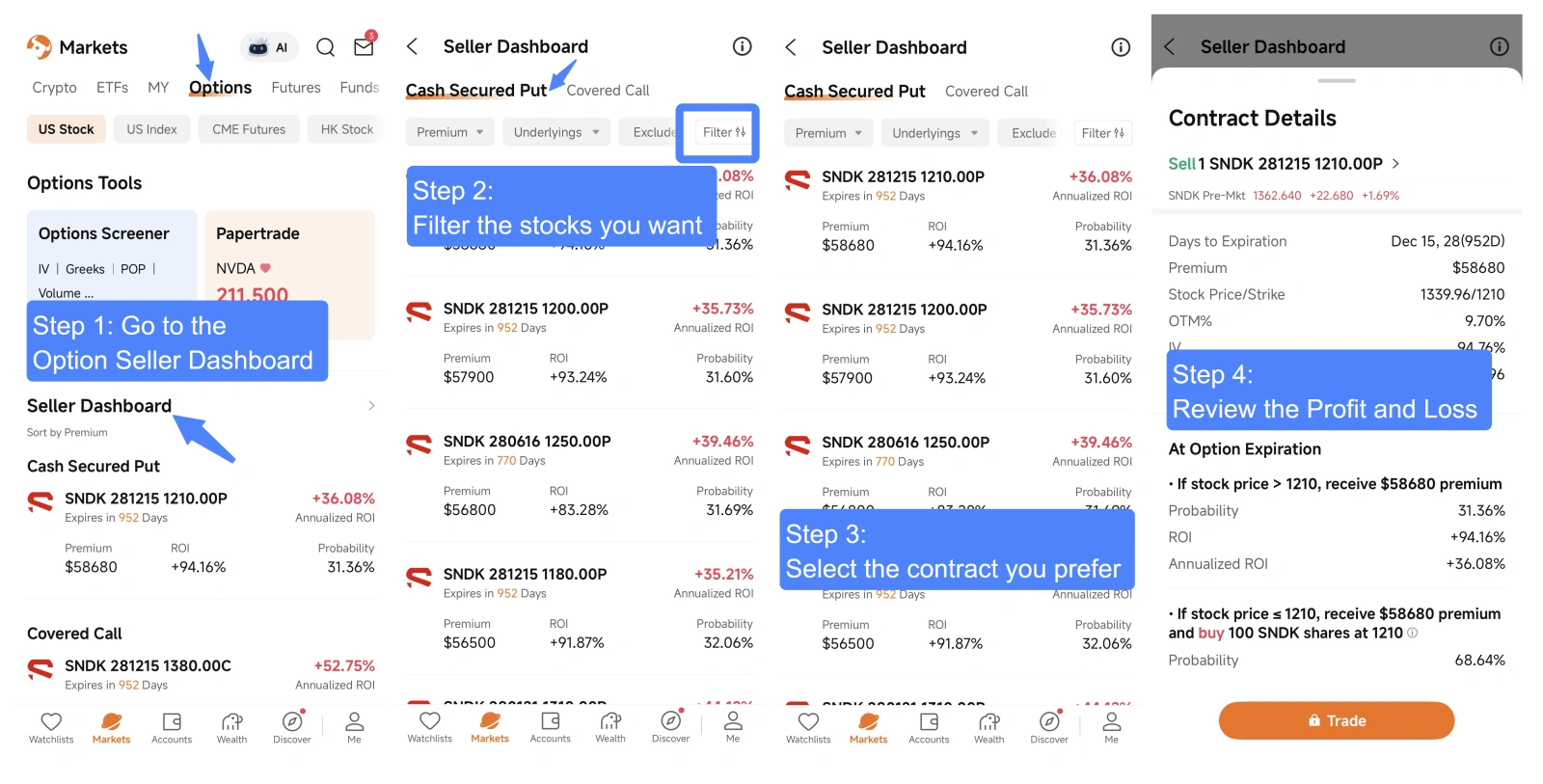
2)Moomoo also offers Option Seller Dashboard.
Simply go to Market > Options, filter by stock and set your preferences, select the contract you're interested in, and review the P&L before placing your trade. It's another easy way to get started with options trading:
05 Final Takeaway
When people hear Buffett say "selling options is essentially selling insurance," their minds jump straight to the Coca-Cola Sell Put story. But there's a second, equally conservative application of being the seller — one designed specifically for shareholders.
Pair a Sell Call with shares you already own, and you turn what would otherwise be a high-risk speculation into a steady income-enhancement engine. That's the Covered Call.
It's not speculation. It takes a selling price you'd accept anyway and converts it into recurring, upfront cash flow — paid to you by a stock you planned to keep holding.
If there's a long-term position sitting in your account that you don't expect to spike anytime soon, consider starting with just one Covered Call and letting it earn its keep. Much like Berkshire's insurance operations, every quiet day is another day generating cash flow for you.
This presentation is for informational and educational use only and is not a recommendation or endorsement of any particular investment or investment strategy. Investment information provided in this content is general in nature, strictly for illustrative purposes, and may not be appropriate for all investors. Read more