Real vs Paper Trading: Key Differences for Malaysians
What is Paper Trading?
Paper trading is a simulated financial trading method that allows you to use virtual funds to test trading strategies in a risk-free environment. This practice is an ideal tool for educating novice investors, and helping them learn market analysis, trading psychology, and risk management while understanding financial concepts and trading principles. For experienced traders, paper trading is an effective means of testing and adjusting trading strategies to enhance real trading performance. One of the key advantages of paper trading is that it allows traders to build valuable statistics and practice trading strategies without financial risk.
What is Real Trading?
Real trading refers to the act of investors using their actual funds to buy and sell securities in the financial market. This trading model is directly related to the investment of capital and the returns, requiring investors to have an in-depth understanding of the market, accurate analytical skills, and strict risk control measures. Real trading includes the opportunity for profit and the risk of capital loss, Therefore, as Malaysian investors, it is necessary to conduct thorough market research and strategy formulation before engaging in trading. Additionally, real-world trading involves psychological factors, emotional stress, and various hidden costs such as slippage and commissions, which are not present in hypothetical trading scenarios.
At the same time, live trading is regulated by laws, regulations, and supervisory policies, and investors need to follow the market rules and regulations of Malaysia. Since the trading actions of investors can have a substantial impact on the market, every buy or sell order has the potential to directly or indirectly affect the price of securities.
Key Differences Between Paper Trading and Real Trading
Paper Trading and Real Trading are two distinct practices in the field of financial investment, with significant differences across several key aspects. Paper trading can serve as a valuable tool for both new and experienced traders to practice and refine their trading strategies without risking real money.
1. Capital Risk
Paper Trading: Utilizes virtual funds, so there is no risk of actual capital loss. Investors can test strategies and learn about the market without financial pressure.
Real Trading: Involves the use of real capital, where any trading decision could lead to capital loss or appreciation, making risk management crucial.
2. Emotional Impact
Paper Trading: Due to the absence of actual capital loss, investors may not experience the same emotional fluctuations as in real trading, such as anxiety, greed, or fear. Traders use paper trading to practice without emotional stress.
Real Trading: Emotional factors play an important role in real trading and can affect the decision-making process of investors. Controlling emotions and maintaining calm and rationality are key to successful trading.
3. Market Influence
Paper Trading: Trading actions do not affect the current market as they do not involve real capital flows and security delivery.
Real Trading: Investors’ buying and selling decisions directly affect market supply and demand, thereby influencing security prices and market liquidity.
4. Trading Strategy and Execution
Paper Trading: Strategy testing and execution occur without the actual market pressure and may not fully simulate all conditions in real trading, such as slippage and trading delays.
Real Trading: The formulation and execution of strategies need to consider factors like market volatility, trading costs, and execution speed, all of which can affect the outcome of trades.
5. Legal and Regulatory Environment
Paper Trading: Generally not regulated by financial regulatory authorities as it does not involve actual capital and security transactions.
Real Trading: Subject to strict legal and regulatory requirements, investors must comply with regulations on trade reporting, tax compliance, and anti-money laundering, among others.
Challenges of Transitioning from Paper Trading to Real Trading
Transitioning from simulated trading to real trading is a significant step in the growth process of every trader, and this process is accompanied by multiple challenges.
Emotional Management: In simulated trading, since there is no real capital loss, traders may feel relaxed and without pressure. However, in real trading, every transaction is directly related to personal financial conditions, which may lead to strong emotions such as anxiety, greed, and fear, affecting rational decision-making.
Execution Differences: In simulated trading, traders can execute buy and sell orders immediately, while in real trading, there may be slippage (the difference in the executed price from the expected price due to price movement), delayed transactions, and liquidity issues.
Strategy Effectiveness: Strategies that perform well in a simulated environment may fail in the real market due to a variety of unpredictable factors.
Capital Management: The concept of capital management may be overlooked in simulated trading, but in real trading, proper capital management is crucial to avoid excessive trading and excessive risk exposure.
Tips for a Smooth Transition from Paper Trading to Real Trading

Transitioning from simulated trading to real trading is an important step on the investor’s growth path, but it is a step filled with challenges. Here are some common coping methods:
1. Substantive Understanding of Risk Management
In the virtual trading environment, because the loss of funds does not lead to actual financial consequences, investors may not handle risk as cautiously as they would with real money. However, in actual trading, the loss of funds is real and, once occurred, is irrecoverable. Therefore, you want to establish strict risk control strategies, including but not limited to setting stop-loss positions, reasonably controlling the scale of investment, and flexibly adjusting your trading strategies according to market changes.
2. Emotional Control
When real money is involved in real trading, investors may be troubled by emotions such as anxiety, greed, or fear, which may interfere with their trading choices. To effectively cope with these emotional fluctuations, you want to enhance self-control by learning emotional regulation techniques such as meditation, mindfulness practice, or cognitive-behavioral therapy. In addition, establishing and adhering to a strict set of trading strategies and rules helps investors maintain discipline and objectivity in trading, thereby reducing the adverse impact of emotions on trading decisions.
3. Gradual Adaptation to Trading Scale
In the simulated trading environment, investors may tend to make bolder trading operations because even if the trading results are poor, there will be no actual economic losses. In contrast, in the real trading market, you want to adopt a more cautious strategy, gradually expanding the scale of trading to become familiar with the market environment and accumulating experience and confidence in the process. This approach helps investors to better understand market dynamics and make wiser investment decisions while controlling risks.
4. Continuous Learning and Strategy Adjustment
The market environment is always evolving, which means that even strategies that perform well in simulated trading may need to be adjusted according to the specific conditions of the real market. You want to continuously pay attention to the latest market developments and constantly improve your trading skills and strategies to ensure you can adapt to market changes.
Why Moomoo Stock Trading Simulator
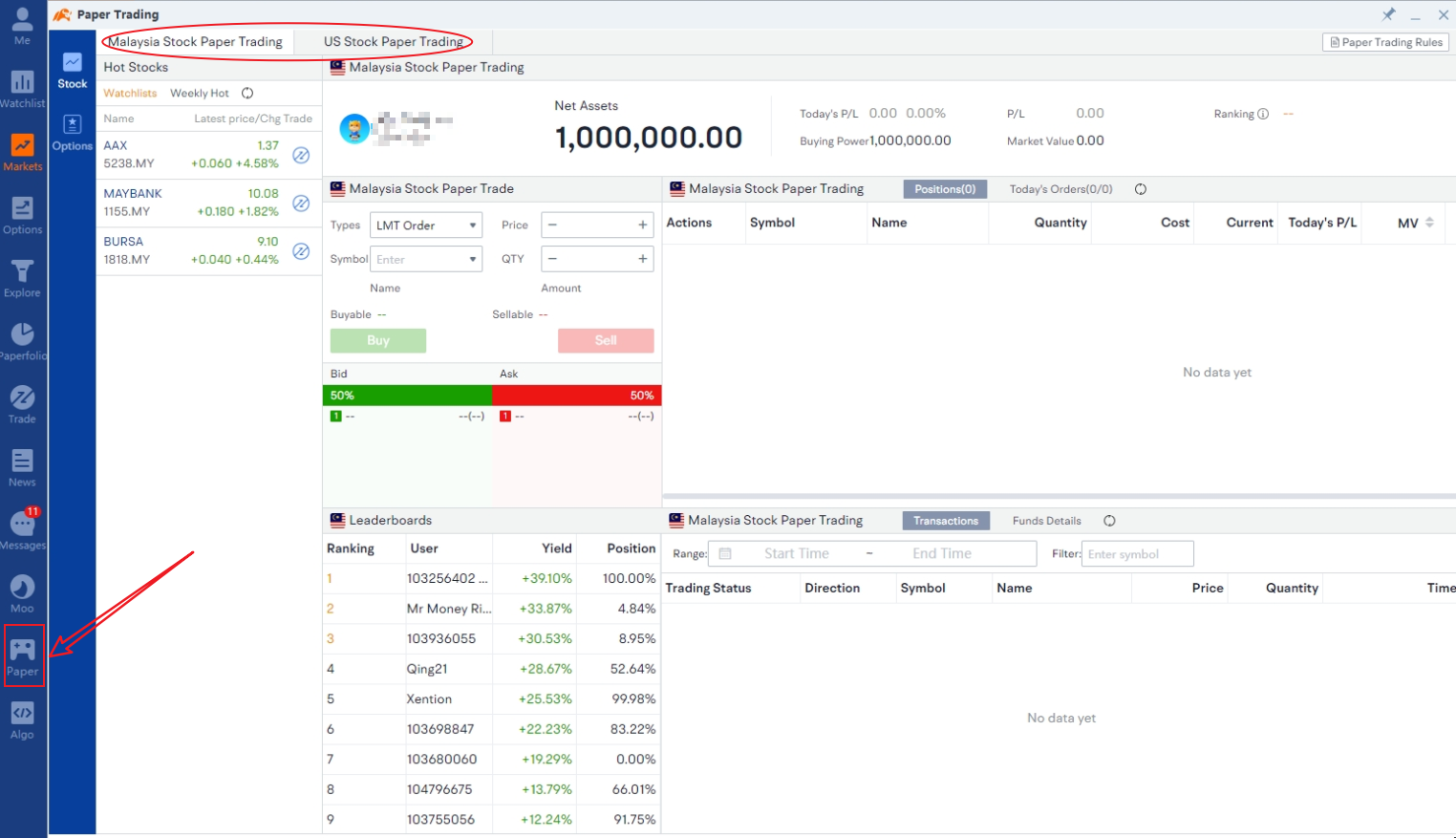
Multi-Market Coverage: The moomoo MY stock trading simulator offers extensive market coverage, allowing users to engage in simulated trading across different stock markets, including but not limited to the United States, Malaysia, Australia, and Singapore. This multi-market coverage ensures that users can test and optimize their trading strategies based on global market dynamics.
High-Fidelity Simulation Environment: The moomoo simulator provides a highly realistic trading environment, utilizing real-time market data and actual trading mechanisms to ensure that the simulated trading experience is as close to real trading as possible. This environment helps investors become familiar with market fluctuations and trading processes without financial risk.
Detailed Paper Trading Rules: The simulator has a comprehensive set of trading rules, including order types, trading times, and fee structures, which closely correspond to the rules of actual trading platforms. This allows users to conduct simulated trades under the premise of adhering to real trading rules, thereby enhancing the learning effect.
Timely News Coverage: The moomoo simulator offers timely updates on market news and information, enabling users to make trading decisions based on the latest market news and events. This timely news coverage helps investors practice how to respond under dynamic market conditions.
User Interface and Experience: The moomoo simulator features an intuitive and user-friendly interface, providing a smooth trading experience and a rich set of charting tools to support users in technical analysis and trading decision-making. A good user experience allows investors to focus on the formulation and execution of trading strategies.
Support for Multiple Asset Classes: In addition to stocks, the Moomoo simulator also supports simulated trading for a variety of asset classes, such as options, futures, and foreign exchange. This diversified support for asset classes provides users with a broader range of investment options, enabling them to test and apply different trading strategies under various market conditions.
As one of the more mature paper trading apps, to understand the specific process of moomoo paper trading, you can visit How to Use moomoo Paper Trading.
Conclusion
By comparing simulated trading with real trading, we can see the key differences between the two in terms of capital risk, emotional impact, market influence, trading strategy and execution, and legal regulation. Simulated trading provides investors with a risk-free platform to test and refine trading strategies, while real trading requires investors to have a deep understanding of the market and strict risk management capabilities. Although simulated trading cannot fully replicate the complexity and emotional pressure of real trading, it is a valuable tool for investors to learn and prepare to enter the market. With the continuous advancement of technology, advanced trading simulators such as the moomoo stock trading simulator offer a highly realistic trading environment, helping investors gain valuable experience before transitioning to real trading.
This presentation is for informational and educational use only and is not a recommendation or endorsement of any particular investment or investment strategy. Investment information provided in this content is general in nature, strictly for illustrative purposes, and may not be appropriate for all investors. Read more