'Oracle of Omaha' Warren Buffett:ROE>20% is preferable
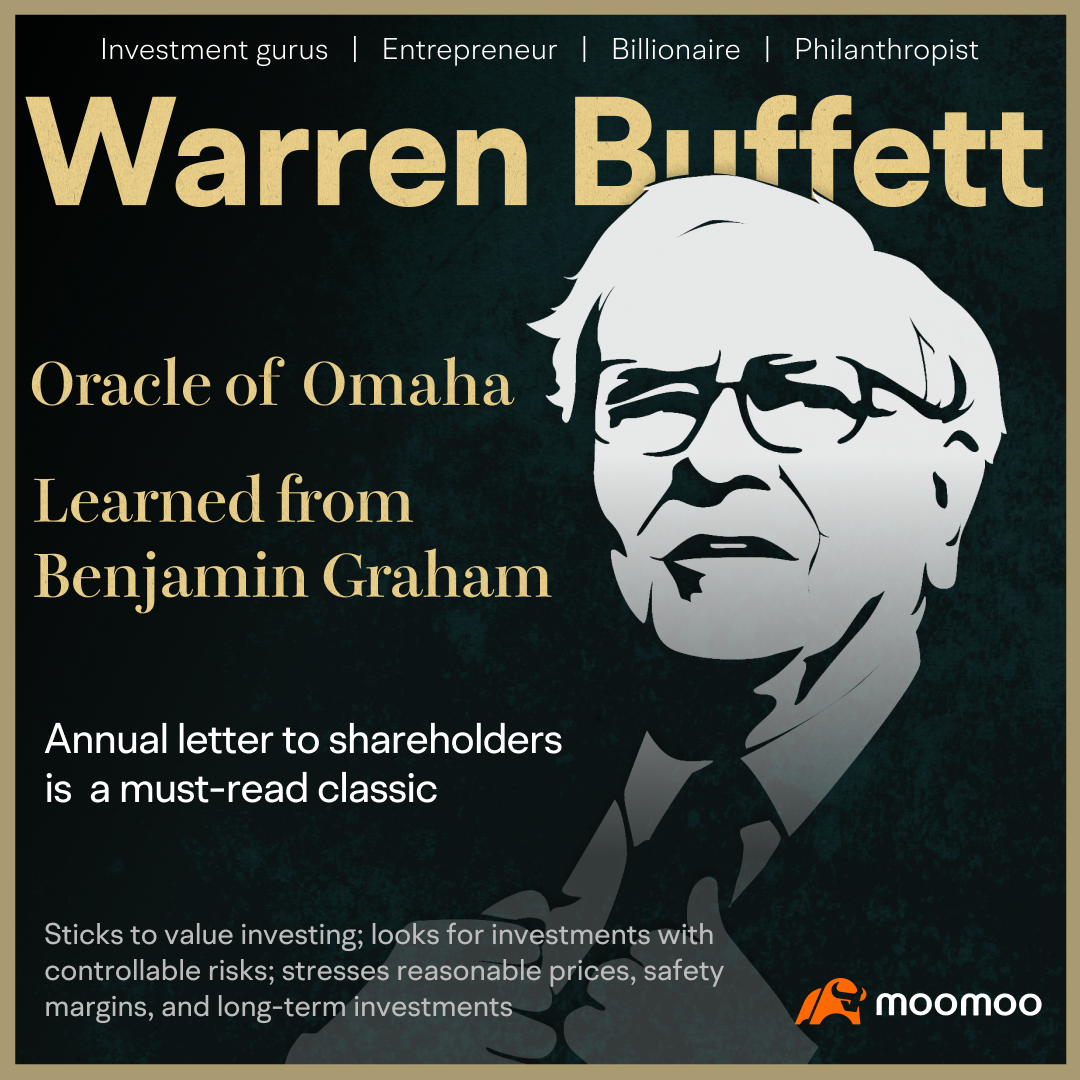
Warren Buffett's Investment Experience and Philosophy
When we talk about investment gurus, the one name that immediately comes to mind is Warren Buffett. Born in Omaha, Nebraska in 1930, he's known worldwide as the "Oracle of Omaha". As an investment gurus, entrepreneur, billionaire, and philanthropist, he has countless fans who make pilgrimages to the Berkshire Hathaway Annual Meeting every year just to hear him speak.
Buffett's father was a stockbroker and a former member of Congress. Young Buffett developed an interest in investing early on, and everyone around him knew he was a math prodigy. He made his first stock investment at age 11, earning a small profit, and by 13, he had started his own business as a paperboy. In high school, he and a friend invested $25 in secondhand pinball machines and sold them later for $1,200!
Buffett studied business at the University of Pennsylvania and the University of Nebraska before obtaining a master's degree in economics from Columbia University. He continued his studies at the New York Institute of Finance.
After graduation, he worked as an analyst at Graham Newman Corporation, where he learned from Benjamin Graham. In 1956, he founded Buffett Partnership Ltd. in Omaha and gradually accumulated millions of dollars in wealth.
Later, he eyed Berkshire Hathaway, a textile company, and partnered with Charlie Munger to take over control of the company in 1965. They developed it into a diversified investment company that invests in insurance, energy, utilities, transportation, manufacturing, retail, and other assets. It's a tool for Buffett to realize his investment philosophy by acquiring mature but undervalued companies and maintaining a large stake in leading companies.
Once he'd accumulated a lot of wealth, Buffett announced in 2006 that he would donate most of it to charity. 85% of the funds went to the Bill and Melinda Gates Foundation, which focuses on global health issues, American libraries, global schools, and more. Before that, he'd already been involved in charitable work.
In addition to his philanthropic deeds, Buffett also leaves us with valuable lessons. For example: "Invest in a business any fool can run because someday a fool will," "Life is like a snowball, the important thing is finding wet snow and a very long hill," "Rule No. 1: Never lose money. Rule No. 2: Never forget rule number one," "If you aren't willing to own a stock for ten years, don't even think about owning it for ten minutes," and perhaps the most famous one: "Be greedy when others are fearful, and be fearful when others are greedy."
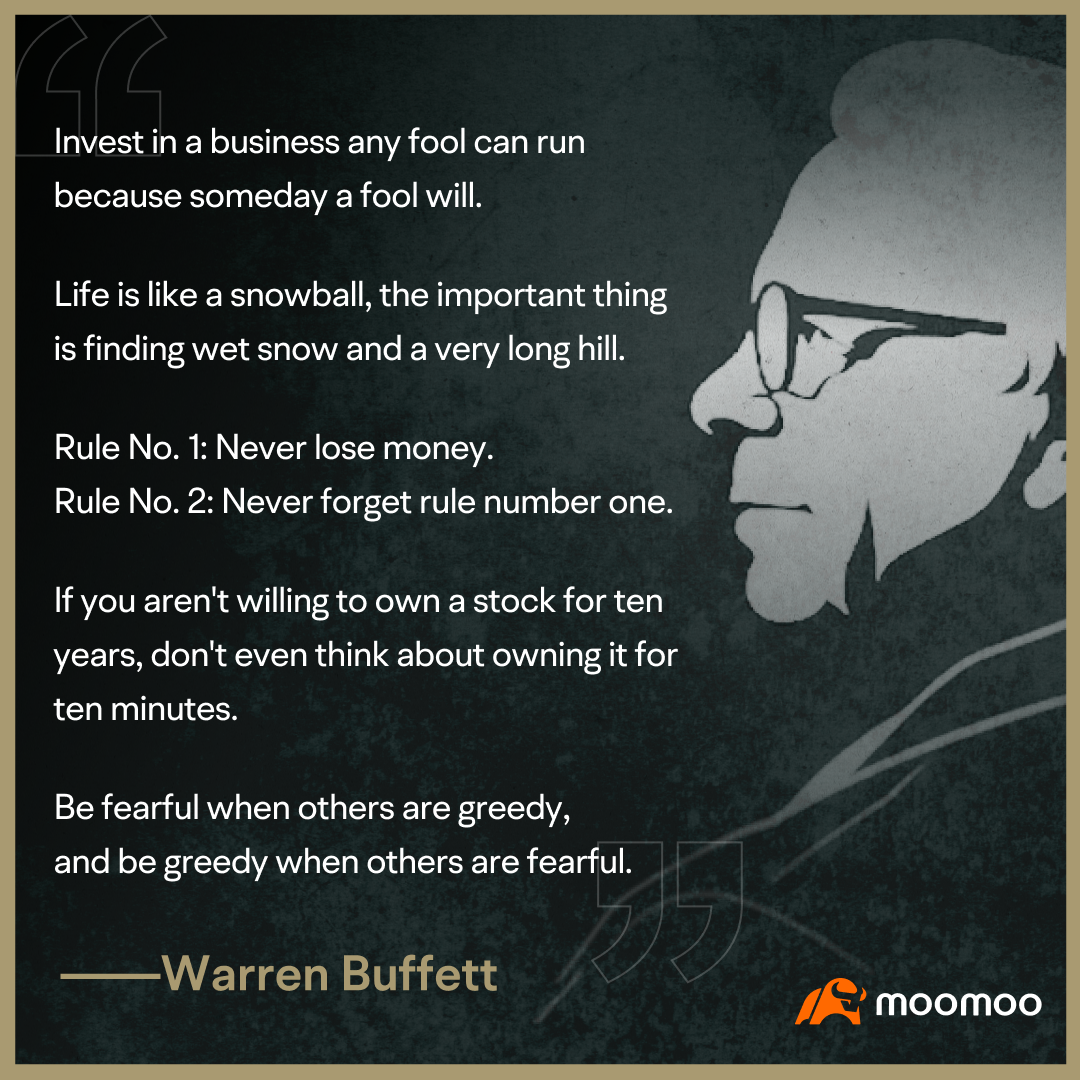
It's worth mentioning that he writes a letter to Berkshire shareholders every year, which is considered a must-read classic in the industry. Robert Hagstrom's book, The Warren Buffett Way, also summarizes Buffett's investment wisdom.
Buffett advocates value investing and seeks investments with controllable risks. He emphasizes a company's intrinsic value (including competitive advantages, financial conditions, management teams, etc.) and avoids investing in companies beyond his scope of expertise. He stresses reasonable prices, safety margins, and long-term investments.
Warren Buffett's Stock Picking Tips
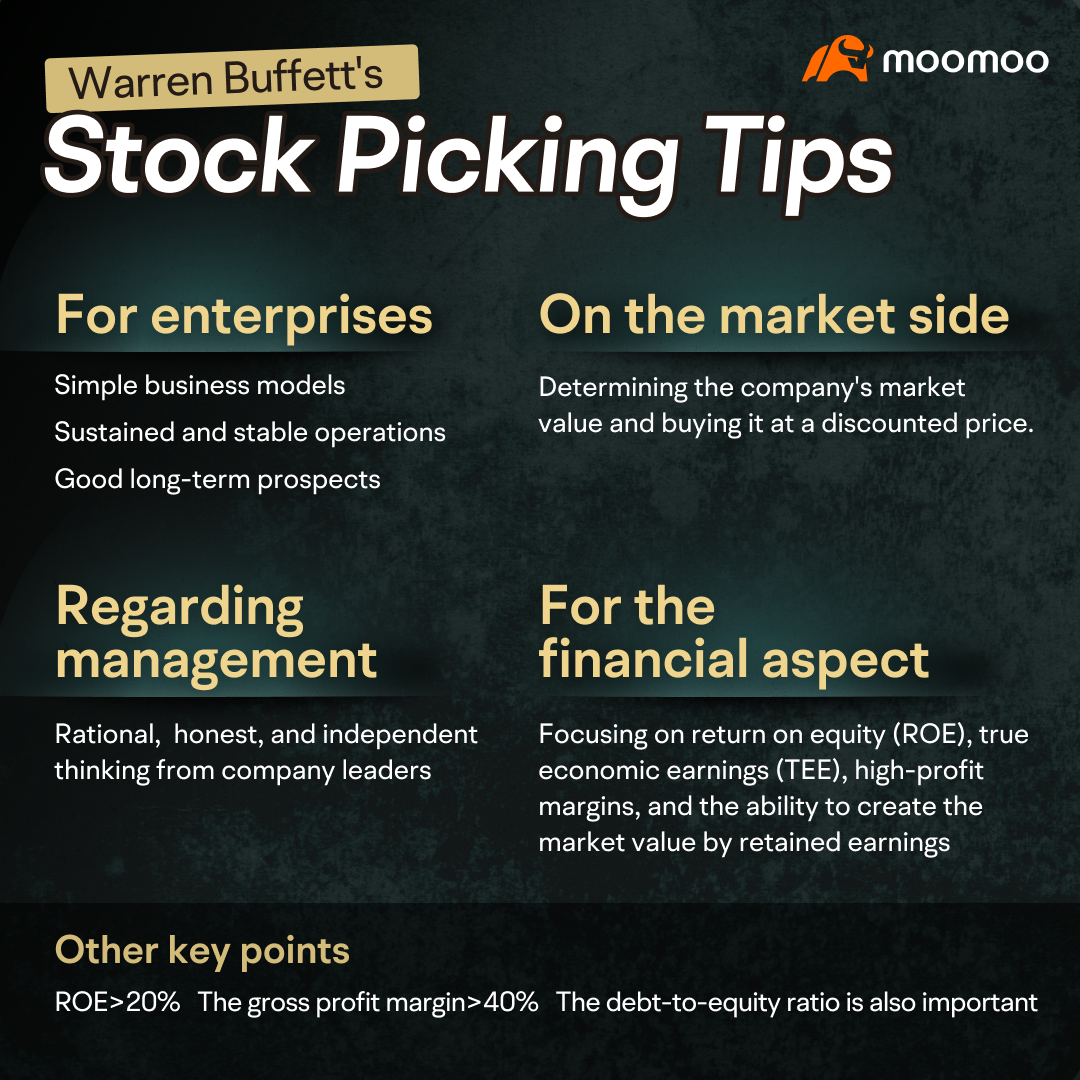
Warren Buffett's investment philosophy provides valuable insights into stock selection strategies.
1. "The Warren Buffett Way," 12 guidelines are summarized in four key areas: enterprise, market, management, and finance.
For enterprises, Buffett looks for simple business models with sustained and stable operations and good long-term prospects.
On the market side, he determines the market value of an enterprise and buys it at a discounted price, using valuation and safety margins to guide his decision.
Regarding management, he values rational, honest, and independent thinking from company leaders.
For the financial aspect, he offers four guidelines:
Buffett advises investors to focus on return on equity (ROE) instead of earnings per share (EPS). Some companies retain profits from the previous year, leading to an increase in EPS. However, ROE measures annual performance better since it represents how much net profit is generated by one unit of net assets. Companies with higher ROE are more efficient at generating profits with their available resources and are often better investments.
He suggests calculating True Economic Earnings (TEE), which is free cash flow obtained by adding depreciation, depletion, and amortization to net income and then subtracting capital expenditures. Companies that generate more cash than they consume are preferred.
Buffett emphasizes high-profit margins as critical indicators of management capabilities and cost control abilities.
For retained earnings, he believes that every dollar should create at least one dollar of market value. If a company's retained earnings over the past ten years add up to X, and the increase in market value over the same period is Y, if Y is less than X, it means the company has not effectively used its retained earnings and has regressed.
2. In his 1977 letter to shareholders, Buffett identified four key principles for stock selection: investing in businesses that have straightforward and predictable operations, good long-term prospects, are managed by ethical and competent executives, and can be purchased at an attractive price. These principles align with the guidelines described above, covering enterprise, market, and management aspects.
3. In his 1987 letter to shareholders, Buffett emphasized the importance of return on equity (ROE) as a critical investment criterion. He specified two conditions that a good investment should meet: first, the average ROE must exceed 20% over the past ten years; second, no year's ROE should fall below 15% during this period.
4. Buffett has repeatedly stressed the importance of gross profit margin, which is calculated as gross profit divided by revenue. In public forums, he has recommended companies maintain a high gross profit margin of at least 40%. Among Berkshire Hathaway's long-term holdings, many companies have met or exceeded this benchmark.
5. Debt-to-equity ratio is another metric that Buffett considers when making investment decisions. Companies that carry excessive debt may be too aggressive and carry higher risks for investors.
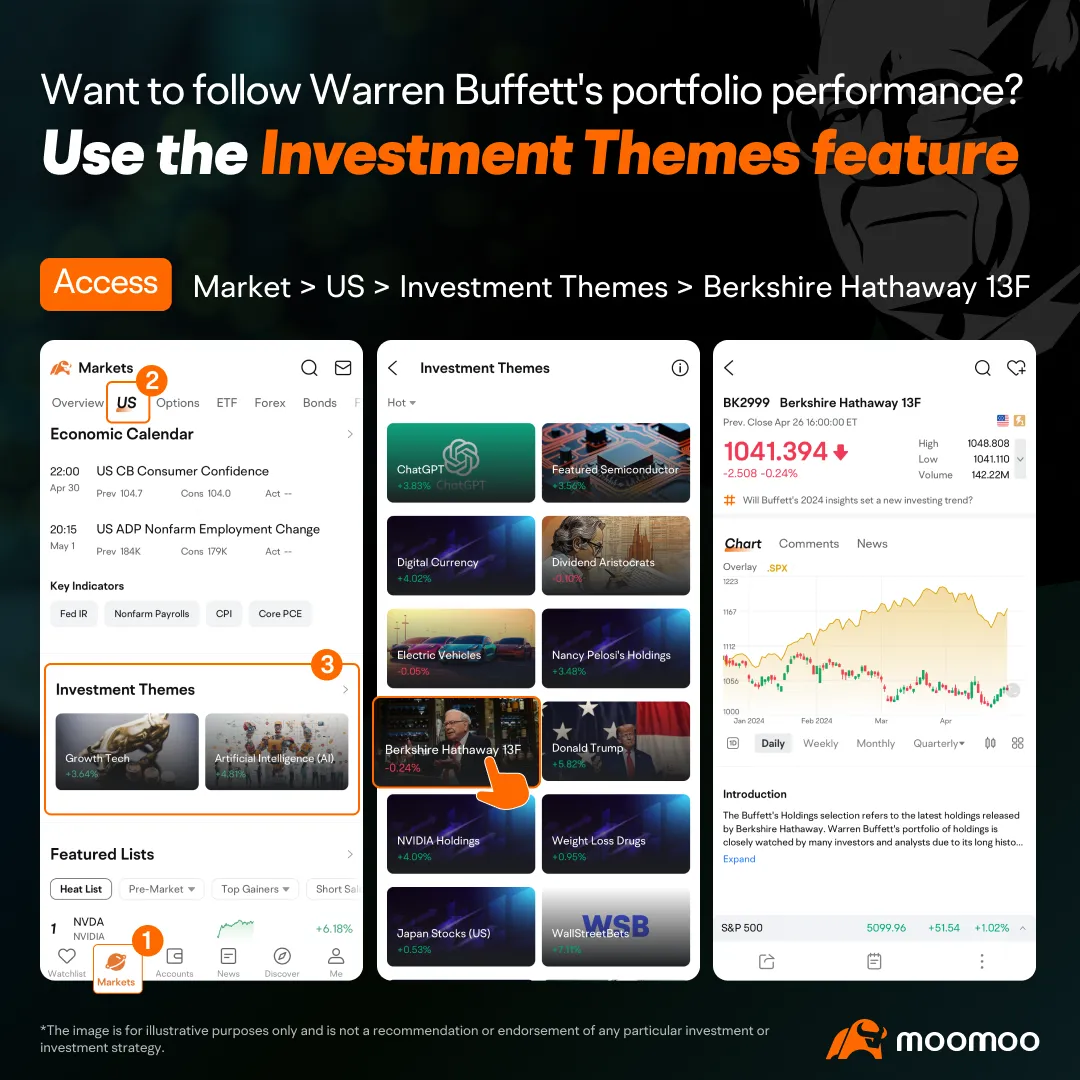
On moomoo, you can follow the trends of Buffett's US stock holdings and explore related stocks using the "Investment Themes" feature.
This presentation is for informational and educational use only and is not a recommendation or endorsement of any particular investment or investment strategy. Investment information provided in this content is general in nature, strictly for illustrative purposes, and may not be appropriate for all investors. Read more
Recommend
Mastering the Dollar Cycle: How to invest in a changing economy
How Will the US Dollar Perform in 2024? A Closer Look into the US Dollar Index
Unveiling Inflation: Why is Your Wallet Shrinking?

Why is the US dollar so powerful worldwide, and how can we tell?
How to interpret the Fed dot plot?
Why do oil ETFs lag behind oil prices in the long run?
Understanding Bessent's Fiscal Blueprint
Unpacking the U.S. Debt Issue
Meet Dr. Copper: Understanding the Copper Market
A look at employment: what other indicators are there?
Do Oil Price Swings Rock the Stock Market?
How Tariffs Could Impact the Copper Landscape?
Why is Oil Called the "Mother of All Commodities"?
GDP: The Barometer of National Prosperity
Are U.S. Treasuries still a safe haven?
How does nonfarm payroll impact the global market?
How Inflation Affects the Market
How to Decode Inflation: CPI, PCE, and PPI
Understanding Treasury Auctions: A Step-by-Step Guide
Gold vs. Gold Miners: A Comparison
Understanding the GDP
How does monetary policy steer our lives and investment
How to analyze the Federal Reserve's monetary policy?
Discussing the driving forces behind rises in gold prices
Strong Consumer Spending Despite Economic Slowdown: Here's Why
Rapidly Rising US Housing Prices: Opportunity or Risk?
The Underlying Conflicts Surrounding Crude Oil Prices
'Father of value investing' Benjamin Graham: Ten Stock Selection Criteria
'Oracle of Omaha' Warren Buffett:ROE>20% is preferable
07 Howard Marks & Oaktree Capital
Listen to the Fed's speakers: Hawks or doves?
Understanding the CCI
Understanding the Federal Reserve Interest Rate Decision
Understanding the Durable Goods Orders
Investing and Labor Market Indicators
Understanding the relationship between the stock market and the bond market
The Rise of the Fed: Can Trump Dismiss Powell?
01 Using 13F filings to learn from big investors
Why does Warren Buffett say don't piggyback on his trades?
Understanding the US Non-Farm Payroll Data
Understanding the US Crude Oil Inventories
Understanding the PPI
Understanding the Retail Sales
How to Preserve Your Wealth in a High Inflation Environment
What is the Debt Ceiling? A Deep Dive into US Fiscal Policy
Discover the bond market: A quick and easy guide
Analyzing the manufacturing industry may help you grasp economic trends
The Fed Dot Plot explained: What it says about US interest rates
What the Federal Reserve does?
08 Carl Icahn & Icahn Enterprises
09 Seth Klarman & Baupost Group
What's in the Fed's Toolbox?
Open the Fed's monetary policy toolbox
A brief history lesson on the Fed and U.S. economy
06 Ray Dalio & Bridgewater Associates
04 Warren Buffett & Berkshire Hathaway
03 How to Read Form 13F
02 Identify a fund's investment strategy
05 Bill Ackerman & Pershing Square Capital
Mastering the Dollar Cycle: How to invest in a changing economy
How Will the US Dollar Perform in 2024? A Closer Look into the US Dollar Index
Unveiling Inflation: Why is Your Wallet Shrinking?
Why is the US dollar so powerful worldwide, and how can we tell?
How to interpret the Fed dot plot?
Why do oil ETFs lag behind oil prices in the long run?
Understanding Bessent's Fiscal Blueprint
Unpacking the U.S. Debt Issue
Meet Dr. Copper: Understanding the Copper Market
A look at employment: what other indicators are there?
Do Oil Price Swings Rock the Stock Market?
How Tariffs Could Impact the Copper Landscape?
Why is Oil Called the "Mother of All Commodities"?
GDP: The Barometer of National Prosperity
Are U.S. Treasuries still a safe haven?
How does nonfarm payroll impact the global market?
How Inflation Affects the Market
How to Decode Inflation: CPI, PCE, and PPI
Understanding Treasury Auctions: A Step-by-Step Guide
Gold vs. Gold Miners: A Comparison
Understanding the GDP
How does monetary policy steer our lives and investment
How to analyze the Federal Reserve's monetary policy?
Discussing the driving forces behind rises in gold prices
Strong Consumer Spending Despite Economic Slowdown: Here's Why
Rapidly Rising US Housing Prices: Opportunity or Risk?
The Underlying Conflicts Surrounding Crude Oil Prices
'Father of value investing' Benjamin Graham: Ten Stock Selection Criteria
'Oracle of Omaha' Warren Buffett:ROE>20% is preferable
07 Howard Marks & Oaktree Capital
Listen to the Fed's speakers: Hawks or doves?
Understanding the CCI
Understanding the Federal Reserve Interest Rate Decision
Understanding the Durable Goods Orders
Investing and Labor Market Indicators
Understanding the relationship between the stock market and the bond market
The Rise of the Fed: Can Trump Dismiss Powell?
01 Using 13F filings to learn from big investors
Why does Warren Buffett say don't piggyback on his trades?
Understanding the US Non-Farm Payroll Data
Understanding the US Crude Oil Inventories
Understanding the PPI
Understanding the Retail Sales
How to Preserve Your Wealth in a High Inflation Environment
What is the Debt Ceiling? A Deep Dive into US Fiscal Policy
Discover the bond market: A quick and easy guide
Analyzing the manufacturing industry may help you grasp economic trends
The Fed Dot Plot explained: What it says about US interest rates
What the Federal Reserve does?
08 Carl Icahn & Icahn Enterprises
09 Seth Klarman & Baupost Group
What's in the Fed's Toolbox?
Open the Fed's monetary policy toolbox
A brief history lesson on the Fed and U.S. economy
06 Ray Dalio & Bridgewater Associates
04 Warren Buffett & Berkshire Hathaway
03 How to Read Form 13F
02 Identify a fund's investment strategy
05 Bill Ackerman & Pershing Square Capital