Index Funds in Singapore
What are Index Funds?
Index funds are a type of investment vehicle that seeks to replicate the performance of a particular market index. They can be structured either as passively managed funds, also known as mutual funds in the US or unit trusts in Singapore, or as passive funds known as ETFs (Exchange-traded Funds).
Unit trusts, not usually listed on an exchange, are bought and sold via a fund manager based on the fund's net asset value of the previous business day. ETFs, on the other hand, are typically bought and sold on an exchange based on the current bid and ask prices on the same trading day.
Indices exist for all sorts of financial instruments, with common ones being made up of a basket of stocks, bonds, or other securities. They are created by index providers which commonly are media-related and often do not themselves create the index funds nor provide a platform for trading them. Examples of index providers include the Dow Jones & Company Inc, an American publishing company that created the Dow Jones Index; the S&P Global Inc, a financial information and analytics firm behind the S&P 500 Index and the joint creators of the Straits Times Index - the Singapore Press Holdings and the UK-based FTSE Group.
Indices primarily seek to represent a targeted investment concept. They can focus on a particular market like the US, non-US developed markets, emerging markets, or the Singapore market, or they may zoom in on a particular segment of a market (e.g., based on market capitalisation, value or growth business orientation, financial corporations, real estate companies, etc.).
Read More: How to Buy Straits Times Index (STI) in Singapore?
Pros and Cons of Investing in Index Funds
By investing in a broad basket of component instruments included in an index, an index fund provides a low-cost, diversified way to invest in the specified market. They allow investors to gain exposure to a wide range of stocks, bonds, and other securities without having to actively manage their investments on an individual basis. How to invest in s&p 500 index in Singapore? Investing in an S&P 500 index fund gives one exposure to five hundred stocks considered to be most representative of the US stock market while investing in an STI index fund allows one to invest in the Singapore stock market with just thirty component stocks.
Another primary benefit of investing in index funds is the lower cost involved. Because index funds are typically passively managed, they have lower management fees than actively managed funds. This lower cost translates into higher returns for investors eventually.
On the other hand, there are drawbacks to investing in index funds. Since the mandate of index funds is to mirror the performance of a particular index, they cannot outperform the market. In other words, if market timing is part of your trading strategy to maximise returns, the entry and exit points are entirely in your hands – in short, do not fall for the common investors' misconception that the mandate of the professional fund manager of any fund, including index funds, is to time the market for you to maximise your returns.
Additionally, index funds do not provide investors with the opportunity to capitalise on individual instruments that may be outperforming the index. Stock selection is what the fund managers of actively managed funds attempt to do, some with success, others without. Take note that index fund managers do no such stock-picking, and neither can you when invested in an index fund, be it a unit trust or ETF.
Historical Performance of Index Funds vs the Overall Market
Historically, index funds have outperformed the actively managed funds, providing investors with higher returns than actively managed funds. Additionally, index funds tend to have lower fees than actively managed funds, which further contributes to their superior performance.
Top Performing Index Funds in Singapore
In Singapore, investors have a wide range of index funds to choose from. Some are unlisted unit trusts while others are ETFs listed on the Singapore Exchange (SGX). There are currently 57 ETFs listed on SGX, distinguished into Excluded Investment Products which are open to all investors, and Specified Investment Products (SIP) which are open only to investors who pass the SGX-administered SIP Quiz.
Online ETF selectors are available for unit trusts and ETFs, including unit trust index funds and index ETFs. Investors can access them via the following links:
● ETF screener of SGX-listed ETFs
To facilitate investment in the Singapore market, the SPDR STI ETF was launched in 2002. It seeks to provide investors with exposure to the Singapore equity market by replicating the performance of the STI, a free float-adjusted market capitalisation-weighted index that comprises the top 30 blue-chip stocks listed on the Singapore Exchange. It is one of the most liquid ETFs in Singapore and is suitable for all investors who are looking for an easy, cost-effective, and diversified way to invest in the Singapore equity market.
The SPDR STI ETF has an expense ratio of 0.3% and an average annual return of 8.2%. It has a low tracking error of 0.1% and is highly liquid.
Other top-performing index funds in Singapore include the Lion Global All-Weather Equity Fund, the ABF Singapore Bond Index Fund, and the Lion-Phillip S-REIT Index Fund.
The Lion Global All-Weather Equity Fund seeks to replicate the performance of the MSCI World Index by investing in equities from developed markets around the world. The fund has a low expense ratio of 0.2%, which makes it an attractive option for investors looking for long-term capital growth.
The ABF Singapore Bond Index Fund seeks to replicate the performance of the Singapore Government Securities Index. It invests in a variety of fixed-income securities issued by the Singapore government and other public entities. The fund has a low expense ratio of just 0.1% and has historically provided investors with steady returns.
Finally, the Lion-Phillip S-REIT Index Fund seeks to replicate the performance of the FTSE ST REIT Index. It invests in a variety of real estate investment trusts listed in Singapore and has a low expense ratio of 0.3%. The fund has provided investors with steady returns over the long term, making it one of the top-performing index funds in Singapore.
Investing in Index Funds
A convenient way to invest in index funds is through moomoo, where you can click on the 'Markets' tab followed by clicking on either the 'SG' or 'US' tabs to view index funds for the respective countries. For example, for the 'US' tab, the largest index funds are displayed at the top as seen in the screenshot in the bottom left. You will then be able to click into a specific index fund to find out more about its constituent stocks. Sign up and download the moomoo app to know more.
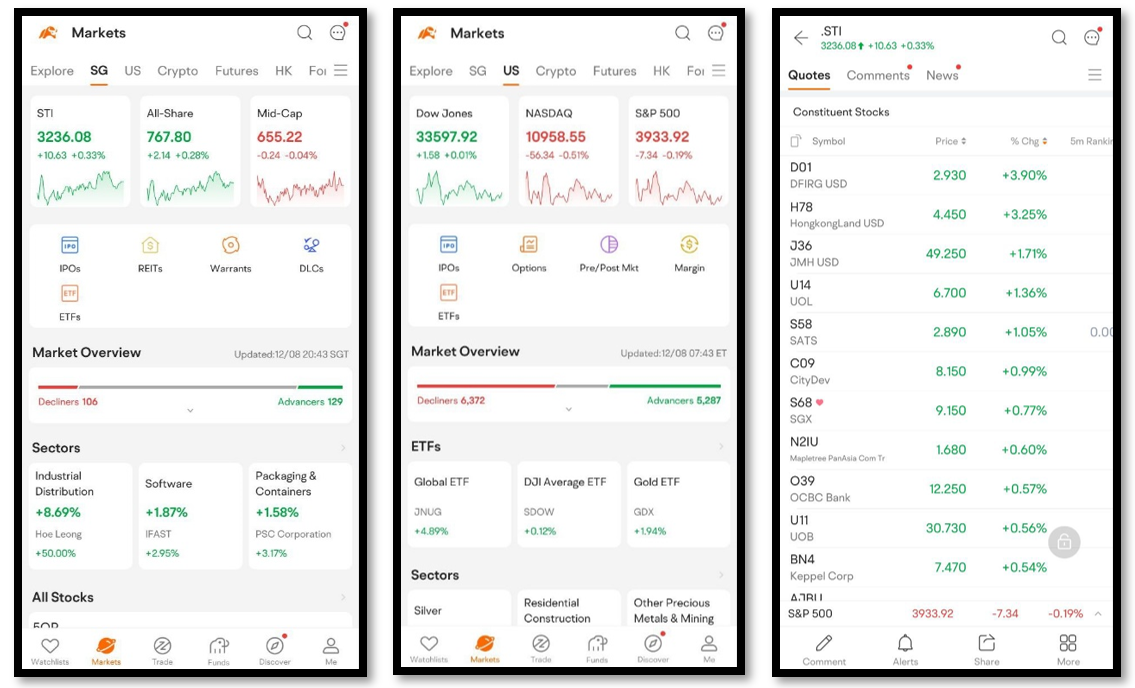
Images provided are not current and any securities are shown for illustrative purposes only.
This presentation is for informational and educational use only and is not a recommendation or endorsement of any particular investment or investment strategy. Investment information provided in this content is general in nature, strictly for illustrative purposes, and may not be appropriate for all investors. Read more
Recommend

How to Invest MyDCD IPO Malaysia 2026
SpaceX IPO 2026: How to Invest in SpaceX in Malaysia
Top 7 Dividend ETFs for Malaysian Investors 2026

How to Invest Stratus Global IPO Malaysia 2026
How to Invest in SkyeChip IPO in Malaysia 2026
Top 10 Features of Stock Brokers in Malaysia
How to Invest in Sunway Healthcare in Malaysia 2026
Cara Melanggan IPO Empire Sushi (5351): Panduan Lengkap
Top 7 S&P 500 ETFs Malaysian Investors
Top 9 Semiconductor ETFs Malaysia 2026
Top 8 Gold ETFs in Malaysia for 2026
Moomoo vs Robinhood: Which Platform for Malaysian Investors
Top 8 Inverse ETFs Malaysia 2026
Moomoo Scams Alert: The Official Anti-Fraud Guide in Malaysia
Top 9 Index ETFs Malaysia 2026
Top 10 Technology ETFs in Malaysia for 2026
Safe Investing in Malaysia: Moomoo MY Statement
Is Moomoo Safe in Malaysia
Top 8 Artificial Intelligence Stocks for Malaysian Investors
Invest in 99 Speedmart Share in Malaysia: A Complete Guide
Top 6 Semiconductor Stocks for Malaysian Investors in 2024
Top Investment Strategies for Banking Sector in Bursa Malaysia
How to Buy Tesla Stock in Malaysia
Top 4 Copper ETFs Malaysia 2026
How to Buy IPO Stocks in Malaysia
Top 7 Sectors in the US Stock Market for Malaysian Investors
Top 10 US Penny Stocks for Malaysian Investors
Popular China Stocks for Malaysia Investors to Buy
Top 10 High Dividend Stocks Malaysia 2026
What Is A Recession?
How to Buy Money Market Funds in Malaysia
How to Buy Stock in Malaysia 2026
Top 10 US Healthcare Stocks for Malaysian Investors 2024
Top 5 Malaysia Dividend Stocks in 2026
How to Invest in Startups Before IPO in Malaysia
Top 7 Leveraged ETFs to Invest in Malaysia
Top 8 Currency ETFs Malaysia 2026
How to Invest in Anthropic IPO Malaysia 2026
Moomoo Malaysia vs M+ Global: Which Platform to Choose
What is a Bond and How to Buy U.S. Treasury Bond?
How to Invest in Foodie Media IPO in Malaysia?
Mutual Funds vs Money Market Funds: Which to Invest in Malaysia
Moomoo Malaysia Brokerage Fees and Pricing
What is Thematic Investing?
Malaysia Data Center: Beneficial Sectors and Stocks
Is Moomoo Legal in Malaysia
8 Benefits of Using Paper Trading Apps for Malaysian Traders
Margin Trading: Guide and Strategy for Malaysian Investors
Top Fixed Deposit Rates in Malaysia 2024
Trading App Moomoo: Download and Guide
Top 8 Benefits of Using Moomoo Malaysia as a Stock Broker
Top 10 US Technology Stocks for Malaysian Investors 2026
US-Listed Chinese Stocks Surge on Policy Boost: Who is Leading the Charge?
China-Linked Stocks Surge Amid Strong Policy Stimulus: Wall Street Says, “This Time Is Different!”
How Much Room is There for Valuation Recovery in China-Linked Stocks?
Top 8 Consumer Products and Services Companies in Malaysia 2024
Top 8 Tips for Using Paper Trading for Bursa Malaysia Investors
Top 10 Real Estate Investment Trusts Companies in Malaysia 2024
Top 10 Construction Companies and Stocks in Malaysia 2024
Top 6 Plantation Companies and Stocks in Bursa Malaysia 2025
Special Purpose Acquisition Company and How to Invest
Top 8 Technology Stocks in Malaysia 2024
Top 10 ETFs in Malaysia 2026
How to Choose Your Ideal ETF in Malaysia?
Top 5 Energy Companies and Stocks in Malaysia 2024
What Is Social Trading
How to Use Paper Trading to Test and Help Refine Your Trading Strategy?
Tax Trading Strategies in a Bear Market
6 ETF Concerns That Investors Shouldn’t Overlook
HK Financial Stocks Make a Strong Comeback Amid PBOC Policies & Fed Rate Cuts: Are High-Dividend Inv
How Stock Charting Tools Can Help You
Choosing a Stock Simulator to Practice Stock Trading
Psychological Condition of the Market
What Is SWOT Analysis?
What Is Copy Trading
What Is Working Capital?
What Is the Spot Rate?
Index Funds in Singapore
How to Practice Trading Without Risking Money?
Mutual Funds in Singapore
What Is Mirror Trading?
What Is Revenue?
What Is Trend Analysis?
What Is a Volatility Smile?
What Is Beta in the Stock Market?
What Does It Mean to Have a Certificate of Deposit (CD)?
What Is a Day Order?
Price-to-Earnings (P/E) Ratio
What Is the National Best Bid and Offer (NBBO) in US Equities?
What Are Market Orders?
Using Volume Oscillators to Confirm Price Movements
Forex Trading in Singapore
What Is a Bellwether?
On-Balance Volume (OBV): What Is It?
What Is Historical Volatility (HV)?
Company Earnings and Earnings per Share What Investors Need to Know
Spot Market: What Is It?
Scalping Stock Trading: How Does It Work?
What Is Market Depth?
What Is a Trailing Stop and How to Use It?
Swing Trading vs. Day Trading: What's the Difference?
Will ESG Investing Be The Future Of Investing?
Hedge Funds in Singapore
Build a Low-Risk Portfolio with Blue-Chip Shares in Australia
What Is the Money Flow Index (MFI)?
How to Invest MyDCD IPO Malaysia 2026
SpaceX IPO 2026: How to Invest in SpaceX in Malaysia
Top 7 Dividend ETFs for Malaysian Investors 2026
How to Invest Stratus Global IPO Malaysia 2026
How to Invest in SkyeChip IPO in Malaysia 2026
Top 10 Features of Stock Brokers in Malaysia
How to Invest in Sunway Healthcare in Malaysia 2026
Cara Melanggan IPO Empire Sushi (5351): Panduan Lengkap
Top 7 S&P 500 ETFs Malaysian Investors
Top 9 Semiconductor ETFs Malaysia 2026
Top 8 Gold ETFs in Malaysia for 2026
Moomoo vs Robinhood: Which Platform for Malaysian Investors
Top 8 Inverse ETFs Malaysia 2026
Moomoo Scams Alert: The Official Anti-Fraud Guide in Malaysia
Top 9 Index ETFs Malaysia 2026
Top 10 Technology ETFs in Malaysia for 2026
Safe Investing in Malaysia: Moomoo MY Statement
Is Moomoo Safe in Malaysia
Top 8 Artificial Intelligence Stocks for Malaysian Investors
Invest in 99 Speedmart Share in Malaysia: A Complete Guide
Top 6 Semiconductor Stocks for Malaysian Investors in 2024
Top Investment Strategies for Banking Sector in Bursa Malaysia
How to Buy Tesla Stock in Malaysia
Top 4 Copper ETFs Malaysia 2026
How to Buy IPO Stocks in Malaysia
Top 7 Sectors in the US Stock Market for Malaysian Investors
Top 10 US Penny Stocks for Malaysian Investors
Popular China Stocks for Malaysia Investors to Buy
Top 10 High Dividend Stocks Malaysia 2026
What Is A Recession?
How to Buy Money Market Funds in Malaysia
How to Buy Stock in Malaysia 2026
Top 10 US Healthcare Stocks for Malaysian Investors 2024
Top 5 Malaysia Dividend Stocks in 2026
How to Invest in Startups Before IPO in Malaysia
Top 7 Leveraged ETFs to Invest in Malaysia
Top 8 Currency ETFs Malaysia 2026
How to Invest in Anthropic IPO Malaysia 2026
Moomoo Malaysia vs M+ Global: Which Platform to Choose
What is a Bond and How to Buy U.S. Treasury Bond?
How to Invest in Foodie Media IPO in Malaysia?
Mutual Funds vs Money Market Funds: Which to Invest in Malaysia
Moomoo Malaysia Brokerage Fees and Pricing
What is Thematic Investing?
Malaysia Data Center: Beneficial Sectors and Stocks
Is Moomoo Legal in Malaysia
8 Benefits of Using Paper Trading Apps for Malaysian Traders
Margin Trading: Guide and Strategy for Malaysian Investors
Top Fixed Deposit Rates in Malaysia 2024
Trading App Moomoo: Download and Guide
Top 8 Benefits of Using Moomoo Malaysia as a Stock Broker
Top 10 US Technology Stocks for Malaysian Investors 2026
US-Listed Chinese Stocks Surge on Policy Boost: Who is Leading the Charge?
China-Linked Stocks Surge Amid Strong Policy Stimulus: Wall Street Says, “This Time Is Different!”
How Much Room is There for Valuation Recovery in China-Linked Stocks?
Top 8 Consumer Products and Services Companies in Malaysia 2024
Top 8 Tips for Using Paper Trading for Bursa Malaysia Investors
Top 10 Real Estate Investment Trusts Companies in Malaysia 2024
Top 10 Construction Companies and Stocks in Malaysia 2024
Top 6 Plantation Companies and Stocks in Bursa Malaysia 2025
Special Purpose Acquisition Company and How to Invest
Top 8 Technology Stocks in Malaysia 2024
Top 10 ETFs in Malaysia 2026
How to Choose Your Ideal ETF in Malaysia?
Top 5 Energy Companies and Stocks in Malaysia 2024
What Is Social Trading
How to Use Paper Trading to Test and Help Refine Your Trading Strategy?
Tax Trading Strategies in a Bear Market
6 ETF Concerns That Investors Shouldn’t Overlook
HK Financial Stocks Make a Strong Comeback Amid PBOC Policies & Fed Rate Cuts: Are High-Dividend Inv
How Stock Charting Tools Can Help You
Choosing a Stock Simulator to Practice Stock Trading
Psychological Condition of the Market
What Is SWOT Analysis?
What Is Copy Trading
What Is Working Capital?
What Is the Spot Rate?
Index Funds in Singapore
How to Practice Trading Without Risking Money?
Mutual Funds in Singapore
What Is Mirror Trading?
What Is Revenue?
What Is Trend Analysis?
What Is a Volatility Smile?
What Is Beta in the Stock Market?
What Does It Mean to Have a Certificate of Deposit (CD)?
What Is a Day Order?
Price-to-Earnings (P/E) Ratio
What Is the National Best Bid and Offer (NBBO) in US Equities?
What Are Market Orders?
Using Volume Oscillators to Confirm Price Movements
Forex Trading in Singapore
What Is a Bellwether?
On-Balance Volume (OBV): What Is It?
What Is Historical Volatility (HV)?
Company Earnings and Earnings per Share What Investors Need to Know
Spot Market: What Is It?
Scalping Stock Trading: How Does It Work?
What Is Market Depth?
What Is a Trailing Stop and How to Use It?
Swing Trading vs. Day Trading: What's the Difference?
Will ESG Investing Be The Future Of Investing?
Hedge Funds in Singapore
Build a Low-Risk Portfolio with Blue-Chip Shares in Australia
What Is the Money Flow Index (MFI)?