What you need to know before trading in Canada - the basics Ⅰ
Introduction to the Canadian securities market
The Canadian securities market stands among the world's most advanced, drawing in top-tier companies and a multitude of international investment funds. In this section, we'll explore the evolution of Canada's securities market, delve into its key exchanges, and highlight the major stock indices that investors should watch.
1. Development overview
Tracing its roots back to the late 18th century, the Canadian securities market has undergone a remarkable evolution, culminating in the establishment of the Toronto Stock Exchange (TSX) in 1852.
The early days of trading were characterized by the bustling energy of floor traders, who relied on vocal bids and intricate hand signals to execute trades. Today, this vibrant scene has transitioned to sophisticated electronic platforms.
As Canada's economy expanded, so did its securities market. The TSX and other major exchanges now boast a wide array of financial instruments, including ETFs, bonds, and derivatives.
By the end of 2021, the market's total capitalization not only underscored its pivotal role in the global financial arena but also highlighted the breadth of investment opportunities it presents.
2. Major exchanges
Generally speaking, there are five designated stock exchanges in Canada:
Toronto Stock Exchange (TSX).
TSX Venture Exchange (TSXV).
Montreal Exchange (ME).
Cboe Canada (formerly NEO Exchange).
Canadian Securities Exchange (CSE).
TMX Group
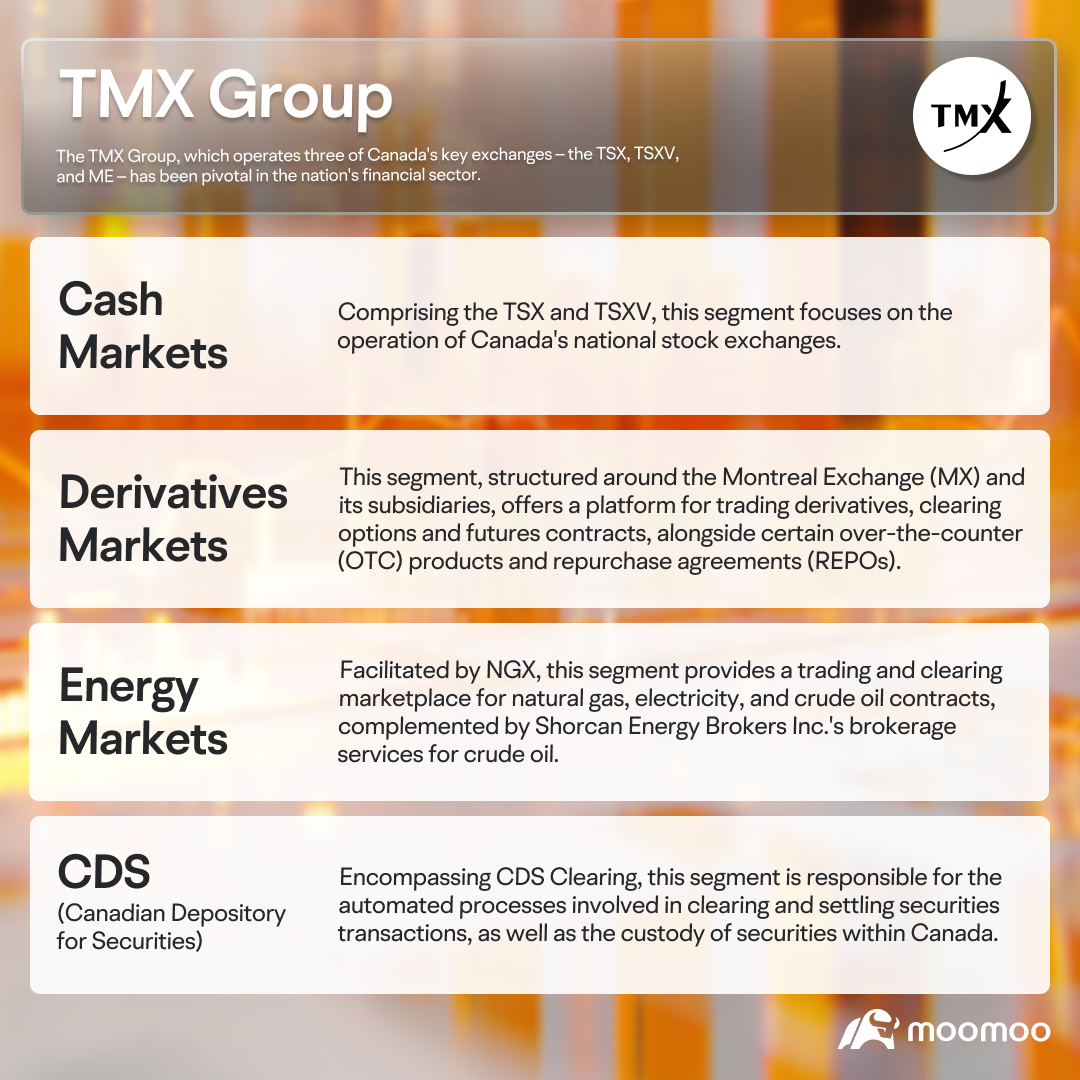
The TMX Group, which operates three of Canada's key exchanges – the TSX, TSXV, and ME – has been pivotal in the nation's financial sector.
Originating from the TSX founded in 1861, the group rebranded to its current moniker in 2008, reflecting its growth and acquisition of other exchanges. As one of the world's top 11 exchanges by market cap, TMX Group offers a suite of services including clearing, data dissemination, and more to a global audience.
It operates through four segments:
Cash Markets: Comprising the TSX and TSXV, this segment focuses on the operation of Canada's national stock exchanges.
Derivatives Markets: This segment, structured around the Montreal Exchange (MX) and its subsidiaries, offers a platform for trading derivatives, clearing options and futures contracts, alongside certain over-the-counter (OTC) products and repurchase agreements (REPOs).
Energy Markets: Facilitated by NGX, this segment provides a trading and clearing marketplace for natural gas, electricity, and crude oil contracts, complemented by Shorcan Energy Brokers Inc.'s brokerage services for crude oil.
CDS (Canadian Depository for Securities): Encompassing CDS Clearing, this segment is responsible for the automated processes involved in clearing and settling securities transactions, as well as the custody of securities within Canada.
TSX: Canada's largest stock exchange
Established in 1852, the Toronto Stock Exchange (TSX) is the heavyweight of Canadian finance and ranks third in size across North America. With over 1,500 listed companies and a combined market capitalization surpassing CAD $3 trillion, the TSX is a hub for major resource firms in mining, oil, and gas, as well as leading Canadian banks and telecom giants.
In 1977, the TSX launched its benchmark index, the TSE 300 Composite Index, which, after a 2002 rebranding, is now known as the S&P/TSX Composite Index. This key market barometer, akin to the S&P 500, aggregates the exchange's most prominent stocks, a topic we'll delve into more deeply later.
TSXV: The venture exchange
The TSX Venture Exchange (TSXV) is the TSX’s entrepreneurial counterpart, offering smaller or emerging companies a springboard to raise capital, as an alternative to private equity or venture capital. Recognized as one of the largest venture markets globally, the TSXV hosts a varied group of firms, including up-and-comers in clean tech, life sciences, and energy sectors.
3. Trading hours
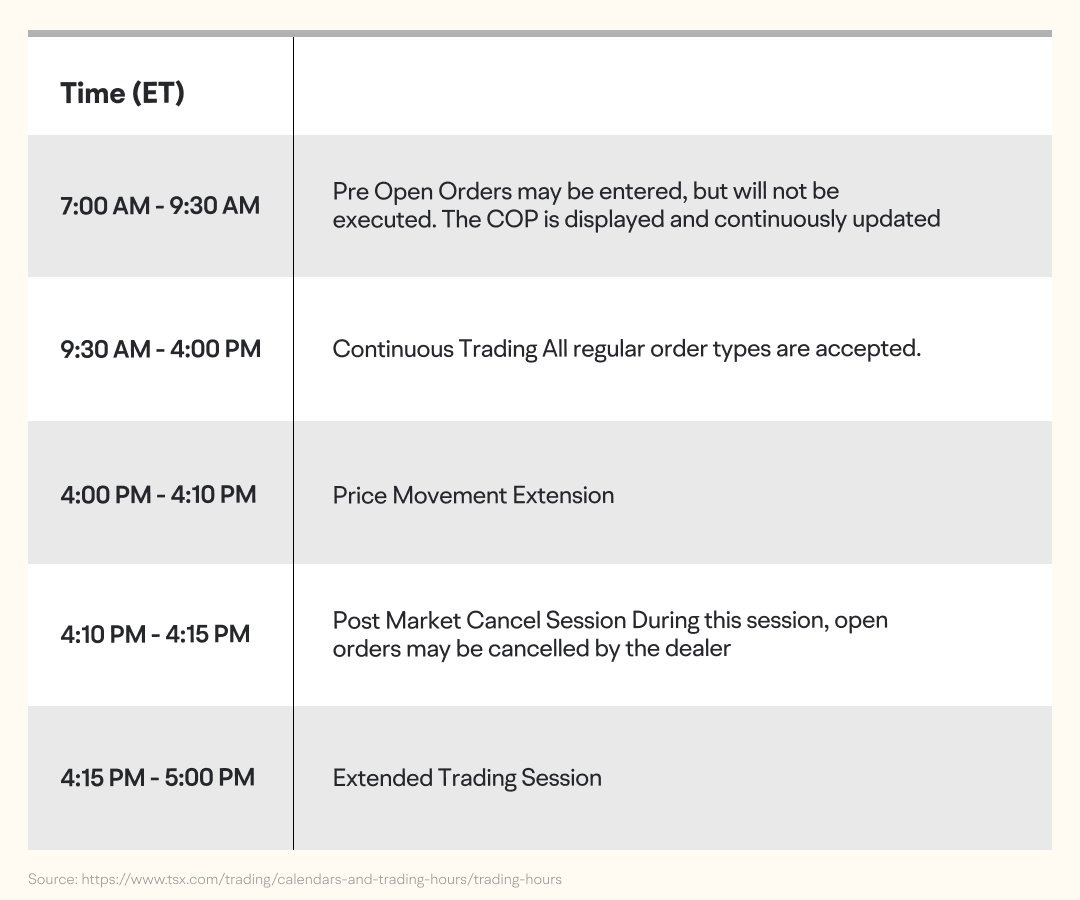
This article explores the trading hours for the TSX and TSXV. Both exchanges operate from 9:30 AM to 4:00 PM ET on weekdays, aligning with U.S. market hours to accommodate the strong economic relationship between Canada and the United States. Trading is paused on statutory holidays.
Pre-open session
The TSX facilitates a pre-open session allowing investors to place or cancel orders without execution. This period helps mitigate volatility from significant overnight news or events before the market officially starts trading.
Closing price session
Closing price session always takes place after the markets close. On the TSX, the extended trading session runs from 4:15 PM to 5 PM ET. During this time, orders can be made at the closing price. Trades are executed at this price unless it's an invalid tick or subject to regulatory approval for a special price crossing.
Note: Specialty price cross is a type of order that involves the crossing of two different markets to determine the best possible price for the trade.
Detailed information can be found in the table below.
4. Settlement cycles
It's important for investors to differentiate between the trade date, when a security order is executed, and the settlement date, when the transaction is completed and securities and funds are exchanged.
Notably, the settlement period in Canada and the U.S. is transitioning from "T+2" (trade date plus two business days) to a faster "T+1" (trade date plus one business day), with this change taking effect on Monday, May 27, 2024.
5. Major stock indexes
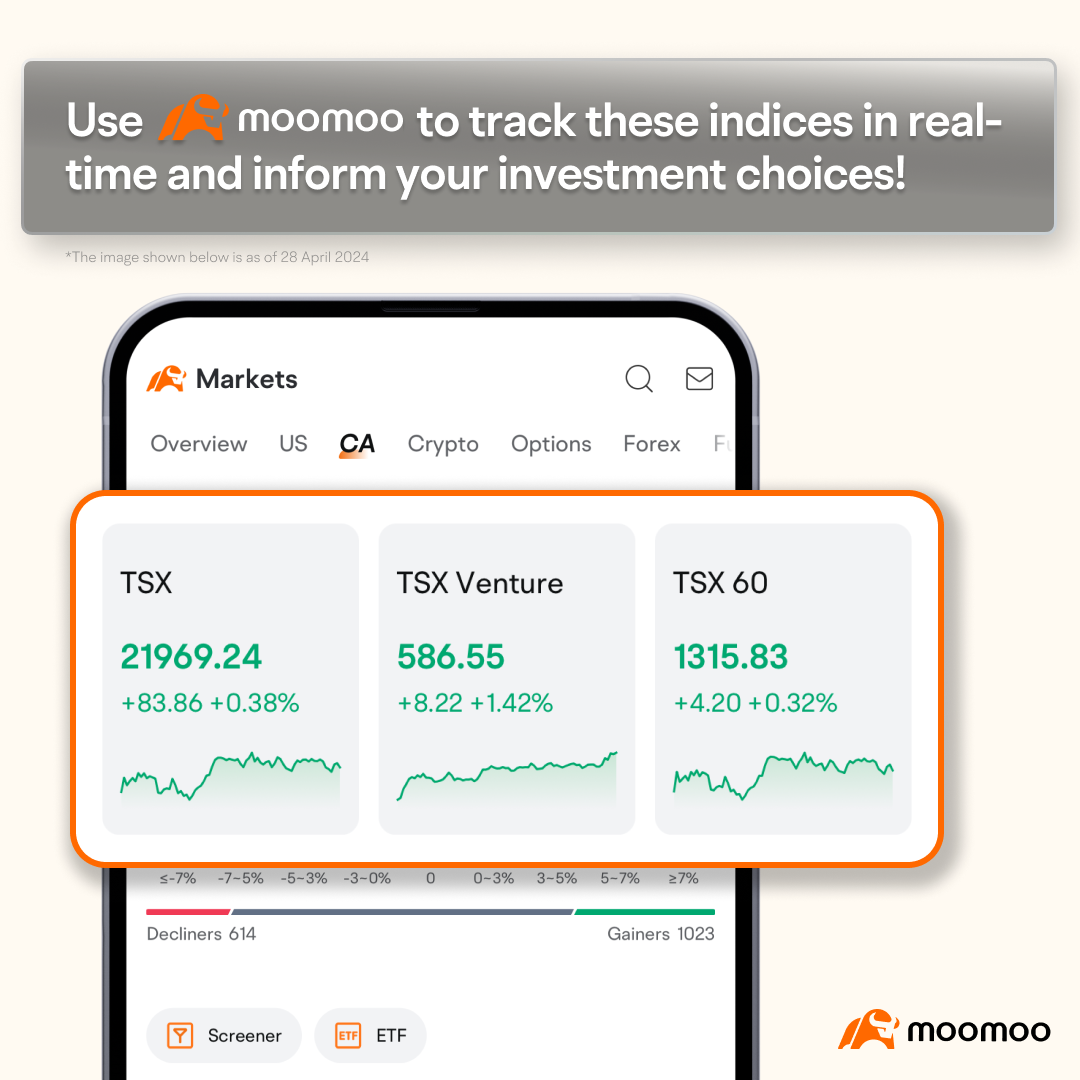
The Canadian stock market features three primary indices: the S&P/TSX Composite Index, the S&P/TSX 60 Index, and the S&P/TSX Venture Composite Index. Use moomoo to track these indices in real-time and inform your investment choices! (The image shown below is as of 28 April 2024).
1. S&P/TSX Composite Index
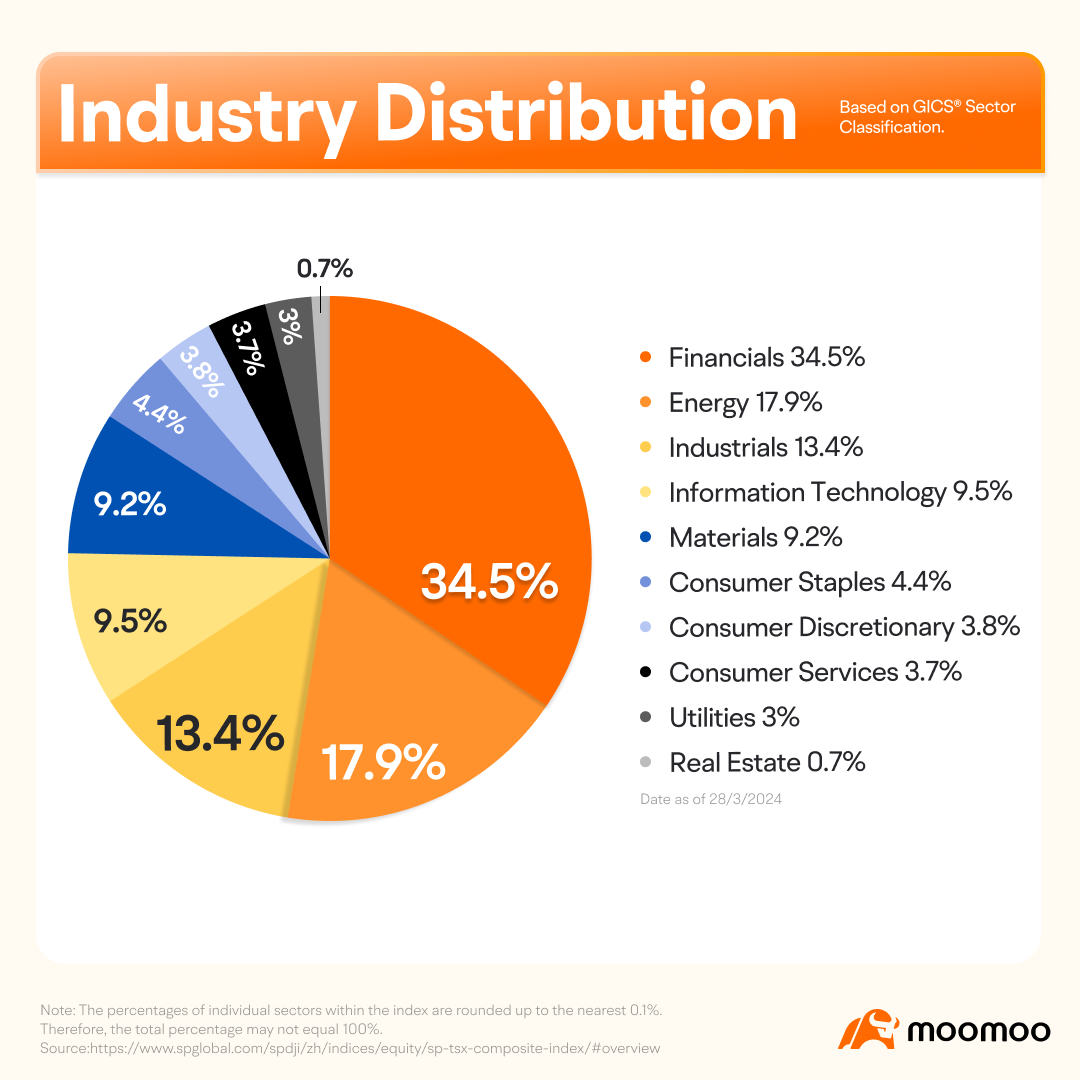
The S&P/TSX Composite Index is the primary index for the Canadian stock market, tracking the performance of the largest companies listed on the Toronto Stock Exchange (TSX). It includes over 230 companies, representing a variety of sectors including finance, resources, and technology (as shown in the chart below). Since the S&P/TSX Composite Index is comprised of Canada's largest and most prominent companies, it is often used as a barometer for the health of the Canadian economy.
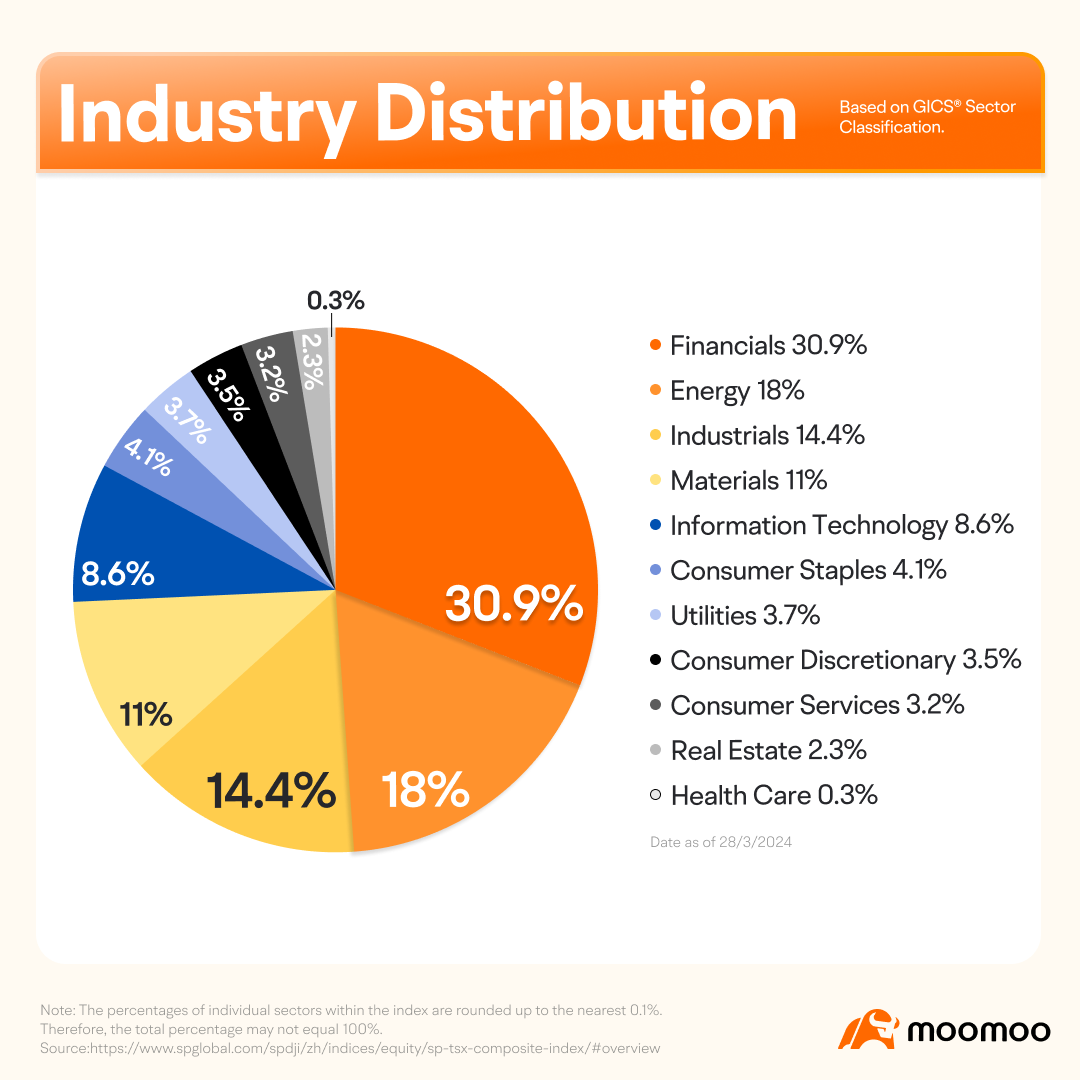
Source https://www.spglobal.com/spdji/zh/indices/equity/sp-tsx-composite-index/#overview
Notable constituents include major banks like Royal Bank of Canada and Toronto-Dominion Bank, as well as energy giants such as Enbridge and Suncor Energy. Here are the Top 10 constituents by market cap as of Apr 26, 2024.
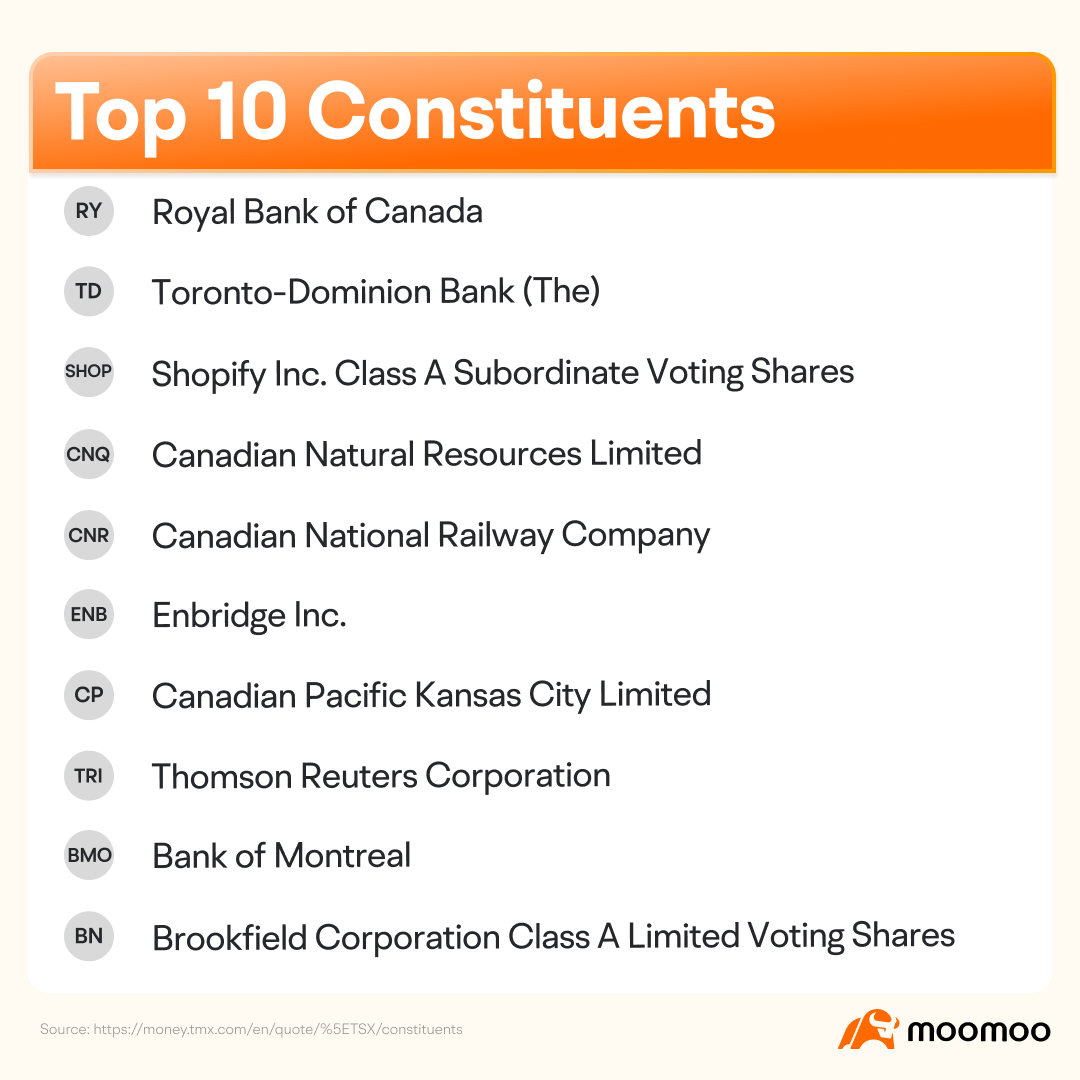
From its recalibration in 1977, the index has seen considerable growth, reflecting Canada's economic expansion and diversification. Recently, the index has shown strong performance. This index reached an all-time closing high of 22,185.25 on April 1, 2024 and an intraday record high of 22,220.91 on March 28, 2024.
2. S&P/TSX 60
The S&P/TSX 60, also calculated by S&P Dow Jones Indices, serves as an alternative to the broader S&P/TSX Composite Index and caters to investors interested in Canada's largest companies. While the S&P/TSX Composite is made up of about 200-250 stocks, the S&P/TSX 60 only contains 60 companies.
As you can imagine, these 60 companies are the ones with the largest market capitalization. For many investors, this segment of the stock market is the one that carries the least amount of risk, because it is where we find the more established corporations, that also enjoy the most liquidity in the market.
It's important to note the substantial influence of the financial sector within the S&P/TSX 60, which accounts for 30% to 40% of its total market cap.
3. S&P/TSX Venture Composite Index
The S&P/TSX Venture Composite Index provides exposure to the Canadian micro-cap sector. Although the number of constituent companies fluctuates, it stood at 419 as of August 2017. Dominated by the materials sector, the index's performance frequently aligns with mineral commodity prices, especially gold.
Collectively, these indices act as barometers for the Canadian stock market's health and are used as benchmarks to assess individual portfolio performance in relation to the wider market.
This presentation is for informational and educational use only and is not a recommendation or endorsement of any particular investment or investment strategy. Investment information provided in this content is general in nature, strictly for illustrative purposes, and may not be appropriate for all investors. Read more