What are the key points to keep in mind before investing?(2)
As of March 1, Canada's main stock index climbed to a near two-year high! The Toronto Stock Exchange's TSX composite index ended up 188.74 points at 21,552.35, its highest closing level since April 2022.
Understanding how to buy stocks is essential before deciding whether investing in them is right for you. So in this article, we will explain the advantages and disadvantages of investing in stocks, the factors influencing stock performance, and what beginners should know when purchasing stocks.
The advantages and disadvantages of stock investing
Stocks represent ownership in a company and are traded on stock exchanges, offering shareholders a share of the company's future profits and potential voting rights. While investing in stocks has many advantages, it's important to be aware of their inherent risks. Below is an overview of the key benefits and drawbacks of stock investing.
Advantages
Outpacing Inflation
Historically, over the long term stocks have yielded a generous annualized return. For example, as of April 8, 2024, the past 6 months annualized return for the TSX composite index was 6.85%. This return exceeds the average annual inflation rate 3.2%, but it requires a longer investment horizon to weather temporary value dips through buy-and-hold strategies.
Liquidity
The stock market allows you to sell your stock at any time. This liquidity makes it easier to adapt your portfolio to changing financial goals or market conditions.
Stock investing also has its share of disadvantages.
Volatility and Risk
Stock markets are notoriously volatile, with prices swinging swiftly due to economic events, company performance or global crises. This volatility can be nerve-wracking for investors, especially those with a low risk tolerance.
Tax Liability
Investors often overlook the tax implications of stock investments. Depending on factors like the holding period and the type of account where a stock is held, gains from stock sales can be subject to capital gains taxes. Understanding these tax rules is crucial for optimizing your returns and avoiding unexpected tax bills.
actors to consider when buying or selling stocks
Investing in the wrong stock can be costly, potentially causing losses or taking years to break even. However, with vast market information, you can analyse a company and make informed buy or sell decisions. This section will guide you on how to identify key factors before stock investing.
1. Understand macroeconomic influences
Macroeconomic influences play a crucial role in your approach to stock market investment. As an aspiring investor, you need to grasp the wide-ranging impacts of macroeconomic variables on stock prices. These factors could include everything from inflation rates and interest rates, to unemployment statistics and even political stability. By understanding these elements, you can better predict market trends and make informed investment decisions.
2. Evaluate financial report
Analyzing a company's financial reports is essential for simplifying trading decisions. It's important to review and compare annual reports, assess profitability, and verify consistent revenue and earnings growth. Additionally, consider the company's dividend payout history. This evaluation provides insight when making decisions on whether to buy or sell a stock.
3. Consider valuation and price
Before trading stocks, evaluate their price and valuation. PE (Price-to-Earnings) ratio is the easiest metric used to evaluate the valuation levels of stocks, indicating the price investors pay for each unit of earnings. You could check out the terminology introduction below to learn more. Generally, a PE ratio below 20 to 25 is considered relatively low in most market contexts, suggesting that the stock might be priced modestly relative to its earnings, potentially indicating undervaluation.
Moreover, it's essential to recognize that standard PE ratios vary significantly across industries. High-growth sectors like technology often have higher PE ratios due to investors' willingness to pay a premium for expected growth. In contrast, mature industries such as utilities or consumer goods may exhibit lower PE ratios reflecting their limited growth potential. Therefore, when evaluating PE ratios, comparing them within the same industry and considering factors like growth potential and cyclicality provides more meaningful insights.
4. Technical indicators
Technical indicators have gained popularity for forecasting stock trends based on recent price movements. These include trade volume, as well as 50-day and 200-day moving averages. Interpreting this data can be invaluable for making informed stock trading decisions.
What to watch out for when buying stocks
Before diving into the stock market as a beginner, it is important to master some common investment strategies that will help you to maintain a good mindset in investing. Next, I will introduce 2 aspects to watch out for when buying stocks.
1. Build a diversified investment portfolio
The concept of portfolio diversification is investing’s version of not putting all your eggs in one basket. It’s a strategy involving spreading your investments across diverse asset classes and sectors to mitigate risk. Through diversification, you can hold groups of stocks from different countries or industries that react differently to market events, and combine them in a portfolio with other asset classes like bonds or even gold.
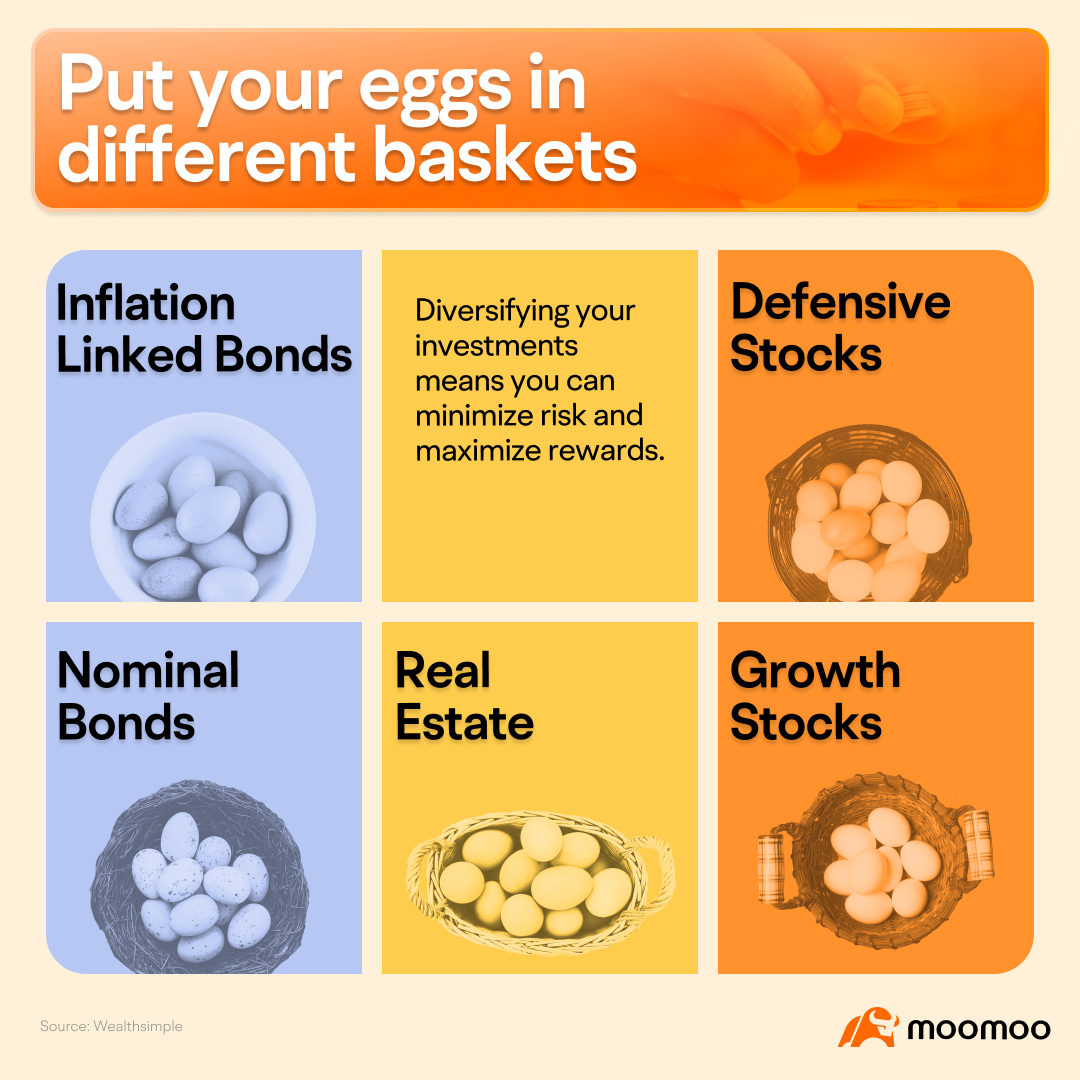
Assets tend to react differently to market conditions. Diversification can help cushion the impact of market volatility and prevent catastrophic losses. When stocks perform poorly, bonds may provide stability. Most securities can be purchased individually or in a collection, such as through a mutual fund, index fund or exchange-traded fund (ETF). For example, you could consider simple, low-cost 'set it and forget it' options like ETFs or mutual funds, particularly index funds and target-date funds.
A diversified portfolio can offer stability over time. This stability can be particularly crucial for those nearing retirement, as it reduces the risk of losing a significant portion of their savings just before they need them.
While diversification aims to mitigate risk, it doesn’t have to mean sacrificing growth potential. Carefully selecting a mix of assets that align with your financial goals and risk tolerance can allow you to still seek attractive long-term returns.
2. Buy stocks for the long run
Rather than trying to pick stocks for short-term growth, it makes sense in some cases to buy stocks for the long run. In the long run, fluctuations aren't necessarily the biggest risk for investors. A potentially bigger risk is how you react to the fluctuations. Many investors are unacceptable on losses—particularly during market movements.
Research shows that holding stocks for over 10 years typically yields higher returns, mitigating short-term risks. While this trend may not persist and risk never fully vanishes, it often diminishes over time. When learning how to find good stocks, look for value. Try to find stocks with metrics that show they are priced too low for their value—and could potentially gain over time. When a company has a history of making good choices and adapting to changes in the market, it's more likely to be around for a longer period of time.
It's important to note that frequent trading can reduce your overall returns. And trying to time the market can result in losses in the long run. Instead, consider adopting a strategy that allows you to invest in stocks that are likely to be around and delivering stable returns years from now.
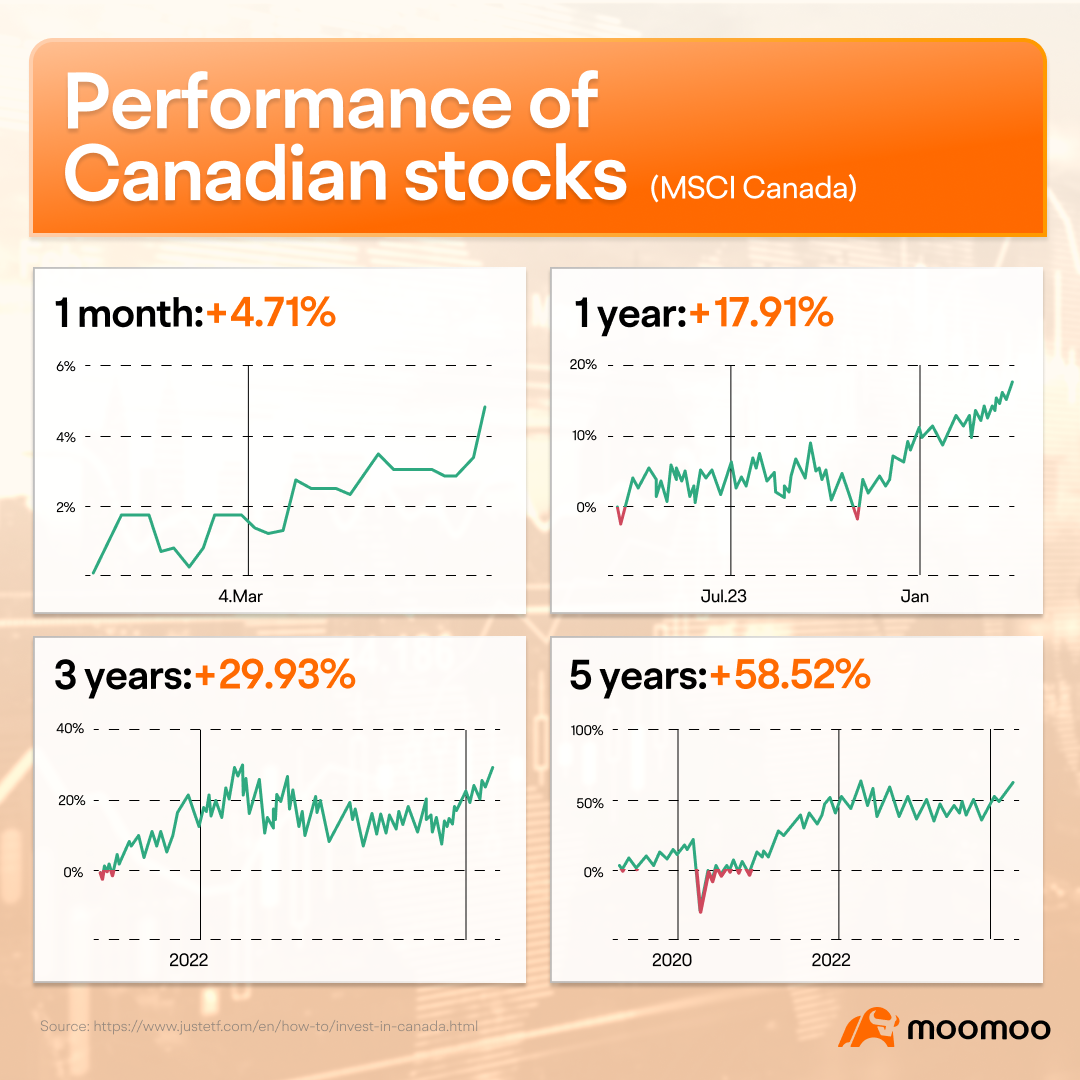
Here are bar charts about the performance of Canadian stocks: Although the market is volatile in the short term and investors lose a lot of money as a result, in the long term the returns are increasing and the longer the investment period, the greater the potential gains.
3. Use informative stock market app: moomoo
Consider installing moomoo on your mobile device. This app can keep you informed about the business world. From real-time market updates to convenient access to market information, research tools, charts, and analysis features that empower you to make more informed investment choices to efficient portfolio management – they help you execute trades with just a few clicks, making it easier to reach your financial goals.
Stock market terminology
Here are a few basic concepts that you should understand before considering buying your first stock:
Dividend: A payment made by a company to its investors to distribute company profits.
Leverage: The use of borrowed money to increase the size of an investment, with the aim of amplifying the potential return.
EPS: Earnings is the amount of money left over after all a public company’s bills have been paid. EPS (Earnings per share) is simply that dollar figure divided by however many shares the company has sold. Higher EPS is obviously better and can drive a stock price upward, but it can be tricky because companies have been known to buy its own stock to reduce the number of outstanding shares, thereby artificially goosing their EPS numbers.
P/E ratio: To calculate the P/E ratio, simply divide the current stock price by the earnings per share from the last four quarters. The resulting number indicates how many dollars investors are willing to pay for every dollar of annual earnings, which is why it’s often referred to as the 'price multiple.' A lower P/E ratio might indicate a company with lower growth expectations, while a higher ratio could suggest higher expectations. Over time, stocks with lower expectations have tended to outperform on average.
Ready to apply your new knowledge and start investing for real? To make this step easier on you, moomoo can empower you with real-time market data to help you uncover, evaluate and act on your investment ideas as well as provide tools to help you keep track of them along the way! Additionally, you could check out our articles on the history of tax-free accounts to further enhance your investment skills!
This presentation is for informational and educational use only and is not a recommendation or endorsement of any particular investment or investment strategy. Investment information provided in this content is general in nature, strictly for illustrative purposes, and may not be appropriate for all investors. Read more