Understanding S&P 500 ETFs for Canadian investors
Key takeaways
If you're investing in your RRSP and are comfortable converting CAD to USD, VOO is the better choice.
If you're investing in your TFSA or taxable account and want an easy way to buy the S&P 500 index, VFV is the better option.
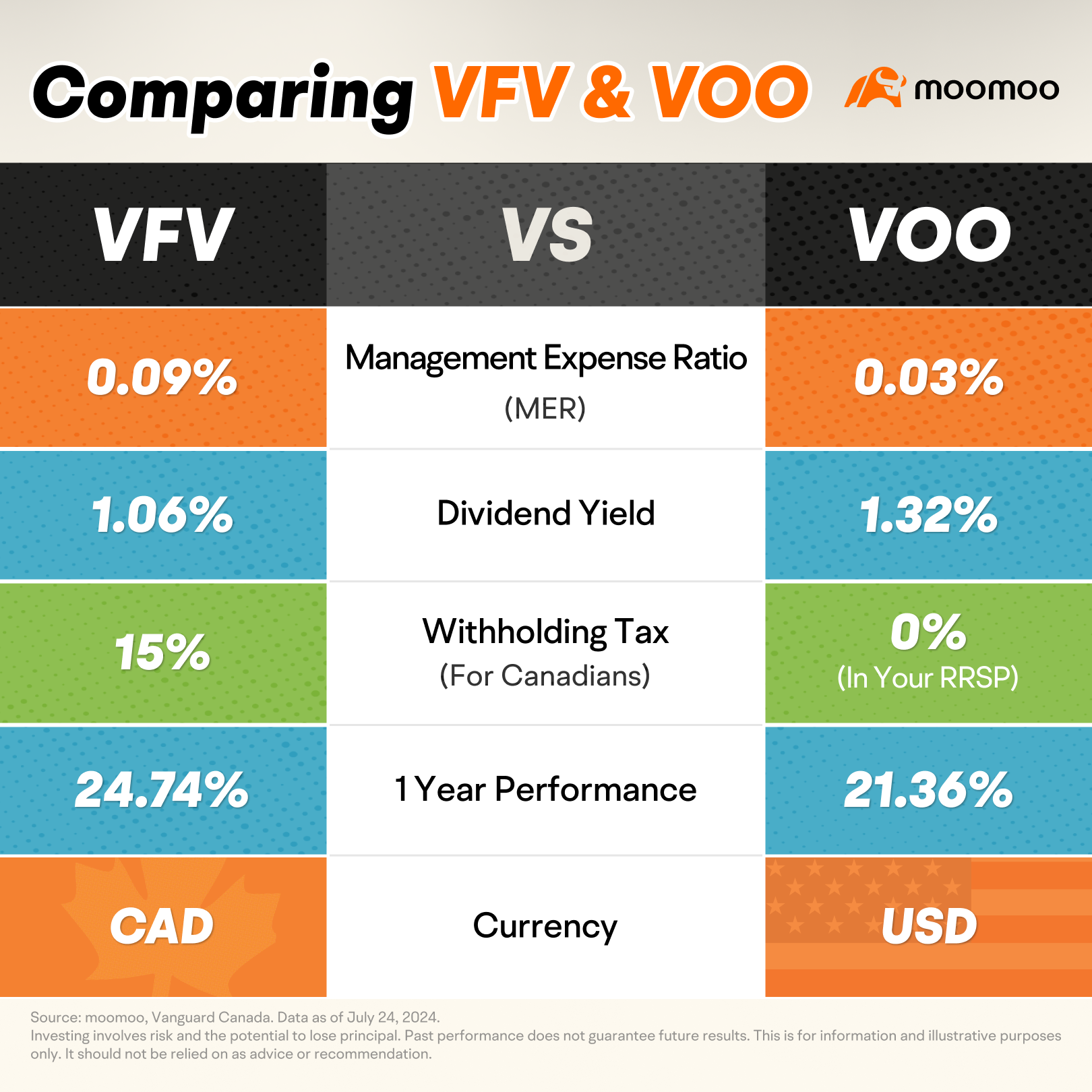
Here are the key differences between VFV and VOO.
The US stock market has seen significant declines in the last two weeks, with the S&P 500 index dropping more than 8% since mid-July 2024.
Some investors may view this market correction as a potential buying opportunity. As a Canadian investor, you might be wondering how to gain exposure to the S&P 500 index in the US market.
Among the many index ETFs available, the most popular ones are the Vanguard S&P 500 Index ETF (TSX: $VFV.CA$ ) and the Vanguard S&P 500 Index ETF (NYSE: $VOO.US$ ).
These two ETFs are both launched by Vanguard and track the performance of the S&P 500 Index. The main difference is that VFV trades in CAD while VOO trades in USD.
This article will help you compare these two ETFs based on their holdings, fees, currency exposure, and tax considerations, so you can make a more informed investment decision.
VFV vs VOO: index ETF holdings
Both VFV and VOO track the S&P 500 Index, which consists of the largest 500 companies listed on U.S. exchanges. According to their ETF factsheets, the two ETFs have the same holdings.
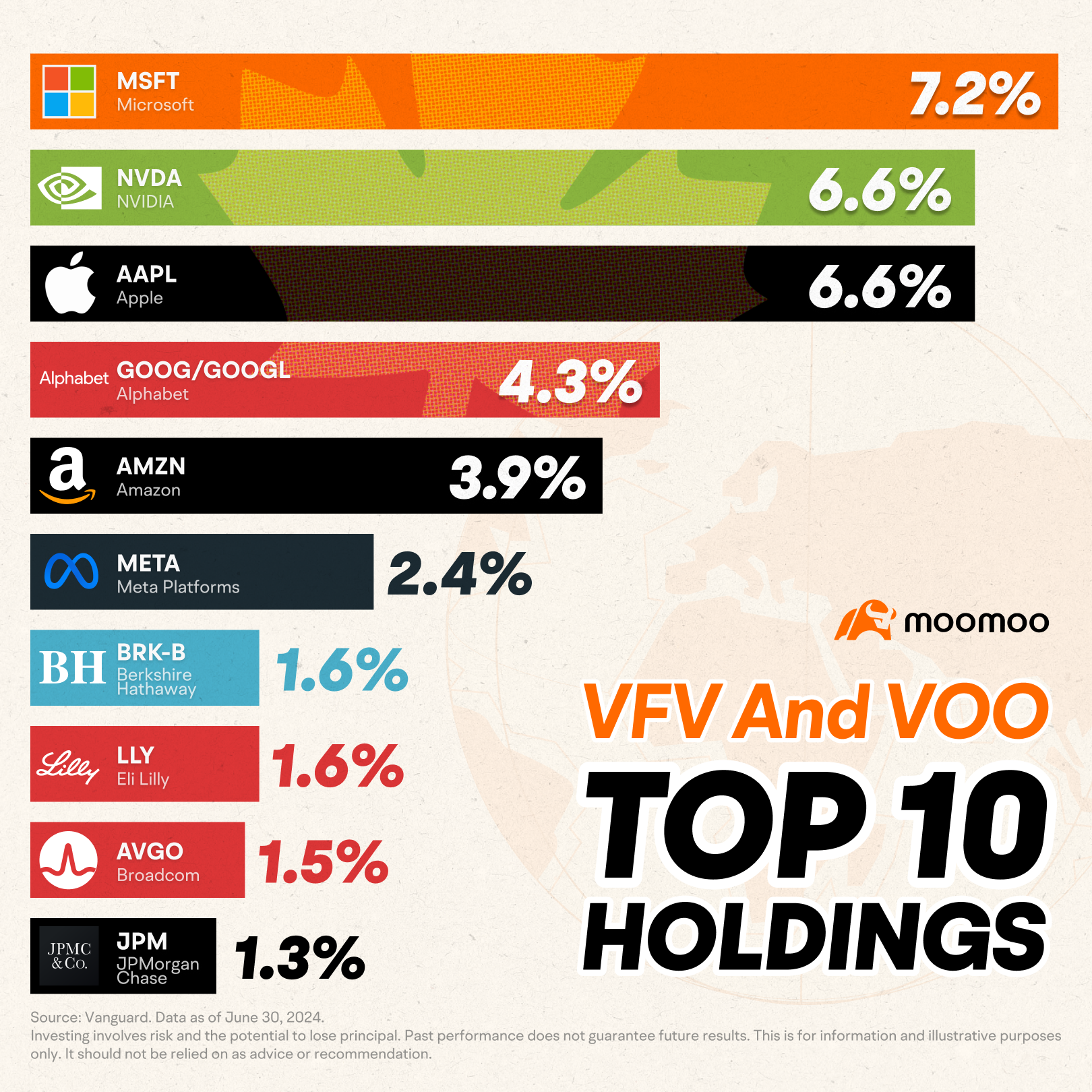
As of June 30, 2024, Vanguard reports that both VFV and VOO hold 504 stocks in their portfolios, with identical top 10 holdings and weights.
The top 10 holdings include Microsoft (7.2%), NVIDIA (6.6%), Apple (6.6%), Alphabet (4.3%), Amazon (3.9%), Meta Platforms (2.4%), Berkshire Hathaway (1.6%), Eli Lilly (1.6%), Broadcom (1.5%), and JPMorgan Chase (1.3%).
Since VFV and VOO contain the same stocks, you can choose your preferred ETF by considering the fees and currency exposure.
VFV vs VOO: historical returns and currency
Although VFV and VOO hold the same stocks, their performance is not always the same.
In the past year, VFV returned 24.74%, while VOO returned 21.36% (Data is calculated from July 27, 2023 to July 24, 2024).
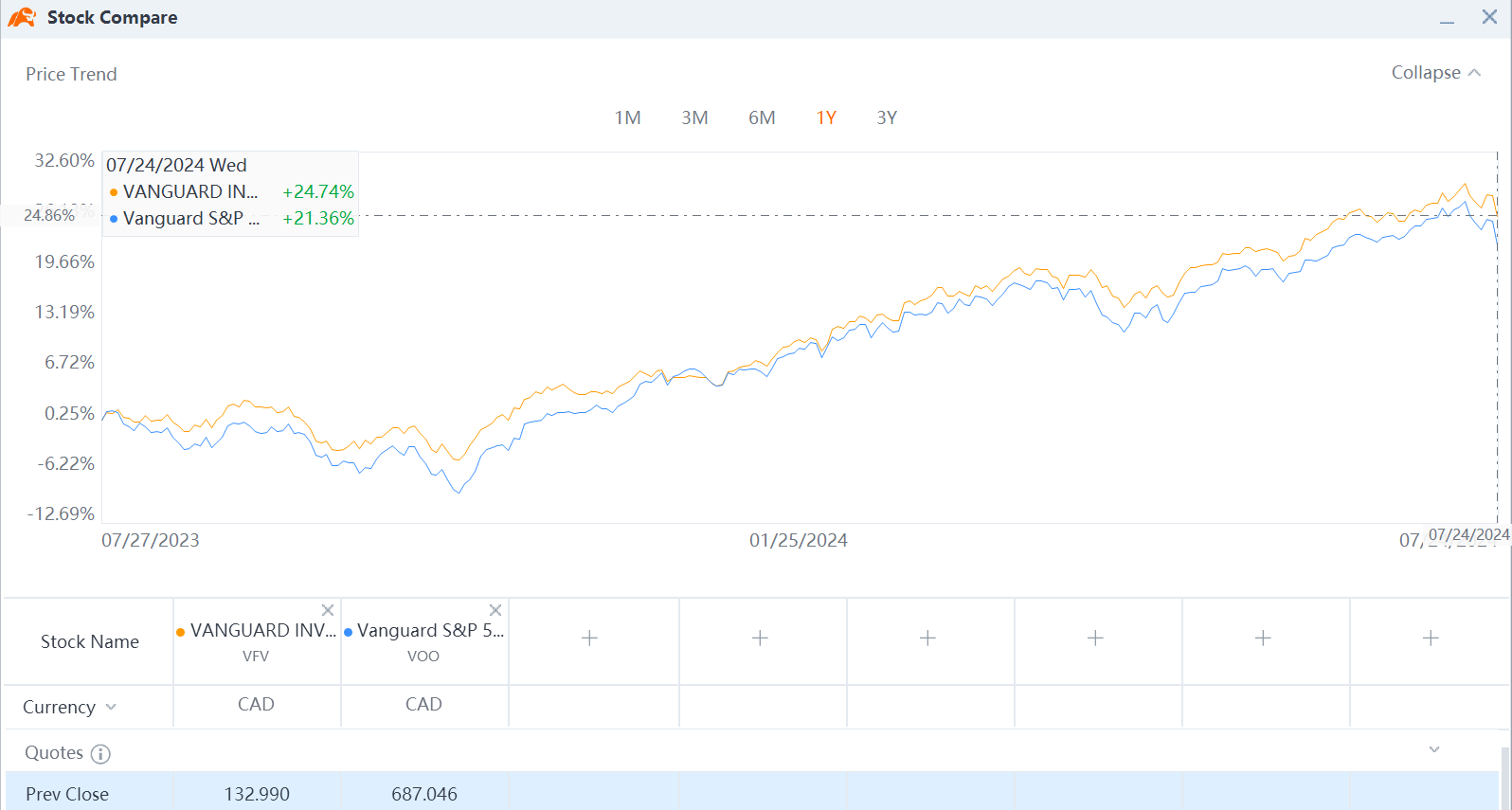
Why is VFV doing better than VOO?
The currency exchange rates play an important role. When you invest in a Canadian ETF like VFV that holds U.S. assets, the CAD-USD exchange rate affects its value beyond the stock price movements. Here's how it works:
If the U.S. dollar appreciates, the VFV will gain additional value.
Conversely, if the Canadian dollar appreciates, the VFV will lose additional value.
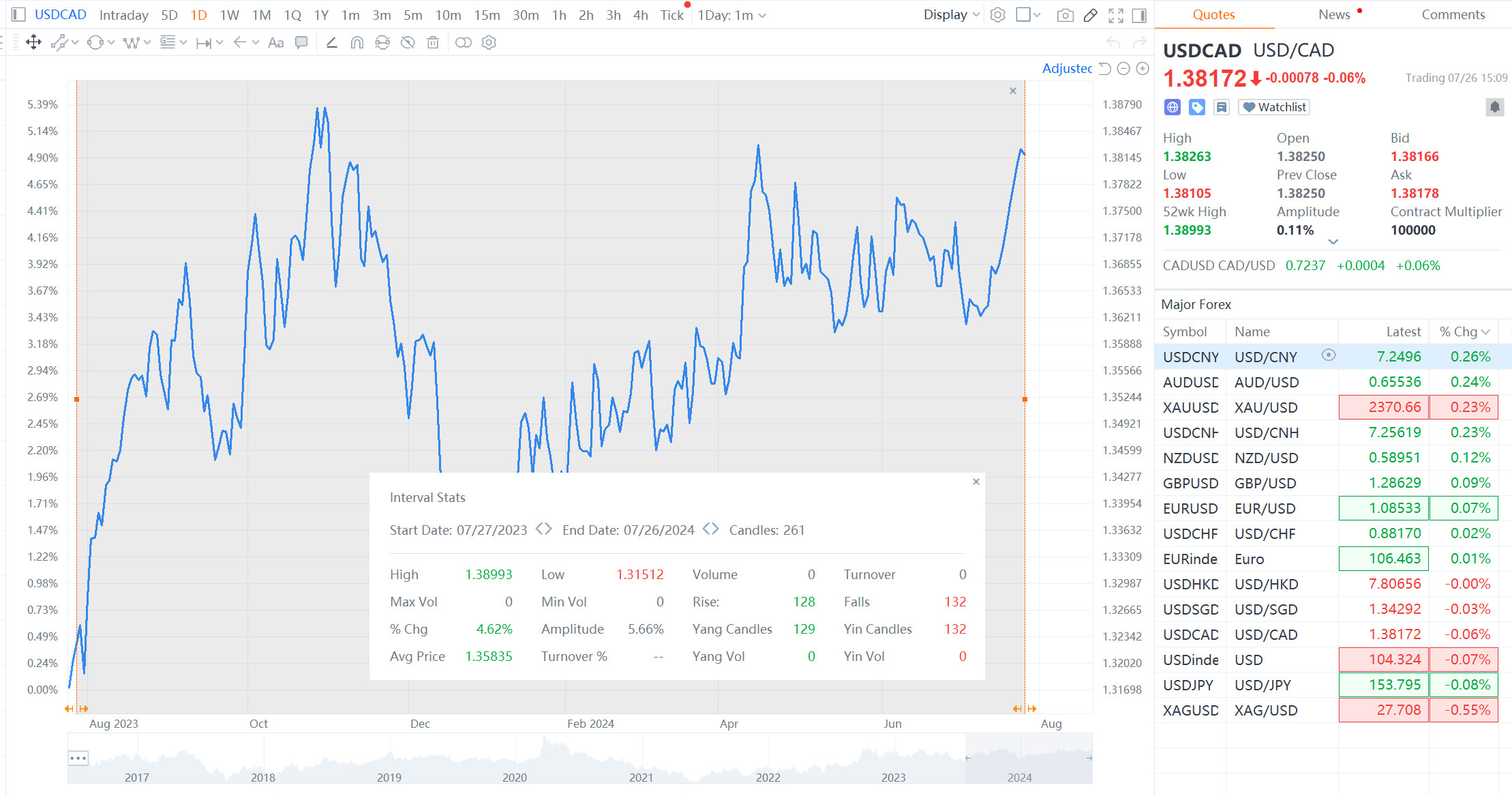
In the past year, the U.S. dollar appreciated by 4% against the Canadian dollar, explaining why VFV outperformed VOO during this period.
Should you invest in VFV or VOO based on currency?
Choosing VFV when you think the Canadian dollar will weaken and VOO when you think it will strengthen might seem straightforward, but the decision is more complex.
An investor who invests in VOO could potentially achieve a similar return by converting gains back to CAD. Let's compare.
Investing in VFV:
Start with 1,000 CAD.
End with 1,247.4 CAD (24.74% return).
Investing in VOO:
Convert 1,000 CAD to USD (exchange rate was 1.32 a year ago), resulting in 756 USD.
Invest in VOO, ending with 917.6 USD (21.36% return).
Convert 917.6 USD back to CAD (current exchange rate 1.38), resulting in 1,267.8 CAD.
The result shows roughly the same return when calculated in CAD.
In Canadian dollars, you will get a similar return from both VFV and VOO, despite currency fluctuations.
However, this calculation doesn’t include currency conversion costs. If conversion costs are high, investing in VFV might be more advantageous.
VFV vs VOO: index ETF fees
Fees are one of the most important considerations when choosing ETFs.
You can use the Management Expense Ratio (MER) to estimate the cost of investing. The MER, which is a fee charged by an ETF, is calculated annually.
According to Vanguard:
VFV: MER of 0.09%
VOO: MER of 0.03%
This means VOO costs less in fees annually.
Investing $10,000 CAD in VFV incurs an annual fee of $9 CAD.
Investing $10,000 USD in VOO incurs an annual fee of $3 USD.
Though both fees are minimal, they can add up if you invest a large amount over the long term.
VFV vs VOO: tax efficiency
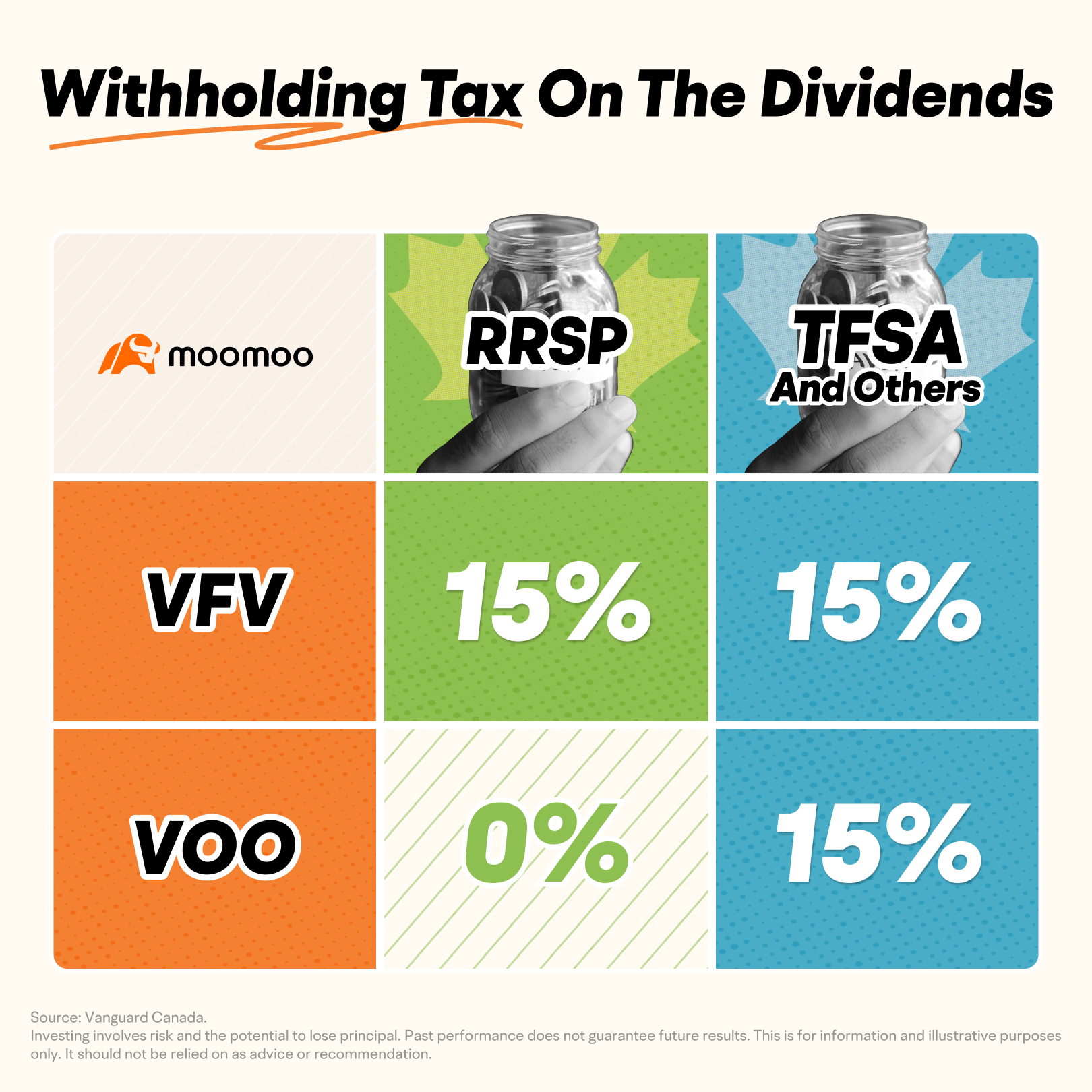
Finally, consider taxes. Canadian investors are subject to a 15% foreign withholding tax on dividends when investing in U.S. Stocks and ETFs.
For example, if VOO's dividend yield is 1.32%, it will be reduced to 1.22% after tax.
However, VFV and VOO have different tax rules depending on your investment account, which can affect your returns.
VFV: This ETF is subject to a 15% foreign withholding tax on dividends, which applies to both non-registered and registered accounts.
VOO: The 15% withholding tax applies to the VOO, but only if the shares are held in a TFSA or a non-registered account. Hold VOO in an RRSP account, to avoid withholding taxes on dividends.
Therefore, holding VOO in an RRSP offers greater tax efficiency benefits compared to VFV.
Risks of investing in an S&P 500 ETF
Investing in the S&P 500 ETF, such as VFV or VOO, can be a solid choice due to its diversification and historical performance.
However, one key risk is market volatility. Economic downturns, global events, and geopolitical crises can lead to significant declines and increased volatility in the stock market.
To manage this risk, diversify your investments, keep a long-term perspective, and regularly monitor market conditions.
This presentation is for informational and educational use only and is not a recommendation or endorsement of any particular investment or investment strategy. Investment information provided in this content is general in nature, strictly for illustrative purposes, and may not be appropriate for all investors. Read more