Canadian Bank Stocks Poised for Soaring: A Guide to Choosing the Best Stocks
Canadian bank stocks are considered to be lower-risk investments, unlike Canadian penny stocks. The Big Six Canadian bank stocks have a history of annual dividend increases, making them top blue chip stocks for income investors.
In this article, we'll provide guidance on selecting bank stocks from different perspectives, including the current economic situation, bank prospects, and key indicators.
The current state of Canadian banks
Banks are crucial to the Canadian economy
Canada’s banking industry is an essential contributor to the country’s economic growth and well-being. Banks are leading taxpayers, progressive employers, and major purchasers of goods and services from Canadian suppliers. They are also good corporate citizens.

High interest rates boost net interest margin
The narrative for diversified banks in 2022 and the first half of 2023 has been a tale of mixed fortunes.
Starting in 2022, the Bank of Canada was forced to raise interest rates to curb high inflation. Higher interest rates often lead to higher margins on loans, which boost net interest margin (NIM) for banks. Initially, earnings from retail banking operations were robust due to rising interest rates. However, uncertainty in the market materially reduced corporate deals. This means that investment banking has made little money in 2022 and 2023.
Banks were forced to increase credit loss provisions
While higher income streams emanated from commercial and retail banking, lower earnings were reported in investment banking and asset management sectors. Lower asset prices mean lower fees gathered by asset managers.
The landscape grew notably more challenging in the latter half of 2023 and continues into 2024.
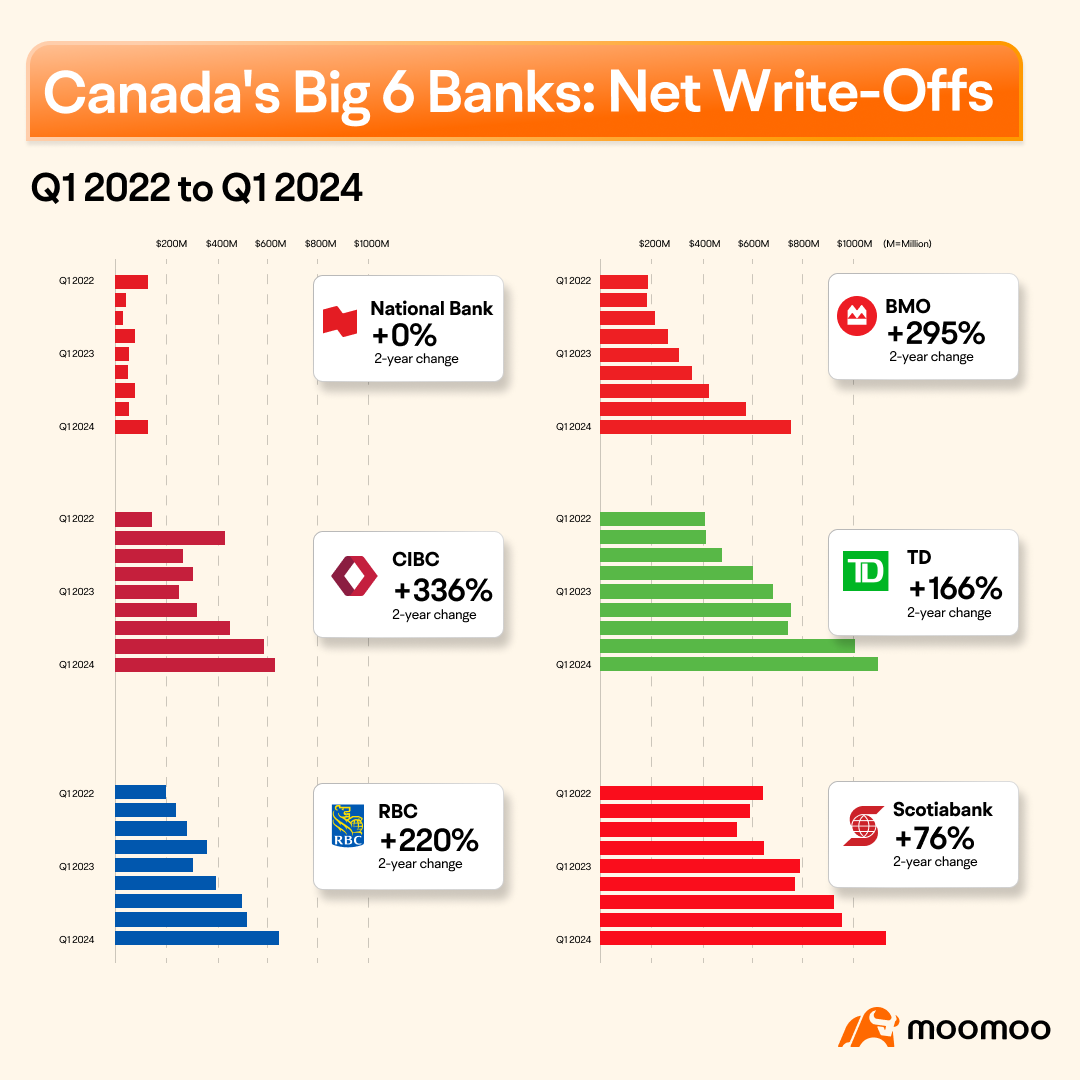
Escalating interest rates have put pressure on both consumer and corporate finances, leading Canadian banks to significantly increase their provisions for credit losses (PCL) towards the end of 2023. This has hurt bank earnings as they have to provision for credit losses.
Outlook for Canadian banks
Market analysts predict that anticipated delinquencies in 2024 may exacerbate the scenario of increasing provisions for credit losses (PCL) and write-downs. The amplified provisions have already dented bank earnings in Q4 2023 and Q1 2024 and are expected to persist as a headwind throughout 2024. Although big banks can manage these losses, they may face difficulty in growing their earnings. Some analysts are concerned that people's expectations for getting a return on their money have been reset due to high interest rates, and when rates come down, the banks will have to compete more for deposits than they used to.
However, other analysts suggest that there is no need to worry too much for two reasons. First, Canadians are careful borrowers, and national mortgage delinquency rates show that over 99% of mortgage holders in Canada are in good standing. Second, Canada's percentage of mortgages in arrears is significantly lower than in the United States and the United Kingdom. Despite the current economic environment characterized by high interest rates, mortgages in arrears in Canada are at the lowest level in decades.

Despite these challenges, current valuations have largely factored them in. While big Canadian banks may face constrained growth prospects in the coming year, their robust dividend yields make them compelling investment opportunities.
Analysis of bank stocks in the Canadian stock market
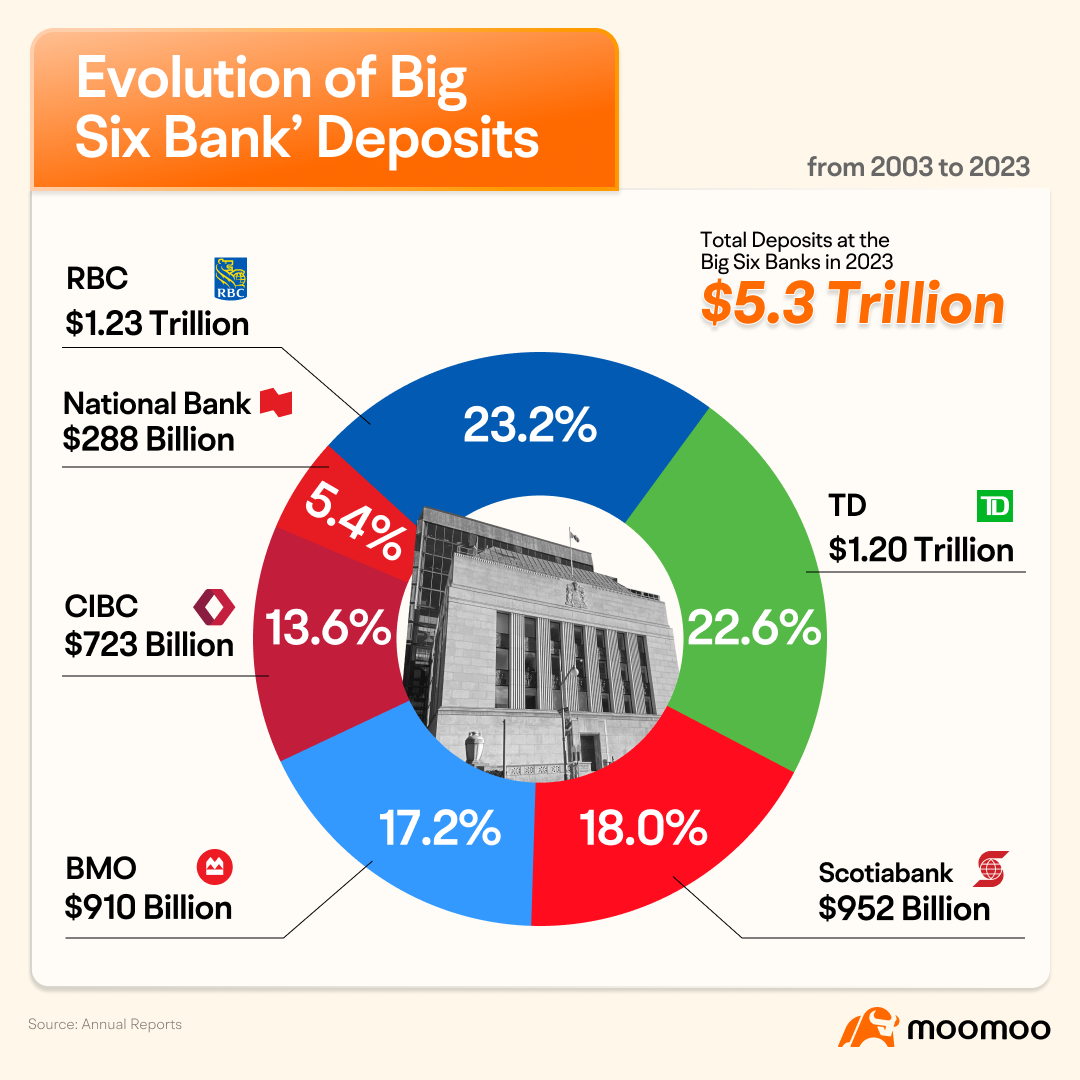
The financial sector is the largest sector in the S&P/TSX Composite Index, with a weight of 31%. Royal Bank of Canada stock (TSX: RY) and Toronto-Dominion Bank (TSE: TD) are the two most significant components of the S&P/TSX Composite Index, accounting for 5.5% and 4.3% respectively.
Historically, banks have been top performers on the TSX. As essential components of the Canadian economy and critical components of the TSX index, Canadian bank stocks are worthy of specific attention.
List of Top Canadian Bank Stocks
How to decide which Canadian bank stocks are best for you
If you're planning to start by investing in just one Canadian bank, a key question remains: How can you determine which bank will give you the best long-term performance? There are some key indicators you can look out for.
First and foremost, analyzing earnings reports is the most critical prerequisite for selecting any stock. This includes diving into quarterly and annual earnings reports that provide a snapshot of the bank's financial performance over time. It's important to look for trends in revenue, net income, operational costs, and other key financial indicators.
Key financial ratios
Return on Equity (ROE): This ratio measures how efficiently a bank uses its equity to generate profits, indicating its profitability.
Net Interest Margin (NIM): NIM assesses the difference between the interest income generated and the interest paid out relative to the bank’s earning assets. It’s a measure of the bank’s lending profitability.
Efficiency Ratio: This ratio measures a bank’s overhead as a percentage of its revenue, indicating its efficiency. A lower efficiency ratio signifies a bank’s ability to generate income with lower operational expenses, thus being more efficient.
Tier 1 Capital Ratio: This ratio measures a bank's financial strength by comparing its core capital (such as common stock and retained earnings) to its risk-weighted assets. It highlights the bank’s ability to withstand financial stress and comply with regulatory requirements.
Non-Performing Loans (NPL) Ratio: This ratio measures the level of loans in or near default, highlighting the bank’s loan portfolio riskiness.
Assess current valuation for appropriate buying time
After carefully examining various financial metrics of bank stocks, the next step is to determine their valuation and overall financial health.
Banks generate earnings through the difference between lending and savings interest rates, so they don't produce "cash flows" in the traditional sense. As a result, we need to value banks differently. Ratios are a quick way to do this. Among these, the Price-to-Earnings (P/E) ratio and the Price-to-Book (P/B) ratio are particularly important for banks.
Price-to-earnings (P/E) ratio: This indicates whether a stock’s price is high or low based on the bank’s earnings.
Price-to-book (P/B) value ratio: This is the ratio of the current market cap of a bank to its accounting value.
Investors searching for a stock with good growth potential often choose those with a low P/B ratio in order to pay less for stocks with more book value.
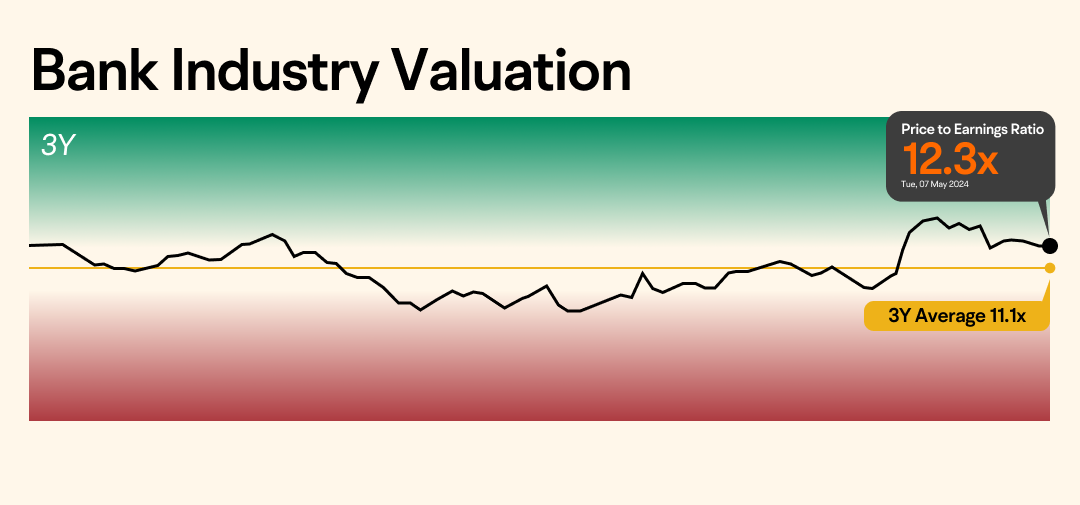
The chart below reveals that the Canadian banking industry is currently trading at a slightly higher valuation than its three-year average. This suggests that investors should exercise caution, as bank stocks may face some degree of downside risk in the future.
Dividends are a sign of investment quality
Canadian banks are well-known for their reliable and increasing dividend income. While some successful banks choose to reinvest most of their profits instead of paying dividends, failing banks rarely pay dividends. By investing only in stocks that pay dividends, you can avoid most of the market's worst banks.
That said, there are two important factors to consider when selecting high dividend bank stocks.
Firstly, dividends can grow. Look for banks that have maintained or increased their dividends during economic and stock market downturns. These banks leave themselves enough financial buffer to handle periods of earnings volatility, while also providing investors with a mix of safety, income, and growth.
Secondly, dividends should be consistent. One of the best ways to identify a quality stock is to look for banks that have paid dividends for at least 5 to 10 years. Dividends are a sign of a bank's financial stability, and a history of dividend payments is a strong indicator of a great dividend stock.
Dividend payout ratio (DPR): This tells how much a bank pays out to investors in dividends, in comparison to the earnings of the stock. The DPR can show how well a bank’s earnings allow for dividends.
Dividend yield: This indicates how much a company pays in dividends yearly, relative to its stock price.
In this article, we covered the current state of Canadian banks, their outlook for the future, and provided some methods for selecting the best bank stocks for investment. Stay tuned for our next article, where we'll focus on the top bank stocks for investment in Canada in 2024.
This presentation is for informational and educational use only and is not a recommendation or endorsement of any particular investment or investment strategy. Investment information provided in this content is general in nature, strictly for illustrative purposes, and may not be appropriate for all investors. Read more