Why a Long-Term Approach to Bitcoin Continues to Attract Interest in 2025?
Key Takeaways
Historical Performance: Over the past decade, Bitcoin has demonstrated significant price growth, often outperforming traditional stock indices. However, it has also experienced extreme volatility, including deep drawdowns.
Accessible Entry: Bitcoin can be purchased in fractions, allowing individuals to begin with small amounts using strategies like dollar-cost averaging (DCA). Still, this approach requires discipline and risk awareness.
Growth Potential: Bitcoin’s finite supply and growing global adoption suggest room for appreciation. However, risks such as regulatory uncertainty, cybersecurity threats, and market swings remain relevant.
Historical Performance: Over the past decade, Bitcoin has demonstrated significant price growth, often outperforming traditional stock indices. However, it has also experienced extreme volatility, including deep drawdowns.
Accessible Entry: Bitcoin can be purchased in fractions, allowing individuals to begin with small amounts using strategies like dollar-cost averaging (DCA). Still, this approach requires discipline and risk awareness.
Growth Potential: Bitcoin’s finite supply and growing global adoption suggest room for appreciation. However, risks such as regulatory uncertainty, cybersecurity threats, and market swings remain relevant.
Many beginner investors wonder, “Is it too late to invest in Bitcoin?” The answer depends on individual goals, time horizons, and risk tolerance among other factors.
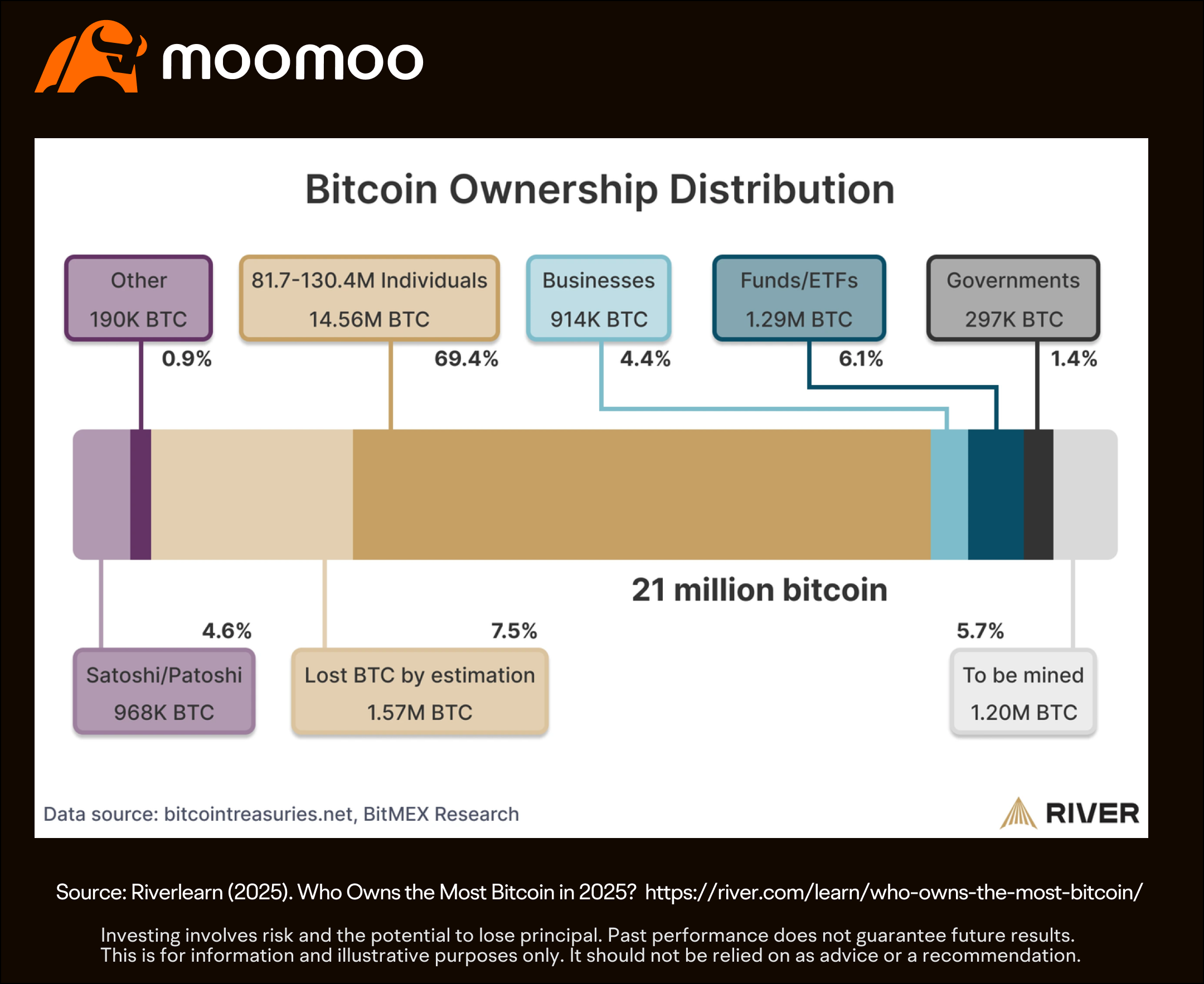
Since its creation in 2009, Bitcoin has evolved from a niche experiment into a globally held digital asset, owned by individuals, institutions, and public companies. As of 2025, approximately 69.4% of Bitcoin, out of the 21 million Bitcoin maximum supply, is estimated to be held by individual investors (Riverlearn, 2025).
The ability to buy Bitcoin in small fractions means investors no longer need significant capital to get started. This article explores three key reasons why a long-term investment approach to Bitcoin still attracts interest in 2025 — along with important risks to consider.
1. Past Performance: Bitcoin vs. S&P 500
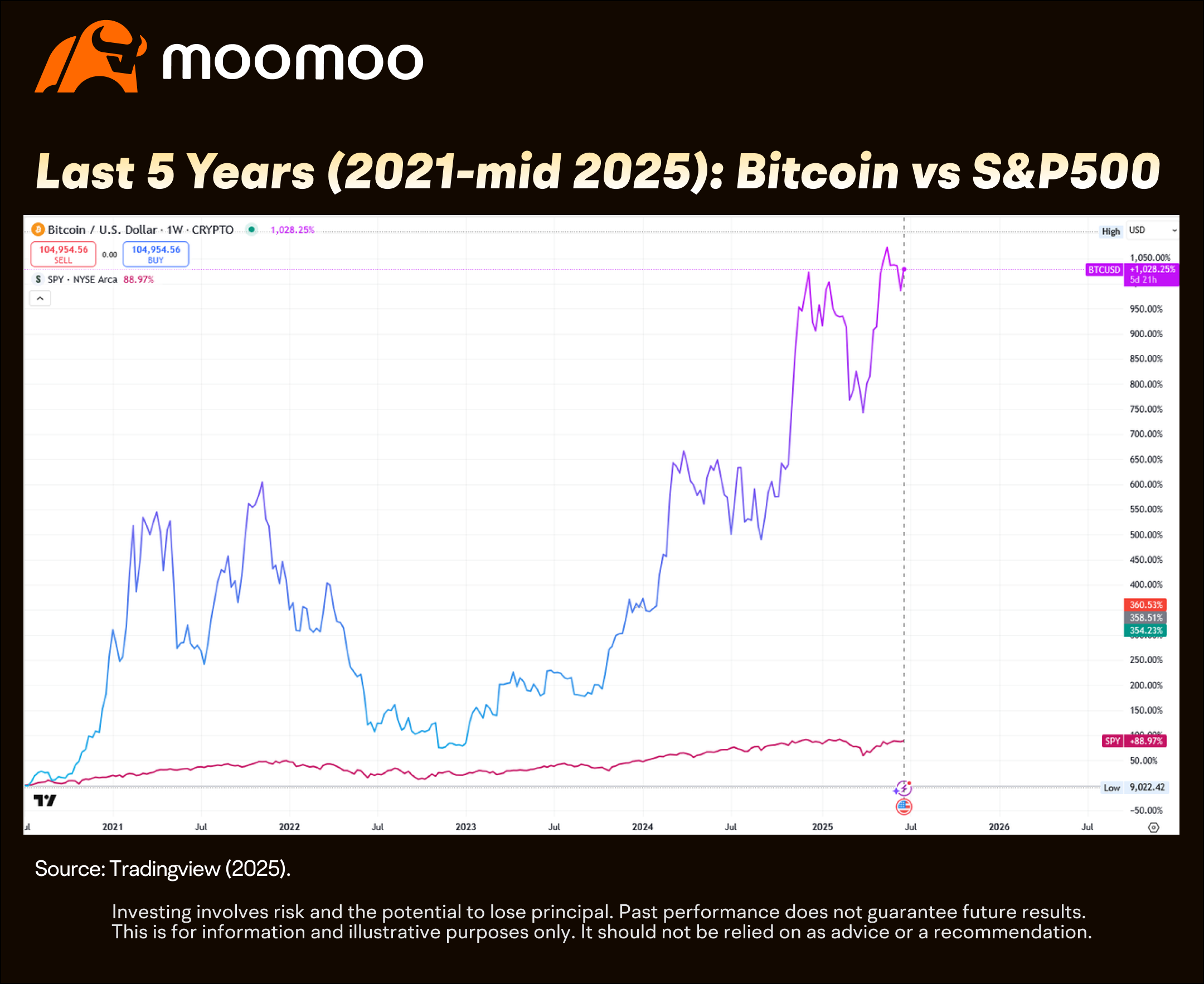
Over the last decade, Bitcoin’s returns have significantly outperformed traditional stock indices. From 2015 to mid-2025, the S&P 500, as represented by the SPY ETF, delivered a total return of approximately +79.77%. In contrast, Bitcoin rose over +1,027%, turning a $1,000 investment into over $10,270.
This stark contrast highlights the potential power of compounding for long-term holders of digital assets. However, these returns come with high volatility, including steep declines of over 75% during bear markets like 2022, as seen in the chart.
Michael J. Saylor (2025), the founder of MicroStrategy, often compares Bitcoin to early Manhattan real estate — potentially undervalued at first, but increasingly scarce and sought-after over time. Decades ago, a city block might have seemed expensive — but today, it is priceless. He argues that Bitcoin, suggesting its 16-year history, might indicate future value as a scarce asset. While this analogy is compelling, past performance is not indicative of future results.

Real-life stories reinforce the long-term value of holding Bitcoin in the past. In 2009, Kristoffer Koch, a Norwegian engineer, purchased 5,000 BTC for only $22 (BBC, 2013). By 2013, his forgotten investment was worth nearly $850,000. Similarly, Michael Saylor redirected his company’s reserves to accumulate over 226,000 BTC, making MicroStrategy the largest public Bitcoin holder (CryptoRank, 2024). High-net-worth individuals and institutions continue to hold large Bitcoin positions, though the asset remains speculative and prone to rapid price swings.
2. Present Access: Start Small and Build Gradually
Bitcoin is often referred to as "digital gold" because of its potential to act as a store of value. But you don’t need to buy a whole Bitcoin to participate. Many beginners start with small amounts — just the price of a cup of milk tea — and add more over time.
Bitcoin can be purchased in fractions, meaning investors don’t need to buy an entire coin to get started. Even small contributions can be part of a long-term investment strategy. For example, Sarah, a university student, sets aside $20 each month to invest in Bitcoin. After one year, she accumulates $240 worth, while spreading out her purchase across different price levels. This method, known as dollar-cost averaging (DCA), helps smooth out price volatility and reduces the emotional stress of investing a lump sum during market highs. Yet, this strategy requires discipline, and small investments may not offset losses during downturns.
This approach reduces the risk of buying at a single peak and helps smooth out volatility. Saylor (2025) calls this mindset shift “Bitcoin is hope” — a view of Bitcoin as a disciplined, long-term savings vehicle rather than a short-term trade but it also demands tolerance for market swings.
3. Future Outlook: Why It May Still Have Room to Grow
Bitcoin’s future remains a subject of debate, but many investors continue to see it as a scarce, deflationary asset with potential to serve as a hedge against inflation or a digital reserve asset. Others remain cautious due to regulatory uncertainty and technological risks.
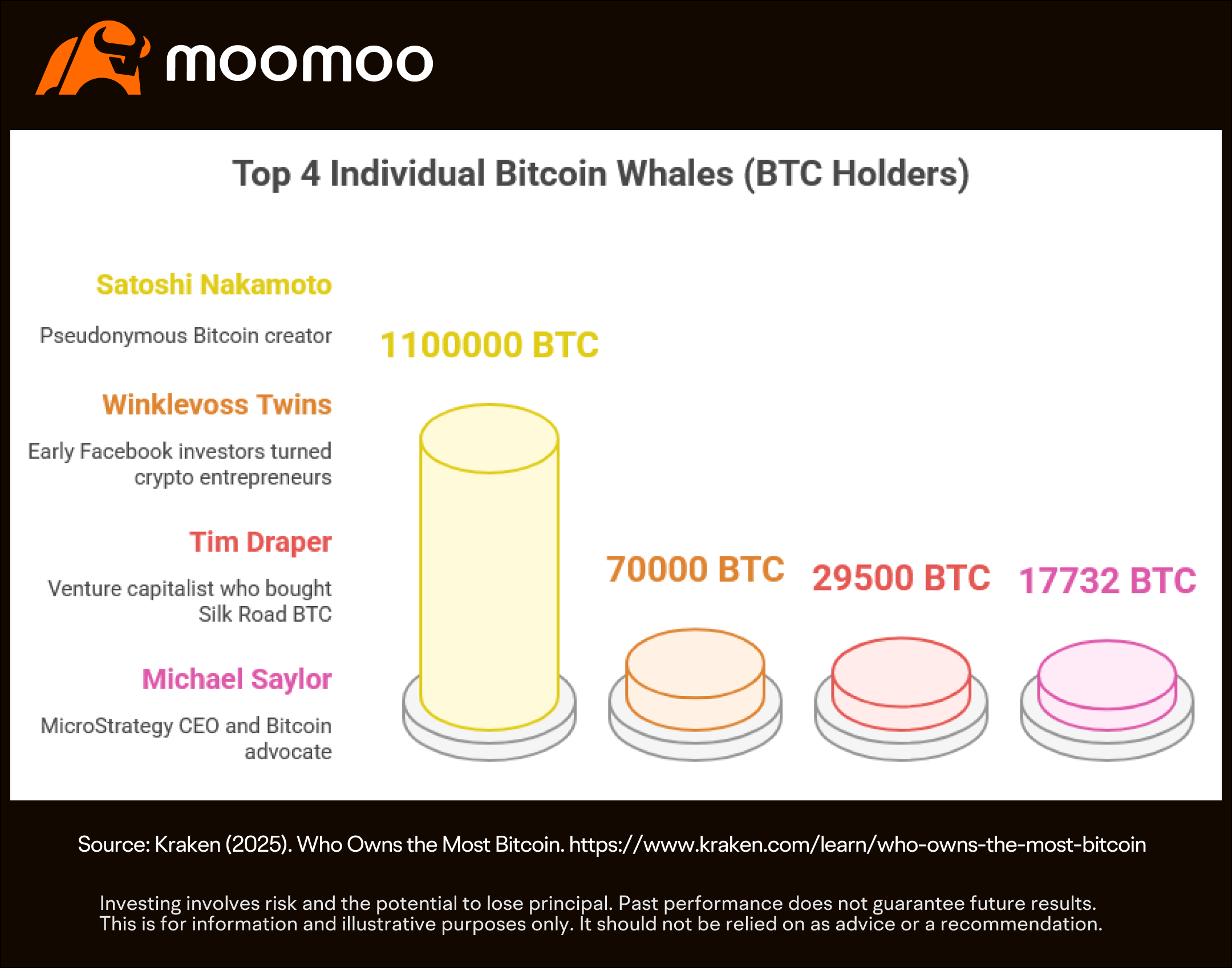
Below is a summary of some of the most well-known top 4 Bitcoin whales (Kraken, 2025):
(a) Satoshi Nakamoto, the creator of Bitcoin, whose stash has remained untouched since 2010, potentially valuing it at over $114 billion
(b) Cameron and Tyler Winklevoss, early Bitcoin adopters and founders of the Gemini Exchange, began accumulating Bitcoin in 2012 when it traded at around $10. Today, the brothers are estimated to hold approximately 70,000 BTC, valued at over $9.8 billion.
(c) venture capitalist Tim Draper acquired 29,656 BTC during a U.S. Marshals auction of Silk Road assets in 2014, when Bitcoin was priced at roughly $632. In 2025, Draper’s estimated holdings have grown to 120,000 BTC, now worth nearly $7.8 billion.
(d) Michael Saylor who personally holds over 17,000 BTC and benefits from the company’s massive 592,100 BTC stash, pushing his net worth to an estimated $12.3 billion.
These individuals — often referred to as “whales” — held their positions through multiple bear markets and market crashes. Their stories reflect the rewards of long-term conviction, but their results are not typical and depend heavily on entry timing, risk capacity, and long-term outlook.
While Bitcoin carries risks — including regulatory uncertainty and price volatility — some investors view a long-term approach as a way to navigate these fluctuations. However, this strategy is not without significant challenges. Major risks include:
Regulatory Uncertainty: Governments may impose strict regulations or outright bans on cryptocurrency trading and usage, potentially impacting Bitcoin's value and accessibility. For example, changes in tax policies or securities laws could affect investor behavior.
Price Volatility: Bitcoin has historically experienced dramatic price swings, such as the 75% drop from its 2021 peak to 2022 low, which can lead to substantial losses if timed poorly.
Technological Risks: Security breaches, such as hacks of exchanges or wallets, and potential flaws in the Bitcoin network (e.g., a 51% attack) could undermine confidence and value.
Market Manipulation: The relatively small market size of Bitcoin compared to traditional assets makes it susceptible to manipulation by large holders or coordinated actions, amplifying price instability. Investors considering a long-term approach should be prepared for these risks, as holding Bitcoin does not assure positive returns and may still result in significant downside risk, especially in unpredictable market conditions.
4. Potential Benefits and Risks of Bitcoin Investing
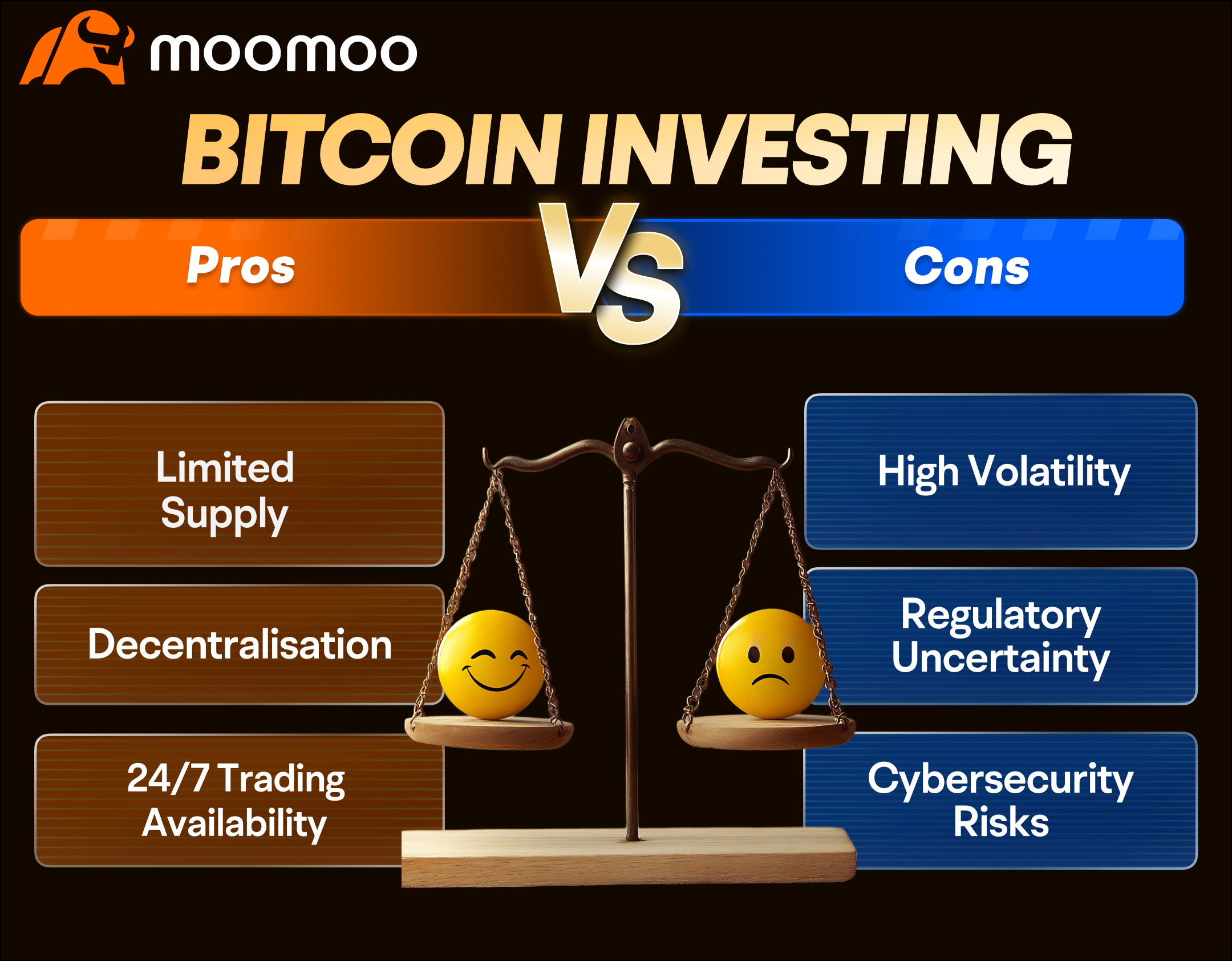
Bitcoin can offer the potential for high returns due to its limited supply, nature of decentralisation and 24/7 trading availability, but it remains a highly volatile asset class, with prices subject to significant price swings, regulatory uncertainty, and cybersecurity risks. As such, Bitcoin may not be suitable for all investors.
Conclusion: A Long Term Perspective, with Caution

Bitcoin’s historical gains, accessibility, and scarcity draw interest, but its volatility, regulatory risks, and potential for loss require careful consideration. Michael Saylor (2025) encourages individuals to think of Bitcoin like insurance — something you buy and hold before you need it, not after. While all investors should evaluate their personal goals, risk tolerance, and investment horizon, Bitcoin continues to represent, for some, a long-term store of value in an increasingly digital global economy.
Disclosure
This presentation is for information and educational use only and is not a recommendation or endorsement of any particular investment or investment strategy. Investment information provided in this content is general in nature, strictly for illustrative purposes, and may not be appropriate for all investors. It is provided without respect to individual investors' financial sophistication, financial situation, investment objectives, investing time horizon, or risk tolerance. You should consider the appropriateness of this information having regard to your relevant personal circumstances before making any investment decisions. Past investment performance does not indicate or guarantee future success. Returns will vary, and all investments carry risks, including loss of principal. All participants shall be responsible for the comparison and consideration of any relevant fees, charges and costs involved before investing.
Cryptocurrencies are not legal tender, not backed by any government, and not FDIC insured or SIPC protected. Cryptocurrency trading involves significant risk and potential loss of principal. It is subject to volatile price swings, market manipulation, and can become illiquid at any time.
Moomoo is a financial information and trading app offered by Moomoo Technologies Inc.
In the U.S., investment products and services available through the moomoo app are offered by Moomoo Financial Inc., a broker-dealer registered with the U.S. Securities and Exchange Commission.
Reference
Michael J. Saylor (2025). Bitcoin Education. Bitcoin
Riverlearn (2025). Who Owns the Most Bitcoin in 2025? Who Owns the Most Bitcoin in 2025? | River Learn - Bitcoin Basics
BBC (29 October, 2013). $22 Bitcoin investment brings Norwegian man fortune. $22 Bitcoin investment brings Norwegian man fortune - BBC News
Cryptorank (8 August, 2024). MicroStrategy’s Michael Saylor Reveals Bitcoin Holdings Top $1 Billion. cryptorank.io/n...
This presentation is for informational and educational use only and is not a recommendation or endorsement of any particular investment or investment strategy. Investment information provided in this content is general in nature, strictly for illustrative purposes, and may not be appropriate for all investors. Read more