Trading in a bear market? Understanding inverse ETFs
Have you ever found yourself biting your nails during market downturns? You're not alone.
While some investors might jump into short selling to dodge losses or even try to rake in some profits when the market dives, it’s a risky move—think of the unlimited loss as the stock price can theoretically rise indefinitely.
For those who’d rather not dance with danger via short selling, there's a potential alternative gaining attention: inverse ETFs (inverse exchange-traded funds).
So, what are these financial tools? And what should you keep in mind before considering them? Let’s break it down!
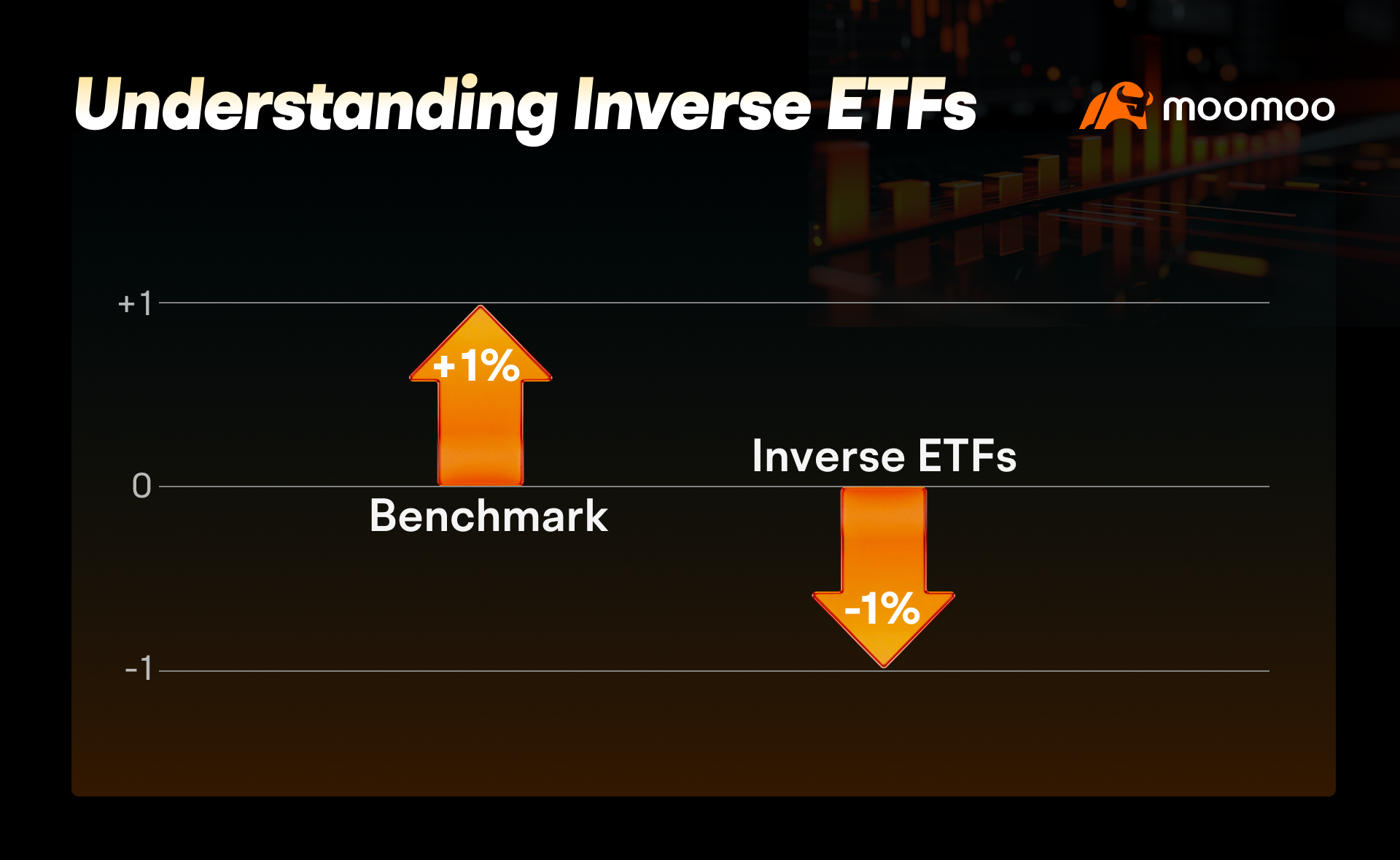
Takeaways:
Inverse ETFs flip the script on an asset’s returns and may be used for hedging during market downturns
Inverse ETFs are engineered to achieve their inverse returns only on a day-to-day basis. Over longer periods, the compounding effect of daily returns can lead to significant deviations from the expected performance
What is an inverse ETF?
An inverse ETF aims to mirror the opposite performance of its underlying asset. Think of it like a financial funhouse mirror using futures or swaps to pull off this trick.
Inverse ETFs let you potentially profit from market dips without the headache of short-selling or margin trading. Some of these are even leveraged, offering a -2x or -3x the reverse return of their underlying asset.
So, if you’ve got a 2x leveraged inverse S&P 500 ETF, and the index drops 1% in a day, your ETF should pop up 2%. But a 1% rise means a 2% drop for your ETF.
Please be aware that leveraged products carry significant risk and are intended for experienced investors who comprehend these risks, including the impact of daily compounding on leveraged returns. These investors should be prepared to actively monitor and manage their investments daily.
If you want to learn more about leveraged ETFs, you can check the course below:
>> Learn more: Leveraged ETFs Made Easy: How They Work and What to Know
You’ll find a buffet of inverse ETFs linked to market indexes, specific sectors, or individual stocks.
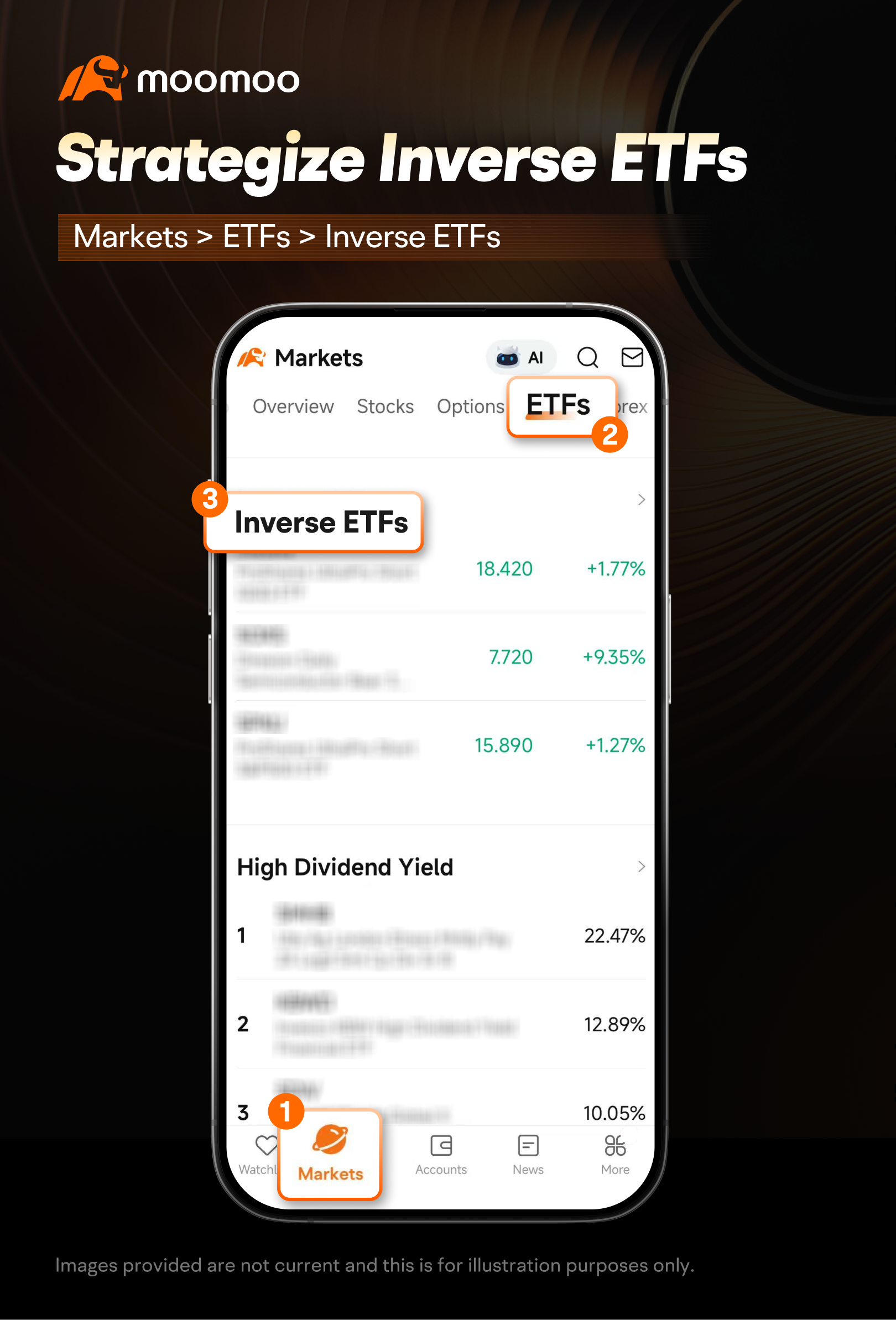
Want to track them down on moomoo? Head to Markets > ETFs > Inverse ETFs.
Downside protection
During market downturns, investors may use inverse ETFs to hedge their bullish positions and manage risks. They offer a way to "short" the market without bearing the risk of unlimited losses.
When you short a stock or ETF in the market, you face the risk of that position potentially rising indefinitely, which could lead to devastating losses in your portfolio. With inverse ETFs, losses are limited to the amount you invest in the position.
Investors can use inverse ETFs in an effort to profit from anticipated market declines or a specific sector without having to sell short individual stocks or the index directly. These are actually long positions with long negative exposure.
They provide an easy way for retail investors to gain short exposure to a market or sector without a margin account or engaging in more complex transactions like options or futures.
Risks to watch
Conventional indices ETFs are designed to match the performance of an underlying index over any period. Most inverse ETFs, however, are designed to meet the investment objective for a single day.
They achieve the opposite daily return of the underlying index through complex derivatives such as futures and swap agreements. At the end of each trading day, the fund manager must adjust the derivative positions to restore the leverage ratio to its initial level.
Because inverse ETFs rebalance daily, long-term performance may not meet your expectations, especially in a volatile market.
Here's an example:
Assuming the market fluctuates by 5% daily over two days. A -1x inverse fund would return -9.75% when the benchmark is up 5%, and 10.25% when the benchmark is down 5% over two consecutive days.
In a volatile market where the benchmark dropped 0.25% over two days, the fund also went down 0.25% and wouldn't act as an effective hedge.
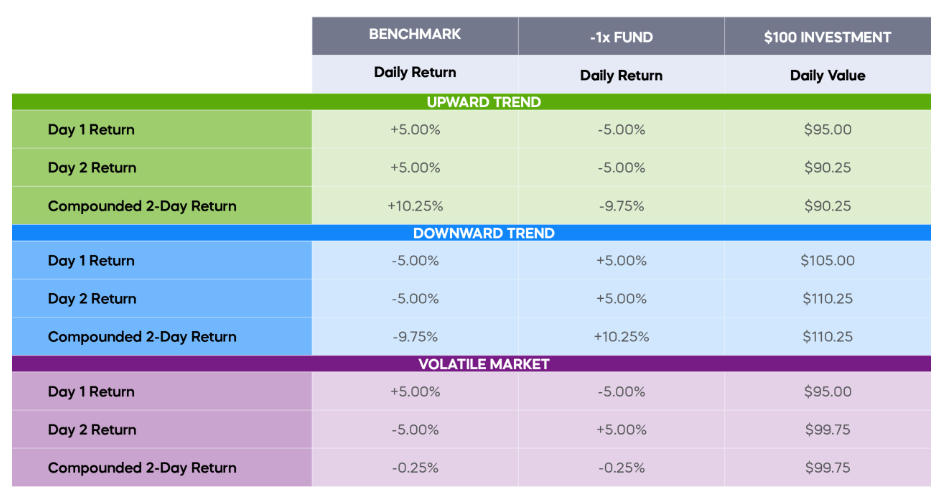
Source: Proshares. This is for information and illustrative purposes only.
Lately, volatility has become very common in the market, and the longer the time frame, the less it experiences sustained upward or downward trends. Because of this and other reasons, inverse ETFs are not suitable for long-term holding.
Inverse ETFs also have higher fees. For instance, the expense ratio for the ETF tracking the Nasdaq-100 index is 0.2%, while the fee rate for the 3x inverse one is 0.95%, which is nearly five times higher.
Some inverse ETFs might have lower trading volumes and wider bid-ask spreads, which can lift your trading costs.
Inverse ETFs might be suitable for investors seeking to hedge long positions or profit from market slumps.
However, they are designed for short-term trading and are generally seen as highly speculative. Long-term traders should stay away.
Exchange-traded products (ETFs) are subject to market volatility and the risks of their underlying securities, which may include the risks associated with investing in smaller companies, foreign securities, commodities, and fixed income investments. ETFs that use derivatives, leverage, or complex investment strategies are subject to additional risks. The return of an index ETF is usually different from that of the index it tracks because of fees, expenses, and tracking error.
This presentation is for informational and educational use only and is not a recommendation or endorsement of any particular investment or investment strategy. Investment information provided in this content is general in nature, strictly for illustrative purposes, and may not be appropriate for all investors. Read more