Long Put Calendar Spread
Strategy Motivation
Suppose you expect the underlying asset's price to remain relatively stable in the short term but may decline in the future. In that case, consider using the long put calendar spread strategy.
Construction of the Strategy
The long put calendar spread is constructed by selling a near-term put and buying an equal amount of longer-term put with the same strike price at the same time.
Brief Description
Using the long put calendar spread strategy, the ideal strike price is near the underlying asset's price on the near-term expiration date. Of course, this requires very accurate judgment ability.
You can also refer to the following criteria to select the strike price: in a relatively stable market, choose at-the-money options; in a bull market, choose out-of-the-money options; and in a bear market, choose in-the-money options.
After establishing this strategy, if the underlying asset's price does not change much in the short term, you can use the sold near-term put option to profit from the time decay.
After the near-term option expires, you can close the longer-term option or open other options to form a new option strategy, depending on market conditions.
Suppose you choose to continue holding the longer-term option. In that case, there is still an opportunity to obtain potential profits from the price decline of the underlying asset. Of course, potential losses may also occur if the underlying asset rises later.
Since the near-term put option with the same strike price should have a lower premium than the longer-term put option, the account funds will be in a net outflow state when establishing this strategy.
Gain & Loss
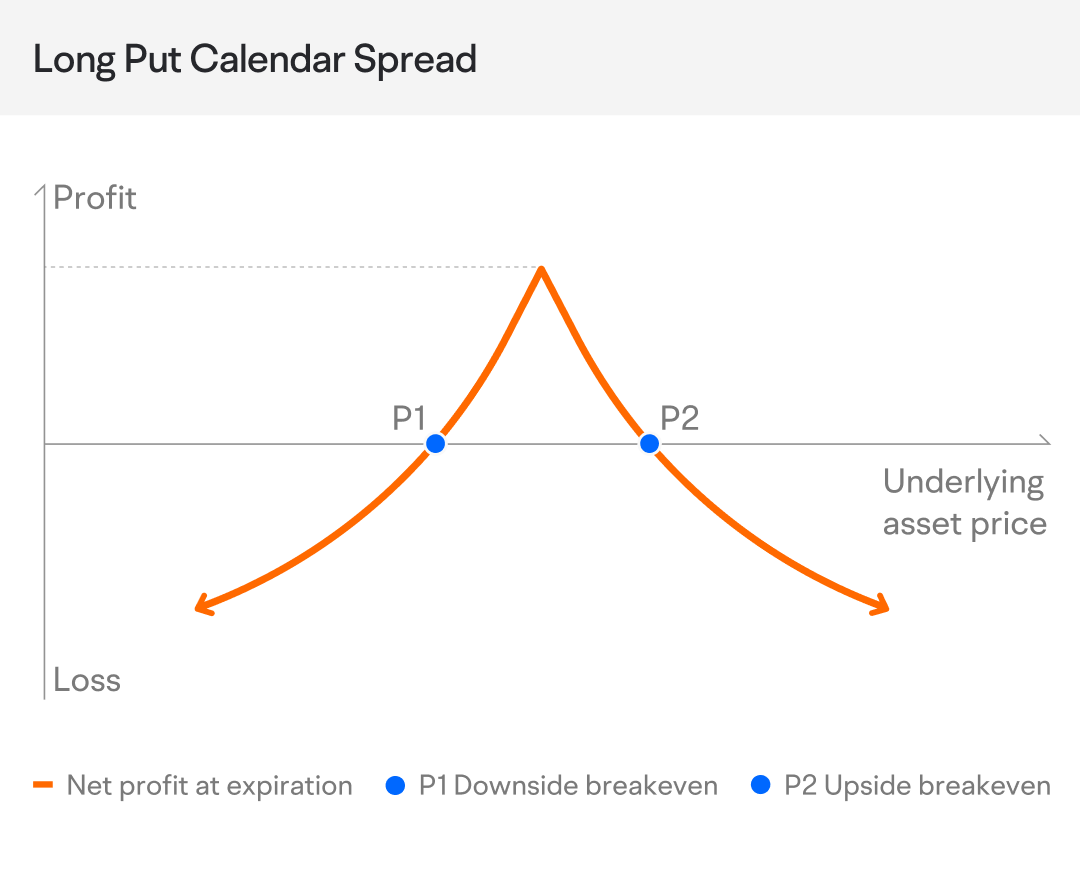
Breakeven
There are two breakeven points for a long calendar spread with puts: one above the strike price and one below.
The breakeven points are the underlying asset's price on the expiration date of the short put, at which the time value of the long put equals the original price of the calendar spread.
However, since the time value of the long put depends on the level of volatility, it is impossible to know for sure what the breakeven stock prices will be.
Max Gain
The potential max profit is realized when the underlying asset's price is equal to the strike price of the short put on the near-term expiration date.
This is because the long put has maximal time value when the underlying asset's price equals the strike price, and the short put expires worthless.
The exact amount of maximum profit depends on the price of the long put, which can vary based on the level of volatility.
Max Loss
The potential maximum loss is the cost of the spread. The entire amount paid for the spread is lost if the underlying asset's price moves sharply away from the strike price.
This presentation is for informational and educational use only and is not a recommendation or endorsement of any particular investment or investment strategy. Investment information provided in this content is general in nature, strictly for illustrative purposes, and may not be appropriate for all investors. Read more