ETFs: How much do they cost?
Finally, we come to a crucial part that most everyone is concerned about – the trading costs and fees of ETFs.
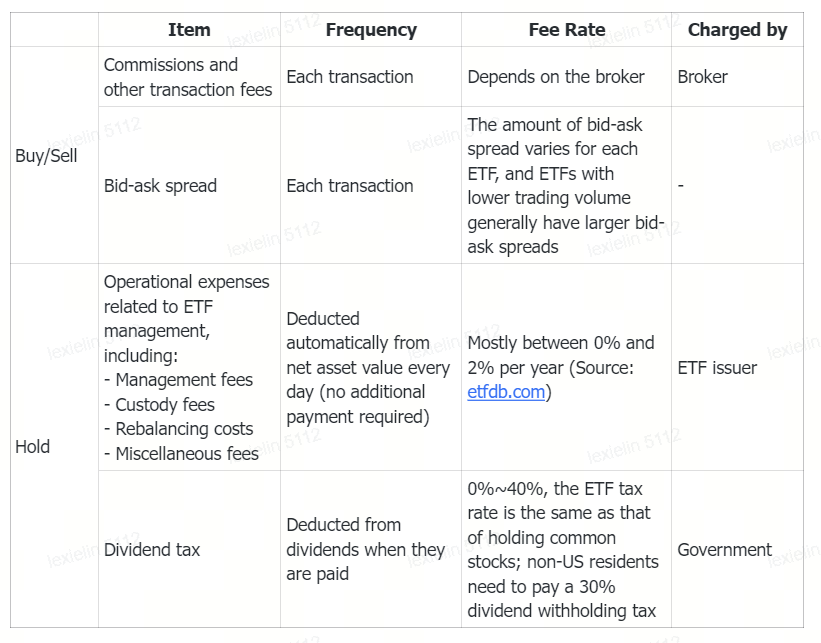
They can be divided into three categories: commissions and transaction fees, operational expenses related to ETF management (including management fees, custody fees, etc.), and bid-ask spread.
Non-US residents also need to pay dividend taxes. Just like trading stocks, buying or selling ETFs incurs commissions and transaction fees for each order executed.
As a result, this cost has a more significant impact on high-frequency traders. Specific charges are determined by each individual broker.
OER refers to the percentage of the annual operational expenses related to ETF management relative to the fund's assets. This fee isn't deducted in a lump sum at the end of the year, but instead, it's subtracted from the fund's net assets every day you hold the ETF.
Suppose your investment in the ETF earns zerore turns after one year. In that case, you will see your holding value gradually decrease from 10,000??10,000to9,990 over that period.
If you invest for more than one year, this fee will compound over time like a snowball.
Therefore, the longer the investment horizon, the more attention you need to pay to the expense ratio, because slight differences can lead to vastly different final returns. This may be a trading cost that many investors overlook, but for frequent traders, this factor may be more critical than expense ratios.
The bid-ask spread amount varies for each ETF, but ETFs with lower trading volumes typically have larger bid-ask spreads. For example, let's assume two ETFs that track the same underlying asset and have a current price of $10. If sold at that point, disregarding other factors, which ETF would have a higher final return?
The answer is:
ETF A: 10.98×100−1%÷12×1100=1097.0810.98×100−1%÷12×1100=1097.08
ETF B: 10.00×100−0.5%÷12×1100=999.5410.00×100−0.5%÷12×1100=999.54
Lastly, if you are a non-US resident, a dividend withholding tax of 30% will automatically be deducted from your ETF's dividends each time they are paid (no payment is required as the tax will be deducted before the dividends are credited to your account). This tax is levied by the US government.
When we trade ETFs, the fee structure is as follows:
Now that you've learned almost everything you need to know about trading ETFs, all that's left is to understand the trading process.
It's a straightforward process, and as long as you have a securities account, it's very similar to trading stocks. Finding the ETF you want to trade is crucial, but we'll cover that topic in another video.
If you enjoyed this video, please give us a thumbs up or leave your thoughts in the comments section. You're also welcome to subscribe to our YouTube channel.
We'll continue producing similar content in the future, and we appreciate your support.
This presentation is for informational and educational use only and is not a recommendation or endorsement of any particular investment or investment strategy. Investment information provided in this content is general in nature, strictly for illustrative purposes, and may not be appropriate for all investors. Read more