What is Algorithmic Trading | Benefits, Strategies & Future Trends
Algorithmic trading, or algo trading, leverages computer programs to execute trades automatically based on predefined criteria. This method is widely used by institutional investors, hedge funds, and retail traders to enhance efficiency and minimize manual intervention. With advancements in technology, algo trading has become more accessible, allowing traders to develop and deploy their own automated strategies. In this guide, we’ll break down what algorithmic trading is, how it works, and how you can get started using platforms like moomoo.
What is algorithmic trading?
Algorithmic trading refers to the use of computer programs and mathematical models to execute trades at high speed and frequency. These algorithms follow a set of rules based on price, volume, timing, and other market-related factors to buy or sell assets with minimal human intervention. The goal is to capitalize on market inefficiencies, reduce trading costs, and improve accuracy in trade execution. Algo trading is widely used in various financial markets, including equities, forex, commodities, and cryptocurrencies, making it a key component of modern financial strategies.
How algorithmic trading works
Algorithmic trading works by implementing predefined trading rules and executing orders automatically when those conditions are met. Traders design algorithms based on strategies such as trend-following, arbitrage, or statistical analysis. These algorithms analyze real-time market data, execute orders in milliseconds, and adjust to market conditions instantaneously. High-frequency trading (HFT) is a subset of algo trading that executes thousands of trades per second. By leveraging automation, traders can eliminate emotional decision-making and ensure precise execution of trading strategies.
Why algorithmic trading matters
Algorithmic trading plays a crucial role in modern financial markets by increasing efficiency and liquidity. It helps traders capitalize on short-lived market opportunities that manual trading cannot. It reduces transaction costs and eliminates slippage by executing orders at optimal price points.
Institutions rely on algo trading to manage large order flows without disrupting market prices. For some retail traders, algorithmic trading provides access to sophisticated strategies that were once exclusive to hedge funds and proprietary trading firms, leveling the playing field in competitive markets.
Algorithmic trading strategies
There are several strategies used in algorithmic trading, each designed to maximize profit and minimize risk. Some of the most common include:
Trend-following strategies: These strategies use moving averages, momentum indicators, and price trends to identify profitable opportunities.
Arbitrage strategies: Traders exploit price discrepancies between different markets or assets to generate low-risk profits.
Mean reversion strategies: These strategies assume that asset prices will revert to their historical average over time.
Market making strategies: Involves placing buy and sell orders simultaneously to capture the bid-ask spread.
Examples of simple trading algorithms
Simple trading algorithms can be built using basic rule-based conditions. For example, a trader might create an algorithm that buys a stock when its price drops below a certain level and sells when it reaches a set profit target. These rule-based strategies can be easily coded and tested using backtesting tools to ensure their effectiveness before execution in live markets.
Example of a moving average trading algorithm
One common algorithmic strategy is the moving average crossover. This involves using two moving averages—one short-term and one long-term. When the short-term moving average crosses above the long-term moving average, it generates a buy signal. When the short-term moving average crosses below the long-term moving average, it signals a sell order. This strategy can help traders identify trends and make data-driven decisions.
How to do algo trading using moomoo
Moomoo offers a user-friendly platform for algorithmic trading, allowing traders to automate their strategies with ease. Here’s how you can get started:
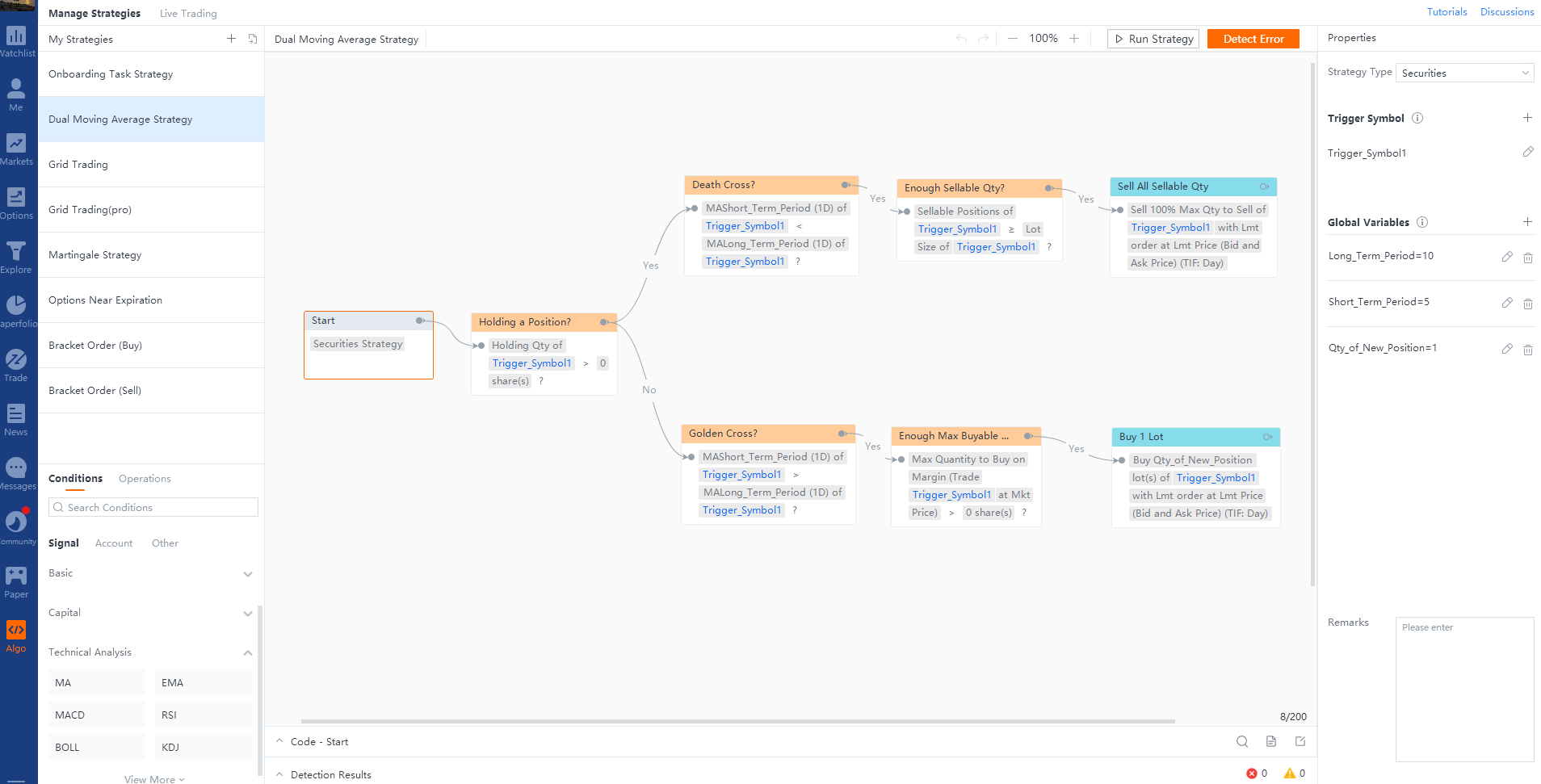
Access the trading bot: Navigate to the ‘Trading Bot’ section within the Moomoo platform.
Choose a strategy: Select from pre-built strategies or create a custom algorithm.
Set parameters: Define trading conditions, such as entry and exit points, stop-loss levels, and profit targets.
Backtest your strategy: Test your algorithm using historical data to evaluate its performance before live trading.
Deploy and monitor: Activate your trading bot and monitor its performance in real time. By following these steps, traders can automate their strategies and optimize trading efficiency on moomoo.
Potential advantages and risks of algo trading
Potential advantages
Speed and efficiency: Algorithms execute trades faster than humans, ensuring optimal market timing.
Reduced emotions: Removes psychological factors that often lead to poor trading decisions.
Improved accuracy: Trades are executed based on predefined rules, reducing errors.
Scalability: Algo trading allows traders to manage multiple trades simultaneously.
Potential risks
Technical failures: System errors, bugs, or connectivity issues can impact trading outcomes.
Market risks: Rapid market fluctuations may lead to unexpected losses.
Overfitting: Backtested strategies may perform well on historical data but fail in live markets.
Regulatory concerns: Compliance with financial regulations is essential to avoid legal complications.
FAQs About Algorithmic Trading
Is algo trading legal in US?
Yes, algorithmic trading is legal in the US. However, traders must comply with regulations set by the Securities and Exchange Commission (SEC) and the Commodity Futures Trading Commission (CFTC). Certain high-frequency trading practices are subject to scrutiny to prevent market manipulation.
How profitable is algo trading?
Algo trading can be profitable if executed with a well-tested strategy. However, profitability depends on factors such as market conditions, execution speed, and strategy robustness. While institutional traders often achieve consistent profits, retail traders may face challenges in maintaining profitability.
How to get started with algo trading
Learn the basics of trading strategies and market mechanics.
Choose a trading platform that supports automation.
Develop or use existing trading algorithms.
Backtest strategies using historical data.
Start with a demo account before trading with real funds.
Is coding required for algo trading?
While coding knowledge can be beneficial, many trading platforms offer no-code or low-code solutions for algorithmic trading. Platforms like moomoo provide pre-built trading bots and customizable strategies that do not require programming skills.
How much money is required for algo trading?
The capital requirement varies based on the trading strategy and asset class. Some platforms allow traders to start with a few hundred dollars, while institutional strategies may require substantial capital. Brokerage fees and minimum balance requirements should also be considered.
Can I do algorithmic trading on my own?
Yes, individual traders can engage in algorithmic trading using online platforms and trading bots. Many platforms provide user-friendly interfaces for creating and testing trading algorithms without requiring extensive technical knowledge. However, ongoing strategy evaluation and risk management are essential for success.
By understanding how algorithmic trading works and leveraging platforms like moomoo, traders can automate their strategies and enhance their trading experience. Whether you’re a beginner or an experienced trader, algo trading provides numerous opportunities to optimize trade execution and improve market performance.
This presentation is for informational and educational use only and is not a recommendation or endorsement of any particular investment or investment strategy. Investment information provided in this content is general in nature, strictly for illustrative purposes, and may not be appropriate for all investors. Read more