Singapore Chinese Investor's Guide to Stock Trading | The Best Stock Trading App for the Chinese Community
In Singapore, as the economy booms and the financial markets mature, an increasing number of Chinese‑Singaporeans are turning their attention to stock market investing. Yet, with a complex and ever‑expanding stock market and a plethora of investment platforms, choosing the stock‑trading app best suited to Chinese investors has become a common challenge for many.
This article will provide a detailed explanation of the fundamental concepts of stock trading, the principles behind making profits in the stock market, and how Singaporean Chinese can choose a stock‑trading app. It will conclude by recommending a highly acclaimed stock‑trading app in the Singaporean market—Moomoo Singapore。
>> [Limited-Time Account Opening Offer for Chinese Nationals]Exclusive account-opening offer for Chinese nationals—act now to embark on a new journey of wealth growth!
What is stock trading?
In simple terms, stock trading is the act of buying and selling shares. Stocks are certificates of ownership issued by a corporation to raise capital, representing the holder's (the shareholder's) claim on the company's assets and earnings. Shareholders are entitled to dividends and other distributions, but they also bear the associated risks. At its core, stock trading involves profiting from price differentials—buying low and selling high.
Basic Concepts of Stocks
Certificate of OwnershipStocks are certificates of ownership issued by a joint-stock company, with each share representing a proportional stake in the company.
Dividends and BonusesShareholders holding shares are entitled, in accordance with the company's articles of association, to participate in the distribution of corporate profits and to receive dividends and bonuses.
How can you make money by investing in stocks in Singapore?
Investing in Stocks in SingaporeMaking money is, in essence, much like buying and selling goods in everyday life—except that the "goods" you're trading are company stocks. Below, we'll walk you through a simple, easy-to-understand example to illustrate how you can earn returns by investing in stocks.
The basic principle of making money: buy low, sell high.
Imagine there's a fruit shop called "Fruit Fragrance" running a sale, with Apple prices much lower than usual. You think this is a great opportunity, so you buy some Apples and take them home. A few days later, the price of Apples returns to normal—and even rises slightly. At that point, you decide to sell your Apples, pocketing the difference.
Investing in stocks follows the same principle. When a company's stock price is low—just like a discounted "fruit‑flavored" Apple—you buy its shares. Then, you wait for the market's perception of the company to improve or for the company's own performance to strengthen, driving the stock price higher. Once the price rises to a certain level, you sell your shares and pocket the difference—this is the basic principle behind making money from stock investments.
Receive dividends
Suppose the "Fruit Fragrance" fruit shop is not only offering discounts but has also launched a membership program: by becoming a member and purchasing a certain quantity of Apples, you can receive free Apples on a regular basis for a specified period. Investing in stocks to earn dividends is just like the "Fruit Fragrance" fruit shop's membership program: once you become a shareholder of a company, you not only have the opportunity to profit from buying low and selling high, but you can also enjoy dividend income distributed by the company.
Dividends are a portion of a company's profits distributed to shareholders as a way of rewarding them. Unlike earning returns by buying low and selling high, dividends are determined by the company based on its actual operating performance and dividend‑distribution policy, so their timing and amount may vary. Over the long term, steady dividend income can provide a reliable stream of cash flow for your investment portfolio.
How do Chinese Singaporeans choose a stock‑trading app?
Stock trading, as an investment approach, offers both unique appeal and inherent risks. For Chinese‑Singaporean investors, selecting a stock‑trading app that suits their needs is of paramount importance. When choosing an app tailored to Singapore's Chinese community, investors should weigh multiple factors to ensure the platform meets their investment objectives and delivers a convenient, secure, and efficient trading experience.
Fully featured trading capabilitiesAn excellent stock‑trading app should offer comprehensive trading features, including buying, selling, canceling orders, and checking portfolio holdings, ensuring investors can execute trades anytime, anywhere.
Fund SecurityStock‑trading apps should employ state-of-the-art encryption technologies to safeguard investors' funds. At the same time, they must implement robust fund‑management and oversight mechanisms to prevent misappropriation of capital.
Real-time market dataA qualified stock app should provide real-time updates on stock prices, market indices, news, and other relevant information, helping investors stay abreast of market developments.
How do Chinese Singaporeans invest in the stock market?
For Singaporean Chinese, understanding and mastering the basic steps and key considerations of stock trading is essential to achieving success in the market. Below, we will provide a detailed guide on how Chinese investors can trade stocks in Singapore, covering account‑opening requirements, funding methods, as well as fees and pricing structures.
1. Account Opening Instructions
To trade stocks in Singapore, you first need to open a securities account. Choosing the right brokerage firm or bank is crucial, as they will provide you with a trading platform, market information, and customer support, among other services.
Moomoo SingaporeAccount Opening Process
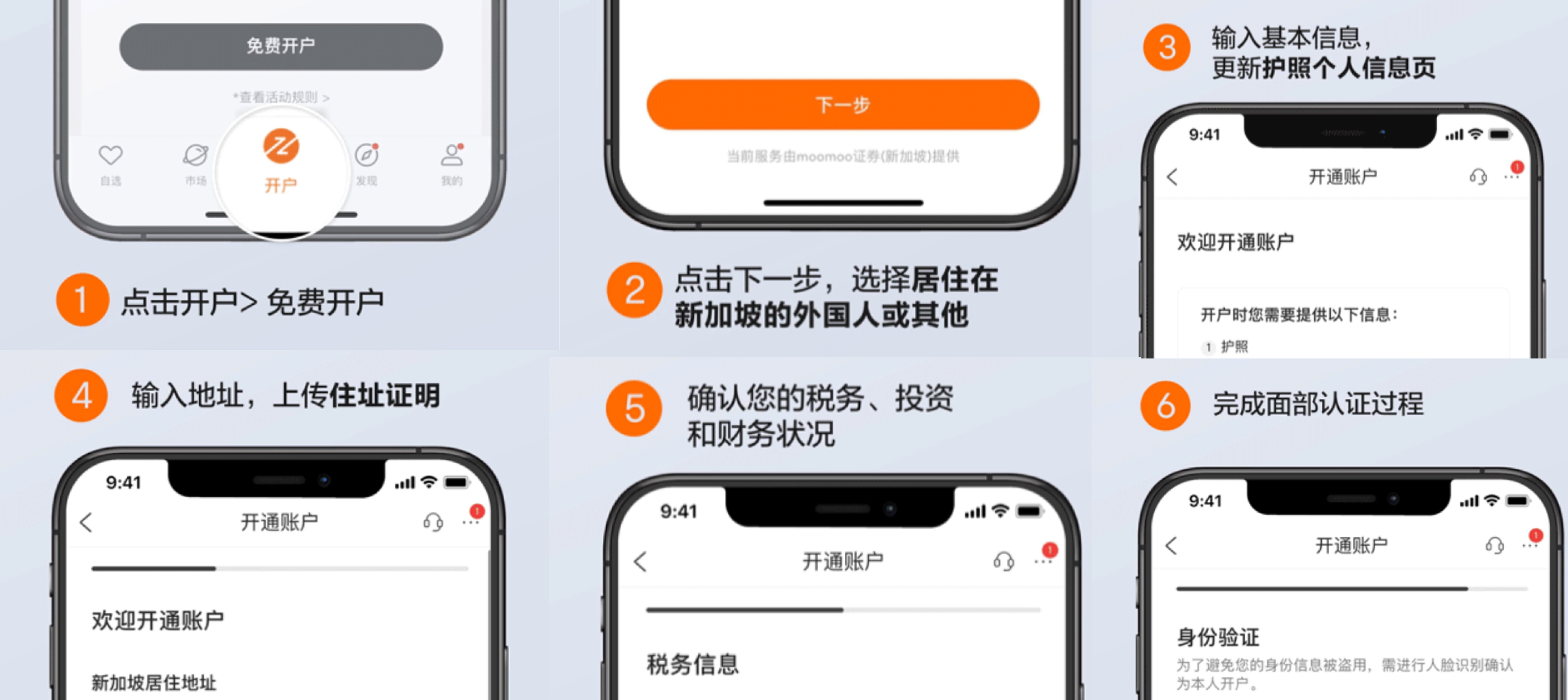
Step one: Open the Moomoo Singapore official website or app, follow the on-screen instructions to complete registration, then click "Open Account" > "Open an account for free”。(Open an account now)
Step 2: Singapore residents may select the option "Singaporean citizen"or"Singapore Permanent Resident”;Non-Singaporean citizens or permanent residentsSelect "Foreigners residing in Singapore"or"Other regions"Option."
Step 3: Enter your basic information (passport, employment details, address, and tax information) to complete the account opening process.
Singapore citizen or permanent residentWhen opening an account, you will need to prepare the following documents:
NRIC photo and proof of address* (Customers who have imported their information via MyInfo are exempt from providing these documents)
Professional status information
Financial Statement Description
Tax Information
Non-Singaporean citizens or permanent residentsWhen opening an account, you will need to prepare the following documents:
Passport photo on the personal data page and proof of address
Professional status information
Financial Statement Description
Tax Information
Note: Customers who are 18 years of age or older may open an account with Moomoo Singapore. In general, the account application is reviewed and approved on the same day it is submitted. However, in certain special circumstances, the review process may take 1–3 business days.
[Limited TimeAccount Opening Offer]Click to claim the luxurious new-user gift pack!
Onemoomoo comprehensive accountSupports multi-currency (SGD/USD/HKD/CNH/JPY), multi-market (SG/US/HK/CN/JP), and multi‑asset class (securities/futures) trading.
Onemoomoo comprehensive accountSupports multi-currency (SGD/USD/HKD/CNH/JPY), multi-market (SG/US/HK/CN/JP), and multi‑asset class (securities/futures) trading.
2. Deposit Methods
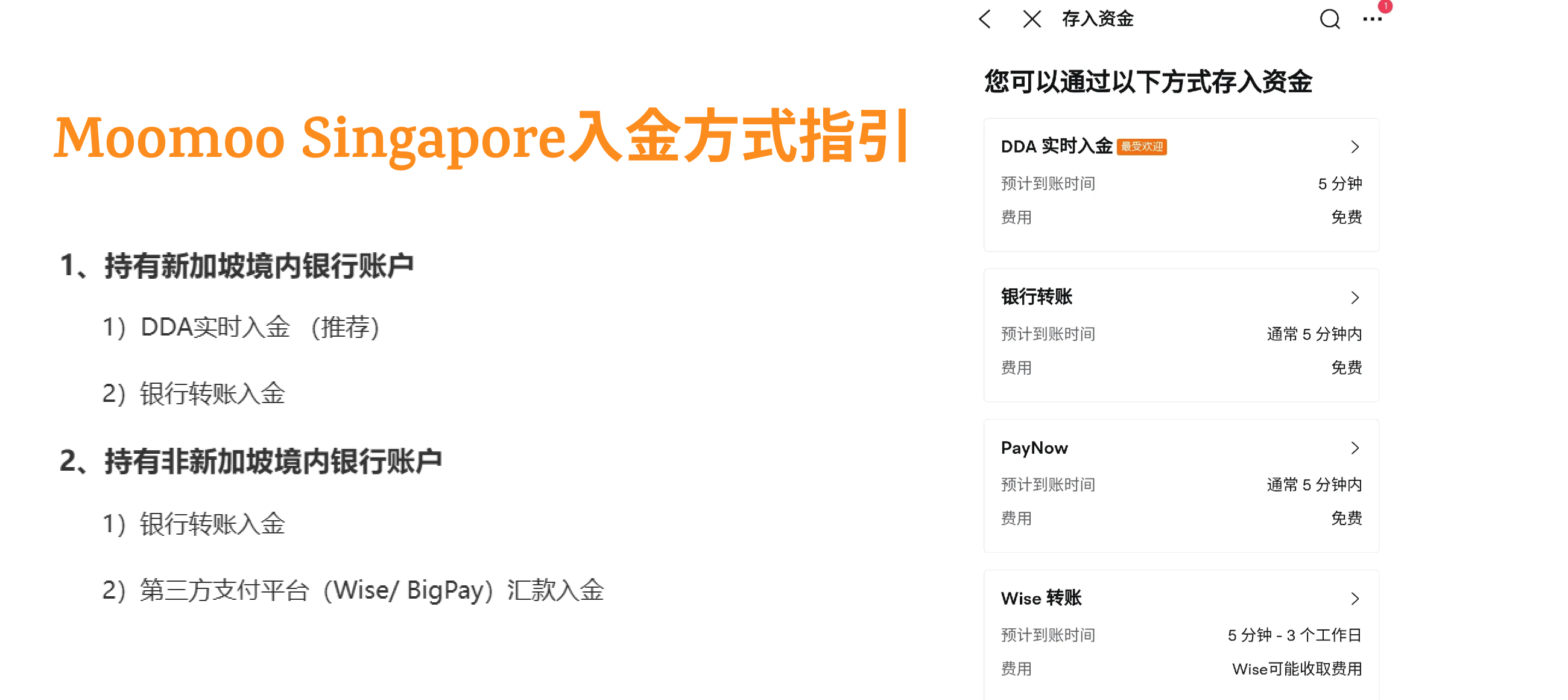
Funding refers to transferring funds into your securities account to enable stock trading. Moomoo Singapore Securities typically offers a variety of funding methods to meet the needs of different investors.How to Choose the Right Deposit Method for You?
Moomoo SingaporeDeposit Instructions
Step one: Open the moomoo app and tapTransaction>More>Deposit funds.Or simply click the deposit link on the right.Deposit Now)
Step two: If you choose bank transfer for deposit, click "Bank transfer", follow the on-screen instructions to complete the deposit. If you don't have a Singapore bank account, you can use Wise's deposit feature—simply click "Wise transfer(Recommended) – Easily complete your deposit.
[Limited TimeDeposit Bonus]Seize market opportunities and boost your earnings! Claim your new‑customer gift now!
Read more:How do I fund my Moomoo Singapore account via bank transfer?
3. Fees and Pricing
Stock trading involves various fees, including brokerage commissions, stamp duty, and transfer fees. Understanding the composition and calculation methods of these costs is essential for managing investment expenses.
Transaction commission: Fees charged by a securities firm for providing trading services are typically calculated as a certain percentage of the transaction amount.
Stamp duty: Taxes and fees imposed by the government on stock transactions are typically calculated as a certain percentage of the transaction amount.
Transfer fee: Fees collected by the stock exchange or relevant institutions during the process of share transfer.
Moomoo Singapore*0 commission offer
U.S. stocks: Enjoy permanent commission-free trading on U.S. stocks and ETFs;
Star stock: New customers trading Singapore stocks, ETFs, and REITs enjoy a one-year commission-free period;
Hong Kong stocksNew customers trading Hong Kong stocks and ETFs can enjoy 30 days of commission-free trading.
China A-shares: New customers trading Chinese A-shares can enjoy 30 days of commission-free trading;
Click to view Moomoo Singapore's trading across various markets.Fee StandardsDetails: By carefully selecting a brokerage firm, strategically choosing your funding method, and understanding the fee structure, you can better manage your investment costs and enhance your returns.How do you activate your commission-free card?
What investment options are available to Chinese Singaporeans?
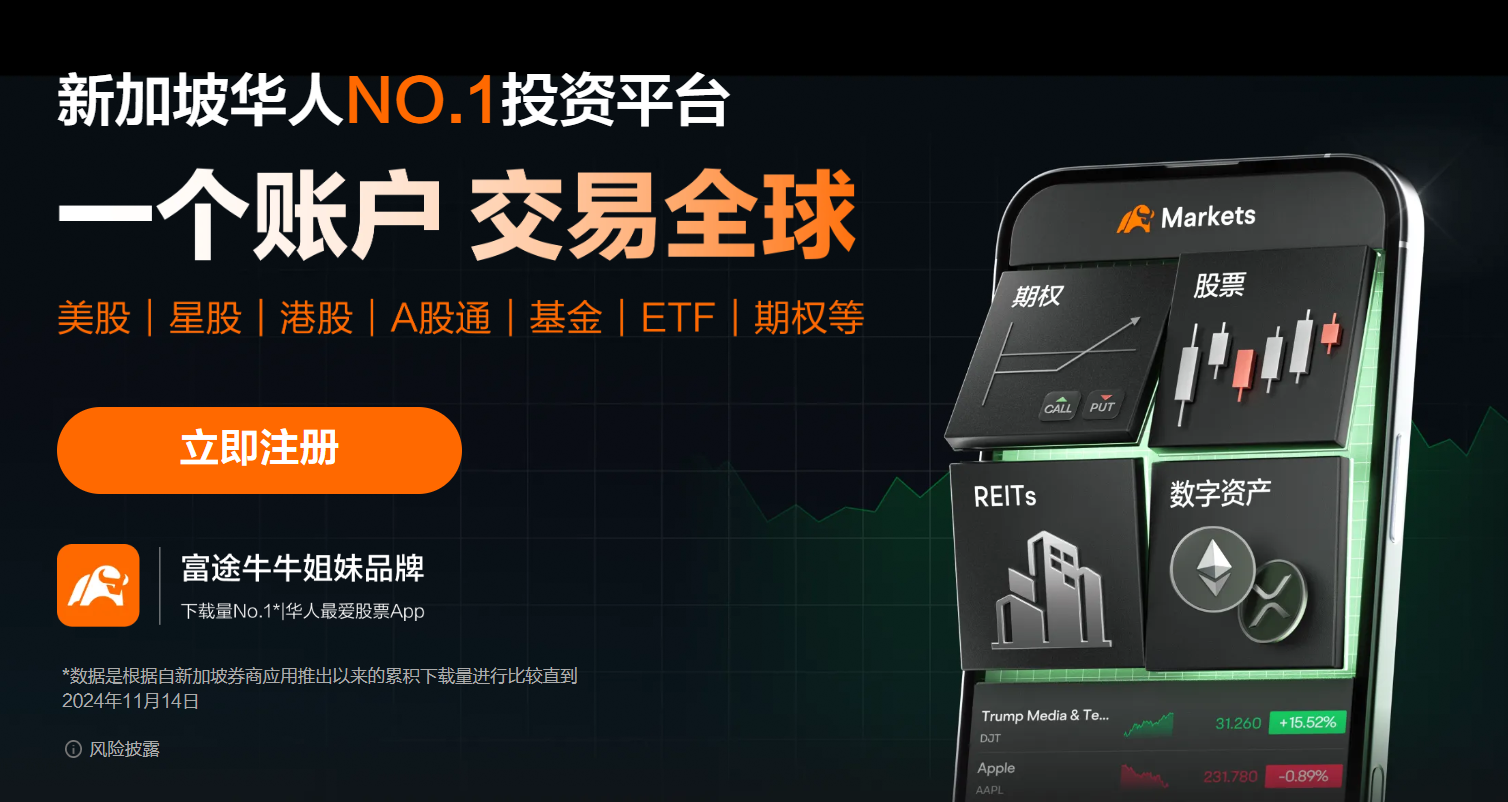
In Singapore, Chinese investors have a wide array of investment options, each with its own distinct advantages and risks. Below is an overview of several key investment avenues that Chinese investors in Singapore may consider.
Stock investment
Stock investing offers investors the opportunity to directly participate in a company's operations and profitability, enabling them to capture capital gains and dividend income through buying low and selling high or by holding shares over the long term. However, equity markets are highly volatile, requiring investors to possess solid market‑analysis skills and an appropriate risk tolerance.
For novice investors, keeping an eye on stock concept lists or popular rankings across various markets can be an excellent way to get started with stock selection. Concept lists often highlight the market's current hot themes, with…Chinese concept stocksFor example, these companies have leveraged China's vast market and its unique industrial advantages to emerge as key players in the global economic landscape, such as…Alibaba、Ideal、JD.comWaiting for enterprises.
Meanwhile, the most active stocks list highlights the shares with the highest trading volume, such as…U.S. Stock Market Activity List、Hong Kong Stock Market Active Stocks ListMoreover, high trading volume indicates strong market attention, helping novice investors conduct research and analysis in a relatively transparent environment.How do I trade stocks on moomoo?
Bond investment
Bond investments are relatively stable, offering investors fixed interest income and lower risk. Nevertheless, bond prices can still fluctuate due to factors such as market interest rates and credit risk.
Fund Investment
Fund investing diversifies risk through pooled investments and is managed by professional fund managers, making it ideal for investors who lack the time or expertise. It includes equity funds, bond funds, balanced funds, and more, allowing investors to choose based on their individual risk tolerance.
AI Stock Selector: How to Analyze Stocks?
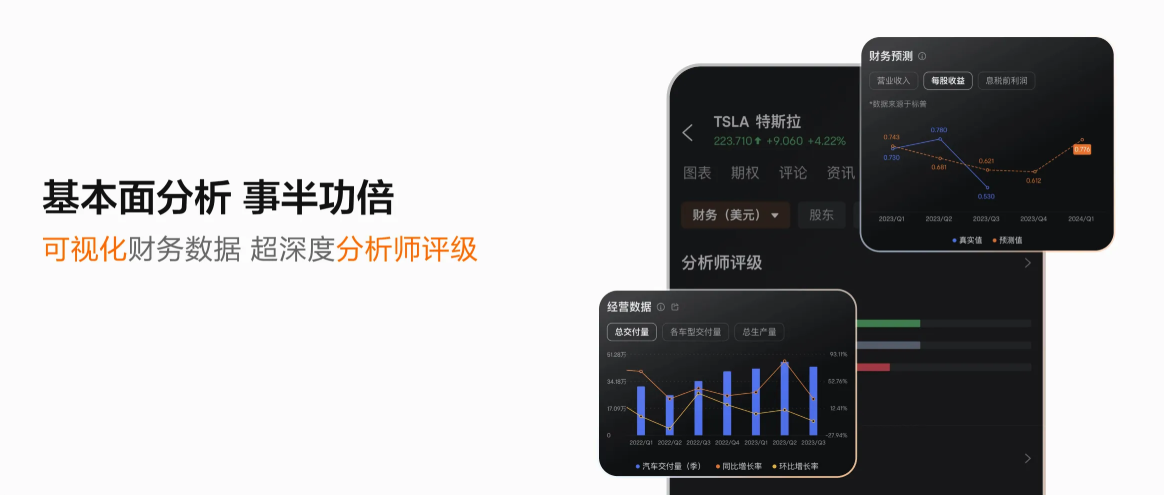
For Chinese‑Singaporean investors, mastering the art of "reading stocks" is a fundamental skill for navigating the stock market. This goes beyond simply tracking price fluctuations; it also entails a deep understanding of a company's fundamentals, broader market trends, and investor sentiment, among other factors. The following sections will provide a detailed guide on how to comprehensively "read stocks."
Company Information: Review the company's financial statements to gain insights into its profitability, liabilities, and cash flow, and assess its position within the industry as well as the capabilities of its management team.
Price Trend: Analyze the stock's historical price trends, paying close attention to support levels, resistance levels, and changes in trading volume, and use technical indicators to aid your analysis.
Market and Macro: Monitor overall stock market trends, hot sectors, and macroeconomic data to understand the impact of policy changes on the economy.
News Updates: Stay abreast of company news and market developments, such as earnings reports and merger-and-acquisition announcements, as these can trigger stock price volatility.
Risk Assessment: Assess investment risks and develop mitigation strategies, such as diversification and setting stop-loss orders.
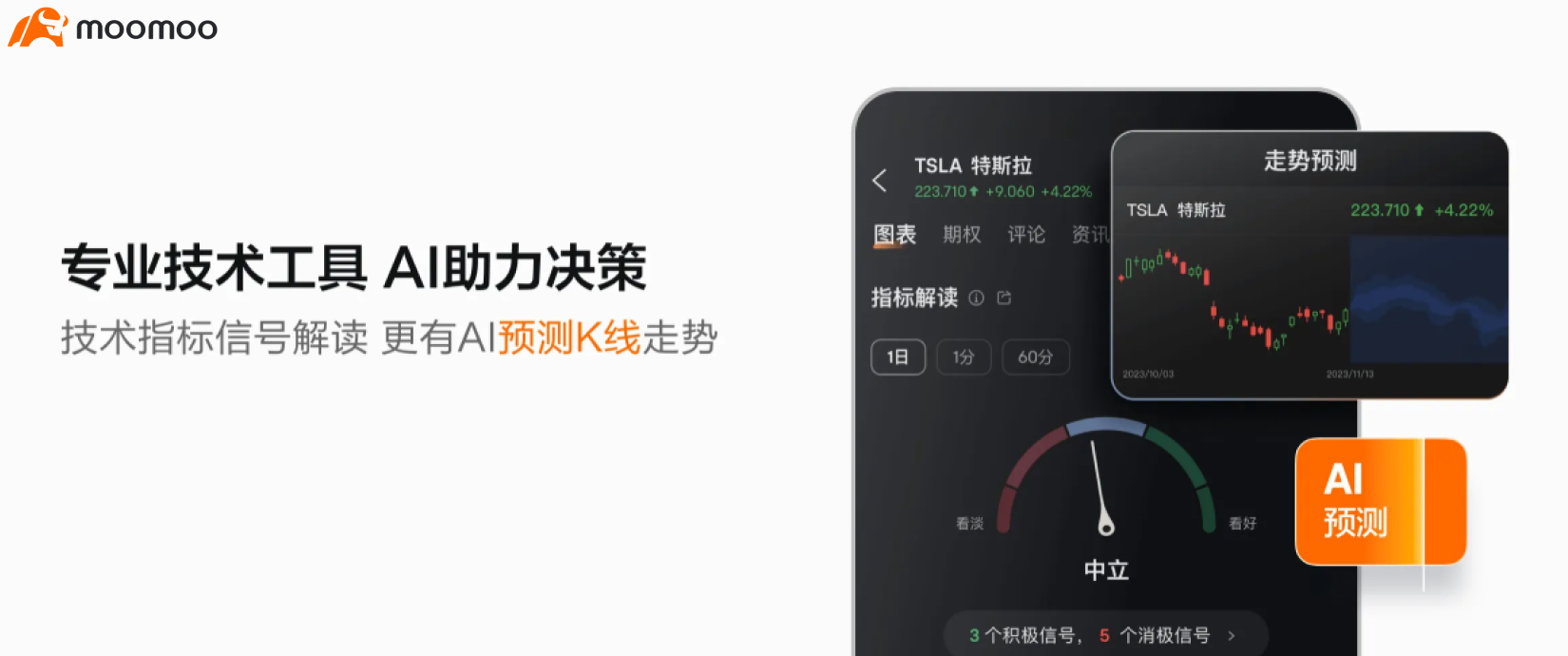
On the moomoo platform, stock market data is clear at a glance, including the name, ticker symbol, price, and percentage change. Tap to enter an individual stock's page to view detailed summary information. The moomoo platform provides investors with a powerful tool for efficient stock selection—AI Stock Selector. When a stock's price action matches a specific technical pattern, the tool automatically highlights it on the candlestick chart and precisely calculates the stock's support and resistance levels, helping investors quickly identify their investment targets.
In addition, the pattern‑based stock selection feature allows investors to easily screen for stocks that match specific patterns (click "Market”>"Hong Kong/U.S. stocks">"Morphological Stock Selection"). Becoming a moomoo member also entitles you to AI-powered analysis and timely access to stock and market news.

Stock Trading Hours Guide: U.S. Stocks, Hong Kong Stocks, and Singapore Stocks
When trading stocks, understanding the trading hours of different markets is crucial. This not only determines whether investors can participate in trades promptly but also influences the formulation and execution of their investment strategies. Below, we provide a detailed overview of the trading hours for U.S. stocks, Hong Kong stocks, and Singapore stocks, helping Singaporean investors better align with market rhythms. The following section offers comprehensive information on each market's trading times:
U.S. stock trading hours
Intraday trading session: Monday through Friday, 9:30 a.m. to 4:00 p.m. Eastern Time (ET)—the primary U.S. stock market trading hours, with no midday break.
In addition to the regular trading session, U.S. stocks also allow pre-market and after-hours trading. Nasdaq has designated pre-market and after-hours trading sessions. However, since different brokerage firms have varying definitions of the timing for pre-market and after-hours trading,The following trading hours apply only to Moomoo Singapore.。Click to learn moreMore U.S. stock trading rules
Pre-market trading session:
Eastern Time: 4:00 AM–9:30 AM
Singapore Time (Daylight Saving Time): 16:00–21:30
Singapore Time (Standard Time): 17:00–22:30
After-hours trading session:
Eastern Time: 4:00 PM–8:00 PM (applicable only to Moomoo Singapore trading)
Singapore Time (Daylight Saving Time): 4:00–8:00
Singapore Time (Standard Time): 5:00–9:00
Hong Kong stock trading hours
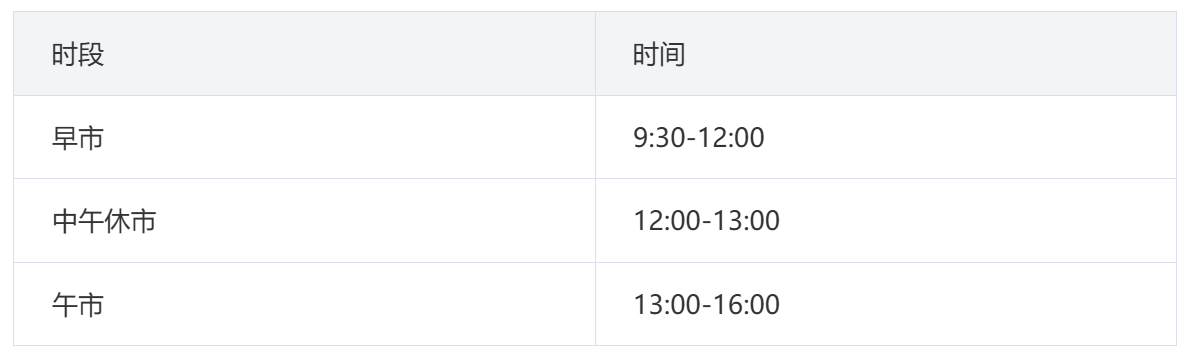
Trading hours in the Hong Kong stock market are highly regular, typically running from Monday to Friday. To help you understand more clearly, we've divided the trading session into several straightforward segments:
Pre-Market Session (SGT)It is divided into four phases: 9:00–9:15—bidding market orders and bidding limit orders may be submitted, modified, or canceled; 9:15–9:20—only relevant orders may be submitted; no order cancellations or modifications are permitted; 9:20–9:22—random matching takes place; from the end of random matching until 9:30 is a suspension period, during which different types of pending buy and sell orders are subject to distinct processing rules.
Continuous Trading Session (SGT): (as shown in the figure above)
The morning market is open from 9:30 a.m. to 12:00 p.m.
The midday market break is from 12:00 to 13:00; order modifications are not permitted during this period, and order cancellations are allowed from 12:30 to 13:00.
Lunch hours are from 1:00 PM to 4:00 PM.
Closing Auction Trading Session (SGT)It is also divided into four phases: 16:00–16:01: The reference price is calculated and announced, and no orders may be submitted; 16:01–16:06: Orders may be submitted, modified, or canceled, with price limits applying to limit‑price bids; 16:06–16:08: Orders may be submitted but not canceled or modified, and there are restrictions on the price entered for limit‑price bids; 16:08–16:10: Random closing; orders may still be submitted but cannot be canceled or modified, and the price entered for limit‑price bids must fall within the prescribed range.
Star stock trading hours
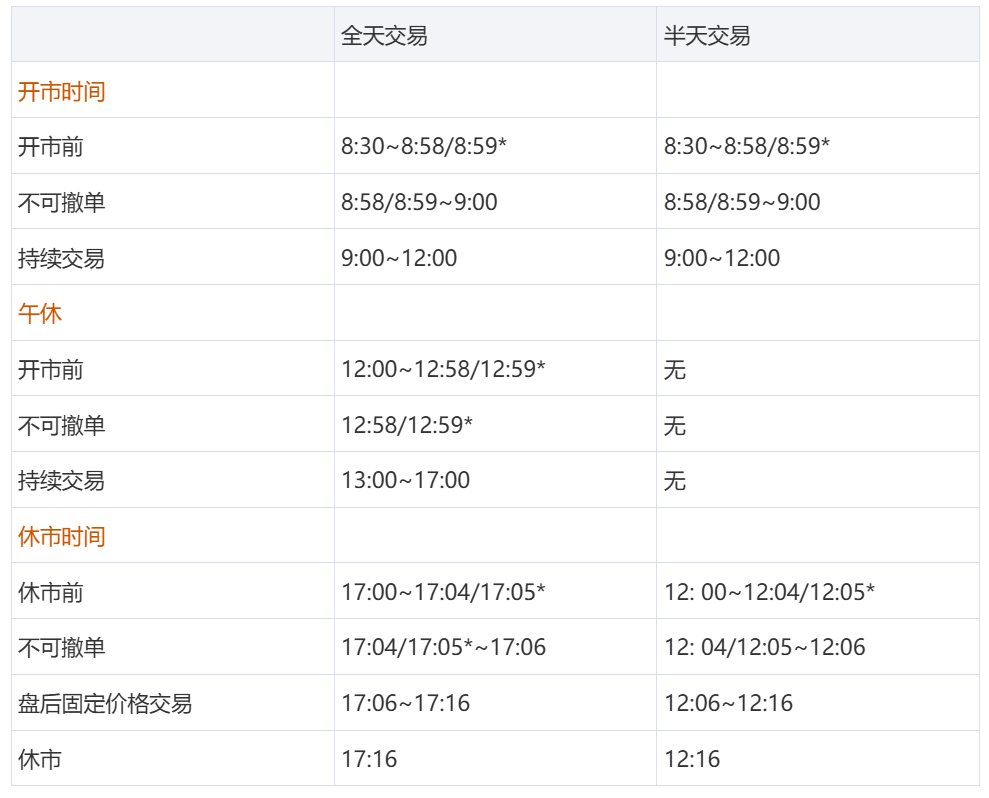
During trading on the Singapore Exchange, the pre‑open and pre‑close sessions end randomly within one minute, immediately giving way to a non‑cancellable order window. Please note that on the day before Lunar New Year, Christmas Eve, and New Year's Day, the Singapore market operates on a half‑day trading schedule.
During the non‑cancellable order periods associated with market open, lunch break, and market close, once the pre‑close trading session ends, investors can no longer enter, modify, or cancel orders; any orders that have not been matched will be carried over to the next trading session.
Additionally, the Singapore market closes at 5:16 p.m. under the full-day trading schedule, or at 12:16 p.m. under the half-day trading schedule.The chart above shows the detailed trading hours for star stocks; click to view.Additional Rules for Stock Trading。
Moomoo SG | The Stock App Best Suited for Chinese Investors
Singapore's No. 1 investment platform for Chinese investors
Moomoo SingaporeFully recognizing the importance of technology in the investment space, Moomoo Singapore continuously invests in R&D, leveraging cutting-edge technological tools to deliver a smarter, more convenient investing experience. From AI-powered stock selection and big‑data analytics to high‑performance trading systems, Moomoo Singapore remains at the forefront of the industry, setting new standards for tech‑driven investing.
1-on-1 Chinese-language customer service exclusively for Chinese speakers
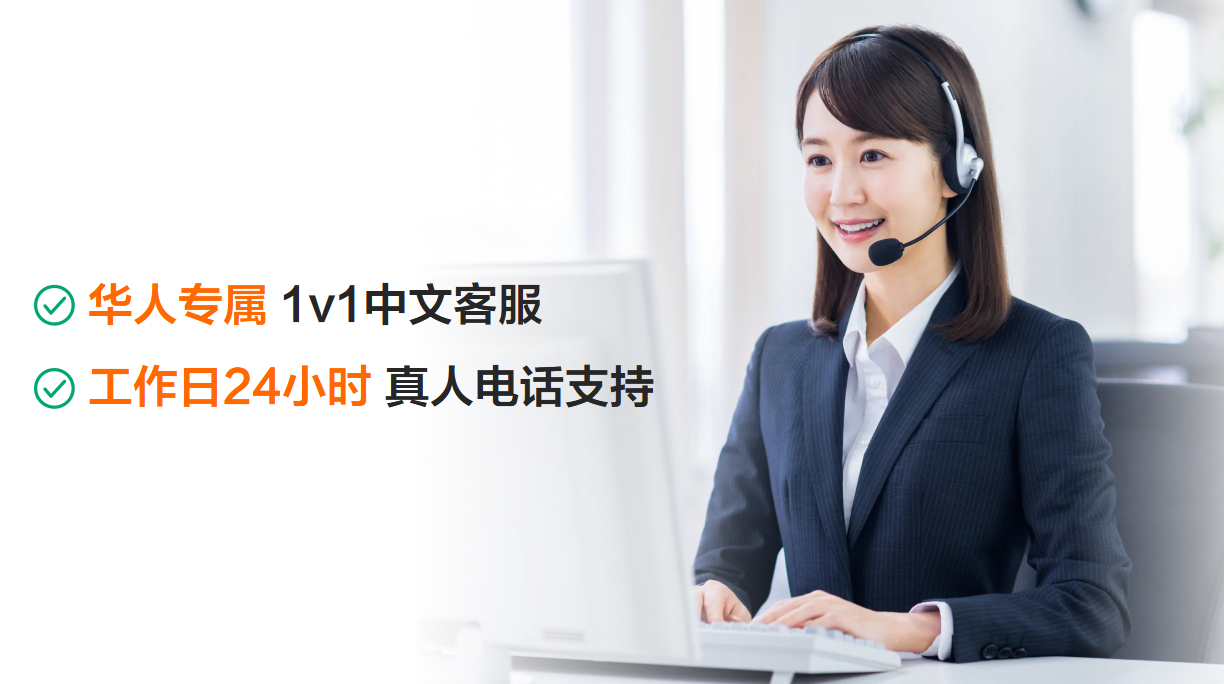
Moomoo Singapore also offers a thoughtful additional service tailored for Chinese‑speaking investors in Singapore: dedicated one‑on‑one customer support in Chinese, with live phone assistance available 24/7 on weekdays. This service not only underscores Moomoo Singapore's deep commitment to its Chinese‑speaking clients but also highlights its professional and meticulous approach to customer care.How can I access 24-hour dedicated customer support?
No currency conversion required—invest globally with a single account.
For Chinese investors in Singapore, foreign exchange conversion is often a cumbersome and costly process. Moomoo Singapore, however, has broken down this barrier by offering a convenient gateway that allows investors to access global markets through a single moomoo account—without the need for currency conversion. In addition to providing a wide range of local investment products, professional investment services, and a secure, reliable trading environment, it also places particular emphasis on meeting the global investment needs of Chinese investors.
"Yu'ebao" offers high annualized returns.
Moomoo Cash PlusThe product has captured the attention of numerous investors with an annualized yield as high as 4.22%. This return significantly exceeds the market average, offering investors an efficient avenue for growing their idle funds. Whether used for short-term storage or long-term investment, Moomoo Cash Plus delivers substantial returns. In addition to providing on-demand redemption—similar to Yu'ebao—it also offers zero‑fee subscription and redemption services.

Summary
In summary, stock trading, as an investment strategy, is both brimming with opportunities and fraught with risks. For Chinese investors in Singapore, selecting a reliable, professional, and personally suited stock‑trading app is of paramount importance.
Moomoo SingaporeWith its robust features, professional services, global investment perspective, and efficient fund-management tools, the platform has become the top choice for Singaporean Chinese investors.
Whether you're a novice just entering the stock market or an experienced investor, Moomoo Singapore offers a tailored investment platform to help you achieve steady wealth growth. As such, for Chinese‑speaking investors in Singapore, Moomoo Singapore is undoubtedly the go-to stock‑trading app.
This presentation is for informational and educational use only and is not a recommendation or endorsement of any particular investment or investment strategy. Investment information provided in this content is general in nature, strictly for illustrative purposes, and may not be appropriate for all investors. Read more