US Interest Rate Cut: Investment Strategies for Singaporean Investors
On the complex chessboard of the global economy, interest rate policy is a key piece that affects the economic trend of each country. As the world's largest economy, the interest rate policy of the United States not only affects the domestic economy, but is also the wind vane of the global capital market.
Currently, the United States Federal Reserve System has taken measures to lower interest rates in response to slowing economic growth and inflationary pressures. This policy shift is widely regarded as a key means of stimulating economic growth, promoting employment and stabilizing financial markets.

However, the cuts in US interest rates are not an isolated event; they have direct and indirect implications for the global economy, particularly for open economies like Singapore. As a country highly dependent on international trade and financial flows, Singapore's investors must be sensitive to changes in US interest rate policy and quickly adapt their investment strategies to the new economic environment.
In Singapore, how to invest in the US stock market during a US interest rate cut cycle? This article will analyze in detail the reasons for the US interest rate cuts, the specific implications for Singapore investors, as well as the investment opportunities that Singaporean investors can take advantage of and the risk management strategies that must be considered in this context. We aim to provide Singapore investors with a holistic perspective to help them make informed investment decisions in an ever-changing global economy.
What is the US Interest Rate Cut?
US interest rates refer to the federal funds rate set by the United States Federal Reserve System (referred to as the ‘Fed’). The federal funds rate is the rate at which banks lend money overnight and is one of the central tools of US monetary policy. By adjusting this rate, the Federal Reserve influences the borrowing costs and money supply of the economy as a whole, thus achieving the purpose of regulating the economy.
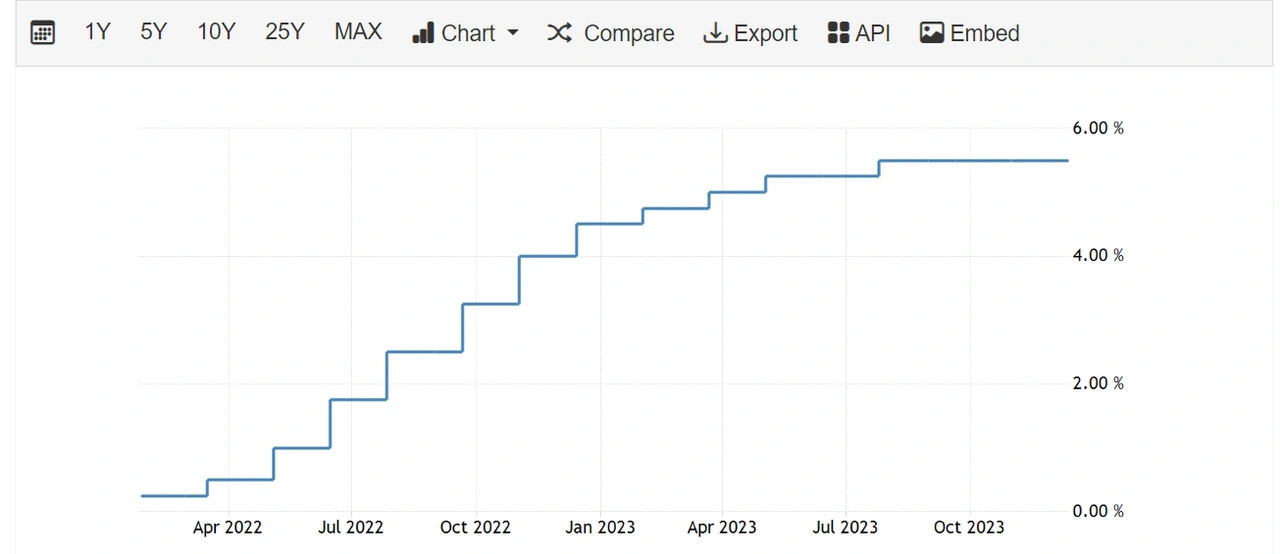
Since March 2022, the Fed has raised rates 11 times to the current range of 5.25%-5.50% to curb inflation, and now that inflation is under control, calls for a rate cut are increasing.
Definition of US Interest Rate Cut
US interest rate cuts refer to the Federal Reserve's decision to reduce the federal funds rate. Such cuts usually occur when the economy is under downward pressure or inflation is too low, to stimulate economic growth.
Lower borrowing costs: Businesses and individuals can borrow at lower interest rates, thereby increasing investment and consumption.
Facilitating credit expansion: banks are more willing to lend and businesses have easier access to capital, boosting business activity.
Boosting the stock market: A low interest rate environment generally makes equities more attractive as returns on fixed-income investments fall.
Impact on the exchange rate: low interest rates may lead to a depreciation of the dollar, making US exports more competitive, but also increasing the cost of imports.
Reasons Behind US Interest Rate Cuts
Inflationary pressures
Inflation is one of the key considerations in the Fed's decision-making. Interest rate cuts may persist for the following reasons:
In recent years, the United States has experienced a period of high inflation, which, despite some moderation, has not yet reached the Fed's 2% target. However, the high interest rate environment has begun to harm economic activity, such as a slowdown in business investment and weak consumer spending.
A slowdown in economic growth
US interest rate cuts are usually a response to slowing economic growth. When the US economy shows signs of weakness, the Fed may resort to cutting rates to stimulate economic activity. Here are some specific indicators:
Declining GDP growth: A lower than expected growth rate of gross domestic product (GDP) indicates weakening economic activity.
Weakness in the job market: A rise in the unemployment rate or a decrease in new jobs created indicates a lack of demand in the labor market.
Declining consumer confidence: A decline in the Consumer Confidence Index indicates a weakening of households' willingness to spend, affecting overall economic vitality.
International trade tensions
International trade tensions may also prompt the Fed to take interest rate cuts. Example:
Tariffs and trade barriers: Tariffs and trade barriers resulting from international trade disputes may increase costs for businesses and discourage exports and investment.
Slower global growth: Slower growth in major global economies could affect US exports and the profitability of multinational enterprises.
Financial market instability
Financial market instability is another important consideration. Interest rate cuts can help stabilize the financial market and prevent the spread of economic crisis:
Stock market volatility: sharp fluctuations in the stock market may trigger panic among investors, leading to capital outflows and economic instability.
Tight credit markets: Tight credit markets may lead to difficulties in financing businesses, affecting investment and expansion plans.
Policy objectives
The Fed's policy objectives include promoting maximum employment, stabilizing prices and maintaining moderate long-term interest rates. Interest rate cuts are an important means of achieving these objectives:
Promote employment: Low interest rates can stimulate investment and consumption by businesses and individuals, increasing employment opportunities.
Stabilizing prices: By regulating interest rates, the Fed can control inflation and keep prices stable.
Supporting economic growth: A low interest rate environment helps businesses and consumers increase spending and boosts economic growth.
Impact of US Interest Rate Cuts on Singapore Investors

The Fed's interest rate decisions have far-reaching implications for global financial markets. Below are the specific implications of the US interest rate cuts on Singapore's economy and investment climate:
Exchange Rate Fluctuations
A decision by the Federal Reserve to cut interest rates may typically lead to a depreciation of the USD, due to the fact that low interest rates make holding USD assets less attractive, prompting investors to move to other currencies or asset classes.
Impact on currencies:
When the Federal Reserve makes an interest rate cut, the USD depreciates relative to other currencies (including the SGD). This is because low interest rates make holding USD less rewarding and investors may move their money to other higher-yielding currencies. The depreciation of the USD makes USD-denominated assets (e.g. equities and bonds) less attractive, further driving capital flows to other markets.
Impact on Singapore companies:
The depreciation of the US dollar relative to other currencies in a low interest rate environment may lead to a relative appreciation of the Singapore dollar. An appreciating SGD will increase the cost of exported goods and reduce their competitiveness in the international market, and export-oriented firms may be exposed to the risk of declining revenues. At the same time, an appreciating SGD would reduce the cost of imported goods, which would be beneficial to importing firms, and this could improve their profitability and competitiveness.
Stock Markets
Lower US interest rate cuts usually have a positive impact on the US stock market. A low interest rate environment usually increases investors' risk appetite, prompting funds to flow into the stock market and driving up share prices. It also reduces the cost of financing for companies, which helps them to expand investment and increase profits. In addition, a low interest rate environment typically increases consumers' ability to borrow and spend, further fuelling economic growth.
Linkage Effect
There is a degree of linkage effect between the US stock market and the Singapore stock market.
Sentiment transmission: The performance of the US stock market tends to influence global investor sentiment. When the US stock market rises, investor confidence increases and the Singapore stock market tends to follow suit.
Capital flows: Global capital flows have an important impact on stock markets. When interest rates in the United States fall, international capital may flow to emerging markets, including Singapore, driving up local stock markets.
Multinational performance: Many Singapore-listed companies have multinational operations, especially those with operations in the United States. The performance of the US stock market has a direct impact on the performance of these companies, which in turn affects their performance in the Singapore stock market.
Bond Market
Interest rate cuts have a significant impact on the bond market. When the Fed decides to cut interest rates, bond prices have an inverse relationship with yields. When interest rates fall, the yields on existing bonds become more attractive relative to newly issued low-interest rate bonds, causing existing bond prices to rise.
Impact of US interest rate cuts on the bond market
Rise in Treasury prices: When interest rates are cut, the prices of US Treasuries usually rise as the yields on existing Treasuries are higher than newly issued low-interest rate Treasuries. The Singapore bond market usually follows the trend of the global bond market.
Increased demand: A low interest rate environment typically prompts investors to seek higher-yielding investments, which may increase demand for high-yield bonds and bond funds. High-yield bonds and corporate bonds typically offer higher yields, which can help improve overall portfolio returns.
Real Estate Market
Interest rate cuts in the US usually have a significant impact on mortgage rates, which in turn affects the property market. When interest rates are cut, banks have lower borrowing costs, which usually leads to lower mortgage rates. Lower mortgage rates make home ownership more affordable, thus stimulating demand for home ownership. At the same time, a low interest rate environment usually prompts banks to offer more favorable loan terms, such as longer repayment periods and lower down payment ratios, further lowering the threshold for home ownership.
Impact of US interest rate cuts on the property market
Real estate market activity: A reduction in interest rates by the Federal Reserve may increase activity in the real estate market, with lower borrowing costs making property purchases more attractive. Interest rates in Singapore generally move in tandem with global interest rates, particularly those of the Federal Reserve. As the Fed lowers interest rates, banks in Singapore may lower their mortgage rates as well.
Changes in mortgage rates: Mortgage rates may fall when the Federal Reserve lowers interest rates, which could spur more buyers into the property market. While lower interest rates may attract more buyers, this may also increase competition in the market, pushing up home prices and rents and offsetting some of the benefits of low interest rates.
Real Estate Investment Trusts (REITs): Real Estate Investment Trusts (REITs) may benefit from cuts in US interest rates as they rely on borrowing when financing property acquisitions. With lower borrowing costs, REITs can refinance existing debt at lower interest rates, improve profitability and increase the amount of capital distributed to investors.
Investment Opportunities for Singaporean Investors

US interest rate cuts offer Singapore investors a range of investment opportunities in both the US and Singapore markets.
Stock Markets
Technology and growth stocks: Interest rate cuts in the United States typically drive the performance of technology and growth stocks. The low interest rate environment reduces the cost of financing for technology companies, making it easier for them to conduct research and development and expand. In addition to large tech companies, many small and mid-sized tech companies typically have higher growth potential, but are also relatively risky.
Cyclical equities: Interest rate cuts in the US usually boost economic recovery, which in turn favors cyclical equities. Banks and financial institutions typically increase their lending activities and profitability in a low interest rate environment. At the same time, a low interest rate environment usually increases consumers' borrowing and spending power, thus boosting the performance of retail and consumer stocks.
Defensive stocks: Although interest rate cuts in the US usually drive the stock market higher, defensive stocks remain attractive in times of economic uncertainty. Utility companies typically provide stable cash flows and dividends, making them a safe haven in times of economic uncertainty. In addition, healthcare companies are usually immune to economic cycles and provide stable revenues and growth.
Bond Market
US treasury bonds: US treasury bonds are considered one of the safest investments in the world, and the low interest rate environment has allowed the price of treasury bonds to rise, providing stable returns.
High-yield bonds: The low interest rate environment makes high-yield bonds more attractive as they offer much higher yields than traditional bonds.
Corporate bonds: The low interest rate environment helps companies to reduce their financing costs and improve their financial position, thereby improving their credit ratings and reducing the risk of default.
Real Estate Markets
Residential real estate: Interest rate cuts in the United States typically reduce the cost of borrowing, and lower mortgage rates make it easier for first-time buyers to obtain loans, potentially increasing demand for homes. This also attracts more investors to the residential real estate market, and increased demand for homes usually leads to higher home prices and capital appreciation opportunities for investors.
Commercial real estate: The low interest rate environment has attracted more investors into the commercial real estate market, particularly office buildings, shopping centers and industrial properties. More investment demand is likely to push up rental levels and increase landlords' earnings.
Real Estate Investment Trusts (REITs): The attractiveness of REITs is likely to increase in a lower interest rate environment, as they typically offer higher dividend yields than traditional fixed income products.
Gold Market
A reduction in US interest rates usually leads to a depreciation of the US dollar, which is denominated in US dollars, and a depreciation of the US dollar pushes up the price of gold. In addition, a low interest rate environment usually increases investors' demand for risk aversion, and the price of gold, a traditional safe-haven asset, usually rises. Investors can invest in gold by purchasing physical gold and gold ETFs.
Crude Oil Market
Interest rate cuts in the United States are usually aimed at stimulating economic growth, which may increase demand for commodities such as crude oil. Interest rate cuts reduce borrowing costs and encourage businesses to expand operations, which may increase energy demand. In addition, as interest rate cuts in the US may weaken the USD relative to other currencies, and as crude oil is usually denominated in USD, a weaker USD may make crude oil more attractive to investors holding other currencies, potentially affecting the demand for and price of crude oil.
Risk Management for Singapore Investors

The Fed's decision to cut interest rates has important implications for Singapore investors' risk management strategies. The following are risk management strategies that Singapore investors should consider in this environment:
Diversification
Diversification is an important tool for risk management. By spreading funds across different asset classes and geographies, the risk of a particular market or asset can be reduced.
Balance between equities and bonds: Maintaining a reasonable ratio between equities and bonds can reduce overall portfolio volatility.
Cross-regional investing: Don't be overly reliant on one region's market; diversify geographic risk by investing across regions.
Investing across sectors: Investing in different sectors can reduce the impact of sector-specific risk.
Using Hedging Tools
Hedging tools can help investors manage specific risks such as market volatility, exchange rate risk and interest rate risk.
Options and futures: By purchasing options and futures contracts, it is possible to lock in gains or minimize losses in the event of unfavorable movements in market prices.
Foreign exchange hedging: For investments involving foreign currencies, foreign exchange futures or options can be used to hedge against exchange rate risk.
Interest rate swaps: Through interest rate swaps, fixed-rate debt can be converted to floating-rate debt and vice versa to accommodate different interest rate environments.
Periodic Portfolio Review
Regular review of the portfolio is an important step in risk management. The market environment is constantly changing and the portfolio needs to be adjusted promptly in accordance with market conditions.
Periodic review: Review the portfolio at least quarterly to ensure it meets your risk tolerance and investment objectives.
Adjust weightings: Adjust the weightings of each asset class according to market changes and economic expectations to maintain a balanced portfolio.
Rebalance: If an asset class is performing well above expectations, consider selling some of the proceeds to rebalance the portfolio.
Focus on Macroeconomic Indicators
Paying close attention to macroeconomic indicators can help investors keep abreast of market movements and potential risks.
GDP growth rate: the rate of economic growth directly affects business and market performance.
Inflation rate: Changes in the inflation rate affect monetary policy and market expectations.
Unemployment rate: Changes in the unemployment rate reflect the health of the economy and affect consumer and investment confidence.
Central bank policy: Pay attention to the policy trends of the Federal Reserve and other major central banks to understand future interest rate trends and economic policies.
Invest via Moomoo Singapore

(*T&Cs and other fees apply.)
Against the backdrop of the current US interest rate cuts, Moomoo Singapore offers a range of investment products and services to help investors capitalize on market opportunities.
Global Asset Trading
Moomoo Singapore offers a diversified investment platform that allows investors to trade global assets, including stocks in the US, Singapore and Hong Kong. In an environment of slashed interest rates in the US, this provides an opportunity for Singaporean investors to invest in global markets that may benefit from interest rate changes through the moomoo platform.
Low Cost Trading
Moomoo Singapore is currently offering zero-commission trading on US equities, as well as promotions for trading in the Singapore market, which is an attractive advantage for Singaporean investors looking to reduce their trading costs. In an environment of slashed US interest rates, this can help investors utilize their capital more efficiently and pursue higher returns.
Analytical Tools
Moomoo platform offers more than 100 analytical tools that help investors gain insight into market trends and individual stock performance. Against the backdrop of interest rate cuts in the US, these tools help Singapore investors better understand market dynamics and formulate their investment strategies accordingly.
Conclusion

In summary, lower US interest rates offer significant investment opportunities for Singapore investors across asset classes. We explore how low US interest rates could benefit investments in technology and growth stocks, high-yield bonds, real estate investment trusts (REITs) and defensive stocks. In addition, we discussed the importance of using platforms such as Moomoo Singapore to access these opportunities and manage investments effectively.
However, it is important to remember that while interest rate cuts in the US can create favorable market conditions, they also come with risks such as market volatility and economic uncertainty. Diversifying portfolios, reviewing investments regularly and keeping abreast of economic indicators are therefore essential strategies for successful long-term investing. By combining these insights and tools, Singapore investors can confidently navigate the markets and achieve their financial goals.
This presentation is for informational and educational use only and is not a recommendation or endorsement of any particular investment or investment strategy. Investment information provided in this content is general in nature, strictly for illustrative purposes, and may not be appropriate for all investors. Read more