2026 Best Crypto Exchanges in Singapore
Key Takeaway
As of 2025, 33 MAS-licensed exchanges operate, ensuring compliance with anti-money laundering (AML), counter-terrorism financing (CFT), and user protection rules.
- Benifits of Licensed Crypto Platform: Regulatory Compliance; Investor Protections; Transparent Operations
- Comparing Singapore Crypto Platform: By comparing these key features—security, fees, transfer flexibility, and trading convenience, you'll find a platform that aligns with your needs in Singapore.
- Safety Tips for Singapore Investors: Stick to MAS-Licensed Platforms; Choose Safety Over Convenience; Beware of Unregulated P2P Trading
Why Trust Moomoo SG?
- Licensed Online Broker for Crypto in Singapore.
- 0 Commission* on Crypto trading
- No Crypto Wallet Needed
- Effortless Deposits and Withdrawals (SGD/USD)
As of 2025, 33 MAS-licensed exchanges operate, ensuring compliance with anti-money laundering (AML), counter-terrorism financing (CFT), and user protection rules.
- Benifits of Licensed Crypto Platform: Regulatory Compliance; Investor Protections; Transparent Operations
- Comparing Singapore Crypto Platform: By comparing these key features—security, fees, transfer flexibility, and trading convenience, you'll find a platform that aligns with your needs in Singapore.
- Safety Tips for Singapore Investors: Stick to MAS-Licensed Platforms; Choose Safety Over Convenience; Beware of Unregulated P2P Trading
Why Trust Moomoo SG?
- Licensed Online Broker for Crypto in Singapore.
- 0 Commission* on Crypto trading
- No Crypto Wallet Needed
- Effortless Deposits and Withdrawals (SGD/USD)
Regulatory Framework for Cryptocurrencies in Singapore
While cryptocurrencies aren't recognized as legal tender in Singapore, they can function as alternative payment methods. (Legal tender denotes the official currency authorized to settle debts and fulfill financial obligations within a nation.) The Singapore Dollar (SGD), issued and regulated by the Monetary Authority of Singapore (MAS), serves as the country's legal tender.
The Payment Services Act (PS Act), introduced in 2019, is the key legislation governing crypto businesses. It was designed to create a more coherent regulatory system, including licensing and exemption rules—topics we'll detail in the following sections. The MAS actively works to refine the regulatory framework for Digital Payment Token (DPT) services, publishing numerous Notices and Guidelines to clarify regulatory expectations. Here are some of the regulations:
- Digital Payment Token (DPT) providers must implement anti-money laundering and counter-financing of terrorism measures, including risk assessment and mitigation, customer due diligence (collecting and verifying customer information, identifying beneficial owners), transaction monitoring, suspicious transaction reporting, and record-keeping (customer information should be retained for five years), etc. (Source: MAS, Notice PSN02)
- It is prohibited to promote digital payment token trading in a way that downplays high risks. Advertising or promotional materials should not be released to the public through public places, media, etc. (Source: MAS, PS-G02)
In 2024, Singapore made major changes to how it regulates Digital Payment Token (DPT) service providers. These changes were mainly due to updates to the Payment Services Act (PS Act) and the introduction of tougher rules that companies have to follow. Here are the important changes in DPT licensing:
- Updated Regulations: The Monetary Authority of Singapore (MAS) updated the PS Act to better protect users and keep the financial system stable. The new rules cover more types of activities, like storing DPTs for customers (custodial services), helping with DPT trades, and sending money across borders.
- Strict Licensing Rules: DPT service providers now have to meet strict requirements to get a license. For example, they must have at least SGD 250,000 (about USD 184,000) in starting capital. They also need to have strong ways to protect against cyberattacks and check the backgrounds of the people and companies they work with. On top of that, they have to tell customers about the risks of investing in cryptocurrencies. (Source: MAS, Licensing for Payment Service Providers)
Licensed vs. Unlicensed Crypto Platforms in Singapore
When choosing a crypto platform in Singapore, understanding the differences between licensed and unlicensed crypto platforms is crucial. Licensed platforms are regulated by the Monetary Authority of Singapore (MAS) under frameworks such as the Payment Services Act (PSA) 2019, particularly under the Digital Payment Token (DPT) service provider regime. In contrast, unlicensed platforms lack such regulatory scrutiny, creating varying landscapes in areas like security, compliance, and user protection. Let's break down their key distinctions across multiple aspects.
Category | Licensed Crypto Platforms | Unlicensed Crypto Platforms |
Regulatory Body | - Supervised by MAS - Compliant with Singapore's Payment Services Act 2019 (PS Act)- Adheres to Digital Payment Token (DPT) service provider regulations - Implements AML/CFT controls to prevent illicit fund flows | Not regulated under Singapore law. Potentially higher exposure to financial crimes (e.g. money laundering) |
Product Safety | All offerings meet MAS regulatory standards | Potentially offers non-compliant products (e.g. unapproved derivatives) |
Fiat Currency Transactions | - SGD deposits/withdrawals are directly supported - Integrated with local banking partners | - SGD transactions are often unavailable - May require peer-to-peer transactions, complicated for beginners. |
Fund Security | Segregated client accounts | - No mandated fund segregation - Custody risks due to opaque practices |
Risk Disclosure | - Legally mandated risk warnings - Pre-trade risk notifications | May lack of risk warnings; investors may not fully understand risks before investing. |
Cybersecurity | Technical security measures meet requirements, ensuring user data safety. | Cybersecurity may not meet standards, may become target of hacker attacks. |
Why Choose Licensed Crypto Platforms in Singapore
In the rapidly evolving world of cryptocurrency, choosing a trustworthy trading platform is crucial. Here's why investing through MAS-licensed platforms in Singapore is a smart choice for both novice and seasoned crypto investors.
Regulatory Compliance
Under Singapore's Payment Services Act, any business offering DPT services — including crypto exchanges/ platforms, custodial wallets, transfers, or facilitating trades in tokens like Bitcoin — must be licensed by MAS. This licensing grants regulatory clarity and bolsters consumer protection. As of June 2025, 33 licensed providers operate under MAS oversight, forming a secure ecosystem for compliant trading. While licensing can't eliminate market risks, it cuts operational failures and fraud via strict AML/CTF rules, tech safeguards, and fund protection, essential in crypto's volatile landscape. (Source: MAS Website)
Investor Protections
Licensed platforms are required to comply with AML/CTF regulations, safeguard customer funds through segregated accounts, and enforce strict technical risk management measures.
Transparent Operations
Regular audits ensure trading policies, fee structures, and consumer protection measures are transparent, empowering investors to make informed decisions.
Key Features to Compare Singapore Crypto Platform
When choosing a cryptocurrency exchange in Singapore, focusing on a few core features can simplify your decision and protect your investments. By comparing these key features—security, fees, transfer flexibility, and trading convenience—you'll find a platform that aligns with your needs as a local user.
Security
Security should be your top priority because crypto exchanges face risks like hacking and fraud. Look for platforms with strong safety measures to keep your funds and data safe.
- Regulatory compliance: Crypto platforms licensed by MAS (e.g., those under the Payment Services Act) follow strict rules, reducing scam risks. As mentioned above in the “Licensed vs. Unlicensed Crypto Platforms” content, licensed platforms are supervised by MAS, compliant with relevant regulations, and implement controls to ensure legitimacy, while unlicensed ones lack such safeguards.

Start Crypto Journey with Moomoo SG!
Robust encryption for fund protection
Regulated by MAS under Major Payment License PS20200617
Robust encryption for fund protection
Regulated by MAS under Major Payment License PS20200617
Fees and Pricing
Fees can eat into your profits, so understanding pricing structures is essential for cost-effective trading in Singapore. Trading platforms charge various fees, and comparing them helps you save money in the long run. Key aspects include:
Types of fees: These include trading fees (often a percentage of each transaction, e.g., 0.1%–0.5%), withdrawal fees for moving crypto out, and deposit fees for adding funds. Other fees may also apply when trading cryptos (e.g. platform fees, collection charges).
Hidden costs: Watch for extra charges like inactivity fees or high spreads (the difference between buy and sell prices).

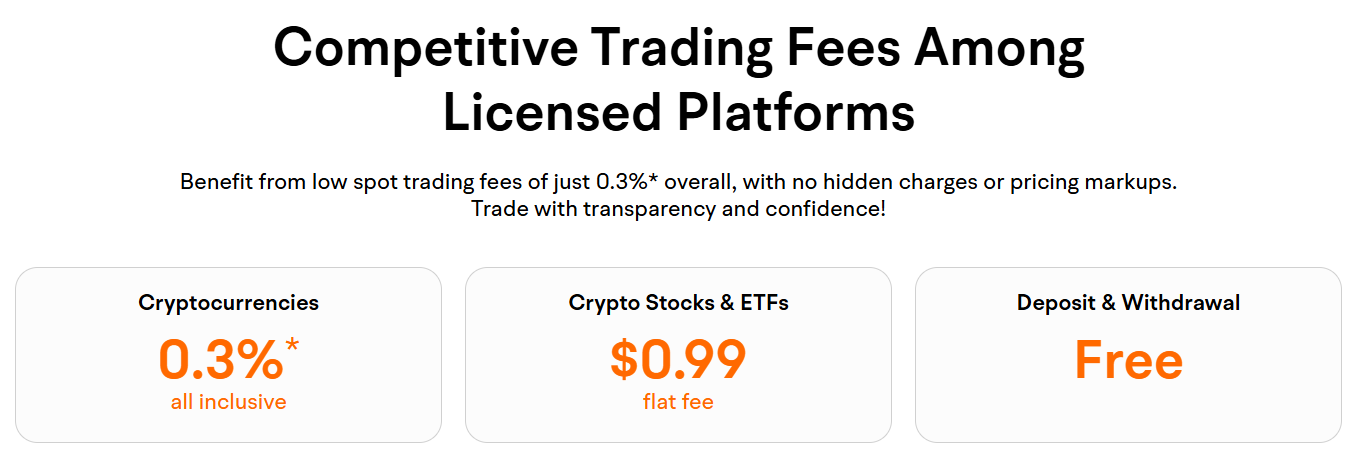
Moomoo Crypto Trading Fees:
0 commission* for all cryptocurrencies
Zero transfer fees for SGD and USD
Transparent fee structure with no hidden charges
>> For other charges, you can click here to view more.
0 commission* for all cryptocurrencies
Zero transfer fees for SGD and USD
Transparent fee structure with no hidden charges
>> For other charges, you can click here to view more.
Transfer Flexibility: SGD or USD
As a Singapore-based user, seamless deposits and withdrawals in your local currency (SGD) or widely used USD can save time and reduce conversion hassles.
User tips: Prioritize exchanges with low or no fees for SGD transfers to keep costs down. For frequent USD users, verify if the platform offers stablecoin pairs (e.g., USDT) for smoother conversions.
Instant SGD/USD Deposits & Withdrawals on Moomoo SG:
✓ No Wallet Setup Required
✓ Local Bank Transfers
✓ 0 Fees & No Fuss
✓ No Wallet Setup Required
✓ Local Bank Transfers
✓ 0 Fees & No Fuss
Convenient Trading
A user-friendly trading experience makes crypto investing smoother and less stressful, especially for beginners. Convenience covers how easy it is to execute trades, access tools, and get support.
- Interface and tools: Look for simple, intuitive dashboards with features like real-time charts, price alerts, and one-click trading. Mobile apps (e.g., from Moomoo App) allow trading on the go.
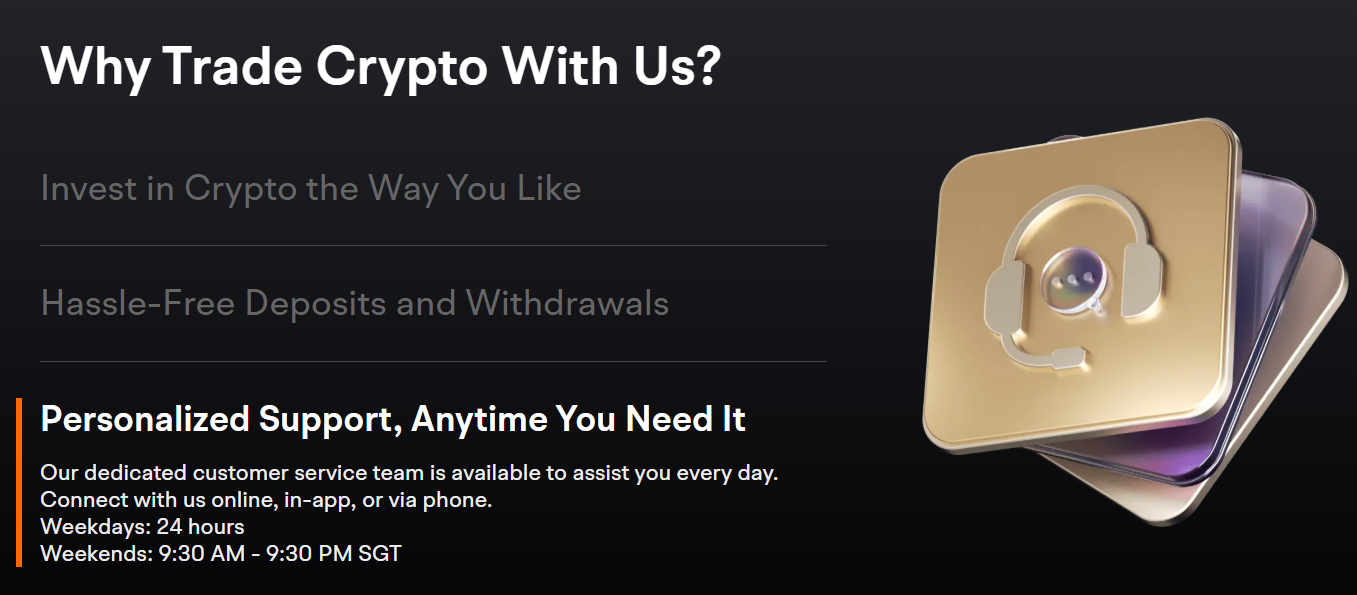
- Support and resources: Good customer service (e.g., 24/5 live chat or local support teams) and educational content help resolve issues fast.
>> Cryptocurrencies, crypto ETFs, stocks, futures—trade them all in moomoo!
Read Also: How to Choose the Right Crypto Trading Platforms
Choosing the Right Crypto Platform: Moomoo vs. Coinbase vs. Coinhako
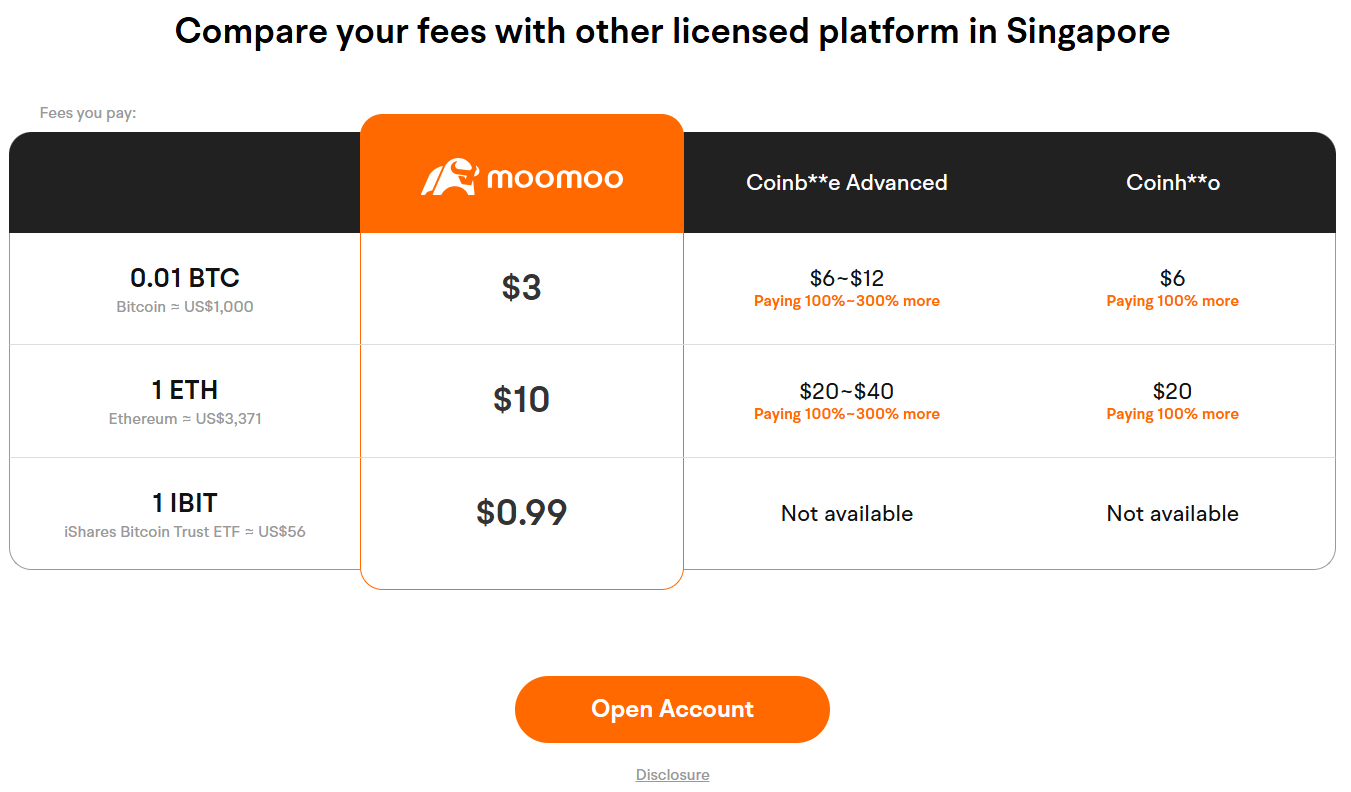
Each platform boasts unique features, fee structures, and security measures, catering to different types of investors. Compared to Coinbase and Coinhako, Moomoo SG offers competitive trading fees, multi-asset investment capabilities across crypto, stocks, funds, and bonds, as well as fee-free SGD/USD fiat transactions. Key differences include: (Source: Moomoo vs. Coinbase vs. Coinhako)
1. Trading Fees & Promotions
Moomoo SG
Crypto spot trading: 0.39% standard / 0.3% promotional rate.
Coinbase
Fiat-to-crypto (BTC, ETH, etc.): ~3-5% conversion fees.
Coinhako
Spot trading: 0.6% fee (additional charges for certain payment methods).
2. Multi-Asset Investment Capability
Moomoo SG
All-in-one platform: Trade crypto, global stocks, funds, bonds, and more in a single app.
Coinbase
Crypto-only: Limited to cryptocurrency trading.
Coinhako
Crypto-only: Limited to cryptocurrency trading.
3. Fiat Deposits & Withdrawals
Moomoo SG
SGD: Instant deposit (DDA, FAST, PayNow, Wise); free deposits/withdrawals.
USD: Bank transfer, Wise transfer; no fees (receiving bank charges may apply).
Coinbase
SGD: Bank transfer (FAST), PayNow.
USD: SWIFT international transfer (3-4 business days, wire fees apply).
Coinhako
SGD: Bank transfer (FAST), PayNow, GrabPay; free deposits.
Read More: How to Buy Crypto in Singapore?
The Future Outlook for Crypto Exchanges in Singapore
Looking ahead, the future landscape of crypto exchanges in Singapore is poised for a dynamic evolution shaped by a blend of regulatory clarity, technological innovation, and market maturation. Technologically, we can anticipate exchanges to embrace cutting-edge solutions like advanced blockchain analytics to offer a wider range of innovative financial products. As the crypto market matures, investor education will also gain greater prominence, with exchanges investing more resources in educational initiatives to empower users with the knowledge needed to make informed investment decisions, thereby contributing to a more stable and sustainable crypto ecosystem in Singapore.
Read More: Crypto vs. Gold: How to Invest?
5 Tips to Reduce Risks When Buying Cryptocurrencies in Singapore
1. Stick to MAS-Regulated Exchanges
Choose centralized exchanges (CEXs) licensed by the Monetary Authority of Singapore (MAS). These platforms comply with KYC/AML regulations, offering built-in fraud prevention, dispute resolution, and stronger security features—unlike unregulated alternatives.
2. Beware of Unregulated P2P Trading
While P2P trading isn't illegal, it lacks consumer protection and carries higher fraud risks. Banks may flag P2P crypto transactions as suspicious, so prioritize regulated platforms for safer peer-to-peer transactions.
3. Think Twice About Decentralized Exchanges (DEXs)
DEXs operate outside MAS's licensing framework, meaning you'll manage assets in self-custody with zero protection if funds are lost. Their lack of KYC also increases the risk of interacting with illicit funds—use them only if you fully understand the risks.
4. Prioritize Asset Security
- Long-term storage: Use hardware wallets to protect assets from online hacks.
- Account safeguards: Enable two-factor authentication (2FA) and set up withdrawal whitelists to prevent unauthorized transactions.
- Phishing prevention: Always verify website URLs and avoid clicking suspicious links before logging into accounts.
5. Choose Safety Over Convenience
Opt for MAS-regulated CEXs over DEXs or unregulated platforms. Their compliance with local laws and security measures (e.g., fraud detection, customer support) provide a safer foundation for crypto trading in Singapore.
Read More: 10 Effective Crypto Trading Strategies for Singapore Investors
Risks of Crypto Trading in Singapore
Extreme Market Volatility
Prices (e.g., Bitcoin) can swing 10%+ daily due to sentiment or news.
Small tokens prone to manipulation (pump-and-dump schemes).
Security Threats
Exchanges/wallets face hacks (e.g., Hodlnaut bankruptcy in 2022).
Phishing, fake apps, and private key loss risk fund theft.
Technical Risks
Mishandling private keys causes permanent fund loss.
DeFi smart contracts may have exploitable vulnerabilities.
Emotional Trading Dangers
FOMO or panic selling amplifies losses; leverage risks margin calls.
Read More: Risk Management Strategies in Crypto Trading for Singapore Investors
FAQs on Crypto Exchanges in Singapore
How many crypto exchanges are there in Singapore?
As of June 24, the Monetary Authority of Singapore (MAS) has issued licenses to 33 major payment institutions for providing Digital Payment Token (DPT) services. (Source: MAS Website)
Which Crypto Wallet is Allowed in Singapore?
There are two primary categories of crypto wallets: hot wallets and cold wallets.
Hot Wallets
Hot wallets are essentially online cryptocurrency wallets connected to the internet. They allow quick access to funds for trading or daily transactions, making them convenient for regular use. Examples include mobile apps or web - based wallets linked to exchanges.
Cold Wallets
Cold wallets, conversely, are offline wallets not connected to the internet. This offline nature provides enhanced security, particularly for storing large crypto holdings. Hardware wallets (like Ledger or Trezor) and paper wallets (physical documents with private keys) are common cold wallet types, ideal for long - term asset storage to minimize hacking risks.
Trade crypto on Moomoo SG without a crypto wallet—just one universal account lets you invest in global assets, including crypto.
Read More: Crypto Mining in Singapore: How it Affects Crypto Price
Is Cryptocurrency a Good Investment for You?
At its heart, cryptocurrency is an asset class with high risks and potentially high rewards. Different from stocks or bonds, crypto assets aren't supported by governments or central banks. Their value depends completely on market demand, supply, and how much they're used.
Bitcoin, the world's biggest cryptocurrency, is well - known for having a limit of 21 million coins. This scarcity, together with global interest, causes its price to be volatile. Actually, Bitcoin lost almost 65% of its value in 2022, which shows how much prices can change even in one year.
For investors in Singapore, the Monetary Authority of Singapore (MAS) doesn't consider cryptocurrencies as legal tender. Although exchanges licensed by MAS offer safer ways to trade, investors aren't protected by Singapore's deposit insurance scheme. That means if you lose funds because of fraud or hacks, you usually can't get them back.
So, is crypto suitable for you? Ask yourself these three questions:
Do you completely understand the risks of extreme price changes?
Can you afford to lose the money you invest without harming your financial stability?
Have you already created a diversified core portfolio with traditional investments such as stocks, bonds, or cash?
If you answer "yes" to these questions, putting a small part (like 1 - 5%) of your portfolio into cryptocurrencies might be reasonable, especially if you're investing for the long term and can handle short - term price fluctuations. But if you're saving for short-term goals or have a low tolerance for risk, crypto may not be the right choice for you.
In the end, crypto investing isn't suitable for everyone, and it should never be done at the expense of your emergency funds, retirement plans, or peace of mind.
What is Spot Trading and Derivatives Trading?
Spot trading involves the immediate purchase or sale of an asset at the current market price, with settlement typically occurring either right away or within a short period, often two business days (known as T+2). It's a straightforward way of trading various assets such as foreign currencies, commodities like gold or oil, and financial instruments.
Derivatives trading, on the other hand, deals with contracts whose value is derived from an underlying asset, such as stocks, bonds, commodities, or market indices. There are several types of derivatives. Futures contracts oblige the buyer to purchase and the seller to sell the underlying asset at a pre-determined price on a future date.
Is Moomoo SG Legal in Singapore?
Yes, Moomoo SG is legally licensed and regulated by the Monetary Authority of Singapore (MAS), holding an MPI License (No. PS20200617). As the leading trading app in Singapore, it ensures secure account opening processes via Singpass, providing users with a compliant and trustworthy platform for financial services.
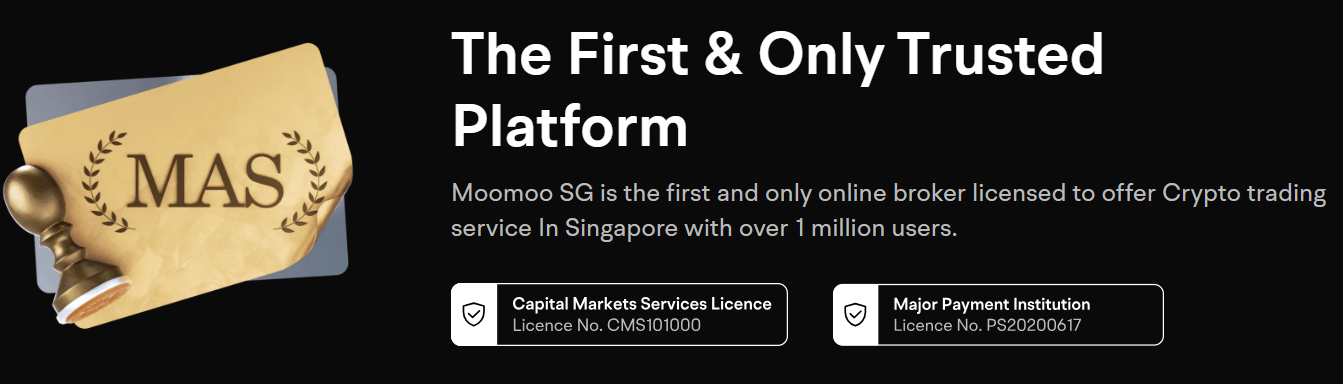
Why Trust Moomoo SG in Singapore?
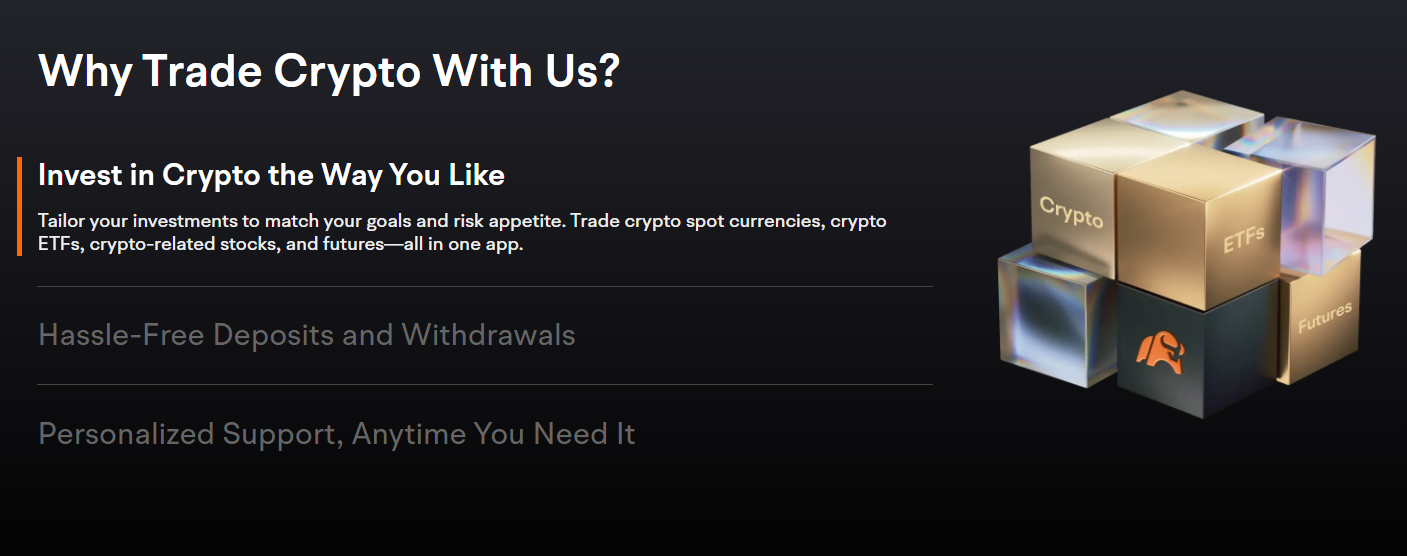
Various Crypto Investment Options: Tailor your investments to suit your goals and risk appetite. Trade a diverse range of crypto related assets, including spot cryptocurrencies, crypto ETFs, crypto-related stocks, and futures. No need to switch between multiple platforms; everything you need for crypto investing is at your fingertips.
Effortless Deposits and Withdrawals: Say goodbye to the hassle of complex wallet setups. At Moomoo SG, we offer fast and seamless SGD or USD transfers to and from local banks. Keep more of your hard-earned money and enjoy a smooth, fee-free experience when moving funds in and out of your account.
Dedicated, Round-the-Clock Support: Our customer service team is committed to providing you with personalized assistance whenever you need it. Connect with us online, through the app, or via phone.
Weekdays: 24-hour availability ensures that help is always just a call or click away, no matter the time.
Weekends: From 9:30 AM to 9:30 PM SGT, we're here to answer your questions and address any concerns. With Moomoo SG, you'll never feel alone on your investment journey.
Read More: Benefits for Trading Crypto with Moomoo
Conclusion: Choosing the Right Singapore Crypto Exchange

In Singapore's evolving crypto ecosystem of 2025, the best exchanges stand at the intersection of regulatory rigor, technological innovation, and user-centric design. MAS-licensed platforms like Moomoo SG have set the standard by integrating secure fund management, transparent fee models, and diverse trading options—all while adhering to the strictest AML/CFT standards. As the market continues to mature, investors must prioritize compliance and security over convenience. Singapore's regulated exchanges offer a pathway to engage with cryptocurrency responsibly, ensuring that your investment journey is both informed and safeguarded in this dynamic financial frontier.
This presentation is for informational and educational use only and is not a recommendation or endorsement of any particular investment or investment strategy. Investment information provided in this content is general in nature, strictly for illustrative purposes, and may not be appropriate for all investors. Read more