How to Invest in Crypto in Malaysia
The world of cryptocurrency is constantly changing, and major events can have a big impact on investment opportunities. The Bitcoin 2025 conference is set to happen in Las Vegas from May 27 to 29. It will bring together big names in tech, financial leaders, policymakers, and crypto trailblazers. This isn't just about figuring out what Bitcoin's future will look like. It might also show us where cryptocurrency regulations are headed, both in the US market and around the world.

If you're in Malaysia and thinking about investing in crypto, keeping an eye on events like this and understanding what they mean is really important for making smart investment choices. This article serves as a complete guide, exploring aspects like crypto legality in Malaysia, investment options such as trading, stocks, and ETFs, and providing insights to navigate this dynamic space.
What is Cryptocurrency?
Cryptocurrency is a digital or virtual form of currency that utilizes cryptography for security, making it nearly impossible to counterfeit or double-spend. Unlike traditional fiat currencies issued by governments, such as the Malaysian Ringgit (MYR), cryptocurrencies operate on decentralized networks based on blockchain technology.
At its core, cryptocurrency serves as a medium of exchange, enabling users to conduct transactions without the need for intermediaries like banks. This decentralized nature eliminates many of the fees and delays associated with traditional financial systems. Additionally, cryptocurrencies offer the potential for high returns on investment, attracting a growing number of investors worldwide. However, it's important to note that the cryptocurrency market is highly volatile and can be subject to significant price fluctuations.
Types of Cryptocurrency
The cryptocurrency market is incredibly diverse, with thousands of different coins and tokens available for investment. Here are some of the most common types of cryptocurrencies:
Bitcoin (BTC): $比特币 (BTC.CC)$ , created in 2009 by the anonymous entity Satoshi Nakamoto, is the first and most widely recognized cryptocurrency. Often referred to as "digital gold," it serves as a store of value and inflation hedge, with its limited supply of 21 million coins enhancing its scarcity and value.
Ethereum (ETH): $以太坊 (ETH.CC)$ is a decentralized blockchain platform that supports smart contracts and decentralized applications (DApps). Unlike Bitcoin, its native token Ether (ETH) facilitates transaction fees and network services, making it a flexible hub for innovation favored by developers and investors.
Ripple (XRP): Ripple $瑞波币 (XRP.CC)$ is a real-time payment network designed for fast, low-cost cross-border transactions. Its cryptocurrency XRP enables efficient fund transfers between financial institutions, offering an alternative to traditional banking systems and securing partnerships with major global banks.
Cardano (ADA): Cardano $艾达币 (ADA.CC)$ is a blockchain platform focused on secure, sustainable infrastructure for decentralized applications and smart contracts. Its token ADA allows users to participate in network governance and earn rewards through staking, while its research-driven development has earned it the label of a "third-generation" blockchain.
Are Cryptocurrencies Legal in Malaysia?
No, cryptocurrencies are not recognized as legal tender in Malaysia. Under the Central Bank of Malaysia Act, the ringgit is the country's sole legal tender, which excludes cryptocurrencies from having that status.
However, cryptocurrencies are regulated under the Capital Markets and Services Order, giving them a clear legal standing within Malaysia's financial regulatory system. In short, while cryptocurrencies aren't legal tender, trading them is legal in Malaysia. There are no laws prohibiting the exchange of services or assets for cryptocurrencies in the country.
Which Crypto to Buy in Malaysia?
As of now, Malaysia's Securities Commission has approved 19 cryptocurrencies for legal trading on licensed exchanges in the country. Here's the list of approved options:
Bitcoin (BTC) | Ethereum (ETH) | Avalanche (AVAX) | Polygon (MATIC) | Maker (MKR) |
Bitcoin Cash (BCH) | Ripple (XRP) | Litecoin (LTC) | Solana (SOL) | Synthetix (SNX) |
Chainlink (LINK) | Uniswap (UNI) | Cardano (ADA) | Polkadot (DOT) | Stellar (XLM) |
Cosmos (ATOM) | Worldcoin (WLD) | Aave (AAVE) | Curve Dao (CRV) |
Are Shariah-compliant Crypto Alternatives Accessible?
For Muslim investors in Malaysia, aligning cryptocurrency investments with Islamic finance principles is key. Shariah-compliant crypto here must meet certain criteria. Firstly, it must steer clear of riba, which means no involvement in interest-based lending or borrowing activities. Interest is prohibited in Islamic finance, so any crypto investment should not entail such practices.
Secondly, transparency is essential. The underlying crypto assets need to be backed by ethical use cases. This ensures that the investment doesn't involve elements of speculation or gambling, both of which go against Islamic teachings.
In 2024, Halogen Capital made a significant move by launching Malaysia's first Shariah-compliant crypto funds. These funds operate under the watchful eyes of well-established Shariah advisors, including Tawafuq Consultancy and Amanie Advisors. Among the available funds are the Halogen Shariah Ethereum Fund (HSETHF) and the Halogen Shariah Bitcoin Fund (HSBTCF), providing Muslim investors with viable options to enter the crypto market while staying true to their faith.
How to Invest in Crypto in Malaysia
Investing in cryptocurrency in Malaysia requires navigating a regulatory landscape that balances innovation with investor protection. While the market offers opportunities for high returns, it also carries risks due to volatility and evolving regulations. Below is a structured guide to three primary investment avenues: crypto trading, crypto stocks, and crypto ETFs.
Crypto Trading
Crypto trading involves buying and selling cryptocurrencies directly on licensed exchanges, making it the most direct way to invest in digital assets.
Steps to Start Crypto Trading in Malaysia
Choose a Licensed Exchange: Use platforms registered with the Securities Commission Malaysia (SC)
Complete Account Setup
Deposit Funds and Trade
Key Considerations
Fees: Exchanges charge trading fees (0.1%–1%) and withdrawal fees (network fees for crypto).
Storage: Leave funds on exchanges for active trading, but use hardware wallets for long-term storage.
Regulatory Compliance: Ensure the platform adheres to SC and BNM guidelines to avoid legal risks.
Crypto Stocks
Crypto stocks refer to shares of publicly traded companies with exposure to blockchain, mining, or crypto services. This approach allows investors to gain indirect exposure to the crypto market without direct ownership of digital assets.
How to Invest in Crypto-related Stocks in Malaysia?
1. Choose a platform: You can buy stocks in Malaysia through licensed brokerage platforms (e.g. Moomoo MY is licensed by SC)
2. Open a trading account: In moomoo, you can open an account in just 3 steps!
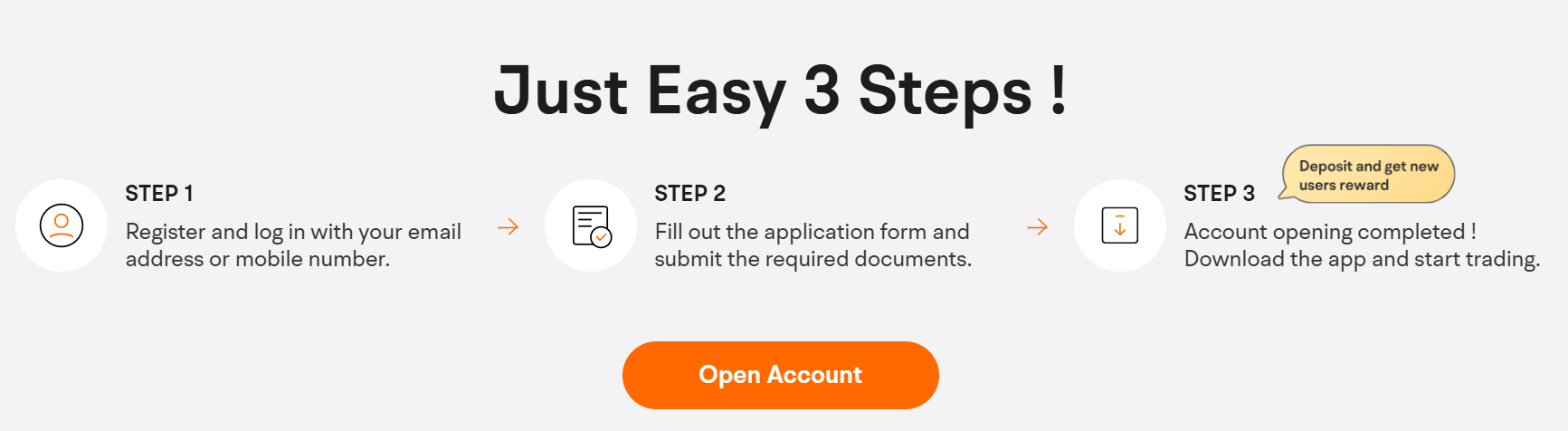
3. Select a stock and start trading: Choose a stock via your brokerage's platform, enter its ticker symbol, specify share quantity and order type (e.g., market/limit), review details, and confirm.
Crypto ETFs
Crypto Exchange-Traded Funds (ETFs) are investment vehicles that track the performance of a basket of cryptocurrencies or crypto-related assets.
Why Invest in Crypto ETFs in Malaysia?
Investing in crypto ETFs in Malaysia offers several key advantages, making them an appealing option for both new and experienced investors:
Lower Barrier of Entry
Crypto ETFs provide a straightforward pathway for traditional investors to access the cryptocurrency market without navigating complex blockchain platforms or digital wallets. This simplicity eliminates the need to learn intricate technical processes, making crypto exposure more accessible to a wider audience.
Fewer Security Concerns
Unlike direct cryptocurrency ownership, which requires managing private keys and digital wallets (posing risks like theft or loss), crypto ETFs are held and managed by regulated financial institutions. This reduces the likelihood of account fraud, security breaches, or wallet-related theft, offering greater peace of mind for investors.
Well-Regulated
Crypto ETFs fall under the strict oversight of Securities Commission Malaysia (SC), ensuring compliance with robust regulatory standards. In contrast, some crypto exchanges may operate with less stringent scrutiny, making ETFs a more transparent and trustworthy option for risk-averse investors.
Lower Trading Fees
Trading crypto ETFs often incurs significantly lower fees compared to buying cryptocurrencies directly. For example, purchasing Bitcoin through an exchange may involve high transaction costs, whereas ETFs typically offer competitive pricing and streamlined fee structures, enhancing cost-effectiveness for regular traders.
Why Choose Moomoo MY for Crypto ETFs
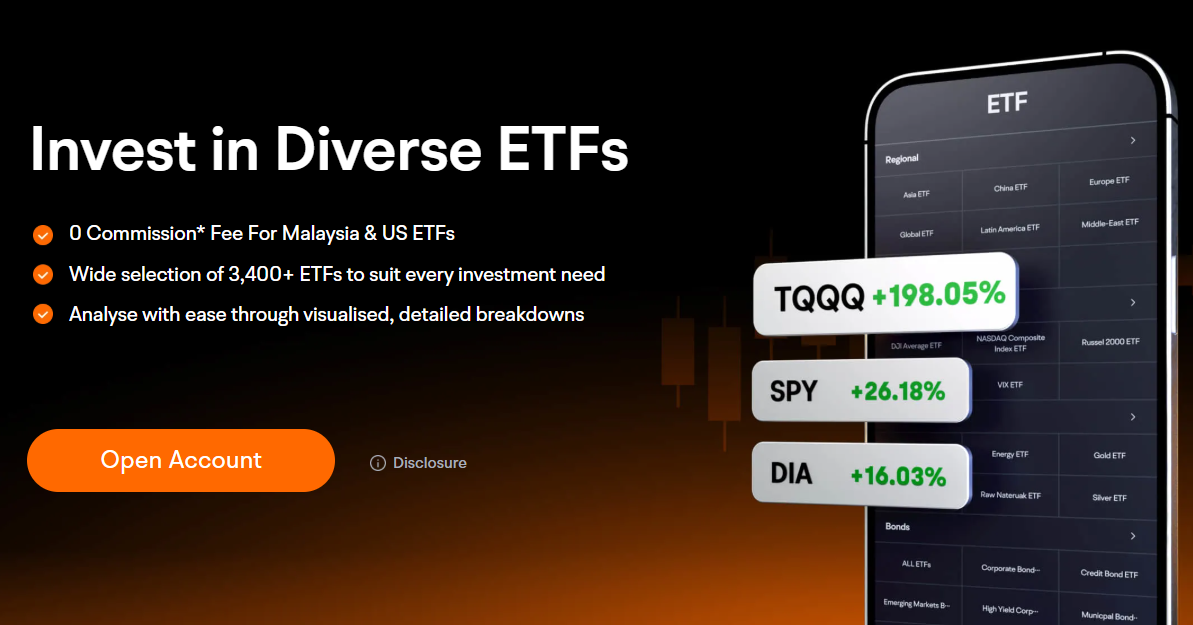
0 Commission* Trading: When investing in Crypto ETFs on Moomoo MY, you'll enjoy the significant benefit of zero-commission trading. Traditional platforms often deduct a portion of your earnings in the form of commissions, but Moomoo MY eliminates this cost.
Over 3,400 ETFs to Choose From: Moomoo MY offers an expansive selection of over 3,400 ETFs, providing unparalleled opportunities in the Crypto ETF space. This wide range allows you to explore different market segments, from well-established crypto-related funds that track major digital currencies to niche and specialized ETFs.
User-Friendly Interface and Powerful Tools: Navigating the world of Crypto ETFs is made simple with Moomoo MY's intuitive and user-friendly interface. Even if you're new to investing, you'll find it easy to search for, analyze, and trade Crypto ETFs.
Top 5 Crypto ETFs & Stocks in Malaysia to Watch
In the vibrant Malaysian investment landscape, the realm of crypto-related ETFs and stocks has been attracting significant attention. Here are the top trading crypto ETFs and stocks from Moomoo's list, as of May 23, 2025. (Source: Moomoo Crypto Promotion)
MicroStrategy Incorporated (MSTR.US)
MicroStrategy Incorporated (MSTR.US) is a leading business intelligence, analytics, and mobility software company. However, it has gained significant prominence in the cryptocurrency space for its bold strategy of accumulating Bitcoin as its primary reserve asset. As of now, MicroStrategy holds one of the largest corporate Bitcoin treasuries globally, making its stock highly correlated with Bitcoin's price movements. This unique approach has transformed MSTR.US into a key investment vehicle for those looking to gain exposure to Bitcoin through traditional stock markets.
MARA Holdings, Inc. (MARA.US)
MARA Holdings, Inc. (MARA.US) is a major player in the Bitcoin mining industry. Headquartered in the United States, the company focuses on building and operating large-scale, energy-efficient Bitcoin mining facilities. Marathon utilizes advanced mining rigs and constantly aims to increase its hash rate to secure a larger portion of Bitcoin mining rewards. As Bitcoin's popularity and mining competition grow, MARA.US represents an investment opportunity in the infrastructure and operations behind the cryptocurrency's creation.
iShares Bitcoin Trust (IBIT.US)
iShares Bitcoin Trust (IBIT.US) is a prominent exchange-traded fund (ETF) that offers investors exposure to the price movements of Bitcoin. As a regulated investment vehicle, IBIT allows market participants to gain indirect access to the cryptocurrency without the complexities of direct Bitcoin ownership, such as private key management and cryptocurrency wallet security. By tracking Bitcoin's performance, this trust serves as a convenient option for both institutional and retail investors looking to diversify their portfolios with a digital asset, while operating within the established frameworks of traditional financial markets.
Coinbase Global, Inc. (COIN.US)
Coinbase Global (COIN.US) is one of the most well-known cryptocurrency exchanges globally. As a publicly-traded company, COIN.US provides a platform for users to buy, sell, store, and trade a wide variety of cryptocurrencies, including Bitcoin, Ethereum, and many others. Beyond its core exchange services, Coinbase also offers institutional trading solutions, custody services, and educational resources. Its role as a gateway between traditional finance and the cryptocurrency world has made it a significant stock in the crypto-financial ecosystem.
Hut 8 Corp. (HUT.US)
Hut 8 Corp. (HUT.US) functions as a Bitcoin mining enterprise, specializing in the extraction of cryptocurrencies. The company offers digital asset mining services, hosting solutions, and managed infrastructure operations to support its mining activities. Established on January 27, 2023, Hut 8 is headquartered in Miami, Florida, positioning itself as a key player in the North American crypto mining landscape with a focus on operational efficiency and scalable infrastructure.
List of Cryptocurrencies that are Approved in Malaysia in 2025
The table below showcases 19 cryptocurrencies approved for use in Malaysia, detailing their specific use cases and core features. By outlining their applications and distinct characteristics, the table underscores the diversity and growing significance of Malaysia's approved cryptocurrency ecosystem within the broader crypto landscape in Malaysia. (Source: SC Website - Crypto Digital Assets)
Cryptocurrency | Purpose | Key Features | Use Cases |
Allows users to lend and borrow crypto without middlemen | Lending based on smart contracts, flash loans, variable and fixed interest rates, supports over 30 digital assets, Tokens (interest-bearing tokens) | Decentralized lending/borrowing, flash loans for trading, yield farming, providing liquidity | |
Aims for efficient stable coin trading with low slippage and fees | Automated market maker for similar assets, low transaction fees, liquidity pools, governance token (CRV), yield farming | Stablecoin and ERC-20 token trading, providing liquidity, yield farming, governance involvement | |
A decentralized platform for governing Dai stablecoin and Maker Protocol | Governance token (MKR), community voting on protocol settings, CDPs for creating Dai | Creating and managing Dai stablecoin, decentralized governance, collateral-backed lending | |
Used for creating and trading synthetic assets that mirror real-world assets | Pooled collateral model, synthetic assets (Synths), infinite liquidity, integrated with layer 2 solutions | Trading synthetic assets, derivatives market, getting exposure to real-world assets without direct ownership, DeFi applications | |
A decentralized payment network for quick, low-cost cross-border transactions and financial inclusion | Fast transactions (2-5 seconds), very low costs, built-in decentralized exchange, asset tokenization | Cross-border payments, remittances, asset tokenization, micropayments, financial inclusion, stablecoin issuance | |
Serves as a decentralized digital currency for peer-to-peer transactions without a central authority | Decentralized, secured by blockchain, limited supply of 21 million coins, unchangeable transactions | Peer-to-peer payments, store of value, remittances, investment asset | |
Helps run and monetize smart contracts and decentralized apps (DApps) | Decentralized, has smart contracts, scalable, can host DApps | Decentralized finance (DeFi), non-fungible tokens (NFTs), supply chain management, gaming, healthcare | |
A smart contract platform to boost blockchain scalability, interoperability, and usability | Unique consensus method, high-speed transactions (thousands per second), low fees, compatible with Ethereum tools, supports custom blockchain creation | Decentralized finance (DeFi), creating custom blockchains, enterprise-level financial solutions, decentralized apps (dApps) | |
Enhances Ethereum's scalability and usability as a Layer 2 solution, cutting fees and speeding up transactions | High scalability with multi-chain setup, works with Ethereum, low costs, strong security | Decentralized finance (DeFi), NFT trading, decentralized apps (dApps), scaling for Ethereum-based projects | |
Functions as a transaction-focused cryptocurrency like an e-cash system, solving Bitcoin's scalability problems | Larger block sizes (up to 32 MB) for more transactions, faster speeds, lower fees, more scalable than Bitcoin | Peer-to-peer payments, remittances, small transactions | |
Facilitates fast, low-cost international money transfers and currency exchanges, acts as a bridge currency for liquidity management | High-speed transactions (3-5 seconds), very low fees, scalable (up to 1,500 transactions per second), energy-efficient | Cross-border payments, remittances, micropayments, financial sector liquidity management | |
Serves as a medium of exchange with faster and cheaper transactions than Bitcoin | Faster transactions (2.5-minute block time), low fees, uses Scrypt hashing algorithm, limited supply of 84 million coins | Peer-to-peer payments, microtransactions, remittances, e-commerce | |
Achieves high-speed transactions while keeping decentralization, suitable for decentralized apps, smart contracts, and digital payments | High scalability, low costs, fast processing, unique PoH + PoS consensus for security and decentralization | Decentralized finance (DeFi), non-fungible tokens (NFTs), gaming, Web3 apps | |
Supplies reliable data to blockchain smart contracts for better performance | Decentralized, scalable, interoperable, secure links between smart contracts and off-chain data, good data quality | Decentralized finance (DeFi), supply chain, gaming, stablecoins, yield farming | |
Works as a decentralized exchange for ERC-20 tokens and a governance token for the Uniswap platform | Decentralized, automated market making, liquidity pools, allows token listing without permission | Governance, token swaps, providing liquidity, enabling decentralized financial services | |
Offers a secure, scalable, and sustainable blockchain for decentralized apps and smart contracts | Layered structure, energy-efficient Ouroboros PoS consensus, scalable, secure, sustainable | Decentralized finance, supply chain management, digital identity, asset tokenization, peer-to-peer transactions | |
Enables different blockchain networks to communicate and share data smoothly | Scalable with parachains, secure via nominated PoS consensus, allows cross-chain communication without intermediaries | Governance, staking, accessing blockspace | |
Creates an 'Internet of Blockchains' by enabling interoperability and scalability among separate blockchains | Tendermint consensus for scalability and security, Cosmos SDK for modular blockchain building, IBC protocol for smooth cross-blockchain interaction | Decentralized apps, blockchain interoperability, governance, staking | |
Worldcoin (WLD) | Builds a global financial and identity network using biometric tech for financial inclusion | Uses iris-scanning for unique digital identities (World ID), runs on Ethereum Mainnet with Optimism Layer 2 | Verifying digital identity, fighting bots and fake accounts on social media, enabling secure voting, facilitating universal basic income |
FAQs on Crypto Trading in Malaysia
What is crypto mining
Crypto mining is the process of validating and recording transactions on a blockchain network. Miners use powerful computers to solve complex mathematical problems, and in return, they are rewarded with newly minted cryptocurrency.
What is staking in crypto
Staking in crypto is the process of locking up a certain amount of cryptocurrency in a wallet to support the operations of a blockchain network. In return for staking their coins, users can earn rewards in the form of additional cryptocurrency.
Why is the crypto market down
The crypto market can be affected by various factors such as regulatory changes, negative news and sentiment, technological issues, and broader economic conditions. For example, increased regulatory scrutiny can make investors cautious, and economic downturns may lead to a decrease in overall investment in risky assets like cryptocurrencies.
How to calculate crypto taxes
The calculation of crypto taxes usually depends on the type of transactions. For example, when you sell or trade cryptocurrency, you need to calculate the capital gain or loss by subtracting the cost basis from the selling price. If you receive cryptocurrency as income, it is usually taxed as ordinary income. Different countries have different tax regulations, so it's important to consult a tax professional.
How to collect free crypto
Some ways to collect free crypto include participating in airdrops, where projects distribute free tokens to users; using crypto-related apps that offer rewards for certain activities like signing up, referring friends, or completing tasks; and staking some cryptocurrencies that offer small rewards for holding and supporting the network.
How to diversify a crypto portfolio
To diversify a crypto portfolio, you can invest in different types of cryptocurrencies, such as major coins like Bitcoin and Ethereum, as well as smaller-cap altcoins with different use cases and technologies. You can also consider investing in stablecoins to reduce volatility. Additionally, spreading your investment across different blockchain projects and sectors can help mitigate risks.
Conclusion
In conclusion, investing in cryptocurrency in Malaysia is a journey filled with opportunities and challenges. While the potential for high returns exists, it's crucial to approach it with knowledge, caution, and a long-term perspective. By understanding the regulatory environment, diversifying your portfolio, and staying informed about market trends and technological advancements, you can make more informed investment decisions. Remember, the crypto market is volatile and ever-evolving. Whether you choose to invest in approved cryptocurrencies, crypto-related stocks, or ETFs, continuous learning and adaptability will be your allies. As you embark on or continue your crypto investment journey in Malaysia, may your endeavors be both rewarding and prosperous.
This presentation is for informational and educational use only and is not a recommendation or endorsement of any particular investment or investment strategy. Investment information provided in this content is general in nature, strictly for illustrative purposes, and may not be appropriate for all investors. Read more