Futures Trading in Malaysia: A Complete Guide
Key Takeaways
- Futures trading offers leverage for amplified returns, hedges against price risks, and has profit potential in both rising and falling markets.
- Trade Futures Easily: Open an account for global investments > Cash transfers > Trade on moomoo
- Popular Futures Trading Strategies: Hedging, Speculating, Swing Trading, Trend Following etc.
>> Trade Futures with low fees on Moomoo MY
- Futures trading offers leverage for amplified returns, hedges against price risks, and has profit potential in both rising and falling markets.
- Trade Futures Easily: Open an account for global investments > Cash transfers > Trade on moomoo
- Popular Futures Trading Strategies: Hedging, Speculating, Swing Trading, Trend Following etc.
>> Trade Futures with low fees on Moomoo MY
What is Futures Trading? Malaysia Investor Guide
Futures are agreements to buy or sell a specific underlying asset at a future date. The underlying asset can be commodities, financial instruments, or indices. A futures contract can be based on a commodity, such as oil or gold, or a security, such as a stock or bond. In futures trading, once the contract is established, the buyer is obligated to purchase the asset, and the seller is required to sell it for a predetermined price when the contract expires—regardless of the current market price at that time.
Futures trading often refers to futures contracts where the underlying assets are securities from the stock market. These contracts are tied to the expected future value of either individual company stocks or major stock market indexes, such as the S&P 500, Dow Jones Industrial Average, or Nasdaq.
Why Choose Futures?
Futures trading offers unique advantages for traders and investors across various financial goals. To fully realize these benefits, it is essential to have the right strategies and tools in place, as they can significantly enhance your success and confidence in futures trading. Here are the core benefits, broken down into key points:
Leverage for Amplified Returns
Futures contracts require only a small percentage of the contract's total value as margin (typically 5–15%), allowing traders to control large positions with limited capital. This leverage can magnify profits if the market moves in their favor, making it efficient for capital utilization.
Hedging Against Price Risks
Futures are widely used for hedging to protect against adverse price movements. For example:
Farmers can lock in crop prices before the harvest to avoid losses from falling market prices.
Investors holding stocks can hedge against market downturns using index futures.
Profit Potential in Both Rising and Falling Markets
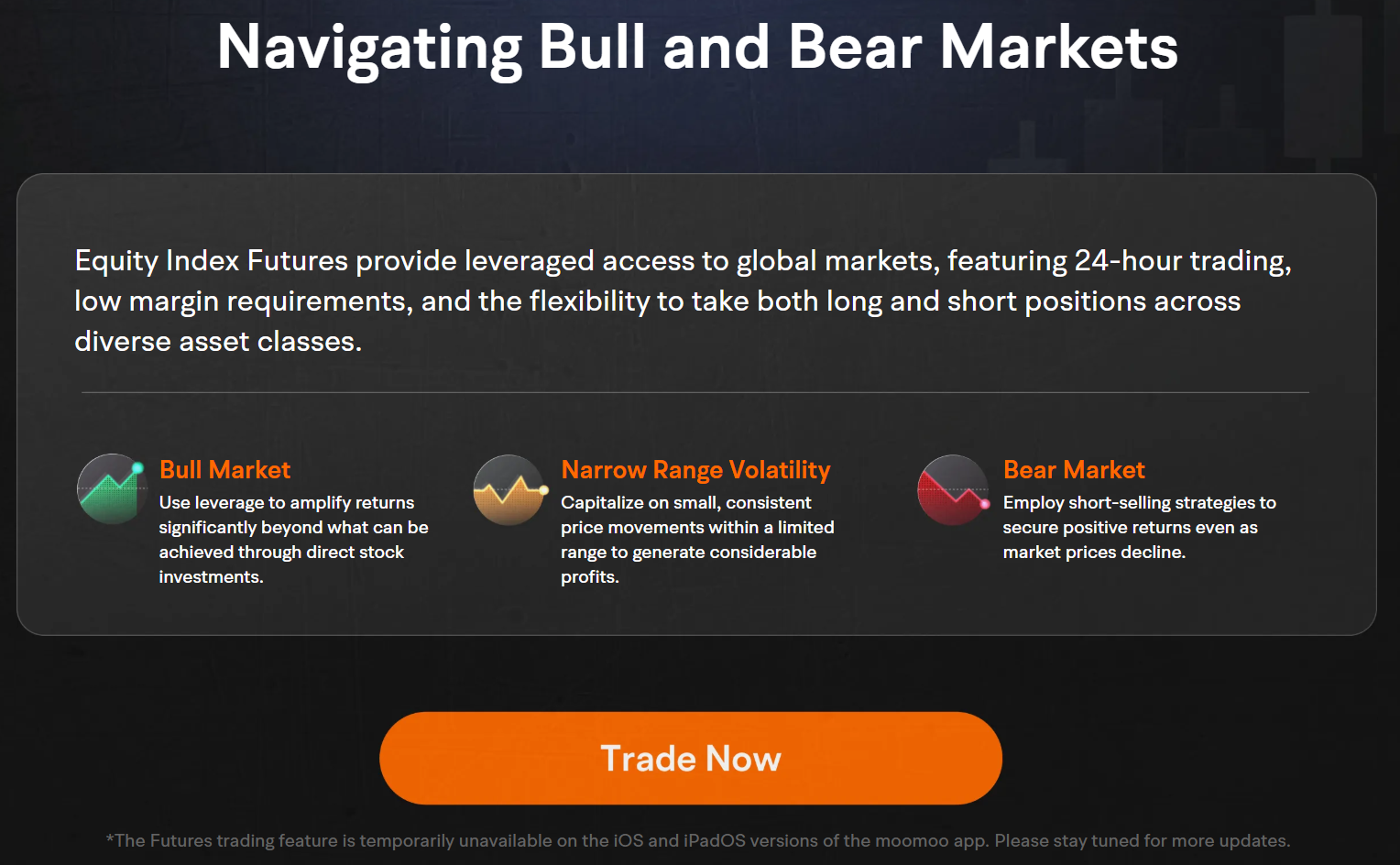
Unlike traditional stock trading, futures allow traders to profit from short selling (betting on price declines). This flexibility means opportunities exist regardless of whether the market is bullish or bearish.
How to Trade Futures in Malaysia?
Trading futures in Malaysia offers opportunities to hedge risks or speculate on price movements of various assets, from commodities to financial instruments. Here's a straightforward guide to get started:
Step 1: Learn the Basic Concepts of Futures Trading
Before venturing into futures trading, it is crucial to grasp the fundamental concepts that underpin this financial instrument.
Contract Size: The fixed quantity of the underlying asset per contract.
Expiry Date: When the contract must be settled (via physical delivery or cash).
Margin: A small percentage of the contract value required to open a position, acting as collateral.
>> Discover essential futures trading basics on Moomoo Learn, and join the 26M+ investor community in Moomoo to discuss together.
Step 2: Decide on a Trading Strategy
Picking a fitting trading strategy is key for steady success in futures trading. Your strategy must match your financial goals, risk tolerance, and trading style. Whether you focus on short-term scalping, swing trading, or trend following, ensure it aligns with how much risk you can handle and what you aim to achieve financially.
Step 3: Research Your Target by Using Tools
Thorough research is essential to make informed trading decisions. In futures trading, you need to research the underlying assets of the futures contracts you are interested in. Here are some tools and resources to help you with your research:
Fundamental Analysis Tools: Fundamental analysis involves evaluating the intrinsic value of an asset by examining economic, financial, and other qualitative and quantitative factors. For commodity futures, you would look at factors such as supply and demand reports, weather conditions, and geopolitical events that can affect the price of the commodity. For financial futures, such as stock index futures, you would analyze economic indicators like GDP growth, inflation rates, and interest rates, as well as corporate earnings reports.
Technical Analysis Tools: Technical analysis focuses on studying historical price and volume data to predict future price movements. Charting software is a key tool for technical analysis. You can use it to draw price charts, add technical indicators (for example, moving averages, relative strength index (RSI), and stochastic oscillator), and spot chart patterns (such as head and shoulders, triangles, and trends).
Moomoo provides a series of practical order features for futures trading, including price-tracking, quantity-filling, quick order modification and cancellation, and order-presetting.
Step 4: Select Your Contract and Expiration Month
Once you have done your research and decided on a trading strategy, the next step is to select the specific futures contract and expiration month. In Malaysia, futures contracts are traded on the Bursa Malaysia Derivatives, which offers a range of contracts, including crude palm oil futures, KLCI futures, and USD/MYR futures, among others.
When selecting a contract, you should consider factors such as liquidity, volatility, and the underlying asset's characteristics.
Step 5: Familiarize Yourself with How Money Works in Your Account
Understanding the financial aspects of your trading account is essential to managing your risk and tracking your performance. Here are some key concepts to familiarize yourself with:
Account Balance: Your account balance is the total amount of money in your trading account, including deposits, profits, and minus losses and fees. It is important to monitor your account balance regularly to ensure that you have enough funds to cover your margin requirements and potential losses.
Margin Requirements: As mentioned earlier, margin is the initial deposit required to open a futures position. In addition to the initial margin, there is also a maintenance margin. Maintenance margin is the minimum amount of equity that must be maintained in your account to keep the position open. If your account equity falls below the maintenance margin level, your broker will issue a margin call, requiring you to deposit additional funds to bring the equity back up to the initial margin level. If you fail to meet the margin call, your broker may close your position to limit their risk.
P&L (Profit and Loss): Profit and loss are the difference between the entry price and the exit price of your futures position. If the market moves in your favor, you will make a profit; if it moves against you, you will incur a loss. Moomoo provides P/L Curve tool for free to help traders better track and analyze their position performance.
Cash Transfers on the Moomoo APP
- Navigate to the Account section and tap the [More] tab in the top-right corner.
- Select [Cash Transfer].
- Follow the prompts to move USD from your Securities account to your Futures account.
>> Just click [Cash Transfer] once to transfer funds and optimize your trading experience on moomoo! Or click here to fund your account directly.
- Navigate to the Account section and tap the [More] tab in the top-right corner.
- Select [Cash Transfer].
- Follow the prompts to move USD from your Securities account to your Futures account.
>> Just click [Cash Transfer] once to transfer funds and optimize your trading experience on moomoo! Or click here to fund your account directly.
Step 6: Place Your Order
Research the futures contracts you want to trade (e.g., understand the underlying asset, market trends, and factors affecting prices). When ready:
Decide whether to go long (buy, expecting prices to rise) or short (sell, expecting prices to fall).
Enter the contract size and order type on the platform.
Ensure you maintain a sufficient margin to avoid forced liquidation of your position.
Opening an Account Easily
Navigate to the futures quote page and click [Trade] to get started.
Read through the Risk Disclosure Statement and then submit your application.
The review process for your application will take 1 to 3 business days.
Once your application is approved, you'll receive a notification – use it to activate your futures account.
How to trade futures on moomoo
You can find futures contracts by going to [Market] -> Futures, or you can directly search for them on the homepage to begin trading.
Navigate to the futures quote page and click [Trade] to get started.
Read through the Risk Disclosure Statement and then submit your application.
The review process for your application will take 1 to 3 business days.
Once your application is approved, you'll receive a notification – use it to activate your futures account.
How to trade futures on moomoo
You can find futures contracts by going to [Market] -> Futures, or you can directly search for them on the homepage to begin trading.
Step 7: Monitor Your Trade-Settle or Close Positions
Before expiry, you can close your position by taking the opposite trade (e.g., sell if you bought). If held until expiry, some contracts require physical delivery (e.g., agricultural commodities), while others are cash-settled (e.g., stock indices).
Popular Futures Trading Strategies to Consider
In Malaysia's investment market—where traders engage with assets ranging from crude palm oil to regional stock indices—adopting effective strategies is key to navigating price volatility and aligning with market goals. Below are four widely used approaches tailored to the opportunities and risks of futures trading in Malaysia:
Hedging
As a risk management tactic, hedging is utilized by traders to mitigate potential losses caused by adverse price shifts in an underlying asset. Futures trading involves taking an opposite position in a futures contract relative to the physical asset or existing portfolio.
For example, a farmer growing wheat might sell wheat futures to lock in a selling price, protecting against the risk of falling wheat prices at harvest time.
Similarly, an investor holding a stock portfolio could buy index futures to hedge against a market downturn.
Similarly, an investor holding a stock portfolio could buy index futures to hedge against a market downturn.
Speculating
Speculating in futures trading focuses on profiting from anticipated price movements by taking directional positions in futures contracts, without owning the underlying asset. Speculators analyze market trends, economic data, and other factors to predict whether prices will rise (going long) or fall (going short). For instance, a speculator who expects crude oil prices to increase due to supply shortages might buy crude oil futures, aiming to sell them later at a higher price.
Unlike hedgers, speculators accept higher risk in exchange for the potential of substantial returns. This strategy is common among active traders and financial institutions seeking to capitalize on short-term market inefficiencies or macroeconomic trends.
Swing Trading
Swing trading is a medium-term strategy that aims to capture "swings" in price movements from days to weeks, rather than minutes (day trading) or months (position trading). Swing traders in futures markets identify short-term trends or price reversals using technical analysis tools like moving averages, support and resistance levels, and momentum indicators.
Trend Following
Trend following is a strategy that aligns with the adage "the trend is your friend," focusing on profiting from sustained price movements in a particular direction—whether upward (bullish) or downward (bearish). Traders using this approach identify existing trends in futures markets through technical analysis, often using indicators like moving averages, trendlines, or the Average Directional Index (ADX) to confirm trend strength. Once a trend is identified, they enter positions in the direction of the trend: going long in a bullish trend or short in a bearish trend.
Risk Management for Trading Futures in Malaysia
Futures trading, with its inherent leverage and market volatility, demands rigorous risk management to protect capital and ensure sustainable success. Effective strategies mitigate exposure to unexpected price swings, leverage-related losses, and operational errors. Below are key principles and practices for managing risk in futures trading:
Set Clear Risk Tolerance and Position Sizing
Define your risk tolerance— the maximum loss you can accept per trade or over a period—before entering any position. A common rule is to risk no more than 1-2% of your total trading capital on a single trade.
Position sizing aligns with this: avoid overexposing capital to a single contract or market. Even with high-confidence trades, diversification across uncorrelated assets (e.g., commodities and financial futures) reduces the impact of a single market downturn.
Risk Management with Moomoo
To support your risk management, moomoo shows real-time risky asset data, so you can quickly see how capital is allocated to high-risk investments. It also provides visual risk updates with simple charts and indicators to clearly show your overall exposure.
To support your risk management, moomoo shows real-time risky asset data, so you can quickly see how capital is allocated to high-risk investments. It also provides visual risk updates with simple charts and indicators to clearly show your overall exposure.
Use Stop-Loss and Take-Profit Orders
Stop-loss orders automatically close a position when a predetermined loss threshold is reached, preventing catastrophic losses. For instance, if you buy a crude oil futures contract at $80/barrel, a stop-loss at $77 limits the downside to $3/barrel.
Take-profit orders lock in gains by closing positions when a target price is hit, avoiding the temptation to hold too long and risk reversals. Balancing stop-loss and take-profit levels (e.g., a 1:2 risk-reward ratio, where potential profit is twice the potential loss) enhances long-term profitability.
Explore Flexible Order Types on Moomoo
Moomoo MY supports Stop-Loss and Take-Profit Orders, along with Common, Conditional, and Prepaid Orders—all with DAY, GTC, and GTD options. Get the flexibility and control you need to trade with confidence.
Moomoo MY supports Stop-Loss and Take-Profit Orders, along with Common, Conditional, and Prepaid Orders—all with DAY, GTC, and GTD options. Get the flexibility and control you need to trade with confidence.
Manage Leverage Wisely
Leverage amplifies both gains and losses, making it a double-edged sword. Avoid maximum margin requirements; instead, use conservative leverage (e.g., 5:1 instead of 20:1) to buffer against volatility.
Monitor margin levels closely. Sudden price swings can trigger margin calls, requiring additional funds to maintain positions. Maintain an excess margin in your account to avoid forced liquidation during market turbulence.
Popular Futures You Can Trade in Malaysia
Category | Name | Code | Exchange | Settlement | Trading hours |
Equity Index | E-mini Nasdaq-100 Futures | NQ | CME | Cash | Sun-Fri 5:00 p.m. - 4:00 p.m. CT |
Equity Index | E-mini Dow ($5) Futures | YM | CBOT | Cash | Sun-Fri 5:00 p.m. - 4:00 p.m. CT |
Equity Index | E-mini S&P 500 Futures | ES | CME | Cash | Sun-Fri 5:00 p.m. - 4:00 p.m. CT |
Equity Index | Micro E-mini Nasdaq-100 Index Futures | MNQ | CME | Cash | Sun-Fri 5:00 p.m. - 4:00 p.m. CT |
Equity Index | Micro E-mini S&P 500 Index Futures | MES | CME | Cash | Sun-Fri 5:00 p.m. - 4:00 p.m. CT |
Equity Index | Micro E-mini Dow Jones Industrial Average Index Futures | MYM | CBOT | Cash | Sun-Fri 5:00 p.m. - 4:00 p.m. CT |
Commodity | USD Crude Palm Oil | FUPO | BMD | Cash | Mon-Fri 10:30 a.m. - 6:00 p.m. MYT |
Commodity | Bursa Malaysia DCE Soybean Oil | FSOY | BMD | Cash | Mon-Fri 10:30 a.m. - 6:00 p.m. MYT |
Commodity | SGX TSI Iron Ore CFR China (62% Fe Fines) Index Futures | FEF | SGX | Cash | Mon-Fri 9:00 a.m. - 2:00 a.m. SGT |
Commodity | USD Used Cooking Oil FOB Straits (Platts) | FUCO | BMD | Cash | Mon-Fri 10:30 a.m. - 6:00 p.m. MYT |
Commodity | Micro WTI Crude Oil Futures | MCL | NYMEX | Cash | Sun-Fri 5:00 p.m. - 4:00 p.m. CT |
Commodity | E-mini Crude Oil Futures | QM | NYMEX | Cash | Sun-Fri 5:00 p.m. - 4:00 p.m. CT |
(Source from moomoo Futures Trading page. Data for reference only)
E-mini Nasdaq-100 Futures (NQ)
E-mini Nasdaq-100 Futures (NQ) are a popular electronically traded futures contract that tracks the performance of the Nasdaq-100 Index—home to top U.S. tech and growth stocks like Apple, Microsoft, and Amazon. With a smaller contract size than the standard Nasdaq-100 Futures, NQ appeals to individual traders and institutional investors alike, offering exposure to the tech sector’s volatility and growth potential while enabling flexible day trading and hedging strategies.
E-mini Dow ($5) Futures (YM)
E-mini Dow ($5) Futures (YM) are a cost-effective way to gain exposure to the Dow Jones Industrial Average (DJIA)—a blue-chip index of 30 leading U.S. companies, from Coca-Cola to Boeing. As the name suggests, each point movement in YM corresponds to a $5 value change, making it more accessible than the standard Dow Futures contract. Traders use YM to speculate on broad U.S. market trends or hedge against risks tied to large-cap, established stocks.
E-mini S&P 500 Futures (ES)
E-mini S&P 500 Futures (ES) are one of the most actively traded futures contracts globally, tracking the S&P 500 Index—a benchmark for the overall U.S. stock market, covering 500 large-cap companies across 11 sectors. ES offers a smaller contract size than the standard S&P 500 Futures, making it a go-to tool for traders looking to capitalize on U.S. market momentum, diversify portfolios, or hedge against equity market downturns. Its high liquidity ensures tight spreads and easy entry/exit for positions.
USD Crude Palm Oil (FUPO)
USD Crude Palm Oil (FUPO) is a futures contract focused on crude palm oil (CPO)—one of the world’s most widely used vegetable oils, critical for food production (e.g., cooking oils, processed foods) and biofuel. Traded in U.S. dollars, FUPO lets traders and industry participants (like food manufacturers or biofuel producers) manage price risks tied to CPO’s volatility, which is often driven by weather conditions in major producing nations (Indonesia, Malaysia), global demand, and trade policies.
USD Used Cooking Oil FOB Straits (FUCO)
USD Used Cooking Oil FOB Straits (FUCO) is a specialized futures contract for used cooking oil (UCO), priced in U.S. dollars and based on FOB (Free On Board) delivery terms at the Straits of Malacca/Singapore— a key maritime hub for commodity trade. UCO is a vital feedstock for biodiesel production, so FUCO serves as a risk management tool for biodiesel producers, waste management firms, and traders, helping them hedge against price swings caused by changes in renewable energy policies, UCO supply shortages, or global biofuel demand.
E-mini Crude Oil Futures (QM)
E-mini Crude Oil Futures (QM) are a scaled-down version of standard Crude Oil Futures, designed to make crude oil trading more accessible to individual traders and smaller institutions. Tracking the price of light, sweet crude oil (the same benchmark as WTI Crude), QM offers exposure to global energy market trends—driven by OPEC policies, geopolitical tensions, and supply/demand shifts. Its smaller contract size reduces capital requirements, while high liquidity ensures efficient trade execution for both speculative and hedging purposes.
Advantages and Disadvantages of Futures Trading
Pros | Cons |
|
|
The advantages of futures trading are as follows: it enables businesses and investors to hedge against price volatility—for instance, farmers can lock in crop prices and manufacturers can offset rising raw material costs. It provides leverage through margin deposits, which can amplify potential returns. Major futures markets boast high liquidity, allowing for easy entry and exit of positions. They also offer diversification opportunities across a range of assets beyond traditional stocks and bonds. Moreover, pricing is transparent, determined by open, competitive bidding on regulated exchanges, which prevents manipulation and ensures a level playing field for all traders.
The disadvantages of futures trading include the fact that while leverage can boost profits, it also magnifies losses—potentially exceeding the initial margin, leading to margin calls or forced liquidation. The trading process is highly complex, with a steep learning curve involving contract specifications and market mechanics, increasing the risk of costly mistakes for novice traders. Futures contracts have fixed expiration dates, requiring roll-overs that may incur fees or price discrepancies, which can erode profits if not managed properly. Strict margin and regulatory requirements, as well as potential changes to these rules, can restrict trading strategies. Additionally, the ease of access and presence of leverage may encourage overtrading, resulting in excessive risk-taking and significant losses.
Understanding Underlying Assets in Futures Trading
In the world of futures trading, the underlying asset is the foundation of every futures contract. An underlying asset refers to the commodity, security, or financial instrument that a futures contract is based on. The price of a futures contract is influenced by the price of the underlying asset, along with other factors such as time to expiration, interest rates, and storage or carrying costs.
Common underlying assets in futures trading include commodities such as crude oil, gold, and agricultural products like wheat, as well as financial instruments such as stocks, bonds, and currencies. For example, a crude oil futures contract is based on the price of crude oil, while a stock index futures contract is linked to the performance of a stock market index.
The price of the underlying asset can fluctuate due to a variety of factors, including supply and demand dynamics, economic indicators, geopolitical events, and changes in market sentiment. These fluctuations directly impact the value of the futures contract, which is why traders closely monitor news and data related to their chosen assets.
Traders use futures contracts to speculate on the price movements of underlying assets or to hedge against potential losses in their investment portfolios. By understanding the characteristics and price drivers of the underlying asset, traders can make more informed decisions when they buy or sell a futures contract. This knowledge helps them better manage risk, identify trading opportunities, and develop strategies suited for different market conditions.
FAQs on Futures Trading in Malaysia
Can you trade futures in Malaysia?
Yes, futures trading is legal in Malaysia. It is regulated by the Securities Commission Malaysia (SC), and traders can access futures markets through licensed brokers, such as those offering products on Bursa Malaysia Derivatives.
How does futures trading work?
Futures trading involves agreeing to buy or sell an asset (like commodities, stocks, or currencies) at a set price on a future date. Traders use these contracts to speculate on price changes or hedge against risks. When the contract expires, the buyer takes the asset (or cash equivalent) at the agreed price, and the seller delivers it. Most traders close positions before expiration to avoid physical delivery.
Is futures trading taxable in Malaysia?
Yes, futures trading profits in Malaysia are subject to tax. Under the Income Tax Act 1967, gains from futures trading are considered "business income" and taxed at the individual's or company's applicable income tax rate.
Is futures trading halal or haram?
Futures trading can be halal if it complies with Shariah principles, such as avoiding excessive uncertainty (gharar) and ensuring the underlying asset is permissible (e.g., not involving alcohol or gambling). Some Shariah-compliant futures products are available.
Is trading futures gambling?
No, futures trading is not gambling. It involves analyzing market fundamentals, technical trends, and risk management to hedge against price fluctuations or speculate on price movements, based on informed decisions rather than chance.
What happens if investors hold a futures contract until expiration?
If held until expiration, the contract is settled either through physical delivery (for commodities, where the underlying asset is exchanged) or cash settlement (for financial futures, where the difference between the contract price and market price is paid in cash), depending on the contract terms.
Exploring Global Futures Trading on Moomoo MY
Moomoo MY opens the door to global futures trading opportunities. It's your gateway to accessing diverse international futures markets, enabling you to tap into global trends and expand your trading horizons right from the platform. Here are the reasons why you should trade futures in Malaysia with moomoo.
Expand Your Portfolio with Multiple Assets
Futures: Trade MY, US & SG futures all in one app.
Stocks: Enjoy 0 commission* on MY, US, SG, HK & China A-stocks.
Cash Plus: Earn up to 5% p.a.* with Moomoo Cash Plus (exclusive for new users).
US Options: Access via the first licensed broker for US options trading.
Trade Futures Globally with Moomoo
Access a diverse range of futures products from top global exchanges, including A50, Volatility Index, Nasdaq, and other popular contracts—all available for trading now. More regional and international futures markets are coming soon.
Make Futures Trading Friendly
Trading futures doesn't have to be complicated—we've designed a seamless experience to put power in your hands:
Free Real-Time Market Data: Stay ahead with instant access to live price feeds, trends, and market insights—no hidden fees, just the information you need to make timely decisions.
Ultra-Fast Account Setup: Skip the paperwork and delays. Open your futures trading account in just 3 minutes with our streamlined digital process, so you can start trading sooner.
24/7 Community Support: Connect with fellow traders anytime through our online forum. Share strategies, ask questions, or get tips from a community of experienced and new traders alike.
Conclusion: Start Your Futures Trading Journey
In conclusion, futures trading in Malaysia offers a dynamic avenue for market participation, but success hinges on understanding its core elements. From grasping what futures are and why they matter in Malaysia's financial landscape to mastering how to execute trades, refine strategies, and prioritize risk management, this guide has laid the groundwork for informed decision-making. By combining knowledge of market mechanics, tailored strategies, and disciplined risk controls, traders can navigate Malaysia's futures market with greater confidence, turning insights into actionable opportunities while safeguarding against potential pitfalls.
This presentation is for informational and educational use only and is not a recommendation or endorsement of any particular investment or investment strategy. Investment information provided in this content is general in nature, strictly for illustrative purposes, and may not be appropriate for all investors. Read more