What Is a Short Squeeze?
A short squeeze is a market episode in which a rising share price pressures short sellers to buy shares to close ("cover") positions, and that covering demand can push the price higher still — drawing in further covering in a self-reinforcing loop. It describes a price-and-positioning dynamic, not a guaranteed outcome and not a recommendation to buy or sell any stock. This guide covers the mechanics, metrics U.S. participants often monitor, how options activity can interact with equity moves, and where moomoo research tools may fit an educational workflow.
What Is a Short Squeeze in Stocks?
In ordinary terms: some investors sell borrowed shares, expecting the price to fall so they can repurchase later at a lower level and return the shares. If the price rises instead, losses can expand quickly — theoretically without the same upper bound that caps a long stock loss at the purchase price. To reduce risk or meet margin requirements, shorts may buy shares in the open market. When many shorts cover around the same time, that buying can amplify an upward move.
That amplification is what people usually mean by a short squeeze. High short interest alone does not prove a squeeze is underway or imminent; prices can also grind lower if the bearish thesis proves correct, if liquidity improves, or if new supply changes the float math. Treating "high short interest" as an automatic long signal has repeatedly disappointed market participants in past cycles.
How Short Selling Creates the Setup
Borrowing, selling, and the obligation to cover
Short selling typically requires locating borrowable shares, selling them into the market, and later buying them back to close the loan. Borrow availability and financing costs can vary by name and broker. Crowded shorts — where a large share of the tradable float is already short — can make covering harder when volume is thin or buyers are aggressive, because shorts compete for limited supply.
Two ratios appear frequently in educational materials:
Short interest as a percentage of float (or shares outstanding, by convention) — how much of available supply is short
Days to cover (short interest ÷ average daily volume) — a liquidity-style ratio, not a countdown to forced buying
Published U.S. short-interest figures are generally updated biweekly and are therefore dated, not a live ledger. Daily short-volume statistics add higher-frequency color but still need interpretation alongside price, news, and liquidity.
The Feedback Loop: Why Prices Can Accelerate
A simplified sequence often used in educational materials:
A catalyst (earnings surprise, news, commentary, technical breakout, or similar) lifts the stock
Shorts facing losses or margin pressure begin covering by buying shares
Buying adds demand; if supply is limited, price rises further
More covering, momentum participation, and — in some cases — options hedging can add demand
The loop can reverse quickly when covering fades, sellers appear higher, or the catalyst is reinterpreted. Sharp upside moves linked to squeezes have often been followed by sharp mean reversion — one reason risk frameworks emphasize size and predefined invalidation rather than chasing parabolic prints.
Metrics Investors Often Review Before Calling It a Squeeze
When a name starts to run, is the move really about covering — or is short interest stale, float misunderstood, or volume too thin to trust the ratio? Misreading a biweekly print as a real-time squeeze "setup" is a common research gap. Context usually matters more than any single screen threshold.
Participants who study squeeze narratives often compare short-interest trends, days to cover, daily short volume versus total volume, and borrow conditions where available — then cross-check catalysts and liquidity. On moomoo, Short Sale Analysis on a stock's Detailed Quotes chart area can surface daily short volume alongside short interest, short-interest ratio, and days-to-cover style metrics; users can long-press for dated detail and open Short Sale Rankings for cross-sectional screening. U.S. short interest is generally biweekly, while daily short-volume series update more often — a distinction that matters when reading charts. Readers can download the moomoo app, open or register an account, and review Short Sale Analysis on a liquid watchlist name — as research, not as a signal that a squeeze will occur.
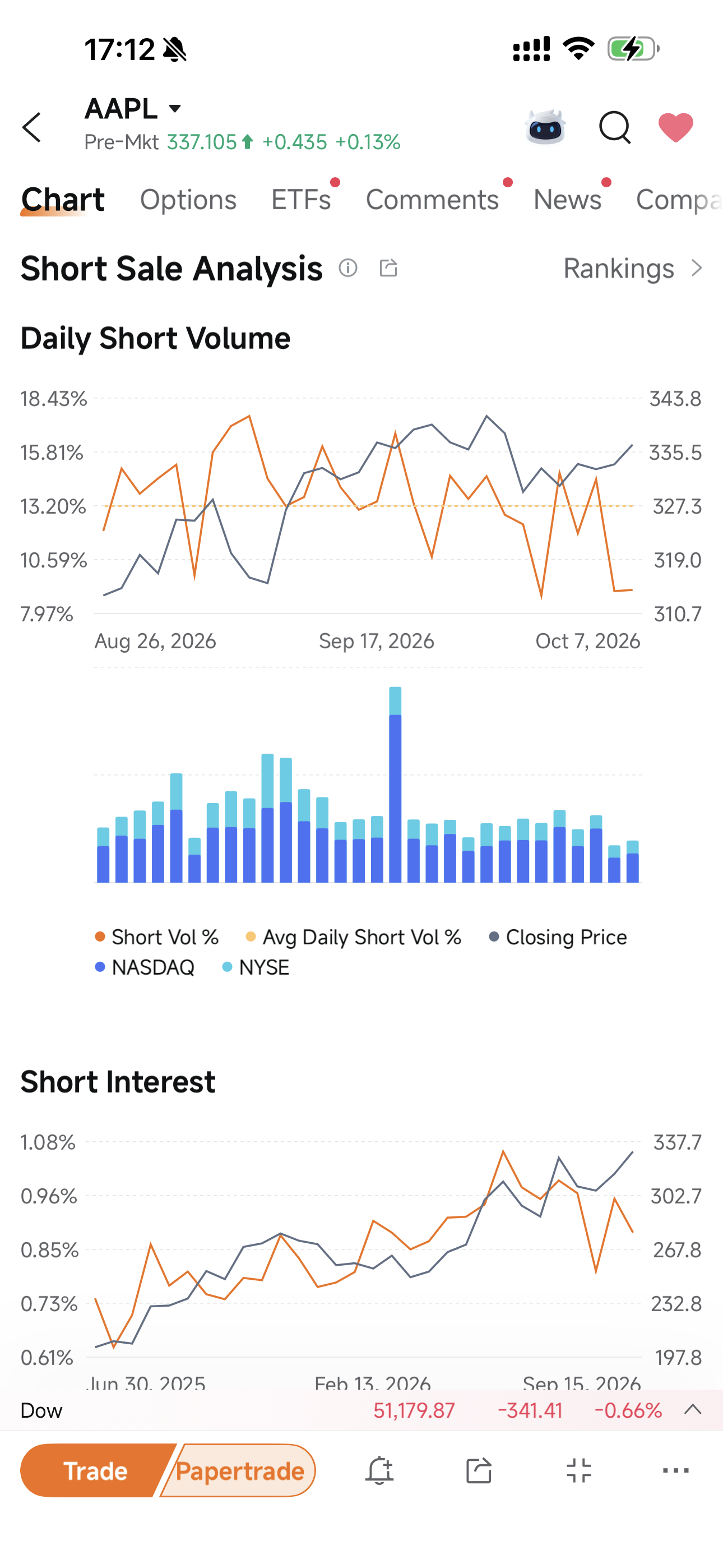
No universal cutoff "proves" a squeeze. Screens that flag elevated short interest or days to cover are conventions for further study, not forecasts.
Catalysts, Options Flow, and Why Context Matters
Short squeeze versus related options-driven dynamics
A classic short squeeze is driven by equity short covering. A gamma-related squeeze narrative, by contrast, centers on dealer hedging: when large call positions leave market makers short gamma, rising prices can require buying more of the underlying to stay delta-hedged, which can amplify the move. The mechanisms can overlap, but data footprints differ — short-interest reports versus options open interest, strike concentration, and unusual prints.
When a heavily discussed name spikes, are observers looking only at equity short interest while ignoring a cluster of large call prints — or treating every unusual options ticket as proof of an impending squeeze? Either shortcut can misread the tape.
Options flow is therefore often reviewed as context, not as an oracle. On moomoo, Unusual Options Activity tracks notably large options trades (commonly referenced around 1,000+ contracts) in list form for individual stocks (Quotes> Options> Unusual Activity) or across the market (Markets> Options> Unusual Activity). Users can open a print for details and simulated performance views, apply filters, and set alerts. That mix of unusual-activity analysis and the Unusual Activity list can help investors see whether elevated call or put activity coincides with a short-interest story — without implying any print should be copied. Interested users can register on moomoo, enable options tools on an eligible account, and browse the list for education and monitoring — not as advice to trade.
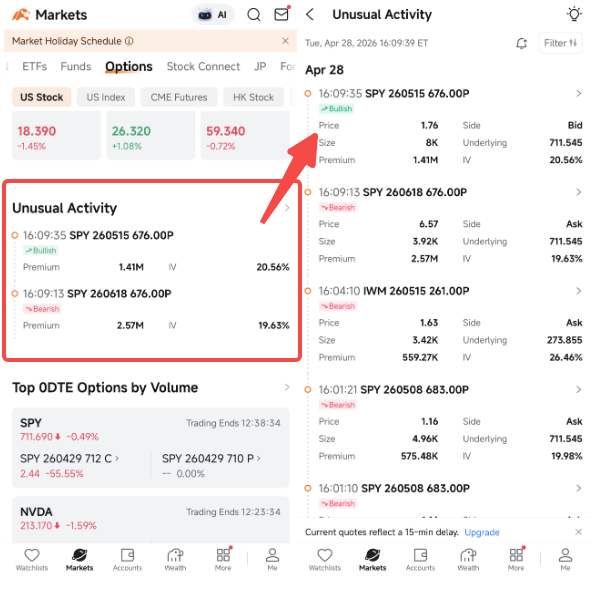
Options involve substantial risk and are not suitable for every investor. Unusual volume can reflect hedging, spreads, or inventory as easily as a directional bet.
Watching the Tape When Moves Turn Fast
Squeeze-like episodes are often associated with wider spreads, fleeting liquidity, and rapid shifts in displayed size. Level 1 shows the top of book; Level 2 depth shows additional resting bids and offers. Some short-term observers use depth to see where size is clustered — while recognizing that displayed liquidity can cancel or refresh in fractions of a second.
During a vertical move, can a single last-sale print show whether buyers are lifting offers in size or whether the book is hollow just above the market? Without depth, that question is harder to examine in real time.
For eligible U.S. accounts, moomoo provides free NYSE ArcaBook Level 2 data subject to stated account-value conditions (commonly a minimum average account value over a recent period; other terms apply). Depth refreshes on a short interval and can sit alongside charts when studying fast tape — for example, noting large displayed bids or offers near recent swings — without treating any book level as guaranteed support or resistance. Users can download moomoo, open an account if needed, and check whether they qualify for free Level 2 as part of a fuller quote picture. Depth informs observation; it does not predict covering cascades or recommend entries.

Common Misconceptions and Risks
High short interest ≠ imminent squeeze. It can also reflect a durable bearish fundamental view.
Days to cover is not a timer. Volume regimes change; the ratio is a snapshot against average volume.
Social attention can amplify both upside and downside volatility; attention is not a thesis.
Borrow costs and locate constraints vary by firm and time; quotes elsewhere may not match a given brokerage.
Chase risk is real: entering after an extended vertical move can expose investors to rapid reversals, gap risk, and wide spreads.
Short selling itself carries distinctive risks (including potentially unlimited theoretical loss on naked shorts) and regulatory constraints; this article does not recommend shorting.
Educational risk frameworks often emphasize verifying data dates, separating equity covering stories from options-hedging stories, sizing for gaps, and defining invalidation before a parabolic candle — as personal risk hygiene, not as a playbook to "trade squeezes."
A Research Checklist (Not a Trade Plan)
Investors studying squeeze narratives may find it useful to review:
Confirm short-interest as-of dates and float vs. shares-outstanding basis
Compare days to cover against recent volume changes, not only a static threshold
Note any catalyst and whether it alters the fundamental short thesis
Cross-check unusual options prints and open-interest concentration
Assess liquidity, spread, and Level 2 depth (where available) before reading extremes
Document personal risk limits in advance; fast tapes can outrun discretionary reaction time
For a single U.S. research workspace, moomoo brings together Short Sale Analysis, Unusual Options Activity lists and detail views, and free Level 2 for qualifying accounts. Downloading the app or opening an account is optional and is not a recommendation to trade any squeeze candidate.
Important: This article is for general informational and educational purposes only. It is not investment, trading, tax, or legal advice, and it does not recommend buying, selling, shorting, or holding any security or using any data product. Investing involves risk of loss, including loss of principal. Short selling and options involve additional risks and are not suitable for all investors. Short-interest and short-volume data can be delayed or incomplete; Level 2 can change rapidly and may not reflect full liquidity. Free Level 2 access is subject to eligibility and may change. Examples are illustrative only. Verify information independently, consider your own objectives and risk tolerance, and consult a qualified professional if needed before any investment decision.
FAQ for Short Squeezes
What metrics are commonly associated with squeeze discussions?
Short interest (level and change), short interest versus float or shares outstanding, days to cover / short ratio, daily short volume, and — where relevant — options unusual activity and dealer-hedging narratives. All of these are contextual inputs, not deterministic signals.
Is a short squeeze the same as a gamma squeeze?
No. A short squeeze centers on equity short covering. A gamma-related squeeze narrative centers on options market-maker hedging as prices move through strikes with large call open interest. Both can appear in the same name, but they are different mechanisms.
Can moomoo tools help with short-squeeze research?
moomoo offers Short Sale Analysis for short-volume and short-interest style metrics, Unusual Options Activity lists and detail views for large options prints, and free NYSE ArcaBook Level 2 depth for eligible accounts. These features support research and quote visibility; they do not predict squeezes or recommend trades. Availability depends on account type and eligibility.
This presentation is for informational and educational use only and is not a recommendation or endorsement of any particular investment or investment strategy. Investment information provided in this content is general in nature, strictly for illustrative purposes, and may not be appropriate for all investors. Read more