How to Start Day Trading for Beginners
Day trading is one of the most active and fast-paced trading strategies in the U.S. financial markets, where traders buy and sell securities within the same trading day to capitalize on short-term price movements. While this approach offers the potential for profit, it comes with inherent risks that every beginner must understand before entering the market.
This guide provides a clear, step-by-step roadmap for beginners looking to start day trading in 2026, with a specific focus on navigating the U.S. stock market's updated 2026 regulatory environment, trading hours, and opportunities. Whether you're trading on the NYSE or NASDAQ, understanding the American market landscape is essential for your success.
Key Takeaway: How to Start Day Trading for Beginners
- Understand U.S. Regulations and Capital Requirements: Familiarize yourself with the latest 2026 FINRA day trading regulatory framework, which eliminates the traditional Pattern Day Trader (PDT) rule and fixed $25,000 minimum equity requirement. Active intraday trading is now governed by dynamic intraday margin standards based on real-time position risk.
- Master Core Market Concepts: Learn key principles like volatility, liquidity, and order types to make informed trading decisions in U.S. markets.
- Choose the Right Broker: Opt for a platform offering low fees, fast execution, robust tools, and educational resources tailored to beginners.
- Prioritize Risk Management: Follow the 1% rule to limit losses, avoid emotional decisions, and develop a written trading plan for consistent success.
- Understand U.S. Regulations and Capital Requirements: Familiarize yourself with the latest 2026 FINRA day trading regulatory framework, which eliminates the traditional Pattern Day Trader (PDT) rule and fixed $25,000 minimum equity requirement. Active intraday trading is now governed by dynamic intraday margin standards based on real-time position risk.
- Master Core Market Concepts: Learn key principles like volatility, liquidity, and order types to make informed trading decisions in U.S. markets.
- Choose the Right Broker: Opt for a platform offering low fees, fast execution, robust tools, and educational resources tailored to beginners.
- Prioritize Risk Management: Follow the 1% rule to limit losses, avoid emotional decisions, and develop a written trading plan for consistent success.
What Is Day Trading and Is It Right for You?
This section defines day trading, contrasting it with long-term investing and swing trading. It helps readers self-assess if they have the right mindset, risk tolerance, and time commitment for active participation in U.S. markets.
Defining Day Trading vs. Other Investing Styles
Day trading involves opening and closing positions within the same trading session—typically during U.S. market hours from 9:30 AM to 4:00 PM Eastern Time. Unlike long-term investors who hold positions for months or years, or swing traders who maintain positions for days to weeks, day traders aim to profit from intraday price fluctuations.
In the U.S., day traders commonly focus on highly liquid securities listed on major exchanges like the New York Stock Exchange (NYSE) and NASDAQ, where trading volume ensures efficient order execution.
The Reality of Day Trading: Pros and Cons in 2026
Pros:
No overnight risk exposure to after-hours news or global market events
Multiple trading opportunities each day in U.S. markets
Potential to profit in both rising and falling markets
Independence and flexibility in your trading schedule
Lower entry barriers (2026 update): No fixed $25,000 account minimum or trade count restrictions for intraday trading
Cons:
Requires significant time commitment during U.S. market hours
High stress and emotional demands
Transaction costs can accumulate quickly
Statistical evidence shows most day traders lose money
Requires strict intraday risk control to comply with updated U.S. margin regulations
How Much Capital Do You Need to Start Day Trading in the U.S.?
A crucial section detailing the financial requirements for day trading in America. It explains the2026 updated FINRA day trading regulations (replacing the legacy PDT rule) and discusses realistic starting capital for different trading goals and risk tolerances.
2026 Updated U.S. Day Trading Regulation (Legacy PDT Rule Repealed)
Effective June 4, 2026, the U.S. SEC and FINRA officially repealed the decades-old Pattern Day Trader (PDT) rule, eliminating the legacy regulatory framework that governed active intraday trading. The traditional rules—including the 5-business-day 4+ day-trade classification, 6% trading activity threshold, and fixed $25,000 minimum margin account equity requirement—are no longer valid.
The legacy PDT system is replaced with a dynamic real-time intraday margin framework under updated FINRA Rule 4210, designed for risk-based supervision rather than rigid trade-count and fixed-balance restrictions. Key updates for 2026 day trading regulation include:
No official PDT account classification or trade volume limits: Traders can execute unlimited intraday trades without being flagged or restricted based on trade frequency
No mandatory $25,000 minimum account equity for active day trading
Real-time Intraday Buying Power: Margin availability is calculated dynamically throughout the trading day based on current account equity, open positions, and intraday profit/loss
Risk-based intraday margin calls: Restrictions and margin calls trigger only when intraday position risk exceeds permitted thresholds (roughly 25% of outstanding position value), rather than violating fixed balance rules
This new rule applies to all U.S. margin brokerage accounts, leveling the playing field for retail traders while maintaining investor protection via real-time risk monitoring instead of static barriers.
Starting with a Small Account: Strategies and Risks (2026 Updated)
With the repeal of the PDT rule, traders can actively day trade with small accounts under $25,000, with flexible options tailored to low-capital beginners:
Cash accounts: Trade with a cash account to eliminate margin risk entirely, though you’ll still need to follow U.S. T+1 trade settlement rules before reusing funds
Small margin account trading: Trade freely with unlimited intraday trade frequency on sub-$25,000 margin accounts, with compliance limited to real-time intraday margin risk limits
Prioritize simulated practice: Use paper trading to build consistent strategies and risk management habits before deploying live capital
Note that smaller accounts carry amplified risk: lower equity means tighter intraday margin limits and less room for market volatility. New traders are still advised to grow account capital gradually to reduce margin call risks and improve trading flexibility.
Essential Knowledge for Beginner Day Traders
Covers the foundational market concepts every beginner must learn before placing a trade in U.S. markets. This section focuses on core terminology and market mechanics specific to American exchanges.
Key Market Concepts: Volatility, Liquidity, and Order Types
Volatility measures how much a security's price fluctuates over time. Day traders seek volatile stocks because larger price swings create more profit opportunities. U.S. market volatility often increases during earnings season, Federal Reserve announcements, and major economic data releases like the monthly jobs report.
For traders looking to capitalize on this earnings-driven volatility, timing is everything. Entering a position after implied volatility (IV) has already spiked can be costly and inefficient. A more strategic approach involves identifying opportunities before the market fully prices in the anticipated move. Specialized tools can help you filter for stocks with upcoming earnings reports and analyze their historical performance, allowing you to find tickers that have historically shown significant price swings post-announcement but currently have a low IV rank. This method helps you position yourself at a lower cost to potentially maximize returns.
To put this into practice, explore moomoo’s Earnings Opportunity feature, which integrates earnings dates, fundamental data, and volatility analysis. You can use it to find and analyze high-potential stocks before they report.
Liquidity refers to how easily you can buy or sell a security without significantly affecting its price. Stocks with high trading volume on U.S. exchanges typically offer better liquidity, tighter bid-ask spreads, and faster order execution.
Order Types you must understand include:
Market orders: Execute immediately at the best available price
Limit orders: Execute only at your specified price or better
Stop-loss orders: Automatically sell when a stock reaches a certain price to limit losses
Stop-limit orders: Combine stop and limit order features for more precise control
Understanding these concepts within the context of U.S. market structure will help you make more informed trading decisions.
Choosing the Best Day Trading Broker for Beginners in the U.S.
This section guides users on selecting a suitable broker for trading in U.S. markets. It highlights critical features and positions our platform as an ideal choice for American traders.
Key Features to Look for: Low Fees, Fast Execution, and a Powerful Platform
When selecting a broker for day trading U.S. stocks, prioritize these features:
Commission structure: Look for competitive or commission-free trading on U.S. equities
Execution speed: Milliseconds matter in day trading; choose a broker with fast, reliable order execution
Platform capabilities: Advanced charting, real-time Level 2 quotes, and customizable interfaces are essential
2026 regulatory compliance capability: Ensure the broker supports real-time intraday margin monitoring to align with updated FINRA day trading rules
Regulatory compliance: Ensure your broker is registered with the SEC and is a member of FINRA and SIPC for investor protection
Cash management features: Consider brokers offering cash sweep programs that allow your uninvested cash to earn competitive interest rates while remaining available for trading
Educational resources: Especially important for beginners learning to navigate U.S. markets
Why Our Platform is Built for Beginner Traders in 2026
Moomoo provides an ideal environment for beginner day traders entering U.S. markets. Our platform offers:
Commission-free trading on U.S. stocks and ETFs
Advanced charting tools with over 100 technical indicators
Real-time market data and Level 2 quotes
Intuitive mobile and desktop interface designed for both beginners and experienced traders
Comprehensive educational resources tailored to U.S. market dynamics and 2026 updated day trading regulations
Real-time intraday margin tracking to help users comply with the latest FINRA risk-based trading rules
A cash sweep program that helps your uninvested funds work harder while you focus on trading
Extended trading hours access for pre-market and after-hours opportunities
Full SEC, FINRA, and SIPC membership for your peace of mind
As the official partner of the New York Mets, moomoo demonstrates our commitment to the American financial community and our presence in the heart of U.S. markets.
Setting Up Your Day Trading Station: Tools & Tech
Discusses the necessary hardware, software, and tools for an effective trading setup. The focus is on practical, accessible technology for beginners trading U.S. markets.
Essential Hardware and Charting Software for Day Trading
A reliable day trading setup doesn't require expensive equipment, but certain elements are essential:
Hardware:
A computer with sufficient processing power and RAM for running trading software
Multiple monitors (at least two) to view charts, news, and order entry simultaneously
A stable, high-speed internet connection with backup options
A smartphone for mobile trading access and alerts
Software:
Professional charting platform with real-time U.S. market data
News feed for tracking market-moving events and economic releases
Stock screener to identify trading opportunities
Trade journal for tracking and analyzing your performance
Real-time margin monitoring tools to track intraday risk exposure under 2026 new rules
How to Use Paper Trading to Practice Risk-Free
Before risking real capital in U.S. markets, take advantage of paper trading (simulated trading) to:
Test your strategies without financial risk
Learn your broker's platform and order entry system
Build confidence in your decision-making process
Track your hypothetical performance over time
Practice intraday risk management aligned with 2026 updated margin regulations
For those interested in more complex instruments like options, paper trading becomes even more critical. Newcomers often struggle with the nuances of selecting strike prices and expiration dates, making it difficult to find a strategy that matches their risk tolerance. A paper trading account with a substantial amount of virtual capital allows you to practice buying and selling options contracts repeatedly without fear of real financial loss. By observing how profit and loss fluctuate with market moves in a live environment, you can refine your timing, test different strategies, and identify potential flaws in your approach—all while lowering your learning costs.
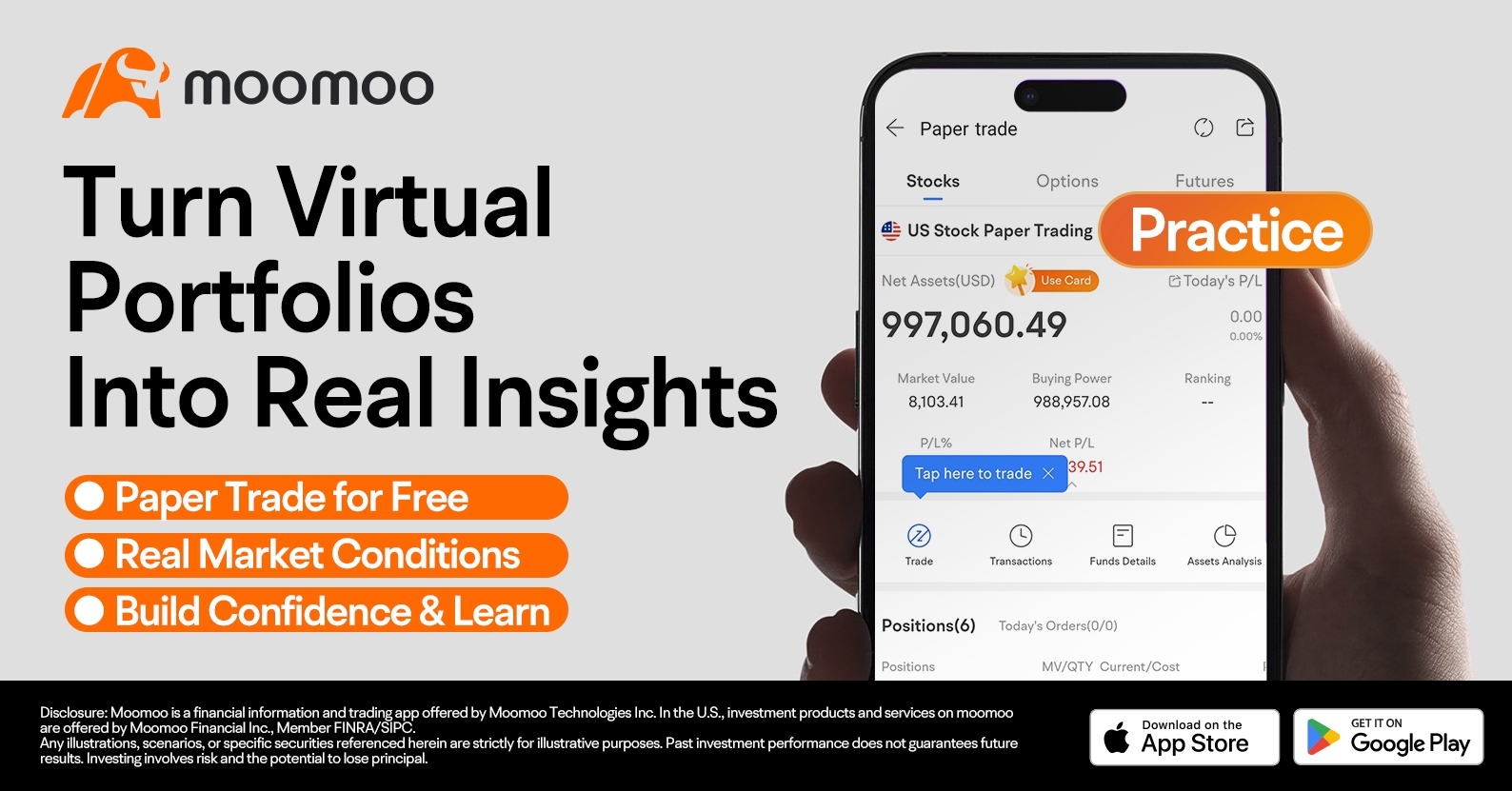
Register for a moomoo account to access our Paper Trading feature, which comes with $1 million in virtual funds. This allows you to walk through the entire options trading process, from order placement to position management, before you commit real capital.
Developing Your First Day Trading Strategy
Introduces simple, popular day trading strategies suitable for novices in U.S. markets. It emphasizes the importance of having a clear, written plan before entering the market.
Popular Day Trading Strategies for Beginners
Momentum Trading: Identify stocks making significant moves on high volume and trade in the direction of the momentum. This strategy works well with U.S. stocks experiencing news catalysts or earnings surprises.
Breakout Trading: Enter positions when a stock breaks through established support or resistance levels with increased volume.
Scalping: Make numerous small trades throughout the day, capturing small price movements. This requires excellent execution speed and low transaction costs.
Gap Trading: Trade stocks that open significantly higher or lower than the previous day's close, a common occurrence in U.S. markets following overnight news.
The Importance of Creating and Sticking to a Trading Plan
A written trading plan is your roadmap to consistency. Your plan should include:
Specific criteria for entering and exiting trades
Maximum risk per trade and per day
Which U.S. market sectors or stocks you'll focus on
Your trading schedule aligned with U.S. market hours
Rules for when NOT to trade (e.g., during major Fed announcements)
Daily intraday margin risk limits compliance rules (2026 regulation update)
Performance review schedule
Discipline in following your plan separates successful traders from those who fail.
A Step-by-Step Guide to Placing Your First Day Trade
A practical, action-oriented walkthrough of the entire trading process in U.S. markets, from identifying an opportunity to closing the position.
Step 1: Identifying a Stock and Your Entry Point
Begin each trading day by scanning for opportunities using:
Pre-market movers and gap scanners
Stocks with unusual volume
Securities near key technical levels
News catalysts affecting specific U.S. companies or sectors
Once you identify a potential trade, analyze the chart to determine your precise entry point based on your strategy's criteria.
Beyond these methods, another powerful technique for identifying opportunities is to follow the "smart money." In the complex world of options, it can be difficult to distinguish between minor retail trades and significant institutional movements. Having a tool that filters for and highlights unusual options activity in real-time can give you a significant edge. For example, detecting a series of massive, bullish "sweep" orders on a particular stock can indicate strong conviction from large players, providing a powerful signal that may align with your own trading thesis.
Download the moomoo app and explore the Options Unusual Activity feature. You can use its real-time filters to screen for abnormal large orders and potentially uncover what institutional investors are doing, helping you make more informed decisions.
Step 2: Setting Your Stop-Loss and Profit Targets
Before entering any trade, define:
Stop-loss level: The price at which you'll exit to limit losses (typically based on technical levels or a percentage of your entry price)
Profit target: Your planned exit price for a winning trade
Risk-reward ratio: Aim for at least 2:1 (potential profit twice your potential loss)
Intraday position size cap: Align position sizing with real-time intraday margin limits to comply with 2026 FINRA rules
Never enter a trade without knowing exactly where you'll exit, whether the trade goes for or against you.
Step 3: Executing and Managing Your Trade
Execute your entry order using the appropriate order type for your strategy. Once in the trade:
Monitor price action and volume
Track real-time intraday margin usage to avoid rule violations
Adjust your stop-loss to lock in profits as the trade moves in your favor
Avoid moving your stop-loss further away from your entry (increasing risk)
Exit at your predetermined target or stop-loss level
Document the trade in your journal for later review
Critical Risk Management Rules Every Beginner Must Follow
This section reinforces the most important aspect of trading: capital preservation. It provides actionable rules to help beginners manage risk effectively in U.S. markets under the 2026 updated regulatory framework.
The 1% Rule: How to Protect Your Trading Capital
The 1% rule states that you should never risk more than 1% of your total trading capital on any single trade. For example:
With a $25,000 account, your maximum risk per trade is $250
With a $50,000 account, your maximum risk per trade is $500
This rule ensures that a string of losing trades won't devastate your account, giving you the staying power to learn and improve. It also helps beginners naturally stay within intraday margin risk limits required by the 2026 updated FINRA rules.
Avoiding Emotional Decisions and "Revenge Trading"
Emotional trading is the fastest path to account destruction. Common pitfalls include:
Revenge trading: Trying to immediately recover losses by taking larger, riskier trades
FOMO (Fear of Missing Out): Chasing trades after they've already made significant moves
Overconfidence: Increasing position sizes after a winning streak
Paralysis: Failing to take valid setups after experiencing losses
Develop routines to maintain emotional equilibrium, including taking breaks after losses, setting daily loss limits, and reviewing your trading journal regularly.
Conclusion
Day trading in U.S. markets offers exciting opportunities but demands respect for its challenges. As you begin your journey in 2026, remember these key takeaways:
Master the 2026 updated U.S. intraday trading regulations (repealed legacy PDT rule, risk-based intraday margin framework)
Master fundamental concepts before risking real money
Choose a broker with the tools, education, regulatory compliance, and real-time margin monitoring you need
Develop and stick to a written trading plan with intraday risk control rules
Prioritize risk management above all else
Treat day trading as a marathon, not a sprint
Success in day trading requires continuous learning, disciplined execution, and emotional control. The most successful traders view losses as tuition payments in their ongoing education.
Ready to begin your day trading journey? Open a paper trading account with moomoo today to practice your strategies risk-free in simulated U.S. market conditions. Explore our comprehensive educational resources designed specifically for beginner traders, and join a community of investors committed to mastering the American markets.
Your path to becoming a skilled day trader starts with a single step—take it today.
FAQs about Starting Day Trading
What is the minimum capital required to start day trading for beginners in the U.S.?
2026 Updated Answer: Following the SEC and FINRA’s official rule change effective June 4, 2026, the legacy $25,000 minimum equity requirement for day trading has been permanently eliminated. There is no fixed minimum account balance or mandatory capital threshold for active intraday stock trading on U.S. margin accounts.
The old Pattern Day Trader (PDT) rule’s static balance and trade-count restrictions are replaced with a dynamic risk-based intraday margin system. Traders with small accounts (even under $25,000) can execute unlimited day trades, provided their intraday position risk does not exceed real-time margin maintenance thresholds. While no official minimum exists, beginners are recommended to start with sufficient capital to absorb market volatility and avoid frequent intraday margin calls.
Can a beginner start day trading with a small account, specifically under the $25,000 threshold?
2026 Updated Answer: Yes, beginners can freely day trade with accounts under $25,000 with no PDT trade-count restrictions. The 5-day/4-trade limit and PDT flagging system no longer apply to any U.S. margin accounts.
Small account traders only need to comply with real-time intraday margin risk limits. Common low-capital trading approaches include using a margin account for unlimited intraday trades with strict position sizing, or a cash account for zero-margin-risk trading (subject to U.S. T+1 settlement rules). Note that Forex and cryptocurrency markets remain unregulated by the PDT framework and continue to offer alternative low-capital practice options.
What is the most important first step for someone learning how to start day trading?
The most critical first step is to build a strong foundational knowledge of the market andmaster the 2026 updated U.S. day trading regulations. Before risking any real money, you must understand core concepts like market structure, technical analysis, risk management, and the new intraday margin compliance rules. The next essential step is to practice extensively using a paper trading account. Most reputable U.S. brokers, like moomoo, offer demo or paper trading accounts that simulate live market conditions with virtual money. This allows you to test your strategies, learn the mechanics of your trading platform, and adapt to real-time intraday risk monitoring without any financial risk. Rushing past education and practice is one of the biggest mistakes a new trader can make.
What are the biggest risks for a beginner starting day trading that I should avoid?
For beginners, the biggest risks are often psychological and procedural. A primary risk is 'revenge trading'—making emotional, impulsive trades to try and win back money after a loss, which almost always leads to bigger losses. Another major pitfall is poor risk management, such as not using stop-loss orders or risking too much capital on a single trade (violating principles like the 1% rule).
With the 2026 regulatory update, the key new risk to avoid is intraday margin overexposure: exceeding real-time risk thresholds and triggering margin calls or temporary trading restrictions. Additionally, beginners must still account for U.S.-specific financial risks including tax implications of frequent trading, such as the wash sale rule, which can lead to unexpected IRS tax liabilities.
What essential tools and software do I need for a beginner day trading setup in the U.S.?
An effective day trading setup requires a few key components. First, a reliable, fast computer is non-negotiable; many traders also use multiple monitors to view charts, news, and their trading platform simultaneously. Second, you need a high-speed, stable internet connection to ensure orders are executed quickly.
Most importantly, you must select a powerful day trading platform with 2026 regulation compliance features. Look for a broker that offers real-time Level 2 quotes (market depth), advanced charting tools, fast order execution, and built-in intraday margin risk tracking to comply with the updated FINRA rules. Platforms like moomoo provide these professional-grade tools, paired with commission-free trading on U.S. stocks, making them ideal for beginner active traders.
How do I choose the right U.S. broker to start day trading as a beginner?
Choosing the right broker is a crucial decision. For day trading in the U.S., you should prioritize several factors. First, ensure the broker is fully regulated and compliant, registered with the SEC and a member of FINRA, with updated systems to support the 2026 intraday margin regulatory framework. Second, evaluate the commission structure; commission-free trading can significantly reduce costs for active traders. Third, assess the trading platform's quality—it must be reliable, fast, and equipped with essential tools like advanced charting, real-time data, and intraday risk monitoring. Finally, consider the broker's support for active traders, including educational resources tailored to new day trading rules and access to paper trading accounts to practice.
This presentation is for informational and educational use only and is not a recommendation or endorsement of any particular investment or investment strategy. Investment information provided in this content is general in nature, strictly for illustrative purposes, and may not be appropriate for all investors. Read more