How to Prepare for the Anthropic IPO: A 2026 Guide for US Investors
The AI sector has become a major growth theme, and Anthropic, the company behind Claude, is one of its most closely watched private companies.
As of 2026, Anthropic has not completed an IPO, and its shares do not trade on the NYSE or Nasdaq. There is no confirmed ticker, IPO price, or listing date. Still, its rapid growth, major funding rounds, and reported IPO preparations have made the potential Anthropic IPO a key topic for US investors.
This guide explains how US investors can prepare, what risks to consider, and what alternatives may be available before Anthropic becomes publicly traded.
Key Takeaway
- Anthropic IPO Watch: Anthropic has not yet completed an IPO, but its potential public listing remains one of the most closely watched AI investment stories for US investors in 2026.
- How US Investors Can Prepare: Investors can prepare by opening a funded brokerage account, monitoring SEC filings, reviewing Anthropic’s S-1 once public, and deciding whether to seek IPO allocation or buy shares after listing.
- Pre-IPO Access Is Limited: Direct pre-IPO exposure is generally limited to accredited investors through private secondary markets, venture funds, or SPVs, and comes with high risk and low liquidity.
- Alternative AI Exposure: Until Anthropic becomes publicly traded, US investors can consider indirect exposure through public partners like Amazon and Alphabet, or diversified AI-focused ETFs.
- Anthropic IPO Watch: Anthropic has not yet completed an IPO, but its potential public listing remains one of the most closely watched AI investment stories for US investors in 2026.
- How US Investors Can Prepare: Investors can prepare by opening a funded brokerage account, monitoring SEC filings, reviewing Anthropic’s S-1 once public, and deciding whether to seek IPO allocation or buy shares after listing.
- Pre-IPO Access Is Limited: Direct pre-IPO exposure is generally limited to accredited investors through private secondary markets, venture funds, or SPVs, and comes with high risk and low liquidity.
- Alternative AI Exposure: Until Anthropic becomes publicly traded, US investors can consider indirect exposure through public partners like Amazon and Alphabet, or diversified AI-focused ETFs.
What Is Anthropic?
Anthropic is an American artificial intelligence company founded in 2021 by former OpenAI employees. The company is structured as a public-benefit corporation and focuses on building reliable, interpretable, and steerable AI systems.
Its flagship product is Claude, a family of large language models designed for tasks such as writing, coding, research, summarization, data analysis, and enterprise automation. Claude competes with other leading AI systems, including OpenAI’s GPT models and Google’s Gemini.
Anthropic is especially known for its “Constitutional AI” approach. Instead of relying only on human feedback, Anthropic trains its models using a set of guiding principles designed to make AI behavior safer, more transparent, and more predictable. This safety-focused positioning has helped the company stand out in a crowded AI market.
Why Investors Are Watching the Anthropic IPO
The potential Anthropic IPO is attracting attention because the company sits at the intersection of several major investment themes: generative AI, enterprise software, cloud computing, automation, and AI safety.
Anthropic has also received major backing from some of the largest technology companies and institutional investors in the world. Amazon has invested billions of dollars and made Anthropic a key AI partner for AWS. Google has also invested heavily and provides cloud infrastructure support. Other investors and partners have included Salesforce Ventures, Zoom Ventures, Menlo Ventures, and major global investment firms.
In 2026, Anthropic’s private-market valuation reportedly increased sharply after large funding rounds. The company announced a $30 billion Series G round in February 2026 at a reported $380 billion post-money valuation, followed by a $65 billion Series H round in May 2026 at a reported $965 billion post-money valuation. Anthropic also reported that its annualized revenue run rate crossed $47 billion in May 2026.
Below is a selected overview of Anthropic's recent funding and valuation milestones:
Approximate Date | Amount Raised / Committed | Implied Valuation | Key Investors / Partners |
|---|---|---|---|
May 2026 | $65 billion Series H | ~$965 billion post-money | Altimeter, Dragoneer, Greenoaks, Sequoia, Capital Group, Coatue, GIC, ICONIQ, XN, and others |
Feb. 2026 | $30 billion Series G | ~$380 billion post-money | GIC, Coatue, D. E. Shaw Ventures, Dragoneer, Founders Fund, ICONIQ, MGX, and others |
2026 | Up to $40 billion strategic commitment | Reported initial valuation around ~$350 billion | Alphabet / Google |
Nov. 2024 | Additional $4 billion investment, bringing Amazon's total commitment to $8 billion | Not publicly disclosed | Amazon |
Late 2023 | $750 million funding round | Reported ~$18.4 billion valuation | Menlo Ventures and other investors |
Mid 2023 | $450 million Series C | Reported ~$4 billion to ~$5 billion valuation | Spark Capital, Google, Salesforce Ventures, Zoom Ventures, and others |
These figures highlight the scale of investor enthusiasm, but they also raise important questions about valuation, profitability, competition, and whether public-market investors will be willing to support similar pricing if Anthropic lists.
Has Anthropic Filed for an IPO?
Anthropic has reportedly taken steps toward a potential IPO process, including a confidential draft S-1 submission to the SEC. A confidential draft S-1 is an early procedural step that allows a company to begin SEC review before publicly releasing its full registration statement.
However, a confidential S-1 does not guarantee that an IPO will happen. It also does not confirm the IPO date, share price, valuation, ticker symbol, exchange, or final offering size.
For investors, the key milestone to watch is the public S-1 filing on the SEC’s EDGAR database. Once that filing becomes public, investors will be able to review Anthropic’s actual financial disclosures and assess whether the IPO valuation makes sense.
How US Investors Can Prepare for the Anthropic IPO
Phase 1 : Open and Fund a US Brokerage Account
The first step is to have a funded brokerage account with a US-registered broker. If Anthropic eventually lists on a major US exchange, most investors will be able to buy shares after the stock begins trading publicly.
Investors who want access to IPO shares at the offering price should check whether their broker offers IPO participation. Not every brokerage provides retail IPO access, and even when it does, allocations are not guaranteed.
Common broker considerations include IPO access, account minimums, research tools, trading fees, customer support, and order types such as limit orders.
Phase 2 : Understand IPO Allocation Rules
Getting IPO shares before the stock begins public trading is often difficult, especially for a high-demand company like Anthropic.
Brokerages may prioritize clients based on account size, relationship history, assets under management, trading activity, or other internal criteria. Some IPO opportunities may be available only to certain eligible investors, and demand often exceeds supply.
It is important to distinguish between IPO allocation and pre-IPO investing. IPO allocation means receiving shares at the official IPO price through a brokerage before trading begins. Pre-IPO investing usually refers to buying private-company exposure before the IPO, often through secondary markets, venture funds, or SPVs. Pre-IPO deals are generally more restricted and may require accredited investor status.
Your brokerage plays a vital role in securing IPO allocations for retail investors. Through platforms like moomoo, eligible U.S. investors can indicate their interest in purchasing shares at the offering price. Familiarizing yourself with this process now—before the excitement of an actual IPO announcement—ensures you won't be scrambling to figure out the mechanics when time is of the essence.
Here are the steps to apply for IPO on moomoo:
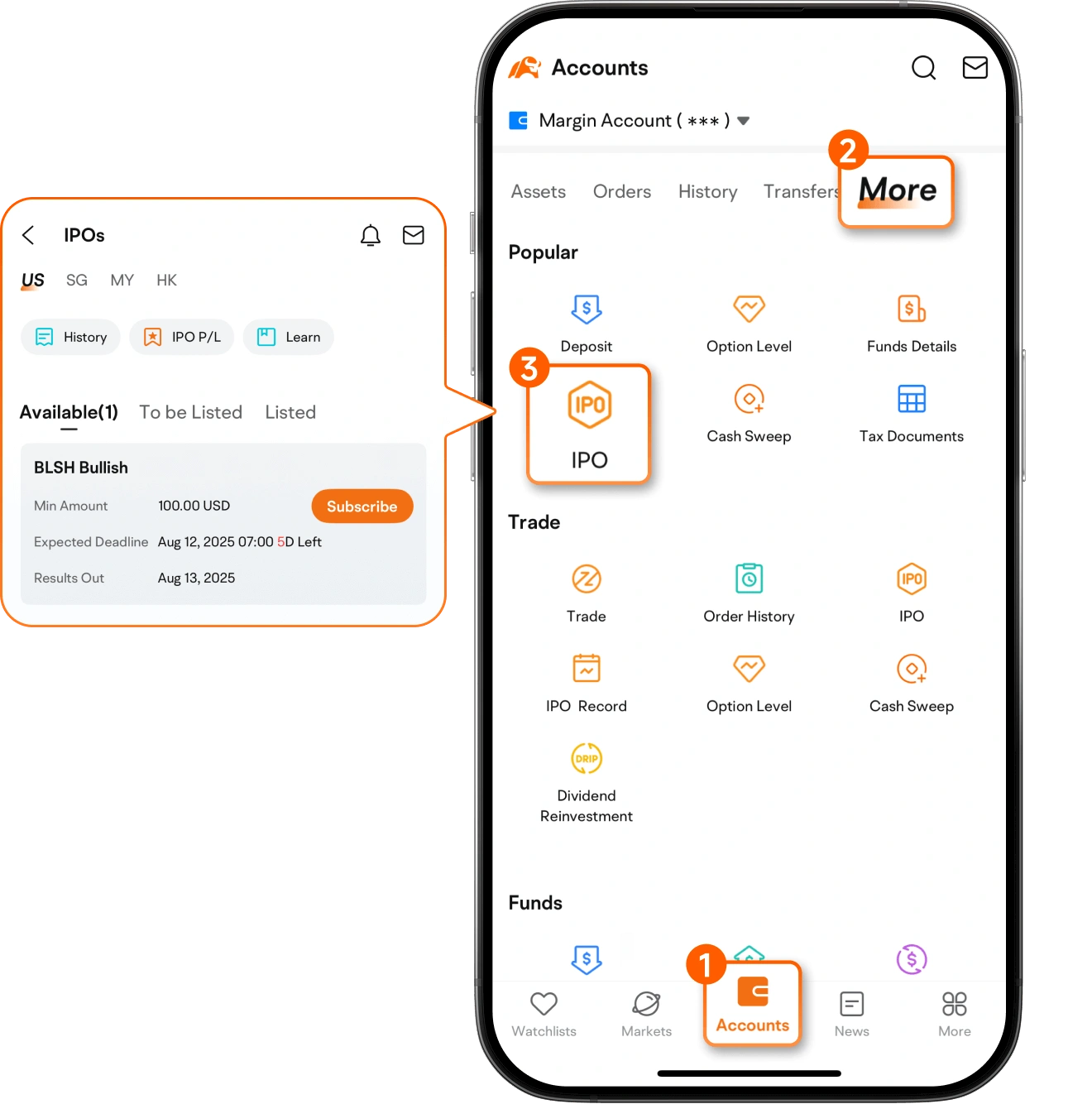
Step 1: Download moomoo app and navigate to Accounts> More> IPO. All available IPOs for subscription will be listed under the "Available" tab.
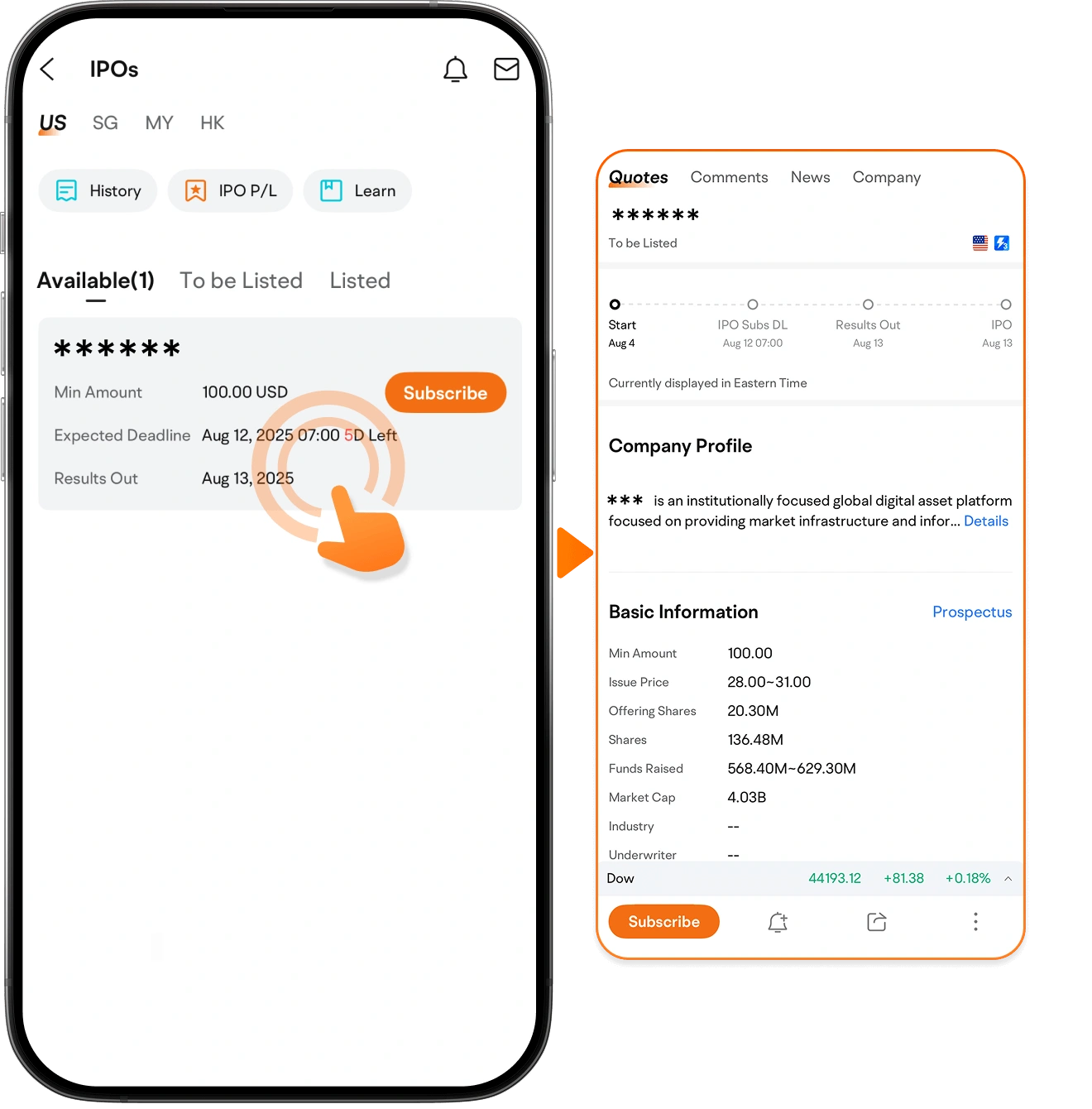
Step 2: Select an IPO you're interested in, tap to view its full details, terms, and offering information.
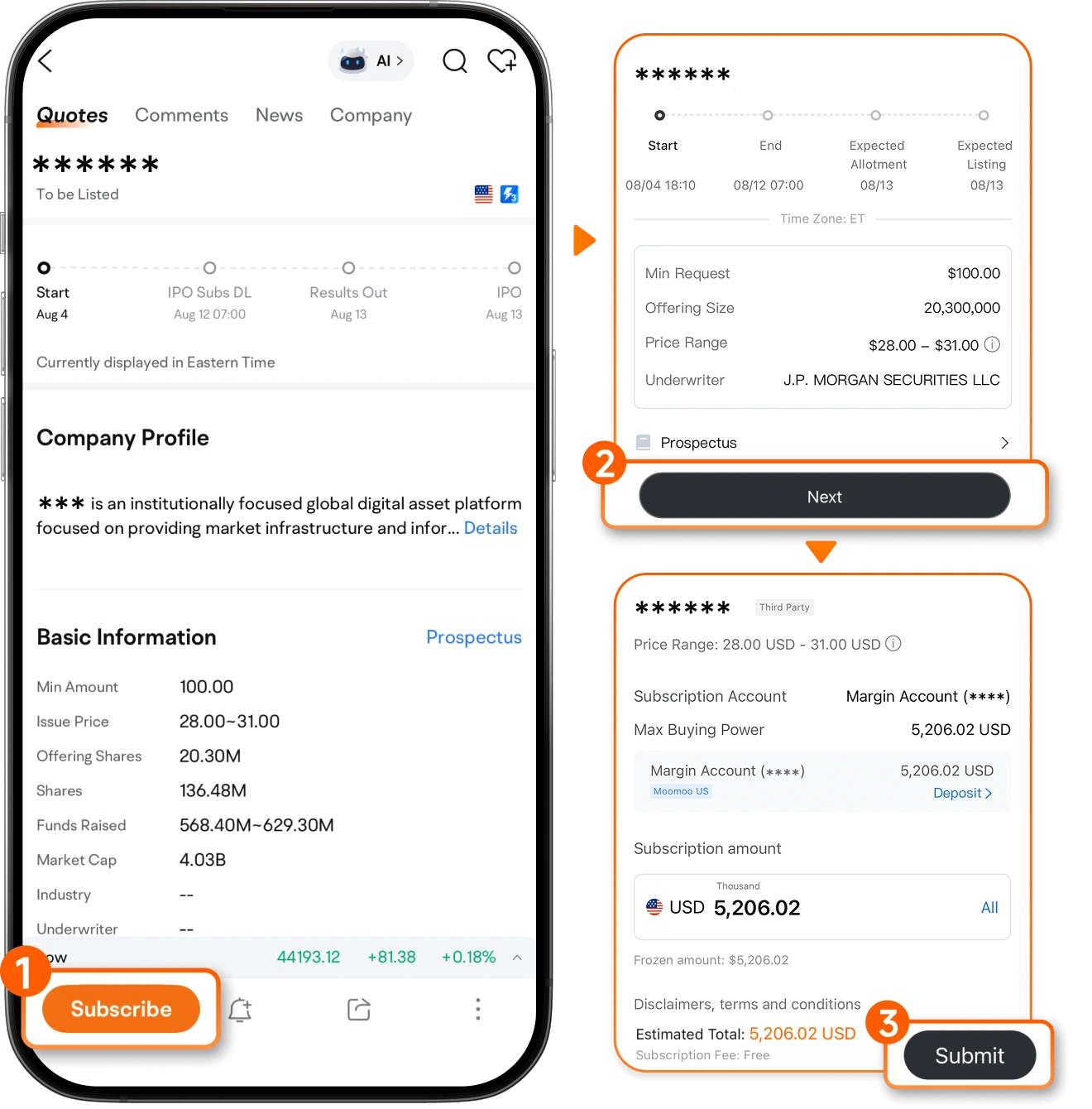
Step 3: Tap "Subscribe", enter your desired subscription amount, then submit. Results will be sent via email and in-app alerts on allotment day.
Phase 3 : Monitor the Public S-1 Filing
The S-1 filing is one of the most important documents investors should review before deciding whether to invest in an IPO.
For Anthropic, investors should pay close attention to:
Revenue growth and customer adoption
Gross margins and operating losses
Cash burn and infrastructure costs
Dependence on cloud providers and strategic partners
Customer concentration
Competitive risks from OpenAI, Google, Meta, Microsoft, and other AI companies
Regulatory risks related to AI safety, data privacy, copyright, and model transparency
Use of IPO proceeds
Share structure and insider ownership
The S-1 will provide the first detailed public look at Anthropic’s financial condition and risk profile.
Phase 4: Plan Your Exit Strategy Before the IPO Starts Trading
Getting IPO shares can feel like the hard part, but deciding how you will manage the position after listing is just as important. Newly listed stocks can move sharply during their first trading sessions, especially when market attention is high. Prices may rise quickly after the open, then reverse just as fast once early buying pressure fades.That is why investors should think through their exit strategy before trading begins.
Order types play a role in this process. For example, a trailing stop limit order may help investors manage IPO volatility by adjusting the stop trigger as the stock moves higher, while also setting a limit price for the sell order if the stock reverses. This type of order does not remove risk, but it can help investors follow a more disciplined exit plan.
How Trailing Stop Limit Orders Can Help With IPO Volatility
Imagine Anthropic prices its IPO at $65 per share. On the first trading day, enthusiasm drives the stock up 50%+ to $100. At this point, you're facing a critical decision. Traditional approaches lead to three scenarios:
You sell immediately: then the stock drops—perfect timing
You hesitate: miss your window, and the stock falls—profits diminish
You sell immediately: then the stock soars higher—leaving money on the table
Most traders experience scenarios 2 or 3. moomoo's Trailing Stop Limit Order eliminates this guesswork by automatically tracking the stock's upward movement while maintaining your downside protection.
Practical Example:
Continuing with the example above, Anthropic reaches $100 (a 50%+ gain), and you want to protect at least a 40% profit. You may set a trailing stop with a 10% trailing ratio and a $1 limit offset:
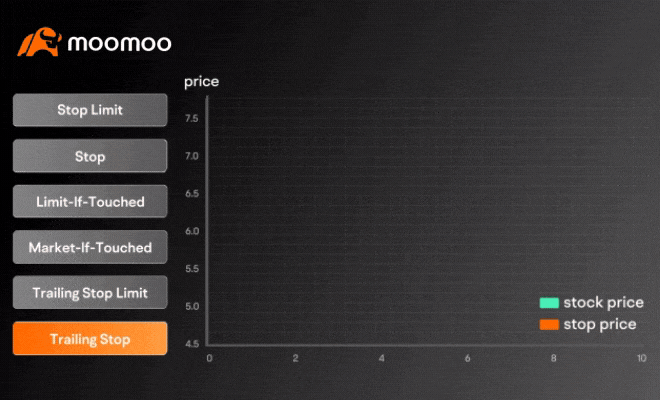
Scenario 1: Stock Continues Rising to $150, Then Pulls Back to $135
- Stock hits $120: Stop price automatically adjusts to $108 (120 × 90%)
- Stock rises to $150: Stop price moves up to $135 (150 × 90%)
- Stock drops to $135: System triggers a limit order at $134 (applying the $1 offset)
- You lock in $69 profit per share ($134 - $65)
- Stock hits $120: Stop price automatically adjusts to $108 (120 × 90%)
- Stock rises to $150: Stop price moves up to $135 (150 × 90%)
- Stock drops to $135: System triggers a limit order at $134 (applying the $1 offset)
- You lock in $69 profit per share ($134 - $65)
Scenario 2: Stock Reverses and Drops
- Stock at $100: Your stop price is $90 (100 × 90%)
- Stock falls to $90: System triggers a limit order at $89
- You secure $24 profit per share ($89 - $65), avoiding further losses
- Stock at $100: Your stop price is $90 (100 × 90%)
- Stock falls to $90: System triggers a limit order at $89
- You secure $24 profit per share ($89 - $65), avoiding further losses
Download moomoo app today to explore the Trailing Stop Limit Order feature! Stop worrying about selling too early or failing to protect your IPO gains—let advanced order types work for you automatically.
Can US Investors Buy Anthropic Before the IPO?
Some US investors may be able to gain pre-IPO exposure to Anthropic, but access is limited.
Because Anthropic is private, its shares are not available through normal public stock exchanges. Pre-IPO opportunities are usually available only to accredited investors, institutional investors, venture funds, or clients of specialized private-market platforms.
Possible pathways include private secondary markets, venture capital funds, and special purpose vehicles.
Private secondary markets may allow eligible investors to buy private-company shares from employees, early investors, or other shareholders. Platforms such as Forge Global or EquityZen sometimes offer access to private companies, depending on share availability and transfer restrictions.
Venture capital funds may provide indirect exposure if they hold Anthropic in their portfolio. However, access to top-tier venture funds is limited, minimum commitments can be high, and investors usually have long lock-up periods.
SPVs may offer exposure to a specific private company by pooling capital from multiple investors. These vehicles can sometimes have lower minimums than direct secondary-market purchases, but they still involve fees, illiquidity, and structural complexity.
Pre-IPO investing is high-risk. Investors may be unable to sell their position for years, may have limited access to financial information, and may pay a private-market valuation that is higher than the eventual IPO valuation.
Accredited Investor Requirements
Many private-market investment opportunities in the United States are limited to accredited investors under SEC rules.
An individual may generally qualify as an accredited investor by meeting one of the following criteria:
Annual income over $200,000 individually, or $300,000 with a spouse or spousal equivalent, in each of the prior two years with a reasonable expectation of the same income in the current year
Net worth over $1 million, individually or jointly with a spouse or spousal equivalent, excluding the value of the primary residence
Certain professional financial licenses in good standing, such as Series 7, Series 65, or Series 82
Not every IPO requires accredited investor status. However, many pre-IPO private placements and secondary-market transactions do.
Key Risks of Investing in the Anthropic IPO
Valuation Risk
Anthropic’s private valuation has increased dramatically. While this reflects strong investor demand, it also creates risk. If the company goes public at a valuation that public-market investors view as too high, the stock could struggle after listing.
A high valuation requires strong revenue growth, improving margins, and a credible path to profitability.
Competition Risk
Anthropic competes with some of the best-funded companies in the world, including OpenAI, Google, Microsoft, Meta, xAI, and other AI startups. A competitor’s breakthrough, pricing pressure, or stronger distribution strategy could reduce Anthropic’s growth potential.
Infrastructure and Cost Risk
Training and operating frontier AI models requires massive computing resources. Even with support from partners like Amazon and Google, infrastructure costs can be extremely high. Investors should watch whether Anthropic can improve margins as it scales.
Regulatory Risk
AI companies face growing regulatory scrutiny in the United States and globally. Potential rules around data privacy, copyright, model transparency, national security, competition, and AI safety could increase costs or limit product deployment.
IPO Volatility
Even strong companies can trade poorly after an IPO. First-day price spikes, lock-up expirations, insider selling, and changing market sentiment can all create volatility.
To better prepare for this volatility, investors can learn from history. Moomoo provides access to historical performance data from recent major IPOs, allowing you to analyze first-day returns, post-listing volatility, and longer-term price trends. By studying how other high-profile IPOs have behaved, you can develop a more informed perspective on potential risks and set more realistic expectations for the initial trading period. Register for a moomoo account to access this historical IPO performance data and better prepare your strategy.
<div style="margin:0; padding:5px 0; display:flex; justify-content:center; background:#fff; box-sizing:border-box;"> <a href="https://moomoo.onelink.me/7xmR?af_force_deeplink=true&af_web_dp=https%3A%2F%2Fwww.moomoo.com%2Fus%2Fdownload&c=13764_80_US%E5%AE%98%E7%BD%91onelinkSEO%E6%96%87%E7%AB%A0&pid=GuanWang" style="display:inline-block; background-color:#ff7a00; color:#fff; font-family:-apple-system,BlinkMacSystemFont,'Segoe UI',Roboto,sans-serif; font-size:16px; font-weight:600; text-decoration:none; text-align:center; padding:10px 20px; border-radius:999px; box-shadow:0 4px 8px rgba(255,122,0,0.2); cursor:pointer; transition:all 0.3s ease; max-width:90vw; box-sizing:border-box; line-height:1.3;" onmouseover="this.style.backgroundColor='#ff8c1a'; this.style.boxShadow='0 6px 12px rgba(255,122,0,0.3)';" onmouseout="this.style.backgroundColor='#ff7a00'; this.style.boxShadow='0 4px 8px rgba(255,122,0,0.2)';">Download Moomoo App for IPO Subscription</a></div>
Alternative Ways to Invest in the AI Theme
Investors who cannot access Anthropic before its IPO, or who prefer not to buy a newly public stock, can consider alternative ways to gain AI exposure.
One option is to invest in public companies that are strategically connected to Anthropic. Amazon and Alphabet are both major public technology companies with exposure to cloud computing, AI infrastructure, and Anthropic’s growth. However, investors should remember that Anthropic represents only one part of their much larger businesses, so this is indirect and diluted exposure.
Another option is to invest in AI-focused ETFs. These funds may hold companies involved in semiconductors, cloud computing, enterprise software, robotics, automation, and AI infrastructure. AI ETFs do not provide direct Anthropic exposure while Anthropic remains private, but they can offer diversified exposure to the broader AI industry.
Conclusion
The Anthropic IPO could become one of the most important AI market events for US investors if the company proceeds with a public listing. Anthropic has a strong brand, major strategic partners, rapid reported revenue growth, and a differentiated position around AI safety and enterprise adoption.
However, investors should avoid treating the IPO as guaranteed. As of 2026, Anthropic is still private, does not have a confirmed public ticker, and has not released a public S-1 with full financial disclosures. The best approach is to prepare early, monitor official SEC filings, understand the difference between IPO allocation and pre-IPO investing, and evaluate the company’s fundamentals once reliable public information becomes available.
For most US investors, the practical path will be to wait until Anthropic lists publicly and then decide whether to buy shares through a standard brokerage account. More sophisticated accredited investors may explore pre-IPO exposure, but those opportunities come with significant risk, limited liquidity, and complex terms.
This article is for informational purposes only and does not constitute financial advice. Investors should conduct their own research and consult a qualified financial advisor before investing in any IPO, private company, or AI-related security.
Frequency Asked Questions
Is the Anthropic IPO date confirmed?
No. As of 2026, Anthropic has not confirmed an IPO date, ticker symbol, exchange, share price, or final valuation. Investors should monitor official company announcements and the SEC’s EDGAR database for a public S-1 filing.
Can investors buy Anthropic stock before the IPO?
Some accredited investors may be able to access pre-IPO exposure through private secondary markets, venture funds, or SPVs. These opportunities are limited, often require high minimum investments, and involve significant risks such as illiquidity, limited disclosure, and valuation uncertainty.
What is the simplest way to buy Anthropic stock?
For most investors, the simplest way will be to wait until Anthropic becomes publicly traded, then buy shares through a standard brokerage account. Because IPO stocks can be volatile, investors may consider using limit orders rather than market orders.
What should investors look for in Anthropic’s S-1 filing?
Investors should review revenue growth, gross margins, operating losses, cash burn, customer concentration, infrastructure costs, competitive risks, regulatory risks, and the company’s planned use of IPO proceeds. The S-1 will be the most important public document for evaluating Anthropic before an IPO.
Are Amazon and Alphabet good ways to invest indirectly in Anthropic?
Amazon and Alphabet may provide indirect exposure because both have strategic relationships with Anthropic and broader AI businesses. However, Anthropic is only a small part of their overall operations, so investors should view this as diversified AI exposure rather than direct Anthropic exposure.
Do AI ETFs provide direct exposure to Anthropic?
No. Since Anthropic is not publicly traded, AI ETFs generally do not hold Anthropic shares directly. However, AI-focused ETFs can provide diversified exposure to companies benefiting from AI infrastructure, software, semiconductors, and cloud computing.
This presentation is for informational and educational use only and is not a recommendation or endorsement of any particular investment or investment strategy. Investment information provided in this content is general in nature, strictly for illustrative purposes, and may not be appropriate for all investors. Read more

