Must-Read for Options Beginners: Get Better Pricing & Faster Fills
Many new option traders know this frustration: you got the direction right, your market read was spot on — yet the returns still fell short. Chances are, your analysis wasn't wrong. You likely lost on the entry details — eaten alive by poor liquidity and the wrong order type through fees and spread.
In options trading, liquidity is the hidden "toll" on every trade. Illiquid contracts can leave you underwater the moment you buy, or stuck with no one to sell to — even when your view is right. Near expiry, positions can get cut in half or go to zero — welcome to the liquidity trap every beginner dreads
This article walks through real examples and practical tips — a ready-to-use entry playbook to guide you fill orders faster, get better pricing, and keep your trading costs in check.
Three Key Metrics to Gauge Option Liquidity
A common mistake: assuming a hot stock means its options are liquid too. Not quite. Option liquidity applies to each specific contract (exact expiry + strike + call/put). It doesn't track the underlying's popularity one-for-one.
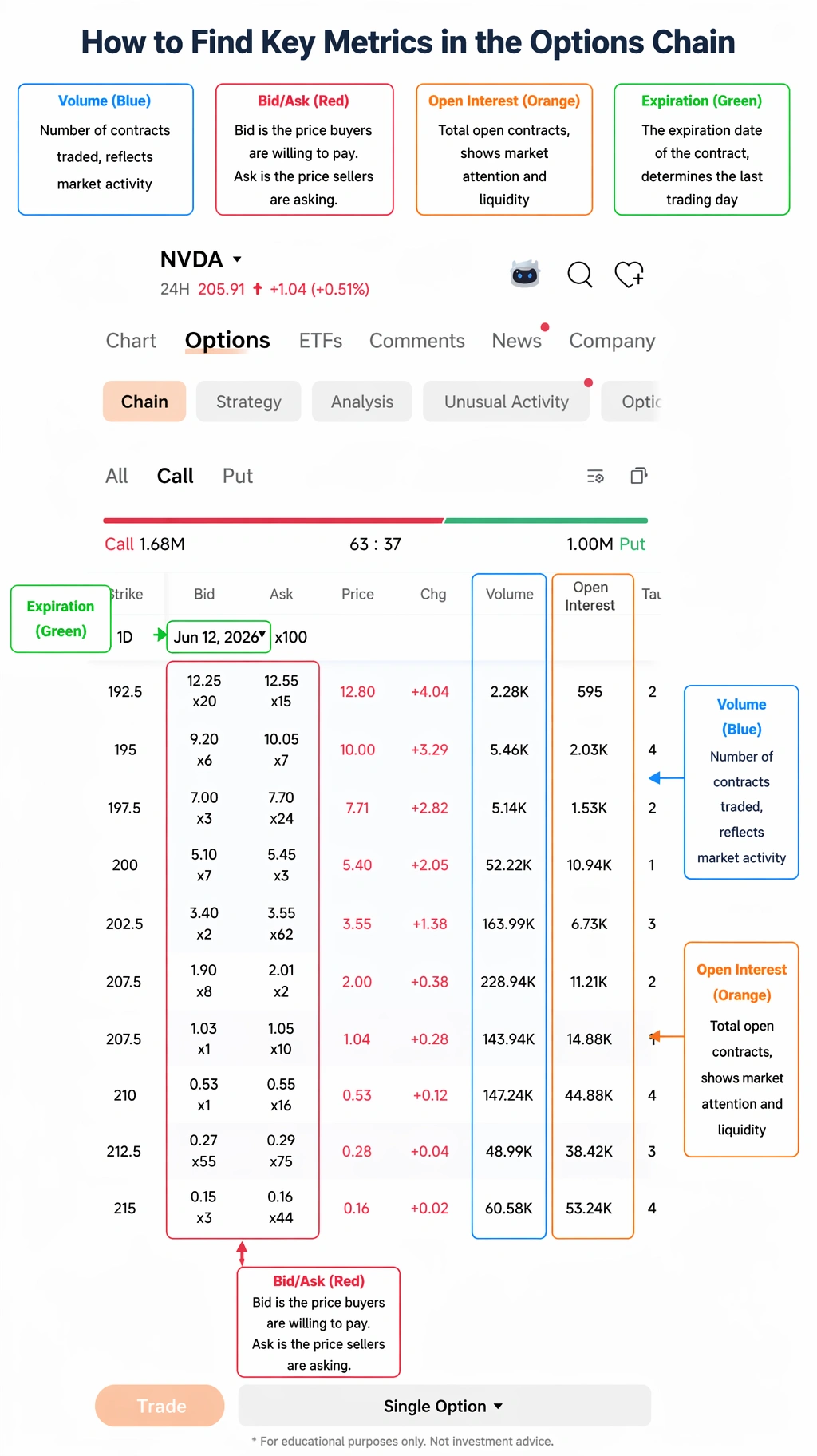
On moomoo, the live option chain and real-time quotes let you check core contract data and the order book on the spot. Focus on these three metrics:
1. Trading Volume
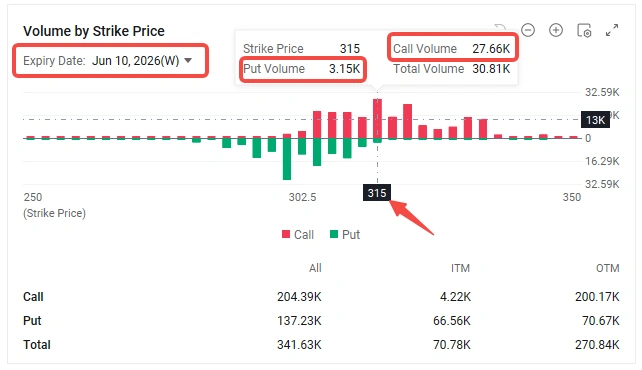
Volume = the number of contracts traded on that option today.
Volume resets daily and updates in real time. Remember: each expiry, strike, and call/put is a separate contract with its own volume — they don't share numbers.
Example: $Apple (AAPL.US)$ options expiring 10 Jun 2026
Same expiry, $315 strike: the call traded 27.66k contracts; the put only 3.15k. Among contracts in that cycle, the $315 call led the pack. With AAPL at $301.54, the picture was clear — the market was betting heavily on WWDC as a catalyst, pricing in a move above 4%.
2. Open Interest (OI)
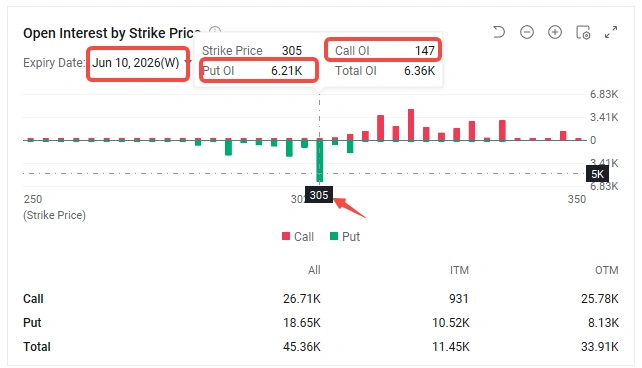
Open interest is the total number of outstanding contracts that are still open and not yet expired. Unlike volume, which moves all day, OI is a snapshot — updated with a slight lag — and reflects where longer-term money is positioned.
Higher OI means more market depth and participants. Supply and demand balance better, so exiting at a fair price is easier. Low OI? You might buy in fine — but struggle to sell out.
Example: $Apple (AAPL.US)$ 10 Jun 2026, $305 strike
The $305 call had just 147 contracts of OI. The put? 6.21k — a huge gap. The market treated $305 as a firm support level for the week, with roughly 1.15% upside from the 8 Jun close. Overall sentiment leaned bullish.
Practical takeaway: holding the $305 put? High OI should make closing out straightforward. Holding the $305 call? Thin OI could mean a discount when you need to exit.
3. Bid-Ask Spread
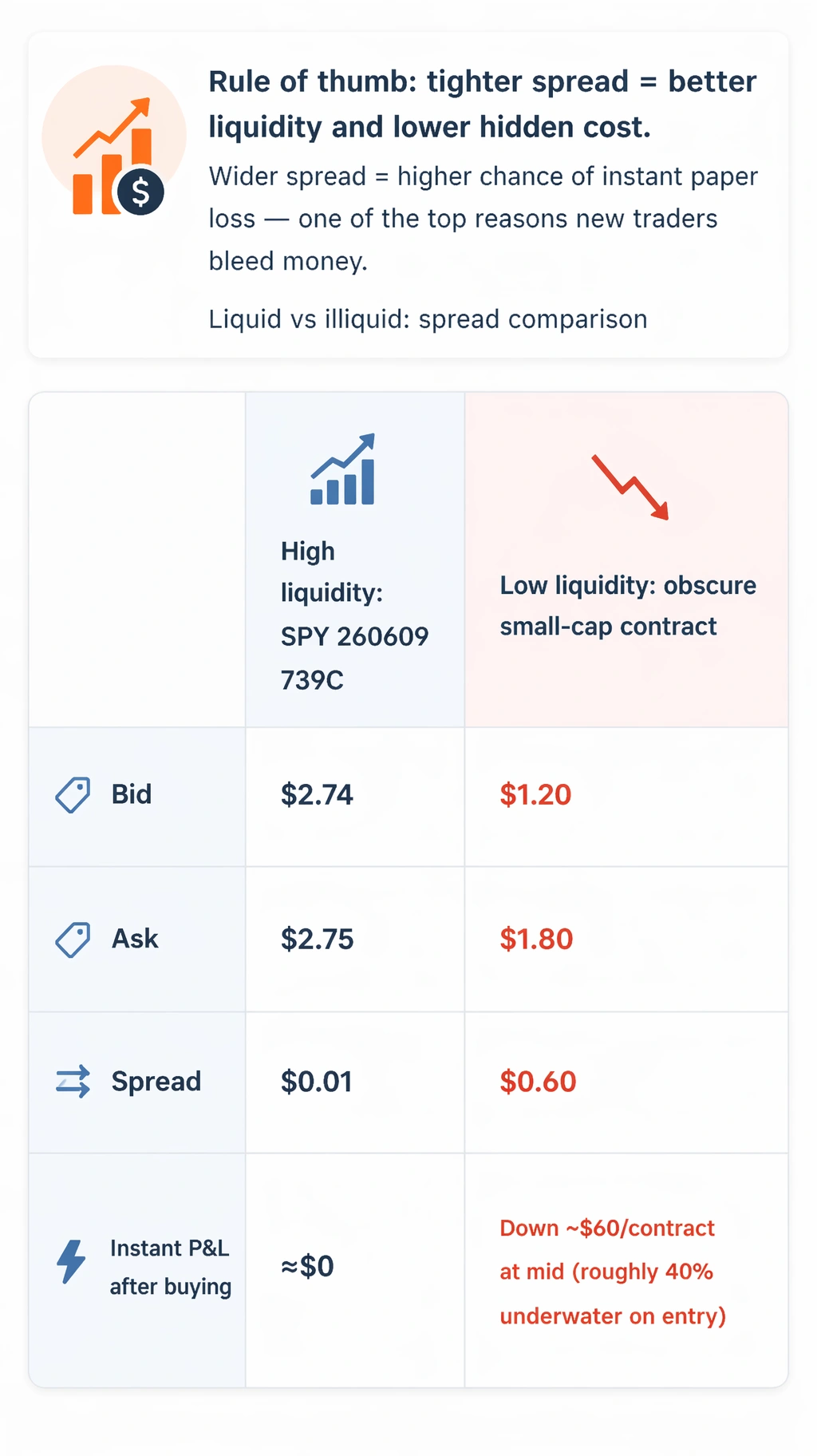
Spread is the metric beginners overlook most — and the one that hits profits hardest. Bid = the highest price buyers are willing to pay. Ask = the lowest price sellers will accept. The gap between them is the spread: Spread = Ask − Bid.
Here's how to use moomoo to check on the key metrics in the option chain, let's take $NVIDIA (NVDA.US)$ for example:
Option Order Types: Pros & Cons
Reading liquidity is step one. Nailing your entry timing and order type is how you turn good liquidity into a good trade. Most option orders fall into three buckets: market orders, limit orders, and advanced conditional orders.
1. Market Order: Speed First, Price Second
A market order means you don't set a price. You're telling your broker:
Fill my order as fast as possible at whatever price the market offers right now.
How it works: a market buy typically hits the best ask; a market sell hits the best bid.
Your actual fill may not match the bid or ask on screen — especially when the market is moving fast or liquidity is thin. That's slippage.
This is the go-to for traders who need speed. The logic is simple: get filled first, worry about price second. Best for time-sensitive entries and exits.
✅ Pros: Easy to use, no need to watch the screen, fastest fill. Great when you need to act quickly — and on liquid contracts with tight spreads, the fill is usually close to what you see.
❌ Cons: No price guarantee. Slippage risk is real. In volatile markets or thin contracts, quotes can shift in seconds — and your fill can land far from what you expected. Buy now, regret immediately.
How does slippage happen?
Example: you see an ask at $2.20 and hit market buy. Before your order lands, the best offer gets taken and the quote refreshes. You might fill at $2.25, $2.30, or higher — extra cost, just like that.
2. Limit Order: Lock Your Price, Not Your Fill
A limit order lets you set a maximum buy price or a minimum sell price.
In plain terms:
– Buying options: "This is the most I'll pay."
– Selling options: "This is the least I'll accept."
The core idea:
Control your price — not whether you get filled right away.
Traders often place limit orders near:
– The bid
– The ask
– Mid-price — halfway between bid and ask
✅ Pros: Precise pricing and cost control. Excellent in calm markets. Handy for multi-leg strategies (e.g. bull call spread) — set one net price and lock in both legs at once.
❌ Cons: No fill guarantee. In a fast rally or sell-off, your limit may never get hit — and you miss the move or can't exit in time.
Tip: Don't set a limit miles away from the spread. You'll likely sit unfilled and miss the trade entirely.
For investors new to options trading, consider starting with high-liquidity tech stocks such as $NVIDIA (NVDA.US)$, $Tesla (TSLA.US)$, $Netflix (NFLX.US)$, and $Intel (INTC.US)$. The recently listed $SpaceX (SPCX.US)$ also has options chains available.
Alternatively, for a more conservative first trade, you can opt for a broad-based index ETF like $SPDR S&P 500 ETF (SPY.US)$, $Invesco QQQ Trust (QQQ.US)$, $iShares Russell 2000 ETF (IWM.US)$, $Vanguard S&P 500 ETF (VOO.US)$.
3. Advanced Conditional Orders
Standard market and limit orders fire immediately. moomoo's advanced conditional orders are trigger-based — you set conditions upfront, and the system acts when they're met. Less screen-staring, less emotion. A favourite among seasoned traders.
In short: the order only submits or executes when your preset conditions are triggered.
You can layer in more logic, such as:
– Underlying rises to a trigger price → sell at a set price (take profit)
– Underlying falls to a trigger price → sell at a set price (stop loss)
– Price tracks up by a fixed amount or % → buy when the level breaks
– Price tracks down by a fixed amount or % → sell when the level breaks
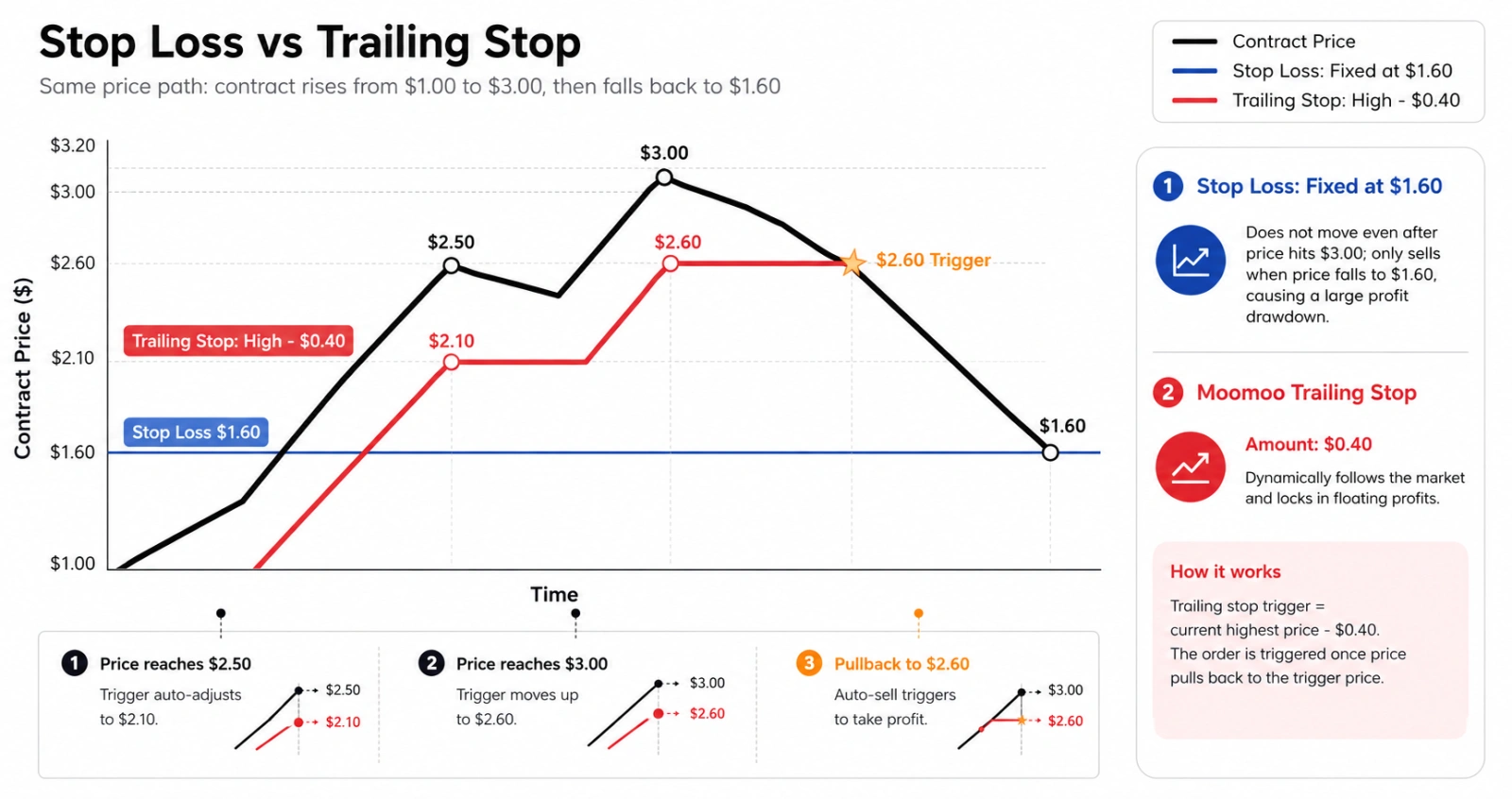
Take a trailing stop limit order. A plain stop loss stays fixed: buy at $2.00, stop at $1.60 — even if the contract runs to $4.00, your stop is still $1.60. A sharp pullback can wipe out all your gains.
moomoo's trailing stop moves with the market — locking in floating profit along the way.
Example: buy a call at $2.00, set a $0.40 trail
– Contract rises to $2.50 → stop adjusts to $2.10
– Contract rises to $3.00 → stop moves up to $2.60
– Price pulls back from $3.00 to $2.60 → sell triggers automatically. Profit secured.
⚠️ Note: In extreme volatility, choppy price action can trigger orders by mistake. Use with care in sideways markets; trend environments tend to suit these orders better.
Four Entry Tips to Avoid Costly Mistakes
1. Check the Last Trade — Start with a Probe Order
Don't blindly chase market orders or park your limit exactly on the bid or ask. On moomoo's option chain, check open interest and live quotes — the last traded price is what the market actually agreed on.
How to do it: if the spread is $1.15–$1.20, trades often cluster around $1.16–$1.17. Buyers can bid slightly below mid; sellers can ask slightly above. Wait for a counterparty. If nothing fills in 10–15 minutes, review the chain and consider adjusting your price or switching strikes.
2. Follow Volume — Skip the Opening Chaos
The first 15–30 minutes after the US open are often noisy. Trends haven't formed, volume is scattered — not the best time for beginners to jump in.
Better approach: wait for the session to settle, then use moomoo's live option chain to spot contracts with surging volume. Cross-check OI for liquidity and direction. Enter only when volume and OI are both active and aligned with your view. Your odds improve meaningfully.
3. Try Odd Lot Sizes
Most traders stick to round lots — 1, 2, 5, 10 contracts. Those prices get crowded and competitive.
Try 4, 6, 7, or 9 contracts instead. Odd sizes can slip past the queue and fill faster. Top up any remainder with a follow-up order — better fill odds, and you keep single-trade risk in check.
4. Try Advanced Conditional Orders
Experienced traders rarely try to nail the exact bottom. They let the market confirm the turn first.
No need to predict every move. Set triggers: enter automatically when a reversal or stabilisation is confirmed; exit when the trend fades and profit shrinks. Less emotion, more consistency.
One caveat: trailing stops can misfire in highly volatile markets, where prices whip up and down. Short-term noise may trigger an entry that doesn't reflect a real trend reversal.
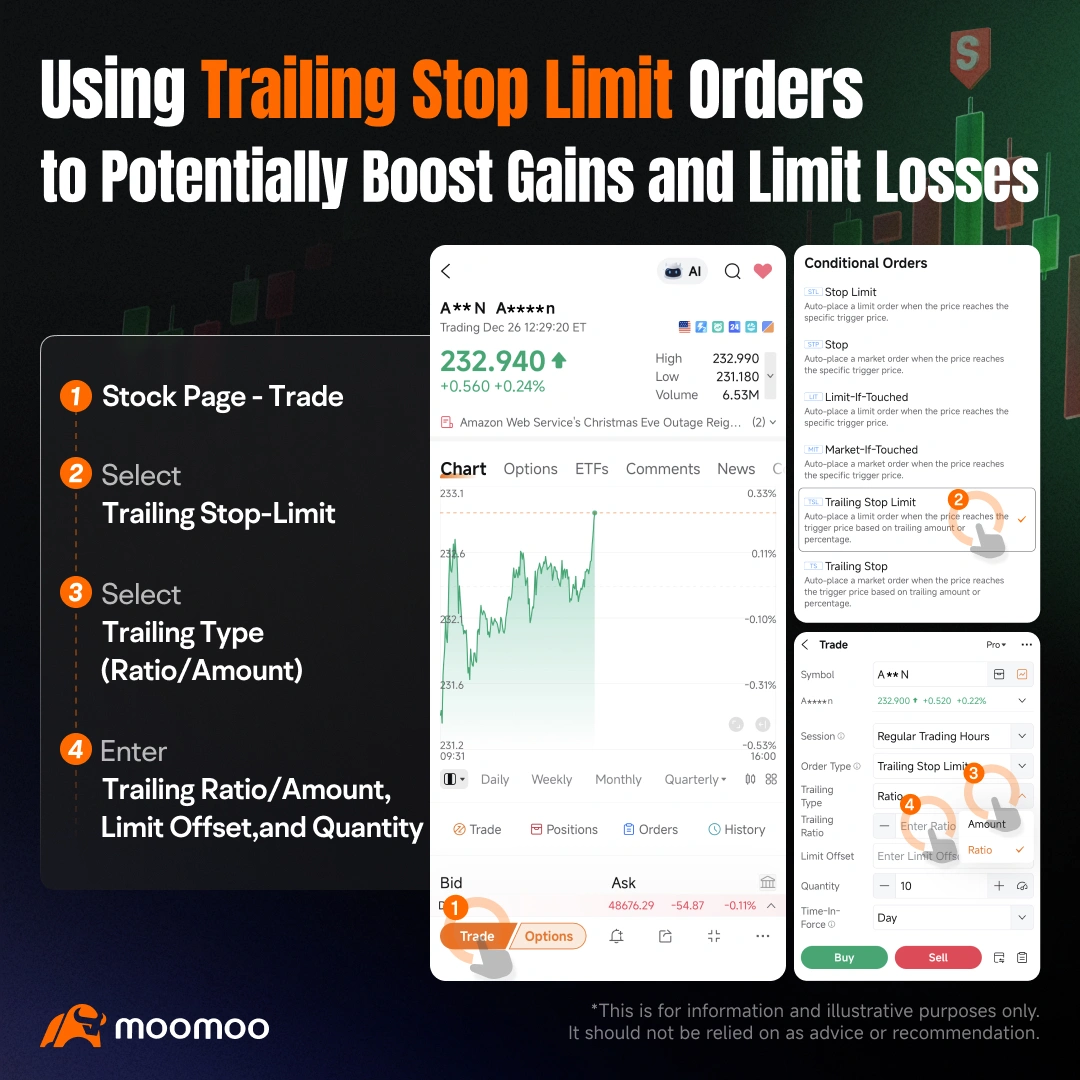
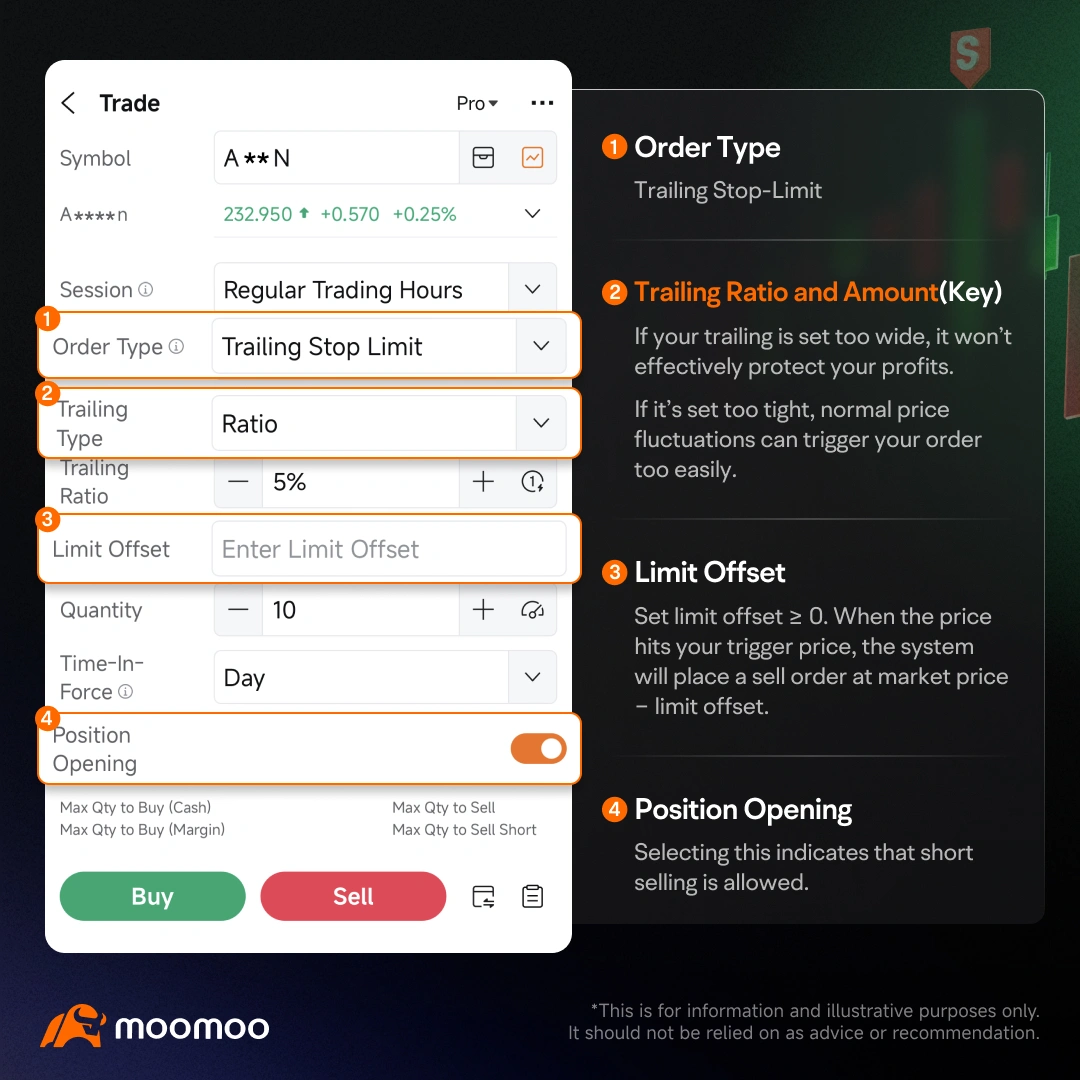
How to use advanced conditional orders on moomoo>>
Disclaimer: Options trading involves significant risk and is not suitable for all investors. Full disclaimers at www.moomoo.com/sg/support/topic5_510. This advertisement has not been reviewed by the Monetary Authority of Singapore.
This presentation is for informational and educational use only and is not a recommendation or endorsement of any particular investment or investment strategy. Investment information provided in this content is general in nature, strictly for illustrative purposes, and may not be appropriate for all investors. Read more