Cryptocurrency Investment in Singapore: Strategies and Insights

In the digital age, crypto trading has become an integral part of the global financial market. With the rapid development of blockchain technology, crypto assets have not only changed our traditional perception of currencies, but also provided investors with new opportunities to grow their wealth while highlighting the associated risks. In Asia, Singapore has become a hotspot for cryptocurrency investment with its open financial policies, advanced regulatory framework and embrace of innovative technology.

The cryptocurrency investment market in Singapore attracts investors from all over the world. Here, investors not only have access to a diverse range of cryptocurrencies, such as Bitcoin and Ether, but also enjoy the favourable policies of the Singaporean government to promote the development of fintech. Together, these factors create a stable and favourable environment for the cryptocurrency investment market in Singapore.
The purpose of this article is to provide a guide on investing in cryptocurrencies in Singapore, including popular coins, analysis of investment strategies, and ways to utilise local resources such as platforms like moomoo for efficient management. Through an in-depth discussion of Singapore’s unique advantages and practical investment tips, we help investors to better capitalise on opportunities, avoid risks and ultimately achieve their financial goals.
What is Cryptocurrency Investment?

Cryptocurrency investment refers to the purchase, holding or trading of cryptocurrencies by an investor with a view to obtaining capital appreciation in the future or profits through trading. Cryptocurrencies, such as Bitcoin and Ethereum, are digital assets that use cryptography to secure transactions and control the creation of monetary units. These currencies are usually not controlled by central banks or governments and instead rely on decentralised networks and consensus mechanisms, such as blockchain technology, to record and verify transactions. Regulatory bodies, like the IRS, classify cryptocurrencies as financial assets for tax purposes, and there are potential future applications of blockchain technology for trading various financial assets, such as stocks and bonds.
Basic Features of Digital Currency
Decentralised: unlike traditional currencies, cryptocurrencies do not rely on a central bank or single governing body to issue and regulate them. Instead, they are verified and recorded through nodes in a network.
Security: advanced encryption technology protects the privacy and integrity of transactions, making it extremely difficult to tamper with data.
Transparency: although an individual's identity can remain anonymous, all transactions are recorded on a public and immutable distributed ledger, known as a blockchain.
Limited supply: many cryptocurrencies are designed with a maximum supply, e.g. the Bitcoin total will never be more than 21 million pieces. This feature helps prevent inflation and increases scarcity value.
Potential Advantages And Rewards of Investing in Cryptocurrencies

Potential Advantages
High return potential: Due to market volatility, prices may rise significantly in the short term, providing significant gains for investors.
Diversification: including cryptocurrencies in a portfolio can help diversify risk, as their performance tends to be less correlated with other traditional asset classes such as stocks and bonds.
Technological innovations: The cryptocurrency space continues to see the emergence of new technologies and applications, such as Decentralised finance (DeFi) and Non-Fungible Tokens (NFTs), which provide investors with more opportunities and application scenarios.
Potential Risks
Price volatility: the cryptocurrency market is very volatile and can move dramatically in a short period of time, which can be a challenge for investors looking for stable returns.
Regulatory uncertainty: changes in regulations in various places, including Singapore, may affect the direction of the cryptocurrency industry. The cryptocurrency legal status varies by jurisdiction, and while trading and investment may be permitted, cryptocurrencies are not recognized as legal tender. This regulatory uncertainty also extends to taxation and the acceptance of cryptocurrencies as a valid means of payment, highlighting the differences between cryptocurrencies and traditional fiat currencies.
Security threats: although the blockchain itself is secure, exchanges and personal wallets are still at risk of theft. Therefore, it is crucial to choose reputable platforms and service providers.
How Cryptocurrencies Work with Blockchain Technology

Each cryptocurrency has its own unique mechanism, but most follow similar principles:
Mining: Some cryptocurrencies require ‘miners’ to use their computing power to solve complex mathematical problems to generate new blocks of coins. This not only facilitates the creation of new coins, but also maintains the security of the network.
Consensus Algorithms: In order to ensure that all participants agree on the latest transaction status, cryptocurrency networks use different consensus algorithms such as Proof of Work (PoW) and Proof of Stake (PoS).
Smart Contracts: Some cryptocurrencies, notably Ethereum, have introduced the concept of smart contracts, allowing developers to write code that automatically enforces the terms of a contract.
Popular Cryptocurrencies for Investment
When making cryptocurrency investments in Singapore, it is crucial to understand the popular cryptocurrencies in the market. Not only do these coins have strong community support, they are also widely recognised for their technical features and application scenarios.
Bitcoin (BTC)
Created in 2009, Bitcoin is the world's first and most recognisable cryptocurrency. Based on blockchain technology, it is a decentralised digital currency designed to enable a peer-to-peer electronic cash system.
Features:
Decentralised: no central authority control, all transactions are verified through network nodes.
Limited supply: total supply is capped at 21 million coins, which is expected to be reached by 2140.
Transparency and anonymity: all transaction records are publicly available, but participants' identifying information can remain relatively anonymous.
Advantages of the Technology Platform:
Bitcoin's blockchain technology provides a transparent and efficient electronic transaction system with security and stability proven over years of operation.
Ethereum (ETH)
Ethereum is an open source blockchain platform that allows developers to build and deploy smart contracts and decentralised applications (DApps). Ethereum (ETH) is the native token on the Ether network that is used to pay for transaction fees and computing services.
Features:
Smart contracts: supports the writing of programs that automatically enforce the terms of contracts.
Programmability: provides a flexible framework to create various types of decentralised applications.
Consensus mechanism: currently uses Proof of Work (PoW), with plans to transition to Proof of Stake (PoS).
Advantages of the Technology Platform:
Ethernet's blockchain technology supports more complex transactions such as smart contracts and dApps. its smart contract capabilities make it ideal for building complex financial services and other applications.
BNB (BNB)
BNB is a native token issued by Binance, the world’s largest crypto exchange. It was originally hosted on Ethereum and used the ERC20 standard, but was later moved to its own blockchain, BNB Chain.
Features:
Multi-purpose: In addition to being used as a fee discount on trading platforms, it can also be used to pay for travel, entertainment, and many other services.
Quarterly destruction: Binance regularly and permanently destroys a portion of BNB from circulation to reduce the total amount, thus potentially increasing the value of the remaining tokens.
Cross-chain compatibility: Compatible with multiple blockchain networks, increasing the usage scenarios of BNB.
Advantages of the technology platform:
BNB is not just a token, but a core component of the entire Binance ecosystem. The development of the Binance Smart Chain further enhances the functionality of BNB.
BTC/USD and ETH/USD on Cryptocurrency Exchanges
BTC/USD and ETH/USD represent the exchange rate of Bitcoin against the US Dollar and Ether against the US Dollar, respectively. These pairs reflect the price movement of their respective cryptocurrencies relative to the U.S. Dollar and are important indicators of the performance of the cryptocurrency market.
Feature:
Benchmark reference: as benchmarks in the cryptocurrency market, they are often used to assess overall market conditions.
Highly liquid: as they involve the global reserve currency, the US Dollar, these two pairs are very active in the market and have a high degree of liquidity.
Volatility: despite the high level of liquidity, the inherent volatility of cryptocurrencies means that these pairs can also experience sharp price movements.
Why Invest in Cryptocurrency in Singapore?

As a hotspot for cryptocurrency investment, Singapore offers a unique and attractive environment for investors to capitalise on the opportunities of this emerging asset class. Here are a few key reasons to invest in cryptocurrency in Singapore:
Stable and Innovative-supportive Regulatory Environment
Friendly regulatory policies: The Monetary Authority of Singapore (MAS) has taken a balanced approach to regulating the cryptocurrency market, both by protecting investors from the risk of fraud and by encouraging technological innovation. For example, MAS introduced the Payment Services Act, which provides clear guidelines for cryptocurrency exchanges and other related businesses, which contributes to a transparent and regulated market environment.
Compliance and trust: By implementing strict KYC (Know Your Customer) and AML (Anti-Money Laundering) regulations, Singapore ensures compliance in the cryptocurrency market. This high-standard regulatory framework has boosted investor confidence and attracted more institutional investors to the space.
Developed Fintech Ecosystems and Financial Institutions
Abundant resources: Singapore has a range of well-established fintech companies, incubators and accelerators that provide strong support for cryptocurrency startups. These resources not only facilitate the development of technology, but also help entrepreneurs grow quickly and enter the international market.
Leading trading platforms: Singapore is home to or operates a number of well-known cryptocurrency exchanges, such as Binance and Huobi. The diverse services and favourable user experience offered by these platforms provide convenient investment channels for local and international investors.
Banking and payment systems: Singapore has a highly developed banking and payment system that can provide stable support for cryptocurrency trading. Many financial institutions are exploring ways to better serve the cryptocurrency industry, including by offering specialised accounts and services. This collaboration between cryptocurrencies and financial institutions aims to improve transaction efficiency and reduce costs.
Favorable Tax Policies
Capital gains tax exemption: In Singapore, capital gains made by individuals from buying and selling cryptocurrencies are generally not considered taxable income. This means that investors can keep more of their gains without having to worry about high tax liabilities.
Business friendly: For entrepreneurs looking to set up a cryptocurrency-related business, Singapore's relatively low corporate tax rate, along with various tax incentives, such as R&D tax incentives, creates a more favourable environment for businesses to grow.
Advanced Cryptocurrency Investment Strategies
When investing in cryptocurrencies in Singapore, mastering a few advanced investment strategies can help investors manage risk more effectively, optimise returns, and maintain a competitive edge in an ever-changing market. Here are a few strategies for advanced investors:
Day Trading
Day trading involves buying and selling cryptocurrencies within the same day to take advantage of market fluctuations to earn short-term profits. This type of trading requires investors to have a keen eye for the market, quick decision-making ability, and good risk management skills. Choosing the right crypto exchanges is crucial for high-frequency trading, as reputable platforms offer better security features and accessibility for both beginners and experienced traders.
Basic Principles
High frequency trading: Day trading usually involves frequent buying and selling operations that may be completed multiple times in a single day.
No overnight positions: In order to avoid the uncertainty of the night market, day traders generally do not hold positions after the close.
Technical analysis-based: Day trading relies heavily on technical analysis to identify entry and exit points.
Swing Trading
Swing Trading is a short to medium term trading strategy that usually involves holding a position for a few days to a few weeks. This strategy is designed to capture price movements in volatile markets and take profits by identifying turning points in the trend.
Basic Principles
Medium-term perspective: Swing traders look at price movements for days to weeks, not minutes or hours for day traders.
Technical analysis-based: relies heavily on technical analysis tools to identify entry and exit points.
Risk management: Set reasonable stop-loss points to protect capital and adjust position sizes according to market conditions.
Mean Reversion
Mean Reversion is a statistically based investment strategy that assumes that market prices will tend to converge to a historical average over the long term. When prices deviate from this average, investors can use this deviation to trade with the expectation that prices will eventually return to the average.
Basic Principles
Market volatility: Prices in the market do not always travel randomly, but there are certain cycles and trends.
Statistical patterns: Based on historical data, prices usually fluctuate within a certain range and have a tendency to revert to the historical mean.
Short-term opportunities: By identifying price deviations from the mean, investors can buy on price pullbacks and sell when prices are too high.
Volume Price Analysis Trading
Volume Price Analysis Trading is a technical analysis method that combines price action and volume to predict the future direction of the market. By observing the relationship between price changes and volume, especially in the context of virtual currency, investors can better understand the dynamics of supply and demand in the market and thus make more informed investment decisions.
Basic Principles
Relationship between price and volume: Changes in price are usually accompanied by changes in volume. High volume tends to imply a high level of market participation, and price movements are likely to be more reliable.
Balance of supply and demand: Higher prices accompanied by higher volume usually indicate stronger buyer power; conversely, lower prices accompanied by higher volume may indicate stronger seller power.
Confirmation of trend: Volume can be used to confirm the validity of a price trend. For example, in an uptrend, an increase in volume on the upside and a decrease in volume on the downside is usually a healthy sign.
Invest Cryptocurrency with Moomoo Singapore

When investing in cryptocurrencies in Singapore, it is crucial to choose a reliable and feature-rich trading platform from a reputable service provider. Moomoo Singapore is an excellent and reliable financial trading platform that not only provides trading services for traditional financial products such as stocks and options, but also supports cryptocurrency investments. Below are some of the key benefits and steps to invest in cryptocurrency through Moomoo Singapore.
The Moomoo Singapore Advantage
Comprehensive Market Coverage
Multiple cryptocurrencies: Moomoo Singapore offers a wide range of cryptocurrency options, including Bitcoin (BTC), Ethereum (ETH), and many other major coins.
Real-time market data: The platform provides real-time market quotes, charts and technical indicators to help investors make more informed decisions.
Advanced Trading Tools
Advanced charting: A variety of built-in technical analysis tools, such as Moving Averages, Bollinger Bands, RSI, etc., facilitate investors to conduct in-depth technical analysis.
Multi-functional toolbox: In addition to basic quotes and stock picks, Moomoo also provides smart staking and price alerts to help investors better manage their risks.
Security and Compliance
Security: Moomoo is accredited in a number of countries, including Singapore and the US, and holds a Singapore Capital Markets Services Licence, as well as a license to operate trust businesses and services.
Compliance: Moomoo Singapore strictly adheres to the rules and regulations of the Monetary Authority of Singapore (MAS).
How to Invest in Cryptocurrency Through Moomoo Singapore
1. Register for an Account:
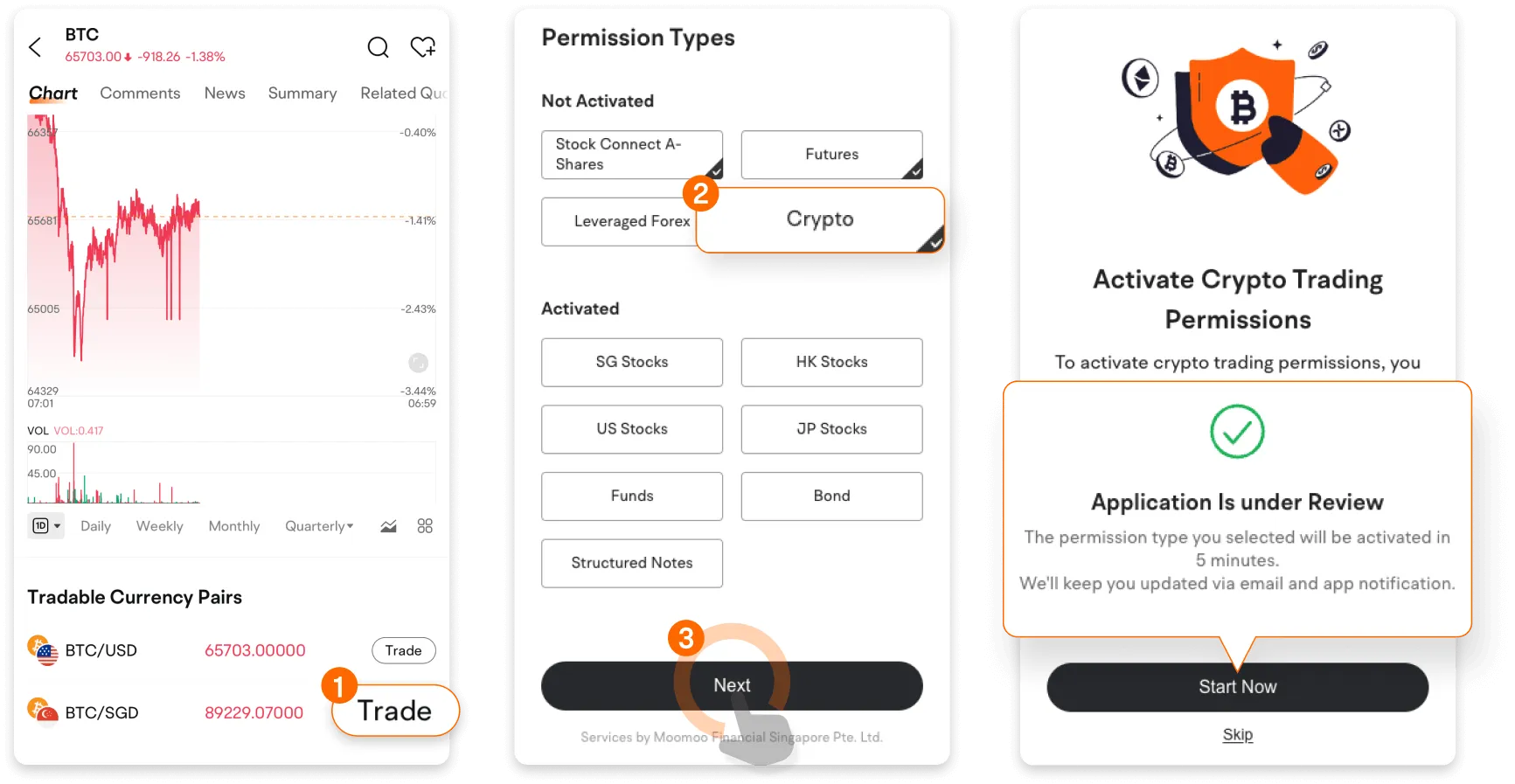
Visit the official moomoo website or download the moomoo app.
Follow the prompts to fill in your personal information and complete the authentication process.
Go to Trading and select cryptocurrency to open a crypto account.
2. Transfer Funds:
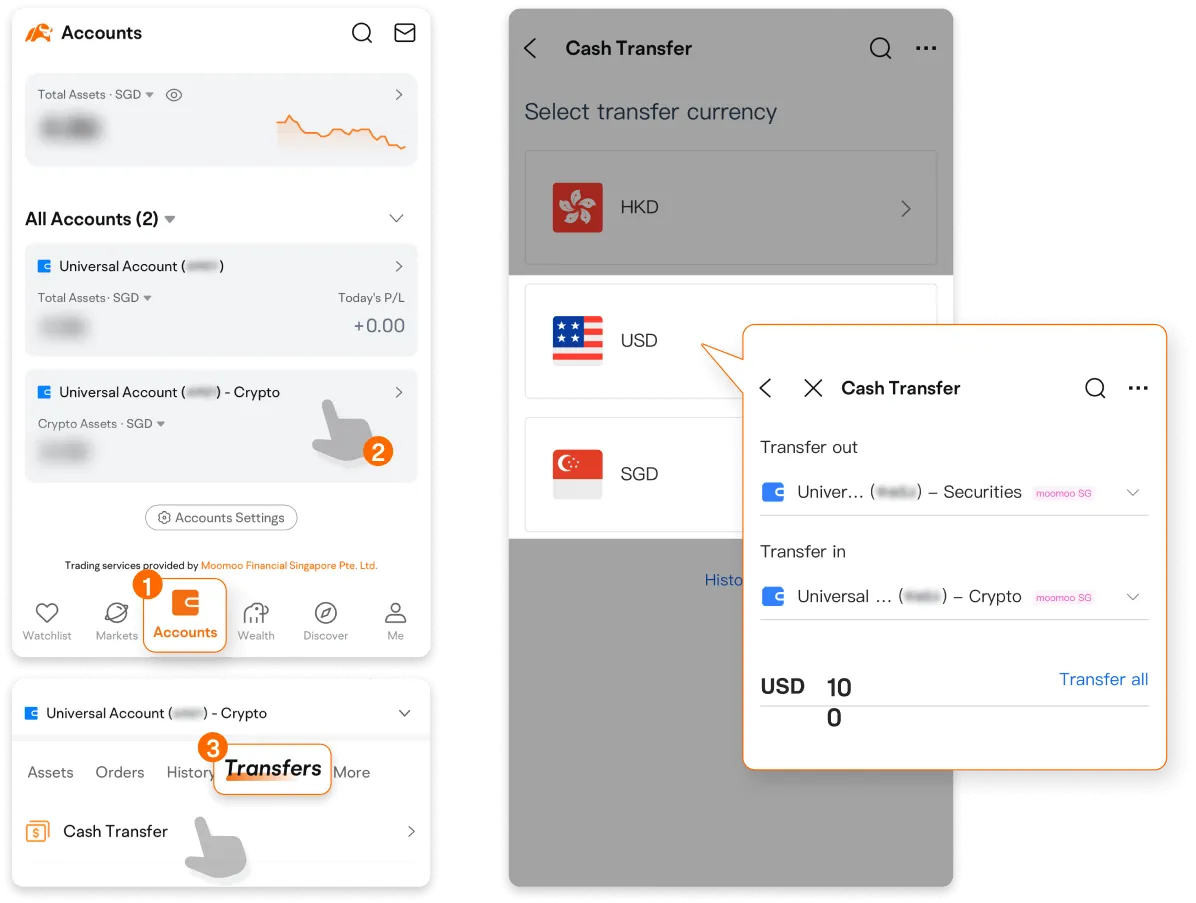
Log in to your moomoo account.
Select Cryptocurrency Account under the Accounts option and follow the instructions to deposit cash (e.g. SGD) into your account.
Multiple deposit methods are supported, including bank transfer deposits, deposits via transfer on payment platforms (Wise/BigPay), and more.
3. Select Cryptocurrency:
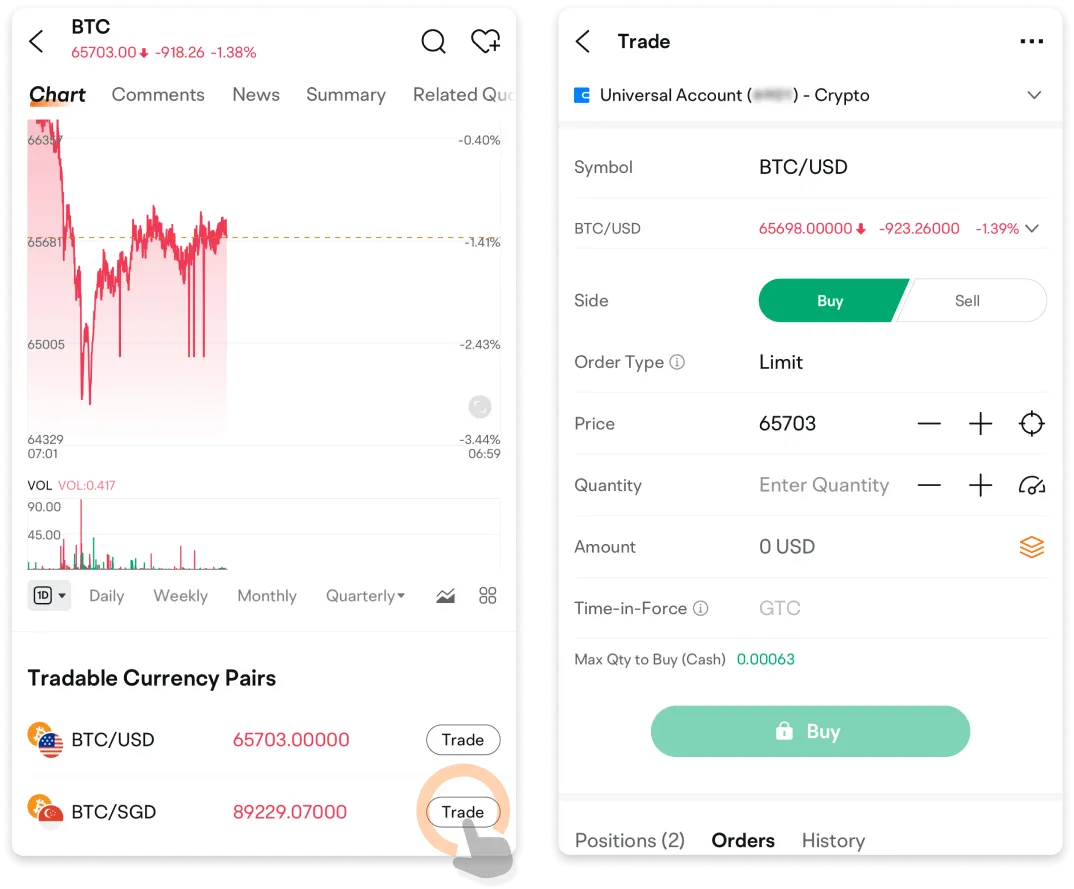
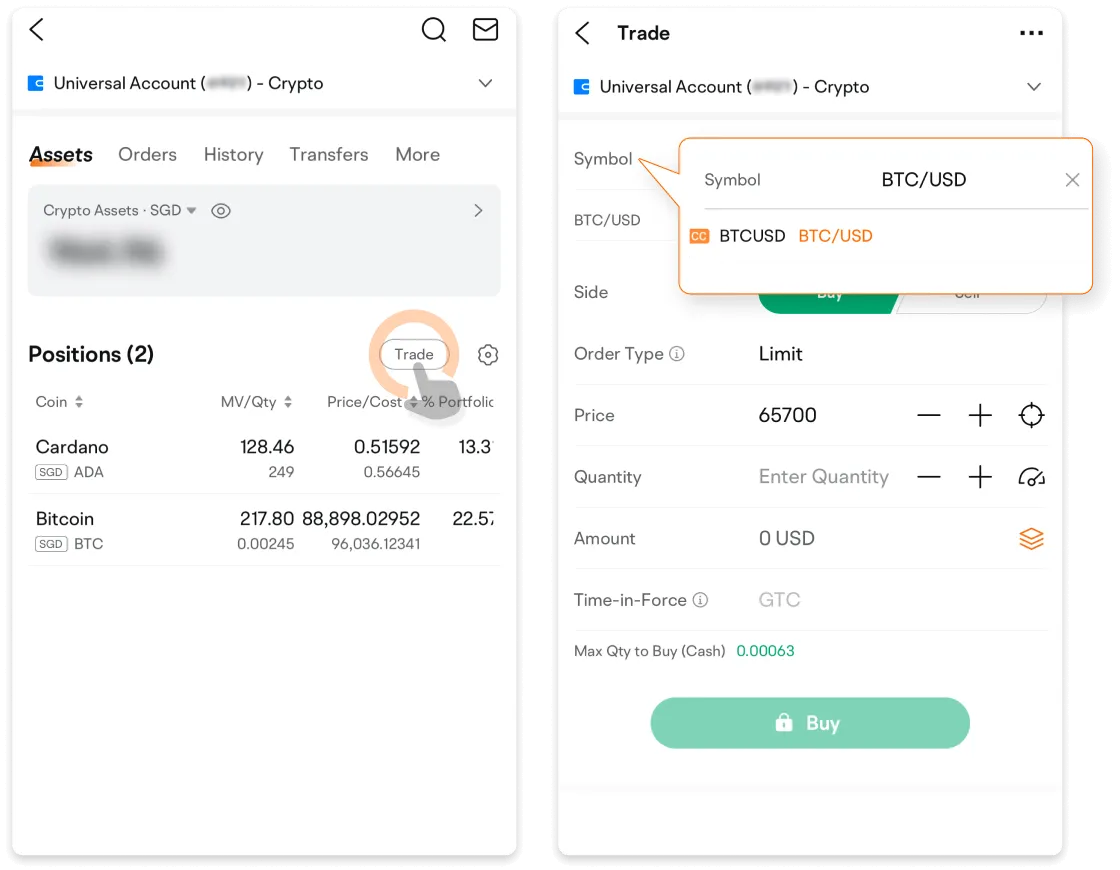
Browse the list of available cryptocurrencies on the moomoo app.
Research with the provided market data and charts and select the coins you are interested in trading.
Conclusion

Cryptocurrency investments in Singapore not only offer opportunities for technological innovation and portfolio diversification, but also benefit from favourable tax policies, advanced fintech infrastructure and a stable and pro-innovation regulatory environment. By employing advanced strategies such as intraday trading, swing trading, mean reversion and volume price analysis, and utilising a fully functional and user-friendly trading platform such as moomoo, investors can better capture market opportunities and manage risk. However, the high volatility and potential risks of the cryptocurrency market make it advisable for investors to conduct adequate research, set reasonable stop-loss points, and maintain a long-term investment perspective. With proper planning and continuous learning, investors can expect to achieve solid growth in Singapore's cryptocurrency market.
This presentation is for informational and educational use only and is not a recommendation or endorsement of any particular investment or investment strategy. Investment information provided in this content is general in nature, strictly for illustrative purposes, and may not be appropriate for all investors. Read more