How to Buy the STI ETF in Singapore
Key Takeaways
- STI ETF Overview: The STI ETF provides a cost-effective way to invest in Singapore's top 30 blue-chip companies, offering instant diversification and exposure to key sectors like financials, industrials, and real estate.
- Two STI ETF Options: Investors can choose between SPDR STI ETF (ES3) and Nikko AM STI ETF (G3B), both of which track the same index but differ in management style, fees, and assets under management.
- Steps to Invest: To buy the STI ETF in Singapore, open a CDP account, select a brokerage platform, fund your account, and execute trades using ticker symbols ES3 or G3B.
- ETF Investment Benefits: With low fees, high liquidity, steady dividend payouts, and long-term growth potential, the STI ETF is ideal for beginners and passive investors.
- STI ETF Overview: The STI ETF provides a cost-effective way to invest in Singapore's top 30 blue-chip companies, offering instant diversification and exposure to key sectors like financials, industrials, and real estate.
- Two STI ETF Options: Investors can choose between SPDR STI ETF (ES3) and Nikko AM STI ETF (G3B), both of which track the same index but differ in management style, fees, and assets under management.
- Steps to Invest: To buy the STI ETF in Singapore, open a CDP account, select a brokerage platform, fund your account, and execute trades using ticker symbols ES3 or G3B.
- ETF Investment Benefits: With low fees, high liquidity, steady dividend payouts, and long-term growth potential, the STI ETF is ideal for beginners and passive investors.
<div style="text-align: center; margin-top: 32px; margin-bottom: 16px;"> <a href="https://openaccount.sg.moomoo.com/setup-page/index" target="_blank" rel="noopener noreferrer" style="display: inline-block; background-color: #ff6600; color: #ffffff; font-size: 18px; font-weight: bold; text-decoration: none; padding: 14px 40px; border-radius: 50px; box-shadow: 0 4px 12px rgba(255, 102, 0, 0.3); transition: background-color 0.3s ease; min-width: 200px;" onmouseover="this.style.backgroundColor='#e65c00'" onmouseout="this.style.backgroundColor='#ff6600'"> Start Investing with Moomoo SG </a></div>
If you are looking for a simple, effective, and highly accessible way to grow your wealth, investing in Singapore’s top 30 blue-chip companies is an excellent starting point. For both investment beginners and those with basic market experience, understanding how to buy STI ETF in Singapore is a fundamental milestone. This comprehensive 2026 guide will walk you through everything you need to know—from understanding what the fund is, to comparing your options, executing your first trade, and building a long-term strategy for financial success.
What is the Straits Times Index (STI) ETF?
To understand the STI ETF, we first need to break down the acronym. "ETF" stands for Exchange-Traded Fund, which is a type of pooled investment security that you can buy and sell on a stock exchange just like an individual stock. The "STI" stands for the Straits Times Index, the benchmark index that tracks the performance of the top 30 largest and most liquid companies listed on the Singapore Exchange (SGX).
When you learn how to buy STI ETF in Singapore, you are essentially learning how to buy a single fund that mirrors this exact index. Instead of purchasing 30 different stocks individually—which would require significant capital and management—the STI ETF offers you a diversified slice of the entire Singapore stock market through a single, convenient purchase.
Key Benefits of Investing in the STI ETF
Investing in the STI ETF comes with several core advantages, especially for those who want a hands-off approach to wealth accumulation:
Instant Diversification: By holding one unit of the ETF, you instantly gain exposure to leading industries. For instance, the fund is heavily anchored by the Financial Services sector (57.23%), alongside Industrials (15.16%) and Real Estate (14.65%). You instantly own fractions of local giants like DBS Group Holdings, Oversea-Chinese Banking Corp (OCBC), and United Overseas Bank (UOB).
Low-Cost Market Access: Buying 30 individual blue-chip stocks would incur massive brokerage commissions. An ETF bundles these together, allowing you to invest with significantly lower transaction and management fees.
High Liquidity: Many SGX-listed ETFs, particularly popular index and commodity ETFs, offer high liquidity. Top products regularly trade millions of shares daily, enabling investors to buy or sell units easily at market prices. Liquidity varies by ETF, with niche products typically seeing lower volumes.
Simplicity and Peace of Mind: There is no need to analyze individual balance sheets or attempt to pick winning stocks. The ETF automatically adjusts to mirror the top 30 companies, saving you time and reducing the stress of active stock picking.
The Two STI ETFs in Singapore: A 2026 Comparison
When researching how to buy STI ETF in Singapore, you will quickly discover that there are two primary options available on the Singapore Exchange (SGX). Both aim to replicate the exact same index, but they are managed by different financial institutions. These are the SPDR STI ETF (ticker symbol: ES3) and the Nikko AM Singapore STI ETF (ticker symbol: G3B).
SPDR Straits Times Index ETF (ES3)
The SPDR Straits Times Index ETF (ES3) is the older and more established of the two funds. It is managed by State Street Global Advisors (specifically, State Street Global Adv Singapore Ltd), with State Street Bank & Trust Co acting as the trustee. Listed on April 11, 2002, this fund has a long and resilient track record of tracking the FTSE/SGX STI TR SGD index. It operates within the limits set out in the CPF Investment Guidelines, making it a staple for many local retirement portfolios.

Nikko AM Singapore STI ETF (G3B)
The alternative option is the Nikko AM Singapore STI ETF (G3B). This fund is managed by Nikko Asset Management. Like its SPDR counterpart, it is designed to track the exact same top 30 blue-chip companies on the SGX. It offers investors a slightly different management structure but serves the exact same core purpose: providing broad, diversified exposure to the Singapore market.
ES3 vs. G3B: Key Differences for Investors in Singapore
While both funds track the same index, they have distinct operational metrics. Below is a comparative analysis based on the latest 2026 market data to help you make an informed decision based on cost and scale.
Metric | SPDR STI ETF (ES3) | Nikko AM STI ETF (G3B) |
Fund Manager | State Street Global Advisors | Nikko Asset Management |
Total Expense Ratio (TER) / Total Fee Rate | 0.28% (Management Fee: 0.30%) | Varies by reporting period |
AUM | 3.24 Billion SGD (As of May 2026) | Varies |
Board Lot Size | 1 Unit | 1 Unit |
Dividend Payout Frequency | Semi-Annually | Semi-Annually |
Top Holding | DBS Group Holdings Ltd (26.63%) | Mirrored Index Weighting |
Note: As of June 2, 2026, the SPDR STI ETF (ES3) currently boasts a massive AUM of 3.24 Billion SGD, reflecting strong institutional and retail trust. Furthermore, the accessible board lot size of just 1 unit means investors can start with as little as the price of a single share (e.g., around 5.18 SGD).
Getting Started: What You Need to Buy STI ETFs
Before you can execute your first trade, there are a few administrative steps you must complete. Bridging the gap between knowing what an ETF is and actually owning one requires setting up the right accounts.
Opening Your Central Depository (CDP) Account
In Singapore, the Central Depository (CDP) account acts as your personal digital safe for investments. Operated by the SGX, the CDP account is the secure repository where all the stocks, bonds, and securities you buy on the open market are legally held under your name. While some modern brokerages offer "custodian" accounts (where the broker holds the shares on your behalf), opening a direct CDP account is highly recommended for beginners as it gives you direct ownership and voting rights for your investments. To make managing your investments easier, some modern brokers like Moomoo SG offer one-click CDP Linkage. This feature allows you to view your CDP-held shares, dividends, and records directly within the trading app, creating a unified and seamless experience so you can manage your trading and holdings all in one place.
Choosing a Brokerage Account to Buy Your ETF
While the CDP account holds your shares, you cannot buy them directly from the CDP. You need a stockbroker account, which serves as the trading platform to execute your buy and sell orders. When choosing a broker, you should prioritize low commission fees, intuitive platform usability, and robust customer support. Another key factor is the speed and ease of account opening; you don't want to be stuck filling out manual forms. Modern platforms like Moomoo SG allow Singapore residents to use Singpass for a fully online application, which can get your account approved in minutes. This makes figuring out how to buy STI ETF in Singapore incredibly straightforward.

How to Buy STI ETF in Singapore: A Step-by-Step Guide
Now that your accounts are ready, it is time to make your purchase. This is the core of our guide. Follow these numbered steps to confidently navigate your brokerage platform and execute your first trade.
Step 1: Fund Your Brokerage Account
Before you can buy units of the ETF, you need capital in your brokerage account. Most platforms in Singapore make this process instantaneous. You can deposit funds using PayNow, FAST (Fast and Secure Transfers), or standard bank transfers. Simply link your local bank account to your brokerage, enter the desired investment amount, and initiate the transfer. For example, setting up a Direct Debit Authorisation (DDA) on the moomoo app can allow your funds to arrive in as little as 5 minutes. Once the funds are reflected in your brokerage balance, you are ready to trade.
Step 2: Search for the STI ETF Ticker (ES3 or G3B)
Log into the moomoo app or desktop platform and locate the search bar. If you have decided to purchase the SPDR fund, type in the unique stock ticker symbol ES3. If you prefer the Nikko AM fund, type in G3B. Clicking on the ticker will bring up the fund's real-time quotes data, historical candlestick charts, and current market price.
Step 3: Place Your Buy Order (Limit vs. Market Order)
Click the "Buy" or "Trade" button. You will now be asked to choose an order type. Demystifying this step is crucial for beginners:
Market Order: This tells your broker to buy the ETF units immediately at the best available current market price. This guarantees the trade will happen quickly, but the final price might fluctuate slightly from what you see on the screen due to real-time market movements.
Limit Order: This allows you to set a specific maximum price you are willing to pay. For example, if ES3 is trading at SGD 5.18, you can place a Limit Order at SGD 5.15. Your broker will only execute the trade if the price drops to SGD 5.15. This gives you price control but does not guarantee the order will be filled if the market price keeps rising.
For highly liquid assets like the STI ETF, both methods are viable, though beginners often use Limit Orders for precise budgeting. Enter the quantity you wish to buy (remembering the lot size is just 1 unit) and proceed.
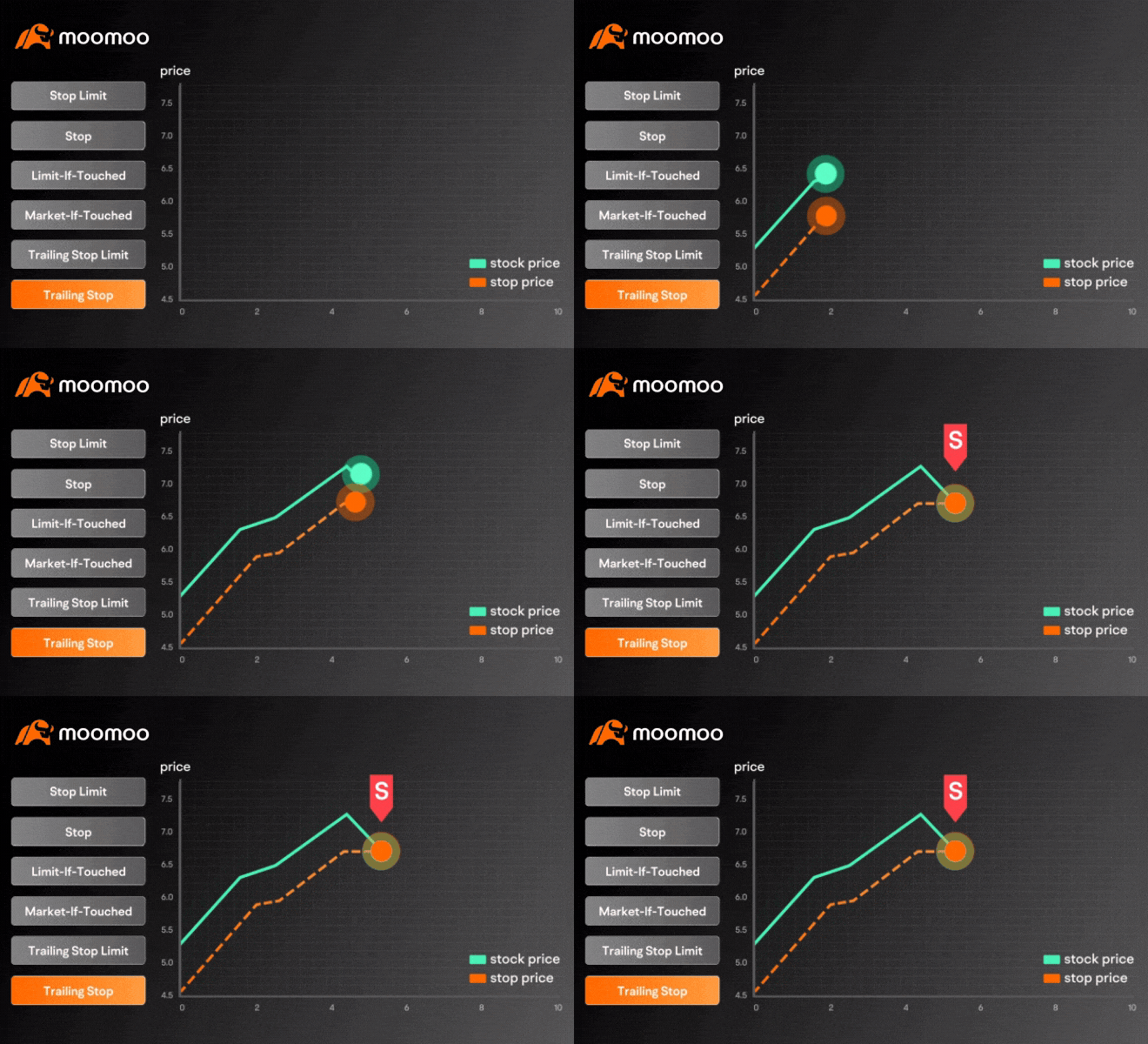
If you've got familiar with regular market and limit orders, Moomoo SG also comes equipped with plenty of high-level order features to upgrade your trading decisions. The Trailing Stop Order serves as a typical case: it adjusts stop levels in tandem with stock price shifts to retain accumulated earnings and cut exposure to falling losses, check the graphic underneath for further details.
Step 4: Confirm Your Purchase and Monitor Your Investment
Review your order details carefully, including the estimated fees, and click "Confirm" or "Submit." Once the market matches your order, it will be marked as "Filled." You can now navigate to your platform’s "Portfolio" or "Assets" tab to view your newly acquired ETF units. Over the next few days, if you linked a CDP account, you will also see the units securely deposited there.
Investment Strategies for the STI ETF
Understanding how to buy STI ETF in Singapore is just the mechanical first step. To truly build wealth, you must apply a strategic approach to your investments. Here are two popular methodologies to consider.
Lump-Sum Investing vs. Dollar-Cost Averaging (DCA)
When you have capital ready to deploy, you face a choice: invest it all at once or spread it out.
Lump-Sum Investing involves taking a large amount of cash and buying ETF units in one single transaction. Statistically, because markets tend to rise over the long term, investing your money as soon as possible often yields higher returns. However, it requires a high risk tolerance, as a sudden market dip right after your purchase can be emotionally taxing.
Dollar-Cost Averaging (DCA) involves investing a smaller, fixed amount of money at regular intervals (e.g., 500 SGD every month), regardless of the ETF's price. When the price is high, your 500 SGD buys fewer units; when the price drops, it buys more. This systematically lowers your average cost per unit over time and completely removes the stress of trying to "time the market."
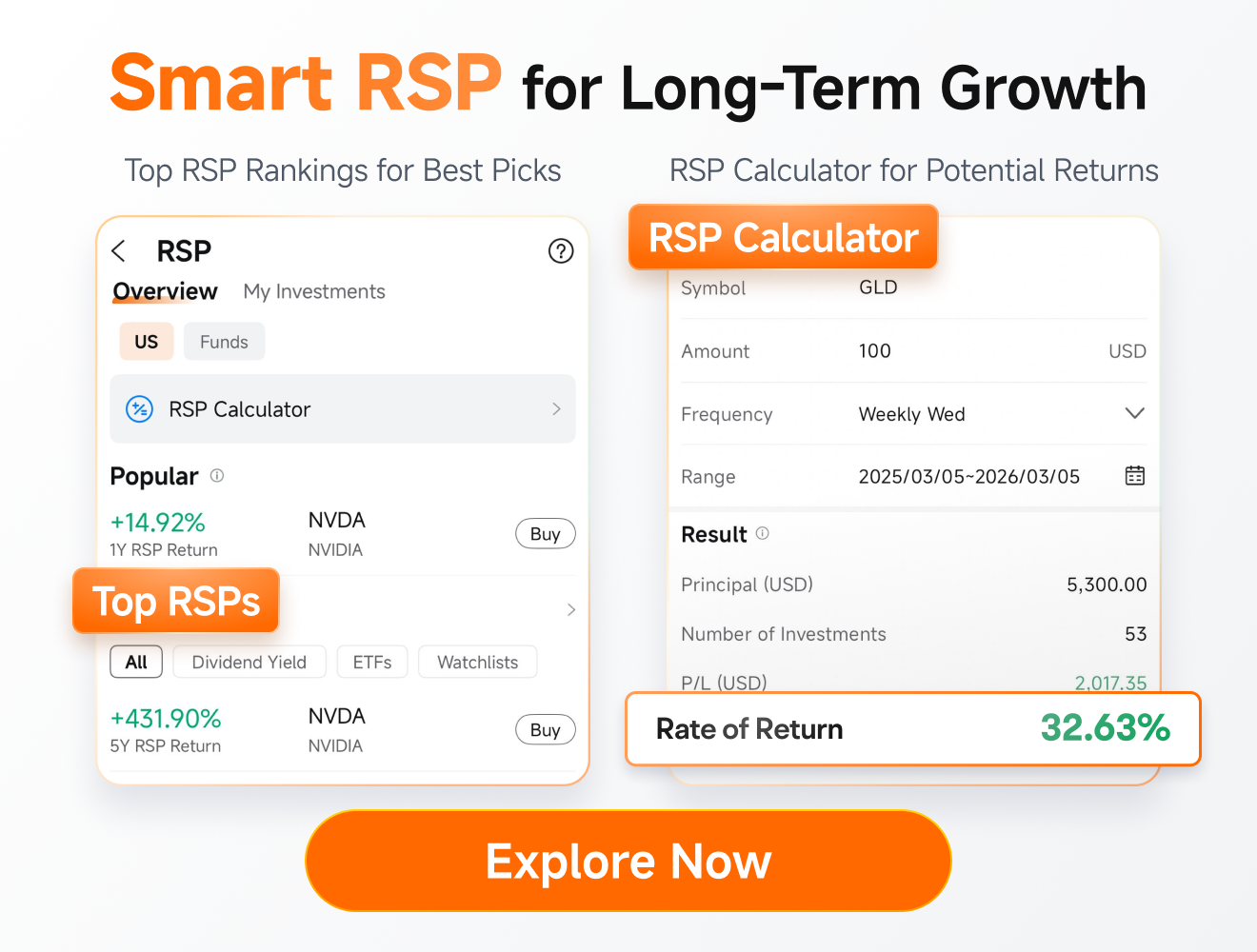
To execute a DCA strategy without the manual chore of remembering to invest every month, you can use an automated feature like a Regular Savings Plan (RSP). This bridges the gap between theory and practice. Platforms like Moomoo SG offer an RSP feature for assets like the STI ETF, allowing you to automatically invest a fixed amount at set intervals (e.g., weekly or monthly). This enforces investment discipline and turns your long-term strategy into a simple, set-and-forget process. You can explore setting up an RSP on the moomoo app to start building your portfolio consistently.
Reinvesting Your Dividends for Compounded Growth
The STI ETF is renowned for its dividend distributions. Instead of withdrawing these cash payouts to spend, a powerful wealth-building strategy is to reinvest them by buying more ETF units. This triggers the effect of compound interest—your dividends buy more units, which in turn generate even more dividends in the next payout cycle. Over a 10-to-20-year horizon, dividend reinvestment can drastically multiply your overall portfolio size.
Understanding the Costs of Buying and Holding STI ETFs
Transparency regarding fees is essential. Every dollar paid in fees is a dollar subtracted from your potential returns. Here is a breakdown of the costs associated with buying and holding the STI ETF.
Brokerage Commission Fees
Every time you execute a buy or sell order, your stockbroker will charge a one-time transaction fee. Thanks to modern digital brokerages, these commission fees have plummeted in recent years, often costing just a few dollars or a small percentage of your total trade value. Always check your broker's fee schedule before trading. To make investing even more accessible, some platforms offer promotional rates that can significantly reduce your costs.
For instance, new users on Moomoo SG can enjoy zero-commission trading on Singapore stocks and ETFs for a full year, which makes strategies like Dollar-Cost Averaging even more cost-effective by eliminating a core trading cost on every purchase.
ETF Management Fees (Total Expense Ratio)
As professionally managed investment products, ETFs come with annual operating fees known as the Total Expense Ratio (TER). The fees are deducted directly from the fund’s net asset value with no out-of-pocket payment required from investors.
ETFs are widely recognised for their cost efficiency, especially when compared to actively managed mutual funds that have higher annual expenses.
Other SGX-related Fees (Clearing & Trading Fees)
Finally, all trades executed on the Singapore Exchange are subject to small, mandatory institutional fees. These include an SGX Clearing Fee and an SGX Trading Fee, which amount to a tiny fraction of a percent (typically around 0.04% combined). Additionally, the prevailing Goods and Services Tax (GST) is applied to your brokerage commissions and SGX fees.
STI ETF Performance & Dividend History (Updated 2026)
To set realistic expectations, it is vital to look at historical data. The STI ETF is designed as a long-term investment, weathering various economic cycles to provide steady growth and income.
Analysing Historical Price Performance
The STI ETF has shown remarkable resilience and steady growth over the long term. As of mid-2026, the SPDR STI ETF (ES3) reported a robust 10-year annualized return of 10.03%. In the medium term, the fund achieved a 5-year return of 14.21% and an impressive 3-year return of 21.41%.
This strong performance is largely anchored by Singapore's robust banking sector. With DBS Group Holdings making up 26.63% of the fund, OCBC at 16%, and UOB at 9.66%, the financial sector’s stability drives the index. Even when individual stocks face headwinds—such as Singtel (6.54% holding) navigating softer share prices despite record dividends—the diversified nature of the ETF ensures the overall portfolio remains insulated from single-company shocks.
A Look at STI ETF Dividend Payouts
For investors seeking passive income, the STI ETF is probably an attractive asset. The SPDR STI ETF (ES3) distributes dividends semi-annually, typically in February and August.
Historically, the fund has maintained a consistent and generous payout schedule. For example, investors received a cash dividend of 0.085 SGD per share in February 2026, following payouts of 0.089 SGD in August 2025 and 0.091 SGD in February 2025. As of mid-2026, the trailing twelve months (TTM) dividend yield stands at a healthy 3.36%. This reliable stream of semi-annual income makes the STI ETF a cornerstone for dividend-focused investors in Singapore.
Conclusion: Start Your STI ETF Journey Today
Learning how to buy STI ETF in Singapore is one of the most empowering financial steps you can take. As this 2026 guide has outlined, the STI ETF offers a robust, accessible, and cost-effective method to instantly diversify your portfolio across Singapore’s top 30 blue-chip companies. With low management fees, high liquidity, and a strong history of steady dividends and capital growth, it is commonly use as a foundational asset for both beginners and seasoned investors alike.
There is no better time to take control of your financial future than right now. Take the next step today: open an account with our brokerage, fund your balance, and begin your investment journey with the STI ETF. Your future self will thank you for the wealth you start building today.

Frequency Asked Questions
Which STI ETF should I consider, ES3 or G3B?
In Singapore, you can choose between two STI ETFs: the SPDR STI ETF (ticker: ES3) and the Nikko AM Singapore STI ETF (ticker: G3B). Both track the same top 30 Singaporean companies. The SPDR STI ETF (ES3) is the more established of the two, with a larger fund size (over 3.24 Billion SGD as of May 2026) and high trading liquidity.
What is the step-by-step process to buy the STI ETF?
Buying the STI ETF is a straightforward process once your accounts are set up. Follow these simple steps on your brokerage platform: Fund Your Account: Deposit money into your brokerage account via PayNow, FAST, or bank transfer. Search for the ETF: Use the search function on your platform and type in the ticker symbol, such as ES3 for the SPDR STI ETF. Place a Buy Order: Choose between a 'Market Order' to buy at the current price or a 'Limit Order' to set a specific price you're willing to pay. Enter the number of units you wish to purchase. Confirm Your Trade: Review the order details, including fees, and confirm your purchase. Your new ETF units will appear in your portfolio once the order is filled.
How much does it cost to invest in the STI ETF?
The costs are generally low and transparent. There are two main types of fees: Brokerage Commissions: A one-time fee charged by your broker for each buy or sell transaction. These are typically very competitive with modern digital brokers. Management Fee (TER): An annual fee for managing the fund, expressed as a Total Expense Ratio (TER). For the SPDR STI ETF (ES3), this fee is a low 0.28% per year, which is automatically deducted from the fund's assets. There are also minor SGX clearing & trading fees applied to each trade.
Is the STI ETF a good investment for passive income?
Yes, the STI ETF is considered an investment commonly used by investors seeking income through dividend distributions. The fund holds Singapore's top 30 blue-chip companies, many of which have a strong history of paying dividends. The ETF collects these dividends and distributes them to investors semi-annually, typically in February and August. As of mid-2026, the SPDR STI ETF (ES3) had a trailing twelve-month dividend yield of 3.36%, providing a reliable stream of income for investors.
This presentation is for informational and educational use only and is not a recommendation or endorsement of any particular investment or investment strategy. Investment information provided in this content is general in nature, strictly for illustrative purposes, and may not be appropriate for all investors. Read more