Beginner's Guide: How to Trade Options in Singapore
Key Takeaway
If you want to make money from options trading, it's important to understand the fundamentals before diving in. So, let's start with the basics and explore what options trading is all about. By building a foundation of knowledge, you'll be able to confidently navigate the market during earnings season and make informed investment decisions.
In this article, we will discuss the following questions, offering you a clearer view of options trading:
What is an option contract?
What can options trading potentially help?
What are basic options trading strategies?
How to trade options in Singapore?
Frequently asked questions
Trade options with Moomoo Singapore
What is Option Trading
An option contract can be broken into two parts: "option" and "contract". "Option" refers to the right to buy or sell an underlying asset at a predetermined price before a specified expiration date, while "contract" refers to the agreement made between the buyer and seller. Simply put, options are contracts that give the holder the right to buy or sell an underlying asset at a fixed price in the future, such as stocks and ETFs.
Next, let's take a closer look at the six essential elements of an option contract.
1. Undelying Assets:
These could be stocks, ETFs, futures, bonds and funds.
2. Direction:
Call (bullish) and put (Bearish).
For call options, you can consider buying a call option if you expect the underlying asset to rise, and selling if you don't expect the stock to rise, though selling options do come with additional risks to keep in mind.
For put options, you can consider buying a put option if you expect the underlying asset to drop, and selling if you don't expect the stock to drop.
3. Strike Price:
It is the price at which an options contract allows investors to buy (in the case of a call) or sell (in the case of a put) the underlying asset before the contract expires.
4. Premium:
It is the income received by an investor who sells an options contract, or the current price of an options contract that has yet to expire. The premium value is constantly fluctuating with the price movement of the underlying assets.
5. Expiration date:
The day when the option expires.
6. Contract size:
For US stock options, a standard contract covers 100 shares. For example, if Alice buys a Call of Microsoft at a price of US$1 per share, the total premium she needs to pay for opening the position will be US$1 * 100 = US$100.
While understanding these elements is crucial, applying them can be challenging when faced with a traditional options chain, which often resembles a dense spreadsheet. To make faster and more informed decisions, traders need a more intuitive tool. The moomoo app presents its Options Chain with a clear, visual layout. With a single tap on any contract, you can instantly see a profit-and-loss analysis, helping you visualize how much you could gain or lose under different price scenarios. You can also filter contracts by expiration date or group them by strategy, making it easier to compare potential outcomes and select a contract that aligns with your risk tolerance. Download moomoo and explore its intuitive Options Chain to visualize potential outcomes before you trade!
How to Trade Options in Singapore
1. Find a licensed broker
Finding a licensed broker will be the first step for investors to trade options online. Investors can evaluate brokers based on several elements, including reliability, features, commissions and fees. Moomoo Singapore vs IBKR Singapore: Which One is Better?
Reliability:
Reliability should be the most important factor when selecting stock brokers in Singapore, as it safeguards individuals' investments. A reliable broker will ensure financial security, efficient trade execution, and data accuracy with minimum or no delay. Quick execution is important for products with high liquidity, such as options. For another, a reliable broker will also provide timely and helpful customer support, ensuring investors receive the assistance they need. As a licensed broker, Moomoo SG offers quick execution service and timely responses to customers' questions.
Features:
A user-friendly platform with useful features will facilitate individuals' stock trading. Advanced trading tools for trading analysis will largely save investors' effort and time. On Moomoo SG, we provide the complimentary Level 2 market data, real-time option chain, options price calculator, visualized implied volatility comparison and so on, offering free advanced features for all investors and traders.
Commissions and fees:
In terms of commissions and fees, different platforms have different rules. According to moomoo fees, platform fees are charged to enable Moomoo SG to continue investing in better technologies to improve our platform to serve our users better.
In addition, there are also third-party regulatory and transaction charges that investors have to pay when trading US options, such as Options Regulatory Fees, OCC Clearing Fees, SEC Fees, and Trading Activity Fees (which are charged for sell orders only).
Beyond platform fees, traders should also pay close attention to trading costs, as commissions and contract fees can accumulate and erode profits over time. This is especially true for active traders or those with smaller accounts. Moomoo SG addresses this by offering US stock options trading with $0* commission. This cost-effective structure means you can implement strategies, like taking profits in stages or adjusting positions frequently, without worrying that transaction costs will diminish your potential returns. Register for a moomoo account to take advantage of $0* commission on your US options trades, ensuring more of your potential returns stay with you.
*T&Cs and other fees apply.
*T&Cs and other fees apply.
2. Open an account with Singpass
To start trading options, you need to demonstrate that you understand how they work. Unlike a regular stock trading account, setting up an options trading account usually requires larger capital, as options trading involves more complex decision-making due to numerous factors. Brokers need to ensure that you have the necessary experience, a clear grasp of the risks involved, and adequate financial resources.
Just as brokers evaluate your suitability for options trading, it's equally important for you to evaluate your broker's credibility. In Singapore, a key indicator of a reliable broker is its regulatory status. Moomoo SG is licensed by the Monetary Authority of Singapore (MAS), which means it must adhere to strict financial standards, including capital requirements and regular audits. This regulatory oversight ensures fair trade handling and the protection of client funds, providing a secure and legally protected environment for your investments. Trade with confidence by choosing a MAS-licensed broker.
>> Download moomoo today and enjoy an investment journey on a platform supported by a robust regulatory framework.
>> Download moomoo today and enjoy an investment journey on a platform supported by a robust regulatory framework.

3. Deposit
Once your account is opened, you will need to complete the CKACAR test to assess your suitability. After successfully completing the assessment, you may then fund your account to trade options. The amount is based on your preference and investment goals. Many brokers accept the transfer of funds from personal bank accounts. When funding your account, you will be required to select a deposit method. Then you can determine the amount of money and submit it.
4. Choose Options Trading Strategy
When choosing an options trading strategy, it's crucial to understand the most commonly used strategies.
For example, options traders may start with the single-leg options strategies we've introduced above, including Buy Call, Sell Call, Buy Put, Sell Put. Covered Call and Cash Secured Put can also be considered by investors as a way to hedge the risks of their stocks. (Note: Selling calls without holding the underlying stock can be risky)
Even with a clear market view, many investors struggle to select the option strategy. For instance, if you expect a stock to rise moderately, should you buy a call, sell a put, or use a complex spread? Moomoo's "Strategy Builder" feature is designed to solve this problem. Instead of manual research, you simply input your market outlook, target price, and desired timeframe through a few simple questions. The tool then intelligently recommends the most suitable options strategies, complete with a full profit and loss analysis for each, allowing you to move from idea to execution with confidence. Try moomoo's Strategy Builder to translate your market outlook into a clear action plan.
>>Sign up and discover potential opportunities in seconds with the Options Strategy Builder feature.
>>Sign up and discover potential opportunities in seconds with the Options Strategy Builder feature.
5. Monitor Options' Performance
Options trading is considered high-risk, capable of resulting in significant or total loss of capital due to leverage, volatility, and strict time constraints. Be it buyers or sellers, what they focus on will be the price of the options.
To understand the price, investors need to monitor the possibility of execution, the ask-bid spread, Greeks such as delta, implied volatility, and the price change direction.
To be more specific, let's have a look at the Black-Scholes model, one of the most widely used models for pricing options:


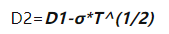
This formula calculates the theoretical option price C using six variables:
S: current market price of the underlying asset
L: option strike price
d: cash dividend rate
T: option time to expiration
y: risk-free interest rate
σ: implied volatility
With this formula, investors can get a good sense of how those six variables influence the option's price. However, some may be overwhelmed by the complexity of the formula and the need for extensive calculations.
While the Black-Scholes model provides a theoretical framework for pricing, manually calculating it for every trade is impractical. To avoid overpaying for a contract, traders need a tool that can quickly assess its fair value. The moomoo Option Calculator does exactly this, providing an instant theoretical value for any contract. By adjusting variables like the date or underlying stock price, you can see how the option's price might change and determine if it's currently trading at a fair price, potentially uncovering buying opportunities before you commit. Stop guessing and start calculating.
>> Download moomoo to use the integrated Option Price Calculator and assess the theoretical value of any contract before you trade.
>> Download moomoo to use the integrated Option Price Calculator and assess the theoretical value of any contract before you trade.
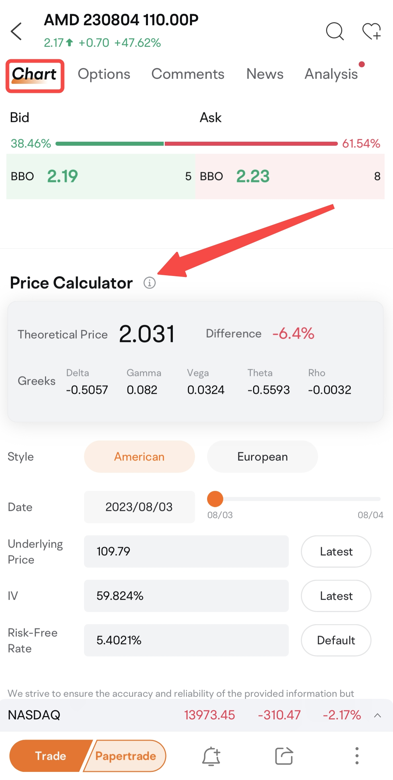
(Any app images provided are not current and any securities shown are for illustrative purposes only and is not a recommendation.)
What can options trading potentially help
By now, you should have learned some basics about options. But you may be wondering about the potential benefits of trading options. Generally speaking, options can potentially help investors in two ways.
1) Risk hedging
Although many people associate options with high risk and volatility, they were originally designed as a hedging tool.
For instance, let's say Alice owns 100 shares of Tesla stock but is worried that its price will drop after an earnings report. She could buy a put option on Tesla to limit her potential losses during the life of the option if the price drops. If the price does increase, she will only lose the premium paid for purchasing the put option, which can be considered insurance bought for her position in Tesla's stock.
To effectively execute a hedge like the one Alice used, traders need to act quickly, especially in a fast-moving market. Sifting through a long list of strike prices to find the right protective put can be time-consuming. On moomoo's Options Chain, you can instantly filter contracts to simplify this process. With just a few taps, you can switch between calls and puts and isolate contracts that are in-the-money or out-of-the-money, allowing you to focus on the strike prices most relevant to your hedging strategy and make faster, more precise decisions.
>> Register on moomoo to use the advanced filtering on the Options Chain, helping you pinpoint the exact call or put you need for your hedging or trading strategy.
2) Leveraging small capital for potentially bigger gains
The leverage effect of options can be thrilling, as it allows relatively small amounts to potentially move much larger amounts. As a derivative instrument, options have a high profit/loss ratio. It is not uncommon for the value of an option to increase several times over. However, it's important to remember that profits and risks go hand-in-hand, and risk management must be carefully considered to avoid taking unnecessary risks.
However, all investment involves risks, and options trading can be risky. For one thing, options value can decline over time or become worthless if they expire out of the money. For another, options trading involves leverage, resulting in higher potential returns and losses. Hence, it is crucial for traders to have a solid understanding of options before taking any actions.
To capitalize on this leverage, traders must first identify the right opportunities. However, knowing which stocks have active and liquid options markets can be a challenge. Moomoo's Options Market feature simplifies this by ranking top US stocks by key metrics like options volume, open interest, and implied volatility. High volume suggests strong liquidity, high open interest indicates significant market participation, and high implied volatility signals expectations of large price swings. This data helps you quickly find options that are actively traded and may offer greater potential for movement.
>> Discover your next trade by exploring the Options Market feature on moomoo. Sign up now to access rankings of top stocks by volume and implied volatility, and find opportunities with ease.
What are basic options trading strategies
Generally speaking, there are four basic single-leg options trading strategies: Buy Call, Buy Put, Sell Call, Sell Put. For those new to options trading, understanding the difference between being a buyer and a seller is crucial. Generally, options buyers have unlimited profit potential and limited risk, while options sellers have limited profit potential but unlimited risk. Based on this, many investors choose to be buyers. However, the pros and cons of these positions are not as simple as they appear.
Buy Call
Buy a call means you need to pay an amount (the premium) for a contract that gives you the right, not the obligation, to buy an asset (the underlying asset) at an agreed price (the strike price) on or before a specified date (the expiration date).
Expectation
The underlying asset will rise in the future.
The maximum loss
loss of the strategy is limited, which equals all the premium costs when opening the position.
The maximum potential profit
Profit is unlimited, as the underlying asset can rise to an unlimited price.
Breakeven Point
Breakeven Point= Strike Price + Premium Per Share
For example, suppose Alice bought a call option of stock XYZ. The strike price is $100, the premium per share is $3, and the current price of the stock XYZ is $80. Cost of the Option = Premium Per Share * Multiplier * Contract Size = $3 * 100 * 1 = $300Breakeven Point = $100 + $3 = $103If the stock price of XYZ does not reach $100 when the option expires, the option will not be exercised, and Alice will lose all the premium, when she will have maximum loss = $300.If the stock price of XYZ rises to or above $100, Alice can decide whether to exercise or not.If the stock price of XYZ rises to $103, Alice achieves breakeven.If the stock price of XYZ rises above $103, Alice will profit.
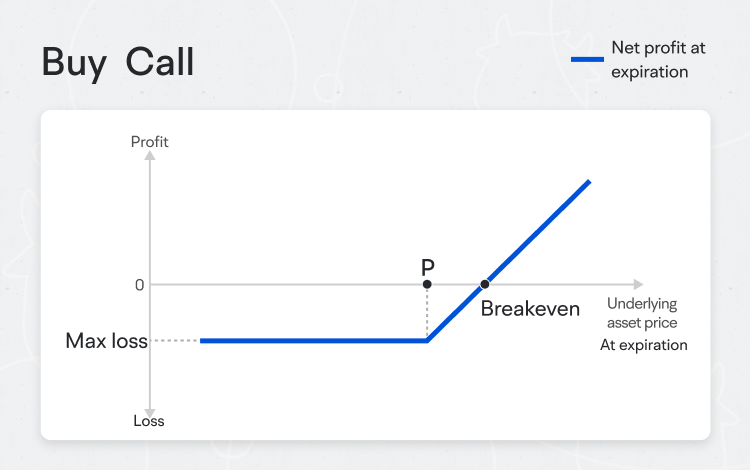
While the breakeven formula is straightforward, calculating it for every potential trade can be slow and inefficient. To ensure a trade is profitable, you must account for the premium cost before entering a position. Moomoo's integrated Options Analysis tool automates this process. When you select any contract in the options chain, it instantly calculates and displays the precise breakeven point, maximum potential profit, and maximum potential loss. This allows you to quickly assess the risk-reward ratio and make a more informed decision without manual calculations. Take the guesswork out of your trades. Download moomoo and use the Options Analysis feature to instantly see the breakeven point and profit/loss profile for any strategy.
Buy Put
Buy a put means you need to pay an amount (the premium) for a contract that gives you the right, not the obligation, to sell an asset (the underlying asset) at an agreed price (the strike price) on or before a specified date (the expiration date).
Expectation
The underlying asset will fall in the future.
The maximum loss
Loss of the strategy is limited, which equals all the premium costs when opening the position.
The maximum potential profit
Profit is also limited but substantial, as the underlying asset can decrease to as low as 0.
Breakeven Point
Breakeven Point = Strike Price - Premium Per Share
For example, suppose Alice bought a put option of stock XYZ. The strike price is $80, the premium per share is $3, and the current price of the stock XYZ is $100. Cost of the Option = Premium Per Share * Multiplier * Contract Size = $3 * 100 * 1 = $300Breakeven Point = $80 - $3 = $77If the stock price of XYZ does not fall to $80 when the option expires, the option will not be exercised, and Alice will lose all the premium, when she will have maximum loss = $300.If the stock price of XYZ falls to or below $80, Alice can decide whether to exercise or not.If the stock price of XYZ falls to $77, Alice achieves breakeven.If the stock price of XYZ falls below $77, Alice will profit.

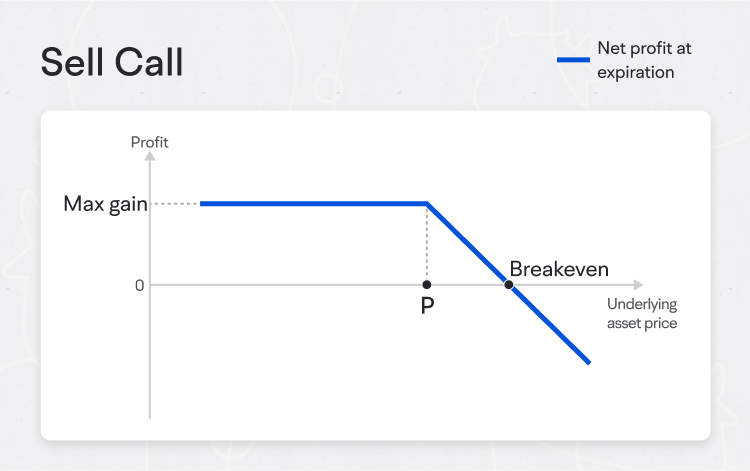
Sell Call
When you sell a call option, you collect a premium for a contract that gives the buyer the right, but not the obligation, to buy an asset (the underlying asset) at an agreed price (the strike price) on or before a specified date (the expiration date). As the seller of the call option, you are obligated to sell the asset at the strike price if the buyer chooses to exercise the option.
Expectation
The underlying asset will not rise in the future.
The maximum loss
Loss of the strategy is unlimited, as the underlying stock can rise a lot without limit.
The maximum potential profit
Profit is also limited, which is equal to all the premiums collected when selling the call.
Breakeven Point
Breakeven Point = Strike Price + Premium Per Share
For example, suppose Alice sold a call option of stock XYZ. The strike price is $100, the premium per share is $3, and the current price of the stock XYZ is $80. Maximum Gain of the Option = Premium Per Share * Multiplier * Contract Size = $3 * 100 * 1 = $300Breakeven Point = $100 - $3 = $97If the stock price of XYZ does not rise to $100 when the option expires, the option will not be exercised, and Alice will gain all the premium, when she will have maximum gain = $300.If the stock price of XYZ rises to or above $100, Alice is obligated to sell the asset at the strike price if the buyer chooses to exercise the option.If the stock price of XYZ rises to $103, Alice achieves breakeven.If the stock price of XYZ rises above $103, Alice will lose money. In this case, Alice will be required to sell 100 shares of XYZ stocks at the price of $103.
Sell Put
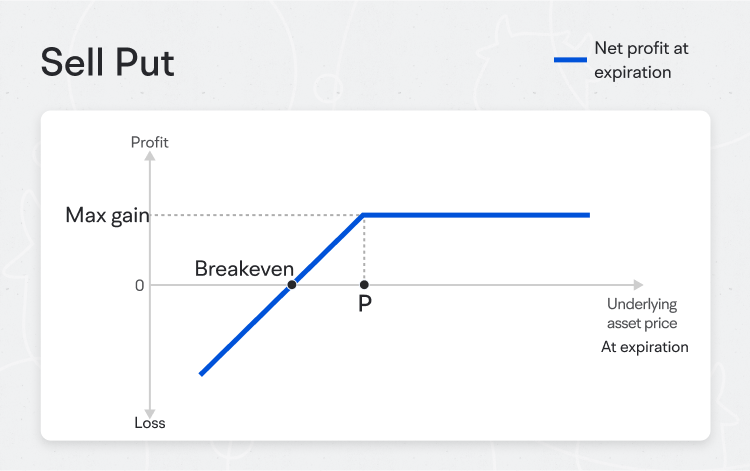
Sell a put means you will collect a premium for a contract that gives the buyer the right, but not the obligation, to sell an asset (underlying asset) to you at an agreed price (the strike price) on or before the expiration date. As the seller of the put option, you are obligated to buy the asset at the strike price if the buyer chooses to exercise the option.
Expectation
The underlying asset will not fall in the future.
The maximum loss
Loss of the strategy is limited but substantial, as the underlying stock can fall to as low as 0.
The maximum potential profit
Profit is limited, which is equal to all the premiums collected when selling the put.
Breakeven Point
Breakeven Point = Strike Price - Premium Per Share
For example, suppose Alice sold a put option of stock XYZ. The strike price is $80, the premium per share is $3, and the current price of the stock XYZ is $100. Maximum Gain of the Option = Premium Per Share * Multiplier * Contract Size = $3 * 100 * 1 = $300Breakeven Point = $80 - $3 = $77If the stock price of XYZ does not fall to $80 when the option expires, the option will not be exercised, and Alice will gain all the premium, when she will have maximum gain = $300.If the stock price of XYZ falls to or below $80, Alice is obligated to buy the asset at $80 if the buyer chooses to exercise the option.If the stock price of XYZ falls to $77, Alice achieves breakeven.If the stock price of XYZ falls below $77, Alice will lose money. In this case, Alice will be required to buy 100 shares of XYZ stocks at the price of $80.
For traders interested in generating income by selling options, finding suitable contracts is key. The "Options Seller Zone" on moomoo is a powerful screener designed for this purpose. It highlights Cash-Secured Put and Covered Call opportunities and lets you filter them based on your risk tolerance. For instance, you can screen for contracts with a high probability of profit and low implied volatility to identify opportunities that align with a steady, high-win-rate strategy, allowing you to profit more scientifically from collecting premiums. Elevate your income strategy with moomoo's Options Seller Zone.
>> Open an account and use our powerful screener to find high-probability selling opportunities that match your risk profile.
Frequently Asked Questions
1. How to trade options?
Trading options is similar to trading stocks. You can place an order after entering the quantity and price.You can choose to buy open or sell short to establish new positions in an option; if you already have a long or short position in an option, you can also close the position through sell and buy operations.
2. What are the supported order types for options?
U.S. equity options trading supports Limit Order, Market Order, Stop Limit Order, Stop Order, Limit if Touched Order, Market if Touched Order, Trailing Stop Limit Order, Trailing Stop Order.
3. What's the trading unit for options?
Options are traded in units of contracts. Typically, one contract unit is equal to 100 shares (corporate actions may result in 1 option not being equal to 100 shares). For example, in the case of option contract AAPL 170314 140.00C, its quoted price is $2, meaning the price (premium) of this contract is $2 * 100 = $200. Upon exercise, you will receive 100 shares of AAPL.
4. What are the trading hours for options?
Trading hours for the options are 9:30-16:00 EST.Note: Options do not support pre- and post-market trading, but some ETF and ETN options are late close exceptions and will trade until 16:15 EST.
5. Why does longing an option increase the margin requirement?
Generally speaking, as the right party, longing an option does not require additional margin. However, in terms of account risk, longing an option is equivalent to converting part of your available funds into a non-collateralized option contract of equal value. As a result, the net assets in your account remain unchanged, but the funds available are reduced.It can be approximated as follows: available funds = net assets - initial margin. The increased margin actually represents a decrease in available funds, similar in principle to when you buy non-collateralizable stock (margin rate of 100%).Note: For the purpose of risk control, if you long an in-the-money or nearly at-the-money option within 3 hours before the close of the expiration date, the initial margin requirement to open a position will be calculated based on the buying power required to exercise the option.
6. Why option orders with a better price than the last traded price are sometimes not filled?
When trading stock options, you may sometimes observe that some orders are filled at worse prices but your own order placed at a better price is not filled. This may be caused by the following reasons.The liquidity of the options market is normal. However, due to the special quotation rules of the U.S. market (BBO / NBBO), the bid and ask you see are the highest bid and lowest offer price of a particular exchange. Some orders may be routed to other exchanges for transactions.In addition, when the market is inactive, it is possible for quotes from different exchanges to vary widely but not be updated timely, which may result in orders not being filled.Since there are Spread Orders in the market, an individual buy/sell order may not be filled.For example, some brokerage firms allow customers to make a spread order by placing a long call order and a short call order. Both orders will be filled at the same time only if the prices of both orders match the ask and bid.To take a specific example, an option on BABA has a bid price of $3.00 and the order is part of a spread order matched on the exchange. A $2.80 sell order submitted at this time will fail to fill may not be filled at 3.00.All of the above descriptions are normal for the U.S. market. The options orders have been submitted and the outcome depends on the exchange.
The issue of unfilled orders often stems from a lack of visibility into market depth. Relying only on the best bid and offer prices doesn't show the full picture of supply and demand. To address this, moomoo provides traders with free 60-level LV2 market data, revealing the full queue of buy and sell orders at different price points. By observing this depth, you can more accurately gauge liquidity and market sentiment, allowing you to place orders more strategically to improve execution speed and pricing. Stop trading in the dark.
>> Download and register on moomoo to get free 60-level LV2 market data, giving you the depth of vision to pinpoint your entry and exit points with greater precision.
*T&Cs and other fees apply.
This presentation is for informational and educational use only and is not a recommendation or endorsement of any particular investment or investment strategy. Investment information provided in this content is general in nature, strictly for illustrative purposes, and may not be appropriate for all investors. Read more