MR Course
(1) Effective Customer Service
Good Customer Service
Customer Service = The process of ensuring customer satisfaction with a product or service. Often, this takes place while performing a transaction for the customer. This could be through in-person interactions, phone calls, self-service systems, among other things.
5 Principles of Good Customer Service
Customer Service Programme
1. Creating a Customer Service Programme
Building Customer Relationship
Customer Retention
Customer Retention Strategies
Underpromise and Overdeliver
Build relationships with customers to let them know they can trust you
Proactive service to eliminate problems before they happen
Set yourself up as the expert in your field to gain customers' brand loyalty
Make it easy for customers to reach you. Offer space to share feedback + offer support
Go above and beyond to meet customers' needs
Customer Emotions
Most customer behaviour is emotionally based, appeal to their emotions to make them feel like they truly matter
Rapport
A crucial element in marketing
Communicate effectively with customers to strengthen your connection & ensure you are understood
Ways to Develop a Good Rapport
Don't criticise, condemn or complain
Give honest and sincere appreciation
Become genuinely interested in the prospect's needs
Smile
Remember the prospect's name
Be a good listener - encourage the prospect to talk
Make the prospect feel important. And do it sincerely.
Respect prospect's opinions. Never say, "You're wrong"
If you are wrong, admit quickly and empathetically
Let the prospect save face
Ways to Build Relationship with Customers
Communicate like a human-being | Make communication as seamless as possible, acknowledging, acting up and following up on feedback where necessary. Today's customers are no longer passive and they want to be listened to. Exceptional communication will improve customer service and give you that point of difference from your competitors. |
Learn about your customer | Building customer relationships ≈ Building rapport as a MR. You need to know your customers, their names, their needs and wants, what kind of dog they own and so forth. |
Ask for feedback | Negative feedback and customer complaints give you the opportunity to hear what the customers really think about your servie. Complaints help you to improve your service, give you a chance to redeem yourself and, keep potentially toxic reviews from hitting social media. |
Stay in regular contact with customers | The key to building customer relationships is to keep your eye on the ball. Every interaction with a customer should be treated as an opportunity to monitor and build that relationship. |
Build trust with customers | Whether you have a committed, rewarding relationship with your wife, girlfriend, dog or hamster, by now you've had loads of practice in building trust. A customer's trust and commitment is built in the same manner. |
Presentation
1. Presenting to Prospects
Important points for presentation | • To avoid any madly rushing meeting, ensure the client has made available sufficient time to discuss the plan. • Encourage the client to ask questions. You must allow the client to talk. • Avoid sitting across the table, try sitting alongside the client, or between any couple. • Use graphs and tables to demonstrate data and projections, to make complex concepts easier to understand |
Marketing Presentation Pre-requisites | • What are prospect's needs? • What are prospect's challenges? • What do their own customers and partners need? • How can your organisation's products/services meet the prospect or prospect's customers' needs? • How your organisation's products/services can make the prospect more competitive in their own market place? • How to communicate these benefits to the prospect so that they recognise the value of your offerings? |
Persuasion in Presentation | • Virtually ALL presentations contain an element of persuasion. • The job is to convince prospects that your services and products will bring benefits to them. • Persuasion involves instilling trust, believability, and confidence in prospects - it helps inject magnetism and charisma into your personality and provides the strategies for winning hearts and minds. • Should not confused with manipulation. |
Required Presentation Skills | • Research and interviewing skills • Listening skills • Effective communication skills • Problem solving skills • Organisation skills • Interpersonal skills • Self-motivation skills • Perseverance |
Customer Experience
1. Customer Perception = Customer perception is one of the most valuable aspects of a company. Managing that perception in all its forms should be a top priority and is the responsibility of every single person in the organisation. A negative experience often means the customer goes elsewhere with their business, each lost customer means more than just their lost business, but it results in lost business from their friends as well.
2. Turning a Negative into a Positive Customer Experience
Customer experience can include a lot of elements, but it really boils down to the perception the customer has of your brand/service. Even if you think your brand/service and customer experience is one thing, if the customer perceives it as something different, that is what the actual customer experience is.
(2) Regulated Capital Market Activities
Dealing in Securities
1. Terminology and Definition
Dealing in Securities (CMSA 2007) | Under Part 2, Schedule 2 of the CMSA 2007, Dealing in Securities' means, whether as principal or agent: (a) acquiring, disposing of subscribing for or underwriting securities, or (b) making or offering to make with any person, or inducing or attempting to induce any person to enter into or to offer to enter into: (i) any agreement for or with a view to acquiring, disposing of, subscribing for or underwriting securities (ii) any agreement, other than a derivative, the purpose or avowed purpose of which is to secure a profit to any of the parties from the yield of securities or by reference to fluctuations in the value of securities. |
Definition of Securities (CMSA 2007) | Under S2 of the CMSA 2007, Securities means: (a) debentures, stocks or bonds ssued or proposed to be issued by any government; (b) shares in or debentures a body corporate or an unincorporated body; or (c) units in a unit trust scheme or prescribed investments, and includes any right, option or interest in respect thereto Additionally, under Section 3 of the Capital Markets and Services (Prescription of Securities) (Digital Currency and Digital Token) Order 2019, digital currency and digital token are also prescribed to be securities for the purposes of securities law. |
Securities Laws & Regulations (Securities Commission Act 1993) | Under S2 of the Securities Commission Act 1993, 'Securities Laws' means: (a) the Securities Commission Act 1993 (b) the Capital Markets and Services Act 2007 (c) the Securities Industry (Central Depositories) Act 1991 (d) any other legislation which the Commission is empowered to administer or enforce; and (e) any other regulations, rules, orders, notifications or other subsidiary legislation made under paragraphs (a), (b), (c) and (d) |
2. Participating Organisations
Under Chapter 1 of the Rules of Bursa Malaysia Securities, a Participating Organisation (PO) is defined as a company that carries on the business of trading in securities on Bursa Malaysia Securities.
Categories of Participating Organisations
Under Chapter 3 of the Rules of Bursa Malaysia Securities, POS are categorised as follows:
(a) Investment Bank
(b) Universal Broker
(c) Special Scheme Broker
(d) 1+1 Broker
(e) Standalone Broker
Registered Persons of Participating Organisation
A PO must register the following persons with BMSB:
• Chief Executive Officer
• Director
• Head of Dealing
• Head of Operations
• Head of Compliance
• Dealer's Representative
Roles and Obligations of a Registered Person
• Continuously satisfy the qualification criteria
• Comply with and give effect to the Securities Laws and the Securities Commission's requirements
• Comply with and give effect to Bursa Malaysia Securities and other relevant authorities' Rules and Directives
• Observe professional conduct, standards of integrity and fair dealing:
• Exercise proper skill, care and diligence
3. Dealer's Representatives
Chapter 3 of the Rules of Bursa Malaysia Securities provides the categories of Dealer's Representatives
Dealing in Derivatives
Terminology and Definition
a. Under Part 2. Schedule 2 of the CMSA 2007. Dealing in Derivatives' means, whether as principal or agent, making or offering to make with any person, or inducing or attempting to induce any person, or soliciting or accepting any order for, or otherwise:
(a) entering into or taking an assignment of the derivative, whether or not on another person's ehalf
(b) taking or causes to be taken action that closes out the derivative, whether or not on another
(c) in relation to an option:
i. exercising any right under the option;
ii. allowing any right under the option to lapse, whether or not on another person's behalf
(d) initiating, originating, or issuing over-the-counter derivatives
b. Under Section 2 of the CMSA 2007, Derivatives' means any contract, either for the purposes of creating an obligation or a right or any combination of both, of which its market value, delivery or payment obligations are derived from. referenced to or based on, but not limited to, underlying securities or commodities, assets, rates, indices or any of its combination, whether or not a standardised derivative or an over-the-counter derivative, but does not include:
(a) securities;
(b) any derivative to which Bank Negara
(c) any over-the-counter derivatives whose market price. value. delivery or payment obligations are solely derived from, referenced to or based on, exchange rates;
(d) any agreement, when entered into. is in a class of agreements prescribed not to be derivatives
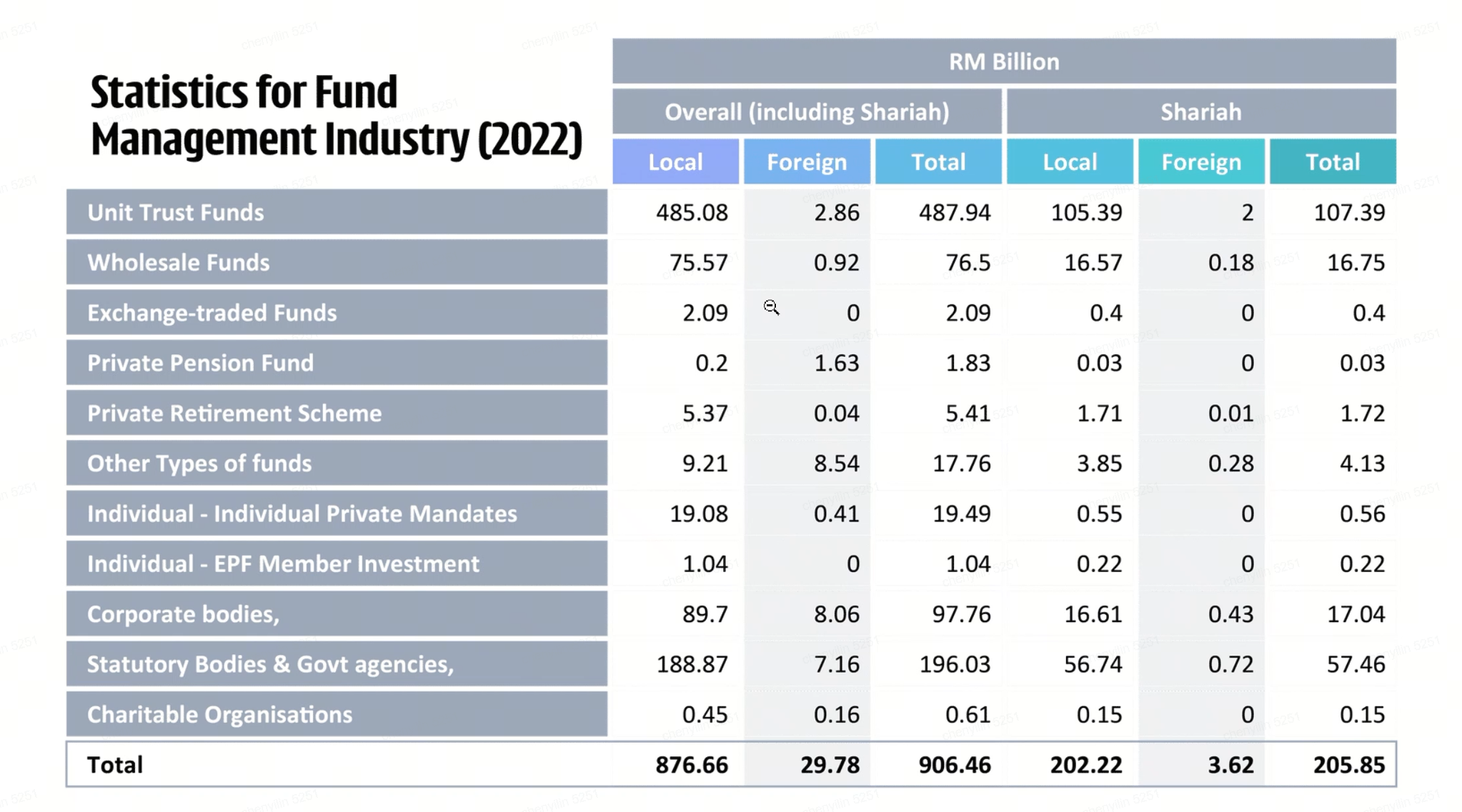
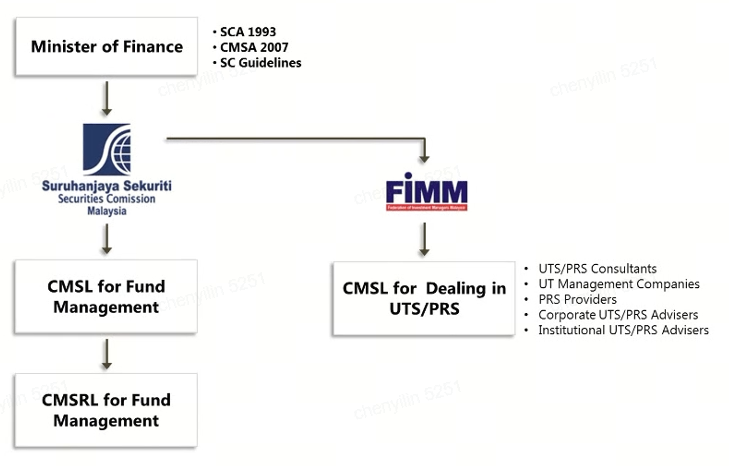
Fund Management
Terminology and Definition:
Under Part 2, Schedule 2 of the CMSA 2007, "Fund Management" means undertaking on behalf of any other person the management of:
(a) a portfolio of securities or derivatives or a combination of both, by a portfolio fund manager, whether on a discretionary authority or otherwise;
(b) an asset or a class of asset in a unit trust scheme by an asset fund manager
Dealing in Private Retirement Schemes
1. Key Components
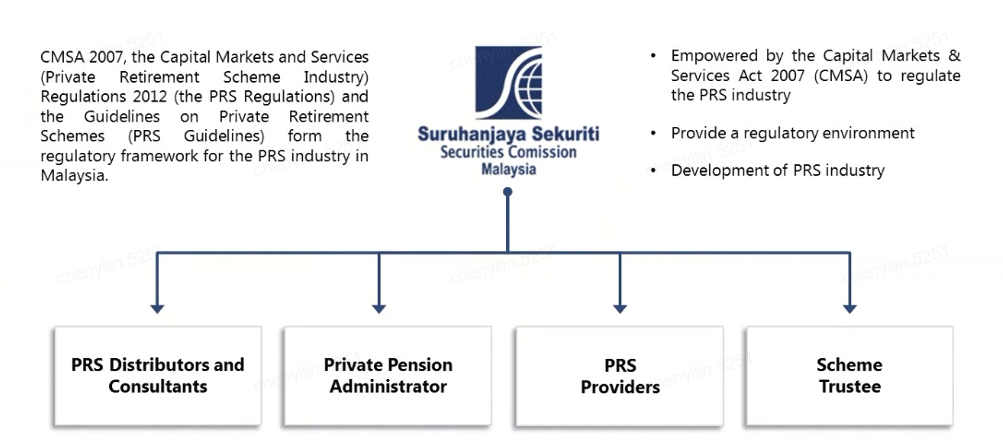
2. PRS Distributors and Consultants
• PRS Distributors are licensed for dealing in PRS or registered persons under the CMSA 2007
• PRS Consultants are representatives of PRS Distributors and need to be registered with FIMM
• Institutional PRS advisers are licensed bankers to distribute PRS schemes from more than one PRS providers
• Corporate PRS advisers are financial planning firms that represent and distribute products from more than one PRS Provider and can act on behalf of the contributors
• PRS Consultants must obtain minimum knowledge of the PRS industry and act with integrity and a high level of professionalism
3. Private Pension Administrator
• The Private Pension Administrator (PPA) is a body approved by the SC to perform the function of record keeping, administration and customer service for the members and contributors in relation to contributions made in respect to the PRS
• The duties of the PPA include:
receiving and transmitting instructions from members
keeping records of all transactions or monies paid or received by members
provide information to PRS Providers, Scheme Trustees or members
4. PRS Providers
• An institution licensed by the SC to establish and provide a PRS and offering schemes for investment by the general public
• The provider is required to manage and administer the funds under the PRS in the best interest of the members
• The main thrust of the duties of a PRS Provider is the proper and efficacious operation of the PRS. They perform a central function in terms of receiving contributions, processing transactions by members and managing fund within the scheme
5. Scheme Trustee
• The Scheme Trustees are ultimately responsible for protecting the interests of the members of PRS schemes
• The main roles and functions of Scheme Trustees are:
holds assets in trust for the members of PRS
facilitate the dealings in units of a fund under the PRS by members
appoint (and remove) independent auditors and ensure that the financial statements of the funds under the PRS are audited report to members on the operations of the PRS
ensure that the funds under the PRS are operated and managed in accordance with the trust deed, relevant rules and guidelines, and acceptable and efficacious business practices
Financial Planning
Terminology and Definition
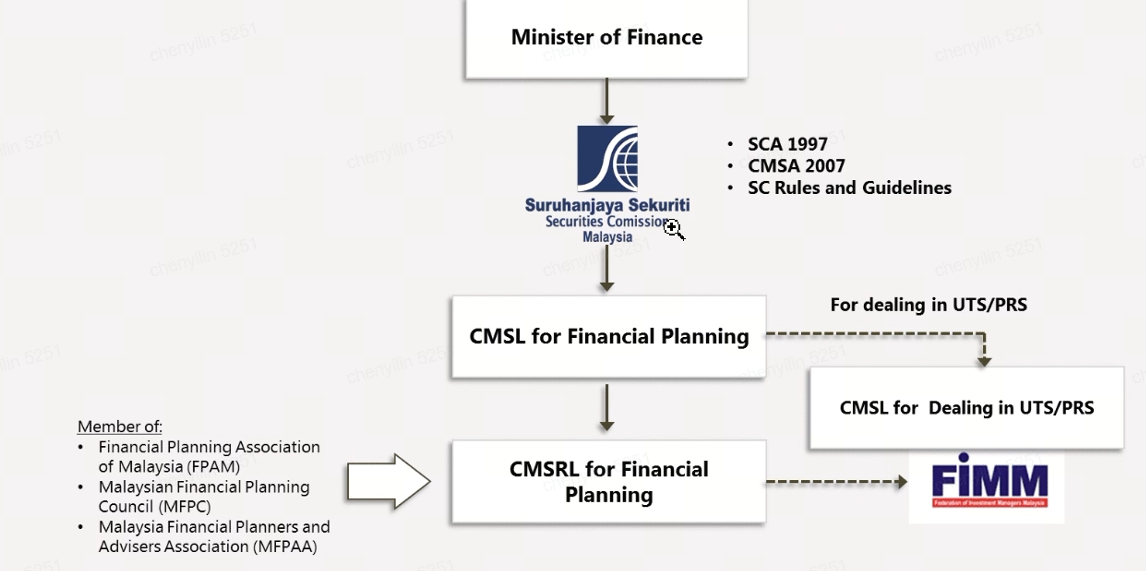
Under Part 2, Schedule 2 of the CMSA 2007. "Financial planning" means analysing the financial circumstances of another person and providing a plan to meet that other person's financial needs and objectives, including any investment plan in securities, whether or not a fee is charged in relation thereto.
Only person who possesses the Capital Markets and Services Licence (CMSL) or Capital Markets and Services Representative Licence (CMSRL) issued by the SC is allowed to hold themselves out as Financial Planner.
Nature of Financial Planning
According to Financial Planning Association of Malaysia (FPAM), financial planning is a process and consist of six steps.
STEP 1: Establishing and defining Client-Planner Relationship
STEP 2: GatheringClient Data
STEP 3: Analysing and evaluating client's financial status
STEP 4: Developing and presenting financial planning recommendations
STEP 5: Implementing the financial planning recommendations
STEP 6: Monitoring the financial recommendations
3. Scope of Financial Planning
Financial Planner (FP) may provide advice to clients pursuant to the assessment and analysis undertaken on his client's needs including on matters related to the plan which has been drawn up, which include analysing client needs over areas such as investments, savings, tax planning, estate and retirement planning.
FP may identify and shortlist capital market products such as unit trust funds, ETFs, PRS, REITs, wholesale funds and fixed income which are capable of meeting the investment objectives of a client.
FP cannot make a specific recommendation on shares of a specific public listed company.
FP may provide broad advice on foreign securities (excluding collective investment scheme) but must not involve specific recommendation on those securities.
An FP who is also a CMSL holder for dealing in securities restricted to unit trusts or dealing in Private Retirement Schemes may sell UTFs or PRS funds.
When providing advice to clients, FPs must have a reasonable basis for all recommendations made (section 92 of the CMSA 2007), for example, recommendations made must be supported by disclosure documents and/or research reports.
4. Regulatory Framework for Financial Planning
Advising on Corporate Finance
1. Terminology and Definition
Under Part 2, Schedule 2 of the CMSA 2007. Advising on Corporate Finance (CF) means giving advice concerning:
(a) compliance with or in respect of Part VI. any regulation made under section 378 and any guidelines issued under section 377 relating to any matter provided under Part VI. or relating to the raising of funds by any corporation;
(b) compliance with the listing requirements of the stock exchange in relation to the raising of funds or related party transactions;
(c) arrangement or restructuring of a listed corporation or a subsidiary of the listed corporation of its assets or liabilities.
2. Approval of Securities Commission for Capital Raising
Section 212 of the CMSA 2007 states that certain activities require the approval of the SC.
The listing and quotation of equity-related securities, debt securities, exchange-traded funds (ETFs) and business trusts on the Main Market of Bursa Malaysia Securities (Bursa Securities)
The transfer of listing from an alternative market (for example ACE Market or foreign stock exchange) to the Main Market of Bursa Securities
A reverse take-over (RTO) of a company, ETF or business trust listed on the Main Market of Bursa Securities
3. Bursa Securities Listing Rules
Companies listed on the Bursa Securities are subjected to one of the following listing rules:
For companies listed on the Main Market
For companies listed on the ACE Market
For companies listed on the LEAP Market
4. Securities Issues in the Secondary Market
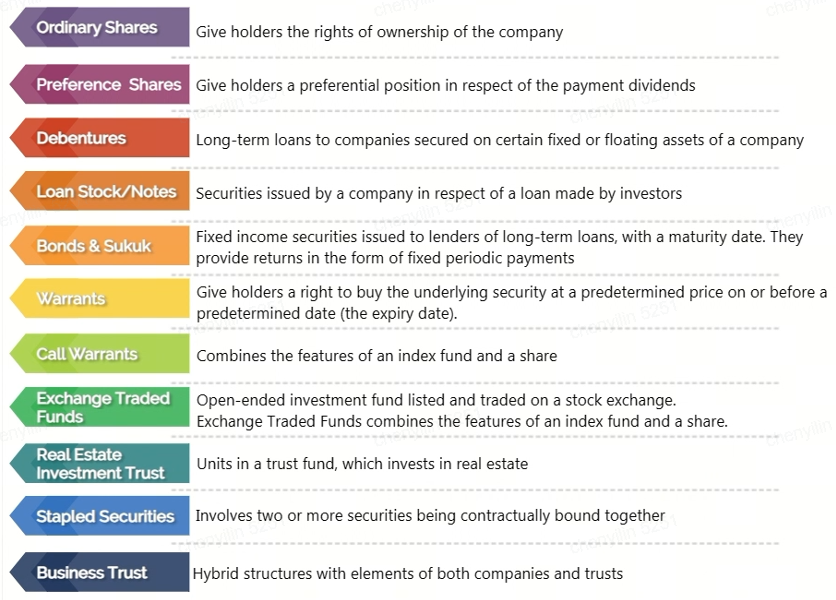
5. Types of Corporate Actions
Terminology and Definition
Under Part 2, Schedule 2 of the CMSA 2007, "Investment advice" means carrying on a business of advising others concerning securities or derivatives or as part of a business, issues or promulgates analyses or reports concerning securities or derivatives.
An investment adviser is a person that engaged in the business of providing advice to others or issuing reports or analyses regarding securities.
Securities research is provided by three main categories of CMSL:
Investment banks
Stockbroking companies
Boutique research companies
Regulations for Investment Advisers (IA)
The CMSA 2007 imposes on them a broad fiduciary duty to act in the best interest of their clients. Several obligations flow from an IA's fiduciary duties:
Full disclosure of material facts: An adviser has an affirmative obligation of utmost good faith and full and fair disclosure of all facts material to the client's engagement of the adviser to its clients, as well as a duty to avoid misleading them.
Suitable Advice: IAs owe their clients a duty to provide only suitable investment advice.
Reasonable Basis for Recommendations: An adviser must have a reasonable, independent basis for its recommendations.
Best Execution: Where an adviser has responsibility to direct client brokerage, it has an obligation to seek best execution of clients' securities transactions
Clearing for Securities or Derivatives
Terminology and Definition
The Clearing for Securities or Derivatives was introduced as a new regulatory framework to include clearing for securities and derivatives as a new regulated activity.
This framework will decouple clearing and trading functions into two distinct regulated activities, allowing intermediaries to specialise in their niche services. The entrance of new stand-alone execution and clearing intermediaries, including foreign-owned entities, will transform the competitive dynamics of the capital market, and enhance cost efficiency for trading and clearing activities.
Definition of Clearing for Securities or Derivatives = Whether as principal or agent, carrying on the business of assuming obligations for the delivery and payment of a person's transaction relating to listed securities or standardised derivatives as set out in the rules of the approved clearing house.
(3) The Relationship: Principal - MR - Client
The basic legal relationship that exists between a capital market intermediary (eg. a stockbroking company, an investment bank or fund management company) and a client is that of principal and agent.
Illustration:
A stockbroking company that is instructed by a client to buy or to sell securities on a stock market, the normal rules of the law of agency apply to the relationship between them. The client is the principal and the stockbroking company is the agent. The client authorises the stockbroking company to buy or sell shares. The stockbroking company is paid a commission or brokerage by the principal.
Relationship Between Principal, MR and Client
01 Principal and Agent (Contract of Agency)
The contract of agency is formed by the agreement of the principal and the agent
The agreement can be express (stated orally or in writing, e.g. in the account opening form) or implied (unsaid or unwritten, but taken for granted). No formality is necessary is necessary as words or conduct show that the two consent to be principal and agent
02 Principle and Agent (Duty)
The rights and duties of each party to the contract of agency depend upon the agreement reached between them
In most cases, the relationship of principal and agent is a fiduciary one. This is because the principal relies on the agent, putting faith and trust in the agent
Consequently, the agent has a duty to act with the utmost good faith towards the principal and, when acting on its behalf, to disclose every material fact that will likely affect the principal's judgment
03 MR and Client
The MR is an agent acting on behalf of the Principal
An MR must make appropriate disclosures to the client which includes:
that he is carrying out referral activities on behalf of his principal; and
informing the client that he is not allowed to give advice or provide recommendation in relation to the regulated activity
Guidelines, para 4.04
An MR has to refer the client to a licensed person if the clients asks for specific recommendation or advice on a capital market product Guidelines, para 4.06
If requested by a client, an MR is required to inform the client of any remuneration scheme and its amount in relation to such marketing activity Guidelines, para 4.06
04 Principal and MR
The relationship between Principal and MR is generally contractual in nature ie. the status of whether an MR is considered a full-time employee or an agent of the Principal is determined by the Principal by way of an agreement FAQ on TR and MR (23 June 2017) Part 3 Q10
Therefore the remuneration structure for an MR will be determined by the Principal FAQ on TR and MR (23 June 2017), Part 3 Q9
The Principal will be responsible to supervise the conduct, ongoing training and development of the MR as well as to ensure payment of the annual fee for the continued registration of the MR FAQ on TR and MR (23 June 2017) Part 3 Q13
Client's Right
The CMSA 2007 on Client's Rights
Being treated fairly and objectively with no conflict of interest on the part of the Principal (or the MR, if applicable).
Dispute Resolution
Clients must be informed of their right to make a complaint as well as where to channel their complaint.
Capital market investors are eligible to seek the assistance of the Securities Industry Dispute Resolution Center (SIDREC) if they have a complaint regarding a monetary dispute with a licensed intermediary.
SIDREC is a body approved by the SC to handle monetary claims by investors up to RM250,000. If the claim is above RM250,000, SIDREC will attend to the claim at a reasonable fee if both parties to the dispute agree to use SIDREC's services.
The Establishment
SIDREC was established for the settlement of monetary disputes between investors and SIDREC Members for the following regulated activities:
Dealing in Securities
Dealing in Derivatives
Dealing in Unit Trusts
Dealing in Private Retirement Schemes (PRS)
Fund Management
The Members
Members of SIDREC include
Banks
Brokers
Fund Management Companies
Unit Trust Management Companies
PRS Providers and Distributors.
Guidelines on Sales Practices of Unlisted Capital Market Products
These Guidelines on Sales Practices of Unlisted Capital Market Products are issued pursuant to section 377 of the Capital Markets and Services Act 2007 (CMSA). These Guidelines shall be referred to as the Guidelines on Sales Practices.
Reasonable Basis
01: Information on the investment objectives, financial situation and particular needs of the person is accurate and complete
02: Has given consideration to, and conducted investigation of, the subject matter of the recommendation
03: The recommendation is Jm based on such consideration and investigation
Marketing Ethical Conduct
Terminology and Definition
Ethical marketing = A process through which companies generate customer interest in products/services, build strong customer interest/relationships, and create value for all stakeholders by incorporating social and environmental considerations in products and promotions. All aspects of marketing are considered, from sales techniques to business communication and business development.
Marketing Ethical Conducts
Competence | • Individuals across the financial services industry shall develop and maintain the relevant knowledge, skills and behaviour to ensure that their activities are conducted professionally and proficiently. • This includes acting with diligence, as well as obtaining, and regularly updating, the appropriate qualifications, training. expertise and practical experience. • Competencies in marketing include contacting prospects, setting appointments, presenting the product's value proposition and developing referrals. |
Integrity | • Organisations and individuals across the financial services industry shall be honest and open in all their dealings. • Maintaining integrity includes behaving in an accountable and trustworthy manner, and avoiding any acts that might damage the reputation of, or bring discredit to the industry at any time. e.g. • Selling products to clients that is consistent with their risk profile henyllin • Have good understanding of the products/services |
Fairness | • Organisations and individuals across the financial services industry shall act responsibly and embrace a culture of fairness and transparency. • Fairness mean treating those with whom they have professional relationships with respect and ensuring that they consider the impact of their decisions and actions towards all stakeholders. e.g. • help customers fully understand the features, benefits, risks and costs of the financial products they buy • minimise the marketing of unsuitable products to customers. |
Confidentiality | • Organisations and individuals across the financial services industry shall protect the confidentiality and sensitivity of information provided to them. • Client's information must be used for its intended purposes only and not divulging information to any unauthorised persons, including third parties, without the necessary consent from those involved unless disclosure is required by law or regulation |
Objectivity | • Organisations and individuals across the financial services industry shall not allow any conflict of interest. bias or undue influence of others to override their business and professional judgment. • All matters that could impair their objectivity must be declared. e.g. • place the interest of the client first • provide client with reasonable and prudent professional advice |
Recommended Reference
Code of Ethics for the Financial Service Industry issued by the Financial Services Professional Board (FSPB)
(4) Market Misconducts, Offences and Unethical Business Conduct
Application of this Part 174. This Part shall apply to:
In respect of securities
(i) acts and omissions occurring within Malaysia in relation to securities of any body corporate which is formed or is carrying on business or is listed within or outside Malaysia; and
(ii) acts and omissions occurring outside Malaysia in relation to securities of any body corporate which is formed or is carrying on business or is listed within Malaysia.
In respect of derivatives
(i) acts occurring within Malaysia in relation to derivatives, whether traded within or outside Malaysia; and
(ii) acts occurring outside Malaysia in relation to derivatives traded within Malaysia.
Prohibited Conducts Under CMSA 2007
Trading in Securities, Derivatives and Fund Management
Priority Given to Client's Order CMSA 2007 S93 | Dealing in Securities as Principal CMSA 2007 S97 | Short Selling (Securities) CMSA 2007 S98 | Dealing in Derivatives as Principal CMSA 2007 S99 | Trading Limits for Derivatives CMSA 2007 S101 | Sequence of Order for Derivatives Trades CMSA 2007 S104 |
For dealings in securities and fund management, entering into a transaction or purchase of sale of securities in priority to client's order. | Entering into a transaction as a Principal with a client without informing the client that (Principal) is acting in the transaction as principal and not as agent. | Selling shares, which he does not own at the time of selling. | Entering into a transaction as a Principal with a client without informing the client that (Principal) is acting in the transaction as principal and not as agent. | Trade or assume in derivatives in excess of the trading limits specified by the Securities Commission (SC) or Bursa Malaysia Derivatives. | Instruct another licensed person to carry out the instruction of client for derivatives contracts unless the consent of that client has been obtained. |
2. Trading in Securities
False Trading/Market Rigging CMSA 2007 S175 | Stock Market Manipulation CMSA 2007 S176 | False and Misleading Statement CMSA 2007 S177 | Fraudulently Inducing Persons to Deal in Securities CMSA 2007 S178 | Use of Manipulative and Deceptive Devices CMSA 2007 S179 | Disseminating of Information About Illegal Transactions* CMSA 2007 S181 | Insider Trading CMSA 2007 S188 |
Matching transactions where the buyer and seller are the same. | Transacting in the securities of a company that will have or is likely to have the effect of raising or lowering or maintaining the price of the company's securities on a stock market, with the intention of inducing other persons to purchase or subscribe for the company's securities. | Making false or misleading statements in the sale of securities. | Inducing or attempting to induce another person to deal in securities by making or publishing any statement, promises or forecast that the maker knows to be misleading, false or deceptive. | To use any device, scheme or artifice to defraud | Circulating information to the effect that the price of securities will likely to rise or fall because of a transaction entered into by the issuer *Illegal Transaction or False Trading | Purchase or sale of a company's securities effected by or on behalf of a person with knowledge of relevant but non-public material information regarding the company that may affect the price of the company's securities (price sensitive information) if made public. |
3. Trading in Derivatives
False Trading CMSA 2007 S202 | Bucketing CMSA 2007 S203 | Dissemination of Information About False Trading CMSA 2007 S204 | Manipulation of Price of Derivatives and Cornering CMSA 2007 S205 |
Creating a false or misleading appearance of active trading in derivatives on a derivatives market or a false or misleading appearance of the market or the price of derivatives. | Confirming an order for a derivatives contract to a client without actually executing it. | Circulating information to the effect that the price of derivatives will likely to rise or fall because of a transaction entered into. | Acquired a substantial quantity of the available derivatives contracts and, as a result, exerts considerable influence on the derivatives' market price. |
Prohibited Conducts Under Guidelines on Compliance Function for Fund Management Companies
Prohibited Conduct Under Code of Ethics and Rules of Professional Conducts (FIMM)
(5) Effective Marketing Skills
Prospecting
Client prospecting is one of the most effective marketing tools to ensure sales continue to flow, grow your marketing pipeline and increase your company's revenue.
Questioning
5 Basic Questions of Marketing
Who is our ideal customer? | To answer this question, review the customers that have bought in the past, either from yourself or other reps. Look for the characteristics that identify a likely prospect. Write them down, so you can remember them. Then keep your eyes and ears open for customers that match that profile. |
How can we best reach customers matching that profile? | To answer this question, start tracking the time that you spend on various sales activities. Look for areas where you're spinning your wheels or doing things that aren't really connected to serving the customer. Then increase the amount of time you spend on really productive selling. |
How can we best add value to that customer's life, career or company? | To answer this question, learn more about the customer's business model and how your offering gets used in the customer's environment. The best way to do this is to spend some time with a customer who is actually using your offering or an offering similar to your own. |
How can we articulate that value to the customer in 15 words or less? | To answer this question, write down your value proposition and then edit it down to something short and sweet. The most important thing here is that it must describe something of value to the customer -- not just a description of your products and services. |
Why are we better than the alternatives? | To answer this question, familiarise yourself with how your competitors are marketing their products. Tune your message (value proposition) to emphasise something that you do best and which is uniquely valuable to your customers. |
Positioning
Active Listening
1. Recommended Videos:
https://youtu.be/z_-rNd7h6z8?si=hJGq-cspWu8VJSsq
https://youtu.be/bFQ8L0q8Np0?si=dcBl0R1UyggBbtET
Speaking - Elevator Pitch
1. Recommended Videos:
Neurolinguistics Programming (NLP)
This presentation is for informational and educational use only and is not a recommendation or endorsement of any particular investment or investment strategy. Investment information provided in this content is general in nature, strictly for illustrative purposes, and may not be appropriate for all investors. Read more