Best 10 ETFs Performance in Malaysia 2023
What is an Exchange Traded Fund (“ETF”)?
An ETF, or Exchange-Traded Fund, is a type of investment fund that is designed to track the performance of a specific underlying asset such as an index, commodity, or other suitable security. It is an open-ended fund, meaning that investors can buy and sell shares of the ETF at any time during market hours, just like a stock.
One of the main advantages of investing in an ETF is that it is a low-cost approach compared to purchasing individual underlying securities. This is because ETFs pool together investors' money to buy a diversified range of securities, which can help to reduce transaction costs and offer investors exposure to a broader range of assets.
In Malaysia, ETFs listed on Bursa Malaysia offer a wide range of geographical and asset class exposure, from US to China and ASEAN, and from stocks to bonds and gold. This allows investors to gain exposure to specific markets and sectors without having to purchase individual securities.
Another advantage of ETFs is that they trade like stock and are listed on a stock exchange. This means that investors can buy and sell shares throughout the trading day, unlike traditional mutual funds which are priced at the end of the trading day. ETFs also offer the flexibility to trade in any amount, from one share to millions of shares, which can help investors to manage their portfolios more efficiently.
In summary, ETFs combine the features of a unit trust and a stock, offering investors the best of both worlds. They provide a low-cost and efficient way to invest in specific markets and sectors, while offering the flexibility of trading like a stock.
Why Malaysia? Insights into the Resilience of the Malaysian ETF Market
Malaysia's ETF market has shown resilience due to several factors. Firstly, the country's economy has experienced steady growth over the years, with a stable political environment and well-developed financial markets. Additionally, Malaysia's ETF market has benefited from the government's efforts in promoting the use of ETFs as a cost-effective investment option.
Furthermore, Malaysia's ETF market has a diverse range of ETFs available to investors, covering various asset classes and sectors. This diversity allows investors to build a well-diversified portfolio using ETFs.
Finally, the transparency and low cost structure of ETFs have contributed to their popularity in Malaysia. The ease of trading ETFs on the stock exchange, coupled with the availability of real-time pricing information and other comprehensive reports, makes them an attractive investment option for both retail and institutional investors.
The List of Malaysia ETFs sorted by Turnover from high to low
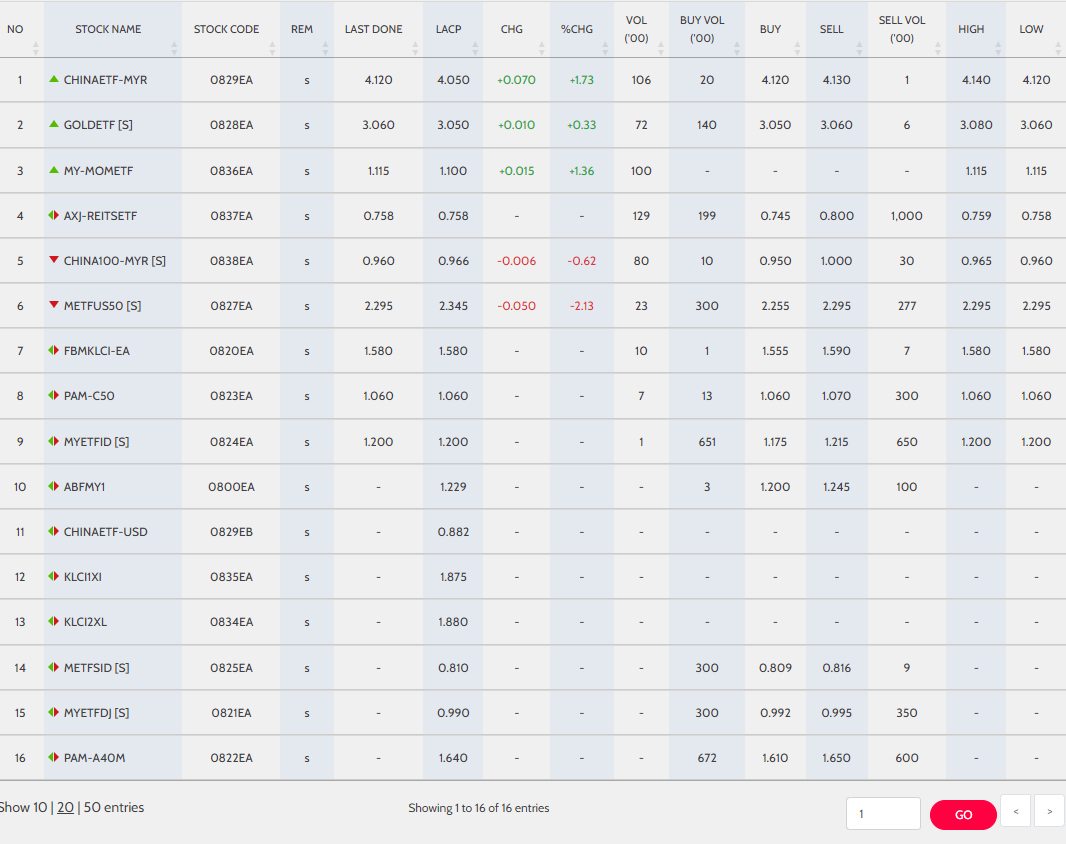
(data as of: Feb 2024 05:00 PM)
Data source: moomoo
Major ETF Issuers in Malaysia
There are currently several issuers of ETFs in Malaysia, including AHAM Asset Management Berhad, AMFunds Management Berhad, i-VCAP Management Sdn Bhd, Kenanga Investors Berhad, Principal Asset Management Berhad, and Value Partners Asset Management Sdn Bhd. These issuers offer a wide range of ETFs that provide investors with exposure to various markets and asset classes.
In an effort to promote the listing of new ETFs on Bursa Malaysia, the exchange has announced that it will grant rebates on the initial listing fee for new ETFs listed between January 1, 2023, and December 31, 2023, based on certain criteria. Specifically, Bursa Malaysia will offer a 100% initial listing fee rebate for any new Sustainable and Responsible Investment (SRI) and Waqf-featured ETFs listed during the period. Additionally, a 50% initial listing fee rebate will be available for any other new ETFs listed during the period.
This initiative is aimed at encouraging the development of new ETFs that are aligned with sustainable investment principles and promoting the growth of the ETF market in Malaysia. By providing these rebates, Bursa Malaysia hopes to attract more issuers to list their ETFs on the exchange and provide investors with more investment options.
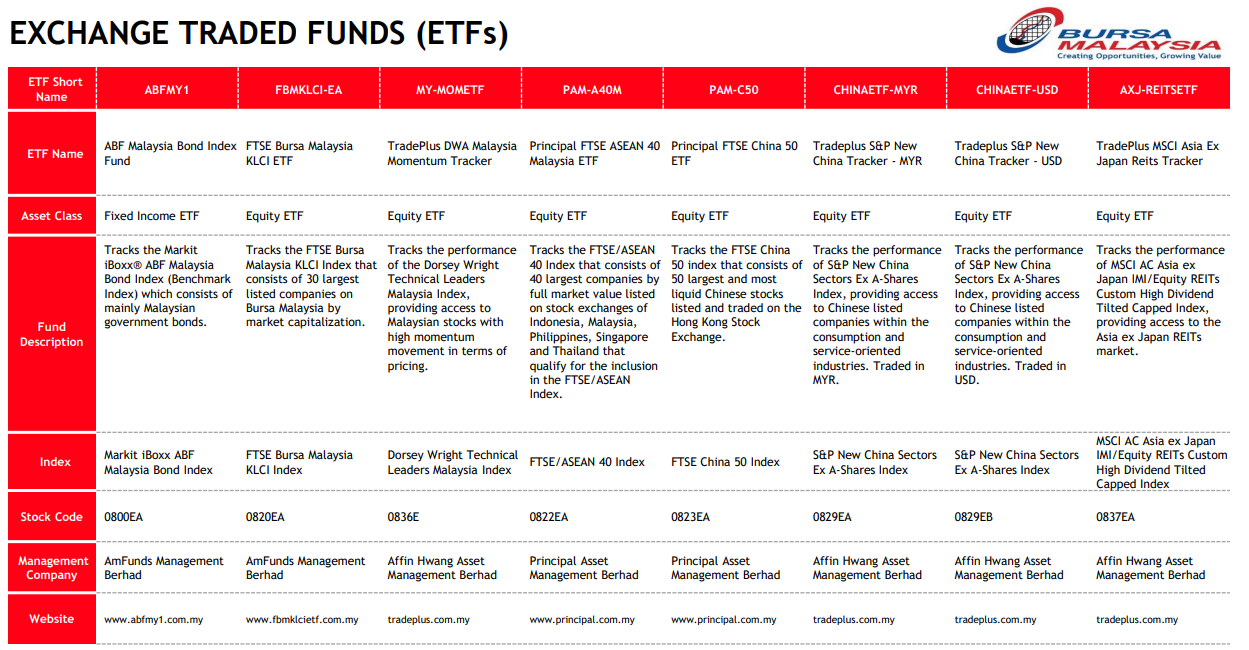
EXCHANGE TRADED FUNDS (ETFs)
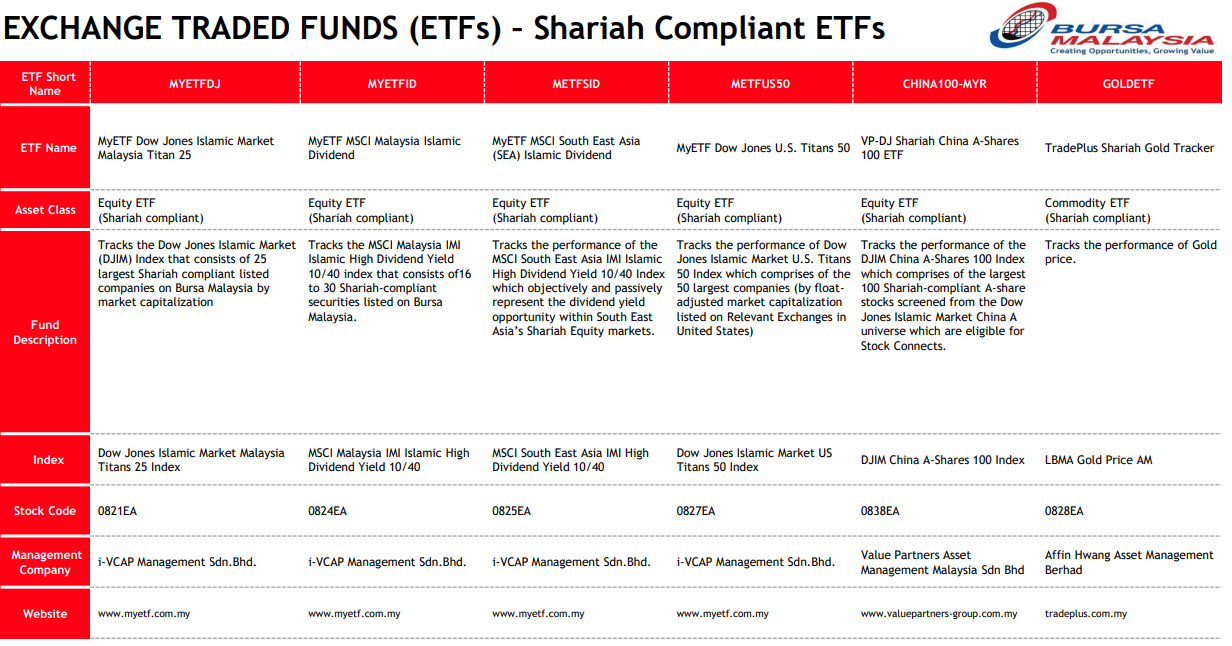
EXCHANGE TRADED FUNDS (ETFs) – Shariah Compliant ETFs
Brief Introduction of i-ETFs:
In addition to traditional ETFs, there are also Shariah-compliant ETFs, known as i-ETFs, available for investors who wish to invest in accordance with Islamic principles. These i-ETFs track benchmark indices where the constituents are only Shariah-compliant securities. This means that the securities included in the index undergo a comprehensive Shariah screening exercise to ensure that they comply with Islamic principles before they can be included in the benchmark index for the i-ETF.
This screening process involves assessing the business activities of the companies and ensuring that they do not engage in activities that are prohibited by Shariah, such as the production or sale of alcohol, tobacco, and gambling-related products. Other factors, such as the level of debt and interest-bearing investments, are also taken into consideration.
Investing in Shariah-compliant i-ETFs allows investors to adhere to their religious beliefs while still gaining exposure to a diversified range of assets. These i-ETFs offer investors the same benefits as traditional ETFs, including low costs, diversification, and flexibility. They are also traded on a stock exchange, making them easily accessible to investors and providing them with the opportunity to trade throughout the trading day.
Why Choose i-ETF for Your Investment Portfolio?
Diversified Exposure: i-ETF offers exposure to a range of companies that make up the tracked index, providing investors with diversified exposure through a single unit.
Cost Effectiveness: The passively managed fund has a low management fee, making it a cost-effective long-term investment option.
Simplicity: i-ETF is listed on Bursa Malaysia's Main Market, making trading easy and convenient. Investors can buy and sell i-ETF units online or through their stockbrokers.
Transparency: The i-ETF price is available in real-time throughout the trading day, and comprehensive information such as daily fund value and quarterly manager reports can be obtained from the fund manager's website. This level of transparency allows investors to make informed decisions about their investments.
EXCHANGE TRADED FUNDS (ETFs) – L&I ETFs
Brief Introduction of L&I ETFs
In addition to traditional ETFs and Shariah-compliant ETFs, there are also Leveraged and Inverse (L&I) ETFs available for investors who wish to take on a higher risk and potentially higher reward investment strategy. L&I ETFs use leverage to amplify the returns of a specific underlying index or asset, allowing investors to potentially earn higher returns than traditional ETFs.
L&I ETFs can be either leveraged or inverse, meaning that they seek to deliver either two or three times the daily return of the underlying index or asset, or the exact opposite of the daily return. This allows investors to take a bullish or bearish view on the market, depending on their investment objectives and risk tolerance.
However, it is important to note that L&I ETFs are not suitable for all investors, as they carry a higher level of risk than traditional ETFs. Due to the use of leverage, L&I ETFs can experience greater volatility and may result in significant losses for investors. Therefore, it is crucial for investors to conduct thorough research and understand the risks associated with these types of ETFs before investing.
In conclusion, L&I ETFs offer a unique investment opportunity for investors who seek to take a higher risk and potentially higher reward investment strategy. While they can provide the potential for higher returns, they also carry a higher level of risk and are not suitable for all investors. As with any investment, it is important for investors to conduct thorough research and seek professional advice before investing in L&I ETFs.
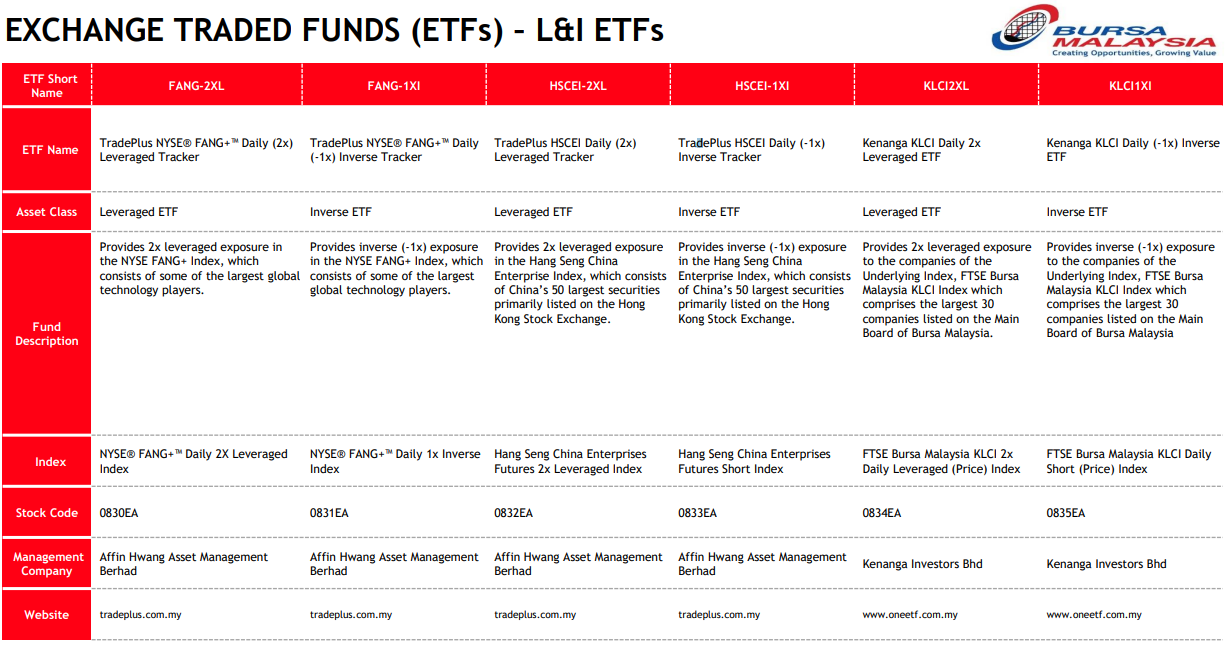
Source: The Edge Malaysia, moomoo
This presentation is for informational and educational use only and is not a recommendation or endorsement of any particular investment or investment strategy. Investment information provided in this content is general in nature, strictly for illustrative purposes, and may not be appropriate for all investors. Read more